Amazon Affiliate Disclosure: Schopping.com may earn a commission when you buy through qualifying links on this page. This does not increase your price. Our goal is to help readers compare outdoor tech, camping gadgets, off-grid power systems, satellite communicators, GPS watches and rugged electronics with practical buying context.
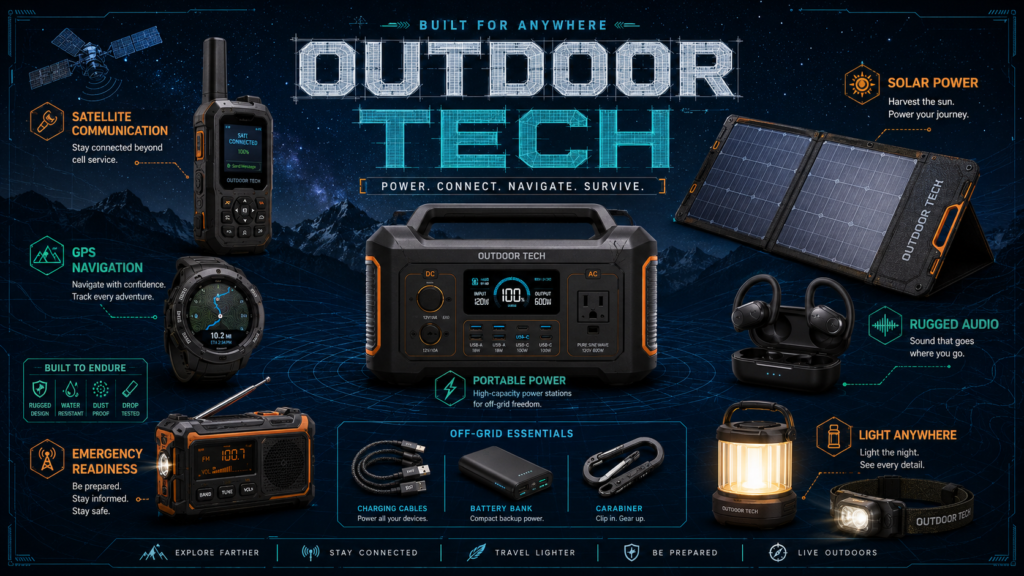
Outdoor tech has moved far beyond flashlights, walkie-talkies and basic power banks. Today’s best outdoor gadgets help you stay connected beyond cell service, power essential devices during camping trips, track routes across remote terrain, monitor weather changes, filter your packing decisions, and reduce the risk of being stranded without communication or energy.
But outdoor technology is not one single product category. It is an ecosystem.
A hiker may need a GPS watch and satellite communicator. A family camper may need a portable power station, solar charger, smart lantern and emergency radio. An overlander may care more about off-grid tech, rugged earbuds, weather alerts, power expansion and redundancy. A minimalist backpacker may only want the lightest safety gear that justifies its weight.
This outdoor tech guide is built as the main hub for Schopping.com readers who want to understand what to buy, what to skip, what each device actually does, and how to build a reliable outdoor setup without wasting money.
For broader product discovery across smart consumer categories, visit the Schopping homepage. For dedicated outdoor gear research, this outdoor tech pillar connects to focused buying guides, comparisons and practical explainers.
Quick Picks: Jump to the Outdoor Tech Section You Need
| Need | Best Section | Related Guide |
|---|---|---|
| I need emergency communication beyond cell service | Satellite communicators | Best Satellite Communicator |
| I want to charge phones, cameras and lights outdoors | Solar chargers | Best Solar Charger |
| I need campsite or RV power | Portable power stations | Best Portable Power Station |
| I hike, trail run or navigate remote routes | GPS watches | Best GPS Watch |
| I want earbuds that survive sweat, dust and rain | Rugged earbuds | Best Rugged Earbuds |
| I want weather alerts and backup information | Emergency radios | Best Emergency Radio |
| I want clever camping upgrades | Camping gadgets | Best Camping Gadgets |
| I’m building a complete no-grid setup | Off-grid tech | Best Off-Grid Tech |
| I want to understand satellite messaging | How it works | How Satellite Communicators Work |
| I want to compare GPS and satellite devices | Navigation vs communication | GPS vs Satellite Communicator |
What This Outdoor Tech Guide Is For
This guide is designed to help readers build a practical outdoor tech setup based on real use cases, not marketing hype.
It covers the equipment that matters most when you are away from normal infrastructure:
- Communication when cellular networks disappear
- Navigation when trails, roads or weather become uncertain
- Power when outlets are unavailable
- Lighting and campsite comfort
- Weather awareness and emergency readiness
- Rugged audio and hands-free gear
- Solar and battery planning
- Off-grid technology for camping, hiking, road trips and preparedness
The goal is not to convince every reader to buy every gadget. The goal is to help you match the right outdoor technology to the risk level, trip length, climate, location and comfort expectations of your adventure.
A weekend campground trip near town does not require the same setup as a five-day backcountry route. A car camper can carry a 1,000Wh portable power station; a thru-hiker cannot. A solo hiker should think differently about satellite SOS than a family camping near a staffed park. Outdoor tech becomes valuable when it solves the right problem at the right weight, price and reliability level.
Who Needs Outdoor Tech?
Outdoor tech is useful for anyone who spends time away from reliable electricity, predictable weather or strong cell coverage. The deeper you go into remote environments, the more the right devices become safety equipment rather than convenience products.
Hikers and Backpackers
Hikers need lightweight hiking tech gear that improves safety without adding unnecessary pack weight. A GPS watch, satellite communicator, compact headlamp, power bank and small solar panel can create a strong baseline for route tracking, emergency contact and device charging.
For trail-specific planning, Schopping’s best tech for hiking guide focuses on the equipment that makes sense when every ounce matters.
Campers and Families
Campers often prioritize comfort, lighting, cooking support, device charging, entertainment and weather readiness. Camping technology can include portable power stations, smart lanterns, solar chargers, emergency radios, rugged speakers, weather sensors, rechargeable fans and water-safe accessories.
For a practical breakdown of campsite energy planning, see Camping Power Guide and Solar Power for Camping.
Overlanders and Road Trippers
Overlanders and vehicle-based travelers can carry more powerful systems: larger battery stations, fridge power, rooftop solar, dash navigation, tire inflators, satellite messengers, action cameras and multi-device charging systems.
This audience benefits most from the best off-grid tech cluster because vehicle travel allows more power, more redundancy and more advanced equipment.
Emergency Preparedness Buyers
Outdoor tech also overlaps with home backup and survival planning. Emergency radios, solar panels, portable power stations, battery banks and satellite messengers can help during storms, outages, remote travel or disaster scenarios.
For this angle, the Survival Tech Guide explains how to separate useful emergency equipment from fear-based buying.
Digital Creators and Remote Workers
Photographers, drone pilots, YouTubers, field researchers and remote workers need reliable outdoor power solutions. Cameras, drones, laptops, microphones, lights and storage drives create a different kind of demand: not just survival, but sustained productivity outdoors.
A creator shooting outdoors for two days may need more battery planning than a hiker walking for four days.
Benefits of Outdoor Tech
Outdoor tech is valuable because it gives you more control over uncertainty. Weather changes. Batteries drain. Trails become unclear. Phones lose signal. Campsites are darker, colder, wetter or more remote than expected.
The right gear helps reduce those weak points.
Better Safety Beyond Cell Service
Satellite communicators and emergency radios address one of the biggest outdoor risks: isolation. If a phone cannot reach a tower, it may still be useful for maps and photos, but not for help. A dedicated satellite communicator can provide SOS functionality, two-way messaging and location sharing depending on the device and subscription.
Smartphones with satellite messaging are also becoming more common, and direct-to-device satellite connectivity is a major trend in modern communications. Regulators and manufacturers have been exploring systems that let standard phones connect to satellites when terrestrial coverage is unavailable. (www.ofcom.org.uk)
More Reliable Power
Portable power stations and solar chargers allow campers to power phones, lights, cameras, medical devices, fans, mini-fridges and communication tools. Modern portable power stations increasingly use long-life LiFePO4 batteries, fast AC charging and solar input compatibility, which makes them more practical for camping and outage use than older lithium battery packs. (Popular Mechanics)
Smarter Navigation
A GPS watch or handheld GPS can track location, pace, elevation, route progress, weather trends and return paths. For hikers, this can reduce dependence on phone battery life. For runners, climbers and backcountry travelers, it can become a route-safety tool.
Better Campsite Comfort
Camping gadgets are not only about survival. Smart lanterns, rechargeable fans, compact projectors, heated gear, water purification devices and rugged audio products can make outdoor nights more comfortable.
The best camping technology improves the experience without turning the outdoors into a fragile pile of electronics.
Better Decision-Making
Outdoor tech helps you make decisions earlier. A battery monitor tells you when to reduce power use. A GPS watch shows whether your route is taking longer than expected. A weather radio warns of storms. A satellite messenger lets you update someone before a delay becomes a rescue situation.
Good tech does not replace judgment. It supports it.
Outdoor Tech Categories: What to Buy and Why
1. Satellite Communicators
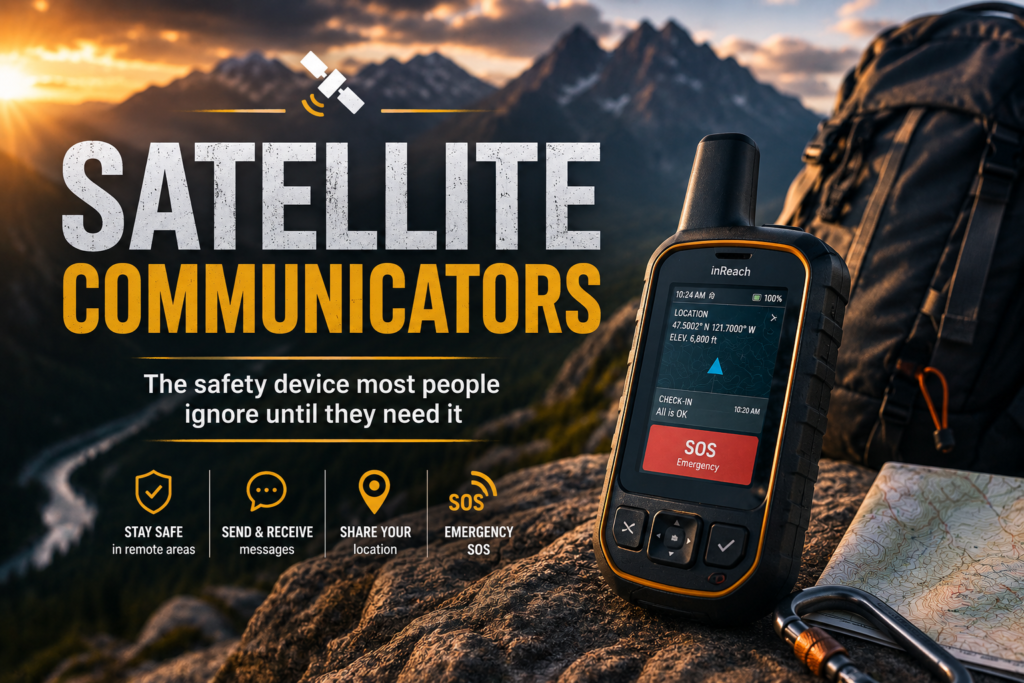
A satellite communicator is one of the most important outdoor tech devices for people who hike, camp, hunt, fish, overland or travel beyond reliable cell coverage.
Unlike a phone, a satellite communicator connects through satellite networks instead of cellular towers. Depending on the model, it may support SOS alerts, two-way text messaging, location sharing, weather updates and check-in messages.
Best For
- Solo hikers
- Remote campers
- Backcountry hunters
- Off-road travelers
- Long-distance cyclists
- Kayakers and boaters
- International adventure travelers
- Anyone going beyond cell signal
What to Look For
A good satellite communicator should offer dependable SOS access, strong battery life, reliable satellite network coverage, clear subscription pricing, rugged water resistance and simple emergency controls. Two-way messaging is preferable because it allows rescuers or contacts to ask questions and confirm details.
A device that only sends one-way alerts may still be useful, but it gives less confidence in a real emergency.
If your main concern is emergency contact beyond cell service, start with our satellite communicator guide before choosing other hiking tech gear.
2. Solar Chargers
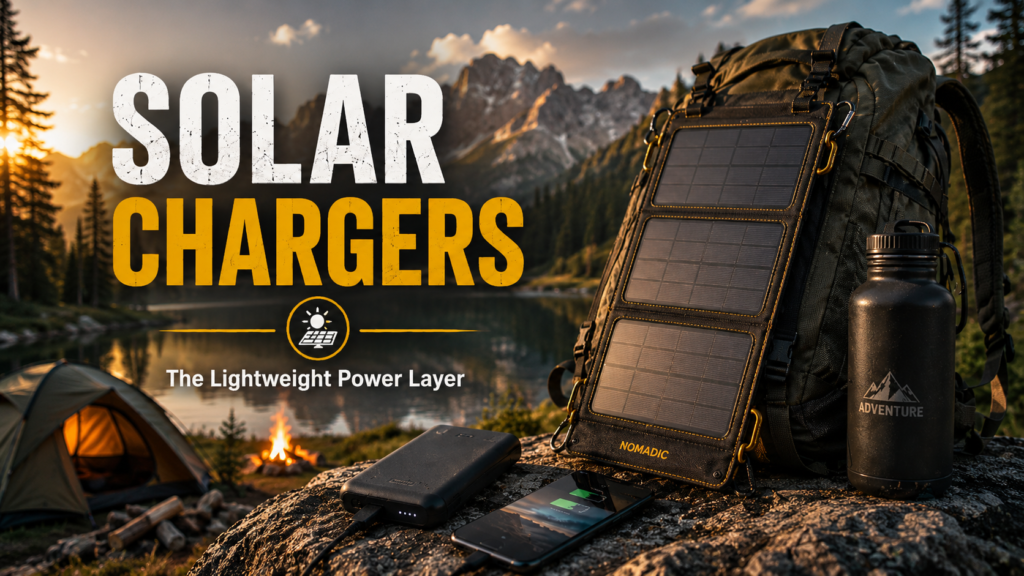
Solar chargers are useful when you need renewable energy outdoors, but they are often misunderstood. A small solar charger is not magic. It cannot reliably power a large campsite by itself. Its value depends on sunlight, panel size, charging speed, battery pairing and trip length.
A compact panel may keep a phone or power bank alive during sunny hiking days. A larger folding panel can recharge a portable power station at camp. For most users, the best setup is not “solar charger only” but “solar charger plus battery storage.”
Best For
- Multi-day camping
- Backpacking in sunny regions
- Emergency kits
- Off-grid charging
- RV and overlanding support
- Power station recharging
What to Look For
Choose solar chargers by wattage, folding design, weather resistance, USB-C output, compatibility with power banks or power stations, panel efficiency and real-world charging expectations. A 10W pocket panel and a 200W folding solar panel belong to completely different use cases.
The broader solar charging market is being pushed by outdoor recreation, clean-energy demand and portable power adoption, with solar compatibility becoming a more common feature in power stations and travel energy systems. (Made-in-China.com)
For a dedicated buying guide, visit Best Solar Charger. For practical trip planning, use Solar Power for Camping.
3. Portable Power Stations
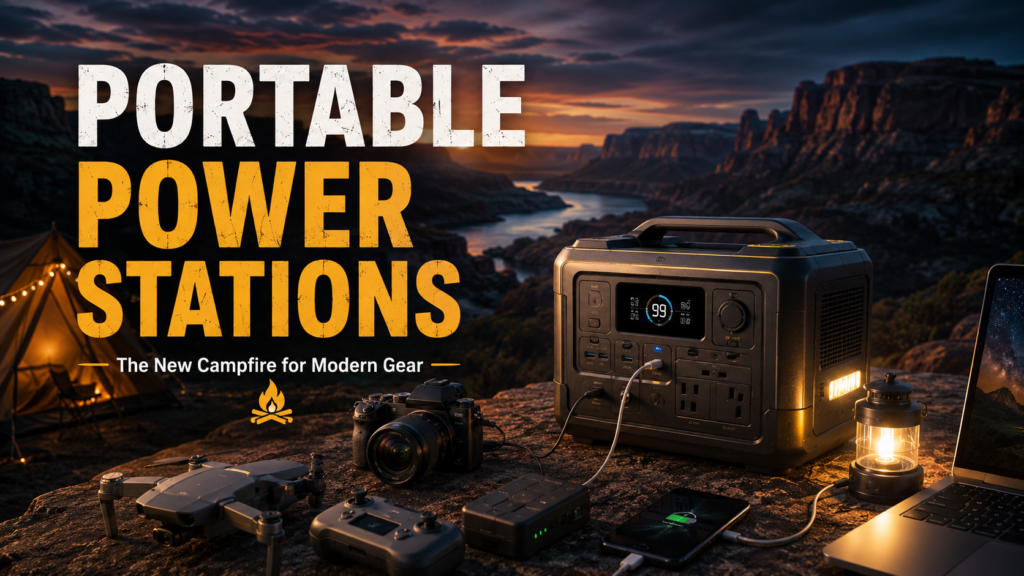
A portable power station is a rechargeable battery system with multiple outputs, often including AC outlets, USB-A, USB-C, DC ports and solar input. It is one of the most useful outdoor power solutions for car camping, RV trips, cabins, festivals, photography, emergency backup and off-grid work.
Portable power stations have become especially important for outdoor creators who carry cameras, drones, laptops, microphones, lights, and editing devices into remote locations. If your outdoor setup includes filming, photography, or mobile production, our creator gear hub goes deeper into the equipment that helps turn travel, camping, and adventure content into polished media.
The category has matured quickly. Modern models are quieter than gas generators, safer for tent-adjacent use, easier to operate and often compatible with solar panels. Many newer units also use LiFePO4 battery chemistry, which is valued for long cycle life and stability.
Best For
- Car camping
- Family camping
- RV backup
- CPAP support
- Camera and drone charging
- Laptops and remote work
- Camp fridges
- Home outage backup
What to Look For
The most important specs are watt-hours, inverter output, surge capacity, battery chemistry, solar input, charge time, port selection, weight, app controls, warranty and expansion options.
A 300Wh unit may be enough for phones, lights and a laptop. A 1,000Wh unit can handle more serious campsite power. A 2,000Wh+ system enters heavy-duty territory for fridges, appliances, tools and extended backup.
Recent portable power station coverage shows a clear market emphasis on fast charging, LiFePO4 battery life, expandable capacity and solar bundle compatibility. (Popular Mechanics)
For product recommendations, see Best Portable Power Station. For energy planning, read Camping Power Guide.
4. GPS Watches
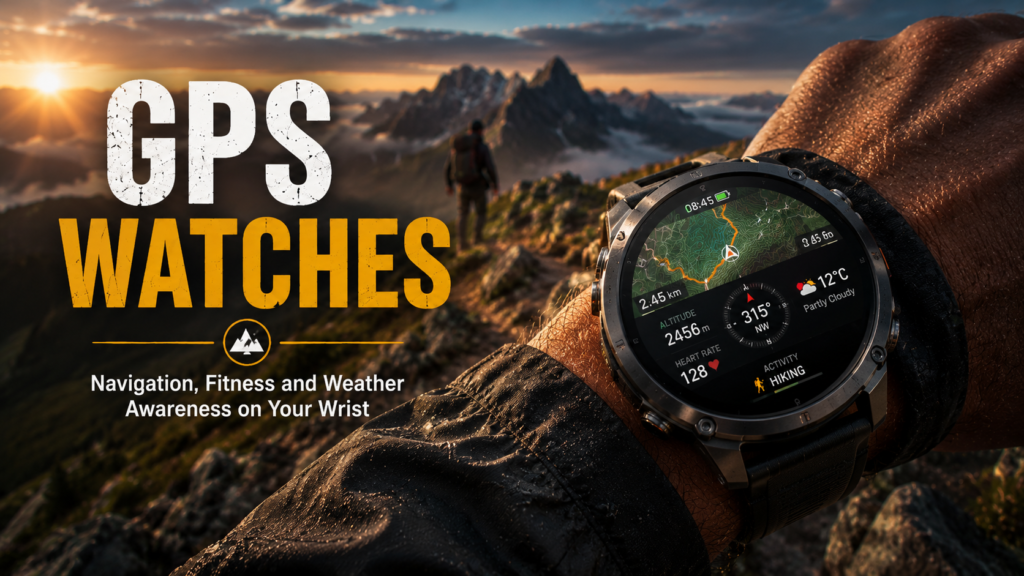
A GPS watch is one of the best outdoor gadgets for hikers, trail runners, climbers and endurance athletes. Unlike a phone, it sits on your wrist, tracks continuously, and often offers better battery modes for long activities.
Premium GPS watches may include topographic maps, breadcrumb navigation, barometric altimeters, storm alerts, solar charging, multi-band GPS, heart-rate monitoring, pulse oximetry, training metrics and expedition modes.
Best For
- Hiking
- Trail running
- Backpacking
- Mountaineering
- Cycling
- Fitness tracking
- Navigation backup
- Weather awareness
What to Look For
Battery life matters more than screen beauty for serious outdoor use. Also compare map quality, GPS accuracy, ruggedness, water resistance, glove usability, sunlight visibility, route import tools and sensor reliability. Some outdoor GPS watch segments continue to emphasize solar charging, topographic mapping, altimeters, barometers and rugged build quality as differentiators for serious outdoor users. (Research and Markets)
For buying advice, visit Best GPS Watch. For trail navigation decisions, the GPS vs satellite communicator guide explains why navigation and emergency messaging are related but not interchangeable.
5. Rugged Earbuds
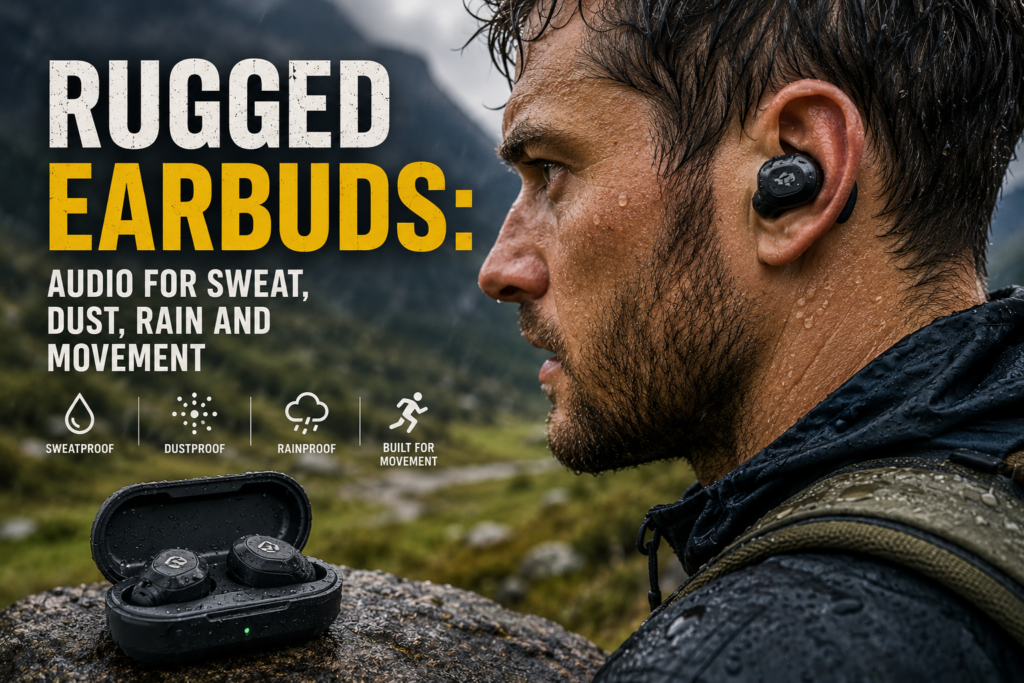
Rugged earbuds are not the first thing people think of when discussing outdoor tech, but they matter for runners, cyclists, campers, hikers and workers who need durable audio. The right pair should survive sweat, rain, dust, pocket abuse and movement.
For readers comparing fit, waterproof ratings, active-use comfort, and audio durability, our dedicated rugged earbuds resource at EarsBud offers deeper guidance on choosing earbuds built for workouts, hiking, rain, dust, and everyday movement.
For outdoor use, sound quality is only part of the equation. Fit security, transparency mode, wind handling, battery life, water resistance and controls are just as important.
Best For
- Trail running
- Campsite entertainment
- Outdoor workouts
- Cycling with awareness mode
- Rainy commutes
- Rugged daily use
What to Look For
Prioritize IP rating, secure fit, ambient sound mode, glove-friendly controls, microphone wind reduction, battery life and charging case durability. Avoid earbuds that seal too aggressively if you need situational awareness near traffic, wildlife or other people.
For product comparisons, see Best Rugged Earbuds.
6. Emergency Radios
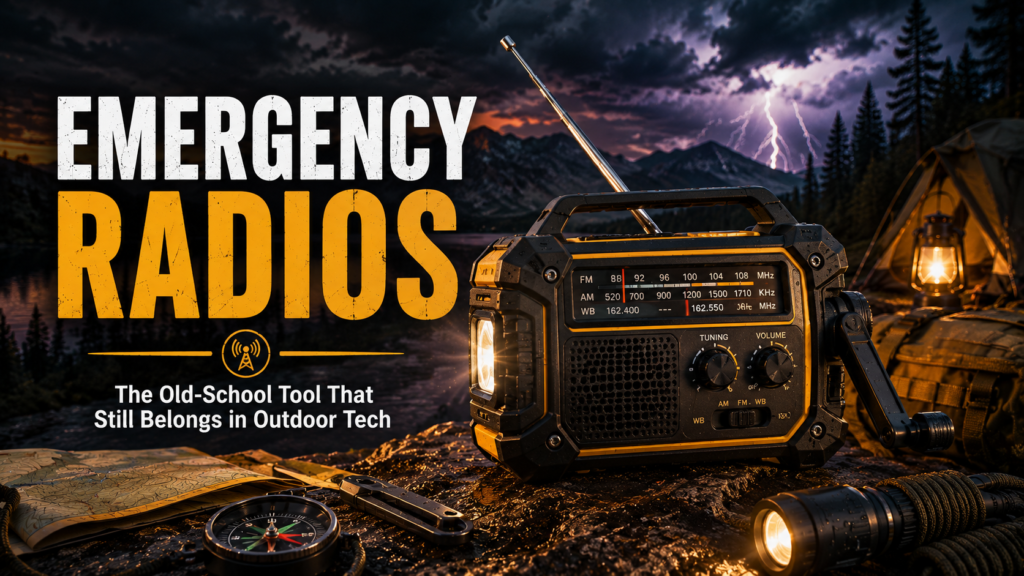
Emergency radios may feel old compared with GPS watches and satellite communicators, but they remain useful because they can receive weather alerts, public warnings and broadcasts without relying on phone networks.
Many models include AM/FM/NOAA weather bands, crank charging, solar trickle charging, flashlights, USB power output and SOS alarms.
Best For
- Storm-prone camping
- Emergency kits
- RV travel
- Cabins
- Power outages
- Group camping
- Disaster preparedness
What to Look For
A strong emergency radio should include NOAA weather alerts where supported, multiple charging methods, a bright flashlight, durable casing, decent speaker volume, battery status visibility and simple controls.
For the full buying guide, visit Best Emergency Radio.
7. Camping Gadgets
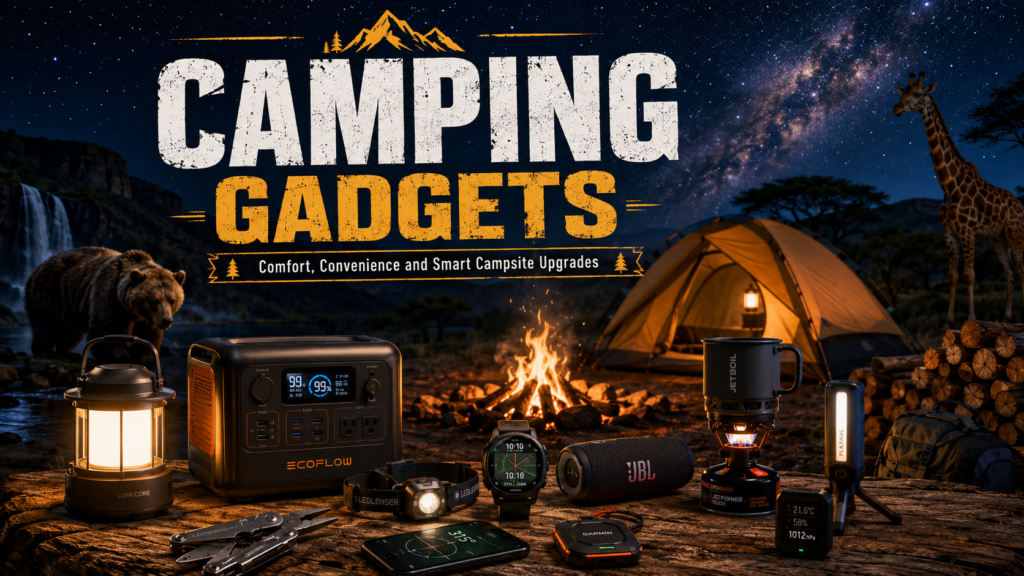
Camping gadgets range from extremely useful to completely unnecessary. The best ones solve repeat problems: lighting, cooking, warmth, sleep, charging, hydration, storage, bug control and weather protection.
Modern camping gadgets are not only about convenience during the day. They also shape how well you recover at night, from quieter campsite lighting to temperature-aware comfort upgrades. For readers building a better rest system beyond the tent, our sleep tech hub covers smart sleep tools, recovery-focused devices, and nighttime comfort upgrades that pair naturally with outdoor living.
Smart camping technology now includes app-controlled lanterns, rechargeable fans, compact water filters, heated sleeping pads, portable air pumps, smart coolers, compact projectors, UV purifiers, sensor lights and collapsible power systems.
Best For
- Family camping
- Weekend campgrounds
- Glamping
- Car camping
- Festival camping
- Outdoor cooking
- Campsite comfort
What to Look For
Good camping gadgets should be durable, easy to recharge, compact enough for your setup and useful more than once per trip. Avoid novelty items that add clutter but do not solve a real outdoor problem.
For comfort-focused upgrades, our best camping gadgets guide highlights practical devices that improve camp life without overcomplicating your pack.
8. Off-Grid Tech
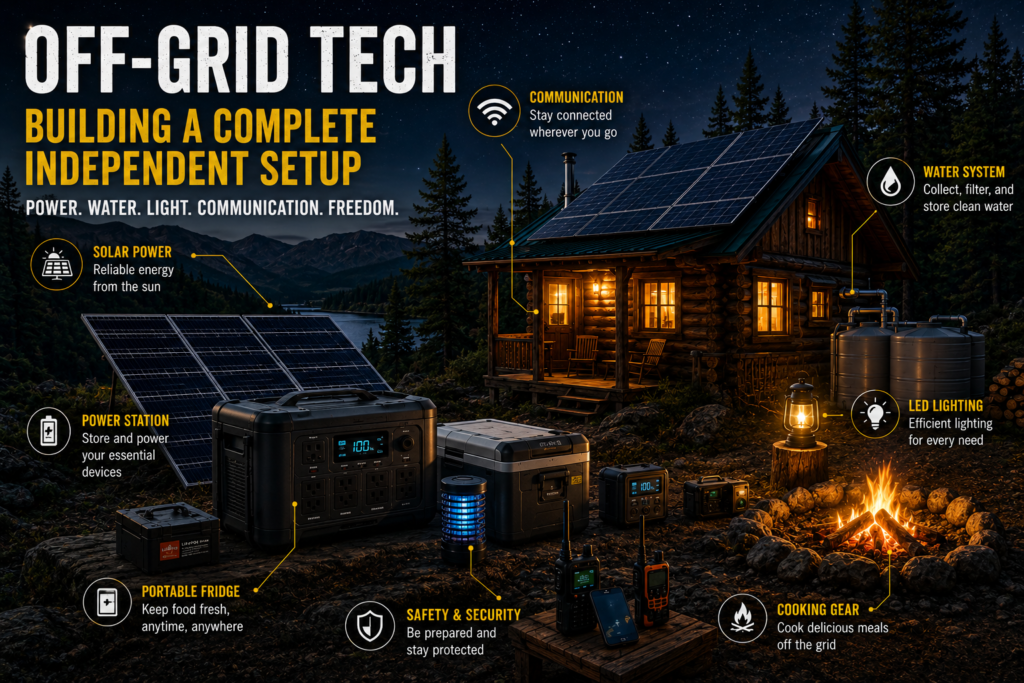
Off-grid tech combines communication, power, navigation, water, lighting and emergency systems into one self-reliant kit. This category is especially important for overlanders, remote workers, cabin owners, preparedness buyers and long-stay campers.
A complete off-grid setup may include:
- Portable power station
- Solar panels
- Satellite communicator
- GPS watch or navigation device
- Emergency radio
- Water filtration system
- Rechargeable lighting
- Rugged earbuds or speaker
- Weather monitor
- Backup power banks
- Cable and adapter kit
- Protective storage
Best For
- Overlanding
- Remote cabins
- Extended camping
- Emergency preparedness
- Digital nomads
- Field work
- Off-grid living experiments
What to Look For
The best off-grid tech is modular. You want devices that work together instead of isolated gadgets that require different chargers, apps, batteries and cables. USB-C standardization, solar compatibility, repairability and redundancy matter more than flashy features.
If you are building a full independent campsite, read the best off-grid tech guide after this page, to compare complete system options.
Outdoor Tech Comparison Chart
| Outdoor Tech Category | Main Purpose | Best For | Typical Price Range | Must-Have Features | Common Mistake |
|---|---|---|---|---|---|
| Satellite communicator | Emergency messaging and SOS | Remote hiking, overlanding, boating | $150–$600 + subscription | SOS, two-way messaging, location sharing, rugged build | Buying without checking subscription cost |
| Solar charger | Renewable charging | Camping, backpacking, emergency kits | $30–$500 | USB-C, weather resistance, right wattage | Expecting tiny panels to charge large devices fast |
| Portable power station | Stored electricity | Camping, RVs, outages, creators | $200–$3,000+ | LiFePO4, AC outlets, solar input, enough Wh | Buying too little capacity |
| GPS watch | Navigation and tracking | Hiking, running, climbing | $200–$1,000+ | Long battery life, maps, altimeter, durable build | Prioritizing display over battery |
| Rugged earbuds | Durable outdoor audio | Running, workouts, camping | $50–$300 | IP rating, secure fit, awareness mode | Ignoring safety awareness |
| Emergency radio | Weather and public alerts | Storms, outages, camping | $25–$150 | Weather alerts, crank/solar/USB charging | Treating it as a phone replacement |
| Camping gadgets | Comfort and convenience | Families, car campers, festivals | $20–$500 | Rechargeable, compact, useful | Buying novelty gear |
| Off-grid tech system | Independent outdoor setup | Overlanding, cabins, preparedness | $300–$5,000+ | Modular power, comms, lighting, water, navigation | No redundancy |
Outdoor Tech Setup by User Type
| User Type | Recommended Core Setup | Optional Upgrades | Avoid |
|---|---|---|---|
| Day hiker | GPS watch, small power bank, headlamp | Satellite communicator | Heavy power stations |
| Backpacker | Satellite communicator, GPS watch, compact solar charger, lightweight battery bank | Emergency radio, rugged earbuds | Large gadgets and duplicate chargers |
| Family camper | Portable power station, lanterns, solar panel, emergency radio | Smart cooler, rechargeable fan, projector | Underpowered batteries |
| Overlander | Large power station, solar panels, satellite communicator, GPS system, emergency radio | Fridge, dash cam, tire inflator, water purifier | Single-point power failure |
| Remote worker | Power station, solar panel, laptop charging kit, hotspot where available | Satellite messenger, rugged storage | No backup charging method |
| Preparedness buyer | Emergency radio, power station, solar charger, lights, communication device | Water filtration, battery organizer | Gear without testing |
Satellite Communicator vs GPS Watch vs Smartphone
| Feature | Smartphone | GPS Watch | Satellite Communicator |
|---|---|---|---|
| Works without cell service | Limited | Yes for GPS tracking | Yes for messaging/SOS |
| Emergency SOS | Depends on model and region | Usually limited or paired | Core feature |
| Battery life outdoors | Moderate to poor with GPS | Strong | Strong |
| Navigation | Excellent with maps | Good to excellent | Limited on many models |
| Messaging | Great with cell/Wi-Fi | Limited | Strong on two-way models |
| Subscription needed | Usually no, except satellite features may vary | Usually no | Usually yes |
| Best role | Maps, camera, general use | Tracking and navigation | Emergency communication |
A GPS watch helps you know where you are. A satellite communicator helps others know where you are when you need help. A smartphone remains useful, but it should not be your only outdoor safety device in remote areas.
For a deeper comparison, link readers to GPS vs Satellite Communicator.
Cost of Outdoor Tech: What Should You Actually Spend?
Outdoor tech pricing varies wildly because the category includes everything from $25 radios to $3,000 power systems. The smartest way to budget is to start with risk and trip style.
Budget Outdoor Tech Setup: $100–$250
Best for casual campers, day hikers and emergency basics.
Possible kit:
- Rechargeable headlamp
- Compact power bank
- Emergency radio
- Basic solar charger
- Weather-resistant phone pouch
- Small camp lantern
This setup improves safety and comfort but does not provide serious off-grid power or satellite communication.
Mid-Range Outdoor Tech Setup: $300–$900
Best for frequent campers, hikers and weekend adventurers.
Possible kit:
- Satellite communicator
- GPS watch or handheld GPS
- 20,000mAh power bank
- Folding solar charger
- Quality headlamp
- Emergency radio
- Rugged earbuds
This is the most balanced range for people who spend real time outdoors but do not need a large power station.
Full Camping Power Setup: $700–$2,500
Best for families, car campers, RV travelers and creators.
Possible kit:
- 500Wh–1,500Wh portable power station
- 100W–300W solar panel
- Rechargeable lanterns
- Camp fan
- Emergency radio
- USB-C charging kit
- Optional satellite communicator
This setup supports comfort, communication and device charging for multi-day trips.
Serious Off-Grid Setup: $2,000–$5,000+
Best for overlanders, cabins, remote work and preparedness.
Possible kit:
- 2,000Wh+ power station or modular system
- Multiple solar panels
- Satellite communicator
- GPS watch or GPS navigation unit
- Emergency radio
- Water filtration
- Rugged storage
- Redundant lighting and power banks
At this level, the focus shifts from gadgets to system design. Compatibility, charging speed, battery chemistry and redundancy become more important than individual product hype.
Trends & Latest Tech in Outdoor Tech
Outdoor tech is changing because outdoor recreation, emergency preparedness, renewable energy and mobile connectivity are merging. The same device that powers a campsite may also support a home outage. The same satellite technology used for remote rescue may soon become part of ordinary smartphones.
Direct-to-Device Satellite Connectivity
One of the biggest outdoor tech trends is satellite connectivity moving closer to mainstream phones. Direct-to-device satellite systems aim to let standard smartphones communicate with satellites when normal cell towers are unavailable. Regulators and manufacturers are actively working through coverage, hardware and network-protection challenges. (www.ofcom.org.uk)
This does not make dedicated satellite communicators obsolete yet. Dedicated devices still matter because they are rugged, purpose-built, battery-efficient and designed around emergency workflows. But the direction is clear: satellite messaging is becoming a broader consumer feature.
LiFePO4 Portable Power Stations
Portable power stations are shifting toward LiFePO4 battery chemistry, faster charging and solar integration. For outdoor buyers, that means longer cycle life, better durability and more confidence for repeated camping or outage use. Recent market coverage and product deals repeatedly emphasize LiFePO4 batteries, fast charging and expandable power capacity as major selling points. (Popular Mechanics)
Solar as a System, Not a Gadget
Solar charging is becoming less about small novelty panels and more about paired systems: folding panels plus power stations, rooftop solar plus vehicle batteries, compact panels plus USB-C power banks. Outdoor buyers are learning that solar works best when paired with storage.
Smarter Campsites
Camping technology is moving into lighting, climate comfort and app-connected control. Smart lanterns, rechargeable fans, sensor-based lighting and power-aware campsite devices are becoming more common in modern camping gear discussions. (Realme)
Rugged Wearables
Outdoor GPS watches continue to improve with better battery modes, stronger satellite positioning, solar charging, mapping tools and health metrics. For serious hikers and endurance athletes, the watch is becoming a navigation device, training computer and safety dashboard in one.
Upcoming Models and Future Outdoor Tech Direction
The next wave of outdoor tech will likely focus less on isolated gadgets and more on connected outdoor systems.
1. Satellite Messaging Built Into More Phones
Expect more smartphones to support satellite messaging, emergency location features or limited off-grid communication. Dedicated satellite communicators will still serve serious outdoor users, but casual users may increasingly rely on phones for basic emergency satellite features.
2. Smaller, Faster, More Durable Power Stations
Portable power stations will continue improving around charge speed, battery lifespan, solar input, thermal management and expansion. The best models will become easier to integrate with vehicles, cabins and campsite setups.
3. Solar Gear Built Into Outdoor Equipment
More backpacks, tents, coolers and camp furniture may include solar-ready or power-routing features. The key challenge will be durability. Outdoor users do not need fragile electronics stitched into rugged gear unless the design can survive weather, dust and repeated packing.
4. GPS Watches With Better Safety Layers
Expect stronger mapping, better offline routing, more accurate sensors and deeper integration with emergency features. Battery life will remain the real battleground.
5. Modular Off-Grid Kits
Instead of buying random gadgets, more consumers will look for complete kits: power station + solar panel + lights + emergency radio + charging cables + storage case. This is especially useful for families and preparedness buyers who want a simple, tested setup.
Risks of Outdoor Tech
Outdoor tech can make trips safer, but it can also create false confidence. The biggest mistake is assuming that owning a device is the same as knowing how to use it.
Battery Dependence
A dead GPS watch, satellite communicator or phone is just extra weight. Always charge before departure, carry backup power, and know how long each device lasts in realistic conditions.
Subscription Confusion
Satellite communicators often require monthly or annual subscriptions. Some plans limit messages, tracking frequency or features. Always check total ownership cost before buying.
Signal Limitations
Satellite devices need a clear view of the sky. Heavy tree cover, canyons, storms or poor positioning can slow or block communication. GPS devices can also struggle in dense terrain.
Water Resistance Misunderstanding
An IP rating does not mean a device is indestructible. Water resistance varies by depth, duration and conditions. Saltwater, mud and freezing temperatures create additional stress.
Overpacking
Outdoor tech should reduce friction, not add chaos. Too many devices mean more cables, chargers, apps, firmware updates and failure points.
Poor Testing
Never take a new satellite communicator, power station or GPS watch into the field without testing it first. Set up accounts, update firmware, test charging, learn buttons and confirm emergency procedures before the trip.
How to Build the Right Outdoor Tech System
A smart outdoor tech setup starts with three questions.
1. What Happens If I Lose Cell Service?
If the answer is “nothing serious,” a phone and power bank may be enough. If the answer is “I could be stranded, injured or unreachable,” consider a satellite communicator.
2. What Happens If My Battery Dies?
If dead batteries only mean no music, the risk is low. If they mean no navigation, no light or no medical-device power, you need redundancy.
3. What Happens If the Weather Changes?
If you camp in storm-prone areas, an emergency radio and weather-aware device matter. If you hike in mountains, weather alerts, elevation data and route timing become more important.
The best outdoor tech setup is not the most expensive one. It is the one that protects your highest-risk failure points.
Outdoor Tech Buying Framework
Before buying any outdoor gadget, score it against five criteria.
| Buying Factor | Why It Matters | Practical Question |
|---|---|---|
| Reliability | Outdoor gear must work under stress | Will this still work in rain, dust, cold or low battery? |
| Weight | Heavy tech changes packing decisions | Is the benefit worth the weight? |
| Power demand | Every device adds charging needs | How will I recharge this outdoors? |
| Redundancy | One failure should not ruin the trip | What is my backup if this fails? |
| Skill required | Gear must be usable under pressure | Can I operate this quickly in bad conditions? |
A product that scores well on all five is usually worth considering. A product that fails two or more should be treated carefully, no matter how impressive it looks online.
Outdoor Tech Should Make You More Capable, Not More Dependent
Outdoor tech is at its best when it makes you calmer, safer and more prepared. A satellite communicator can turn isolation into contact. A GPS watch can turn uncertainty into direction. A portable power station can turn a campsite into a functional base. A solar charger can stretch a trip. An emergency radio can keep you informed when networks fail.
But technology should not replace outdoor judgment. It should sharpen it.
The strongest outdoor setup is not the one with the most devices. It is the one where every item has a purpose, every battery has a plan, and every critical function has a backup.
Use this Schopping outdoor tech hub as the starting map. Then move into the focused guides for satellite communicators, solar chargers, portable power stations, GPS watches, rugged earbuds, emergency radios, camping gadgets and off-grid systems based on how you actually spend time outside.
FAQs: Outdoor Tech
What is the best outdoor tech for camping in 2026?
The best outdoor tech for camping in 2026 usually starts with power, lighting, communication and weather awareness. A strong campsite setup includes a portable power station, solar charger, rechargeable lantern, emergency radio, power bank, weather-resistant cables and, for remote locations, a satellite communicator. Families may also benefit from rechargeable fans, smart coolers, compact projectors and rugged speakers. The best setup depends on whether you camp near your car, hike into a site or stay off-grid for several days.
Is a satellite communicator worth it for hiking and camping?
A satellite communicator is worth it if you regularly hike, camp, hunt, fish, paddle or drive in areas with poor cell coverage. It is most valuable for solo travelers and remote routes where a phone may not be able to call for help. The main benefit is not everyday messaging; it is emergency access, location sharing and the ability to tell someone where you are when normal networks disappear. The only major drawback is subscription cost, so buyers should compare monthly plans before choosing a device.
What size portable power station do I need for camping?
For basic camping, a 300Wh to 500Wh portable power station can charge phones, lights, earbuds, cameras and small devices. For family camping, laptops, fans or longer trips, 700Wh to 1,200Wh is more comfortable. For camp fridges, CPAP machines, cooking appliances or off-grid work, consider 1,500Wh or more. The best approach is to list every device you plan to power, estimate daily watt-hour use, then choose a power station with extra capacity for weather delays and charging losses.
Are solar chargers good for backpacking?
Solar chargers can be good for backpacking if you hike in sunny conditions and understand their limits. A compact solar panel can help maintain a phone, GPS device or power bank over multiple days, but it may charge slowly in clouds, forests or short winter daylight. Many backpackers are better served by a high-capacity power bank for short trips and a lightweight solar charger for longer routes where sunlight is reliable. Solar is most useful when paired with battery storage.
What outdoor tech should I buy first?
Buy outdoor tech in order of risk. If you go beyond cell service, start with a satellite communicator. If your main problem is battery life, start with a power bank or portable power station. If you hike unfamiliar trails, start with a GPS watch or reliable offline maps. If you camp in storm-prone areas, start with an emergency radio. For most people, the first four items should be communication, lighting, power and navigation before comfort gadgets.
People Also Ask
What are the most useful outdoor gadgets for off-grid camping?
The most useful outdoor gadgets for off-grid camping are the ones that support basic independence: a portable power station, solar panel, satellite communicator, emergency radio, rechargeable lantern, water filter, GPS device, headlamp and backup power bank. Comfort gadgets such as fans, rugged speakers and smart coolers are useful after the essentials are covered. Off-grid camping works best when your gear is modular, rechargeable and compatible with the same charging system.
Can outdoor tech replace traditional camping skills?
Outdoor tech cannot replace traditional camping skills. It can support navigation, safety, charging and communication, but it should not be the only reason you feel prepared. Batteries die, devices break, apps crash and signals fail. Campers should still know basic route planning, weather reading, fire safety, water management, first aid and emergency decision-making. The best outdoor tech enhances skill; it does not substitute for it.
What is the difference between camping technology and survival tech?
Camping technology focuses on comfort, convenience and better outdoor living. Examples include lanterns, power stations, fans, smart coolers and rugged earbuds. Survival tech focuses on safety, communication, weather awareness, water, light and emergency readiness. Examples include satellite communicators, emergency radios, GPS devices, water purifiers and backup power. Some products overlap, but the buying priority changes: camping tech improves the trip, while survival tech protects the person.
Do I need both a GPS watch and a satellite communicator?
You may need both if you spend time in remote areas. A GPS watch helps with navigation, route tracking, elevation, pace and location awareness. A satellite communicator helps with SOS, messaging and location sharing beyond cell service. They solve different problems. If you only hike near populated trails, a GPS watch and phone may be enough. If you travel where rescue or contact would be difficult, a satellite communicator becomes more important.
What is the best outdoor power setup for a weekend camping trip?
The best outdoor power setup for a weekend camping trip is usually a 500Wh to 1,000Wh portable power station, a 100W solar panel, a compact power bank, USB-C cables and rechargeable lights. This setup can handle phones, lanterns, cameras, speakers and small comfort devices. If you use a fridge, CPAP machine or laptop, move toward a larger power station and test your energy usage before the trip. Always charge everything fully before leaving home.