
Affiliate Disclosure
Schopping may participate in affiliate programs, this means we may earn a commission when visitors click certain links and make qualifying purchases, at no extra cost to the buyer. Our editorial goal remains buyer education: helping readers understand premium domains, digital assets, new websites, authority brands and online business opportunities with clear, practical guidance.
Updated on July, 2026.
A premium domain name can change the way a new website is perceived before a visitor reads a single word. It can make a business feel more established, easier to remember, easier to trust, and easier to share. That is why serious founders, ecommerce operators, affiliate marketers, agencies, local businesses, and digital asset investors often look for premium domain names for sale before they build a brand from scratch.
A weak domain name makes everything harder. Paid ads feel less trustworthy. Email outreach looks less polished. Search listings look less clickable. Referrals are easier to forget. A strong premium domain does the opposite: it gives the business a sharper first impression and a cleaner digital address.
This page is part of Schopping’s Digital Assets Hub. The goal here is focused: helping buyers understand what makes a domain premium, how to choose a domain name for a business, how to compare premium domains, what risks to avoid and how premium domains support new websites before the first article, product page or sales funnel goes live.
Quick Picks: Find the Section You Need
| Buyer Question | Best Section |
|---|---|
| I am new to domain names | What Is a Domain Name? |
| I want to know the meaning of premium domain | What Is a Premium Domain Name? |
| I want to buy premium domain names rightnow | Explore our Full Catalog |
| I need help choosing a name | How to Choose a Domain Name |
| I want to compare premium vs normal domains | Premium Domain vs Standard Domain |
| I want pricing guidance | Premium Domain Costs |
| I want cheaper options | How to Buy Premium Domains Cheap |
| I want to buy a domain for a new website | Premium Domains for New Websites |
| I want SEO-focused names | Premium Domains and SEO |
| I want a full website instead of only a domain | Domain Name vs Authority Website |
What This Guide Is For
This guide is for buyers who want to purchase a premium domain name with a business purpose, not just collect names because they sound interesting.
It is especially useful if you are:
- Launching a new website
- Starting an ecommerce brand
- Building an affiliate site
- Creating a lead generation website
- Naming a startup
- Buying digital assets
- Comparing domain names for sale
- Looking for brandable domain names
- Buying a domain before building an authority website
- Deciding between a premium domain and a ready-to-launch website
If you are still learning the broader category, start with what is a digital asset. If your question is specifically “how do I buy a domain name?” this page gives you the commercial and strategic version, while how to buy a website name covers the beginner bridge.
Return to the Schopping homepage to browse home office setup equipment or visit our partner network you explore the ultra premium names catalog.
Who Needs Premium Domain Names?
Premium domains are not only for venture-funded startups. They are useful for any buyer who understands that the name is part of the business infrastructure.
Startup Founders
A founder needs a name that investors, customers, partners, and early users can take seriously. A premium domain can reduce the “is this real?” hesitation that new companies often face.
Ecommerce Sellers
For ecommerce, trust is fragile. A polished domain name can help a product store feel more legitimate, especially when the buyer has never heard of the brand before.
Affiliate Marketers
Affiliate marketers often build content around comparisons, reviews, buying guides, and product categories. A strong premium domain can make the site feel less like a disposable blog and more like a real authority brand.
Agencies and Consultants
Agencies, consultants, freelancers, and service businesses need domains that pass the credibility test in email signatures, proposals, invoices, and landing pages.
Local Businesses
A memorable domain can help a clinic, law office, repair company, home service provider, or local ecommerce brand capture direct visits and referrals.
Digital Asset Investors
Domain investors look for scarcity, buyer demand, category relevance, resale potential, and long-term brand utility. Premium domains can act as standalone digital assets or as foundations for larger website assets.
Builders of Authority Brands
If you want more than a domain name, visit Authority Brands for ready-to-launch authority website concepts and starter authority sites for niche website foundations.
What Is a Domain Name?
A domain name is the readable address people type into a browser to visit a website. For example, in example.com, the domain name is the main digital address of the website.
Technically, a website lives on hosting infrastructure, but users do not remember server locations or IP addresses. They remember names. That is why a domain name is often the first brand asset a new website owns.
What Is the Domain Name of a Website?
The domain name of a website is the main address connected to that site. If a business uses brand.com, that is the domain name. If it uses shop.brand.com, the main domain is still usually brand.com, while shop is a subdomain.
What Is a Website Domain?
A website domain is the address people use to reach a website online. It usually includes a name and an extension, such as:
.com.net.org.io.ai.shop.co- country-code extensions such as
.pk,.uk,.ca, or.de
For business use, the domain should be easy to say, easy to spell, and aligned with the brand’s market.
What Is a Fully Qualified Domain Name?
A fully qualified domain name, often shortened to FQDN, is the complete domain path that points to a specific location in the domain name system. For example:
www.example.com
It includes the host name, domain name, and top-level domain. Most buyers do not need to think deeply about FQDNs when purchasing a premium domain, but it matters for technical setup, DNS records, email configuration, and hosting.
What Is a Premium Domain Name?
A premium domain name is a domain that has higher-than-normal value because of its branding strength, commercial relevance, scarcity, memorability, keyword quality, extension, or buyer demand.
A domain becomes premium when it can help a business look better, sound better, sell better, or scale more easily.
A premium domain name may be:
- Short
- Memorable
- Brandable
- Easy to spell
- Easy to pronounce
- Category-relevant
- Keyword-aligned
- Commercially useful
- Already registered and listed for resale
- Attached to a trusted extension such as
.com - Valuable to multiple possible buyers
For people who still ask “What is a premium domain“? Just know, the best premium domains feel natural. They do not require explanation. A person hears the name once and can imagine the business behind it.
For broader domain strategy, Schopping’s Atom Premium Domain guide explains how names create identity, while SEO domain names focuses on search-driven naming.
What Makes a Domain Name Premium?
A domain becomes premium when it has value beyond basic registration.
1. Brandability
A premium domain should sound like a business, not just a phrase. Brandable names are flexible enough to support growth. A narrow name may fit one product today but become limiting tomorrow.
Example logic:
- Too narrow:
BestBlueRunningShoesForMen.com - More brandable:
StridePeak.com
The second name can support shoes, fitness gear, training guides, and a larger brand.
2. Memorability
If people cannot remember the name, the business loses direct traffic and referral power. Good names are easy to recall after a conversation, podcast mention, video, or ad.
3. Commercial Relevance
A premium domain should fit a market where buyers spend money. A beautiful name in a dead category is less useful than a clear name in a profitable niche.
4. Extension Strength
The .com extension remains familiar and trusted for many mainstream businesses. At the same time, newer and specialized extensions continue to grow in certain sectors, especially around tech, software, ecommerce, and AI. Recent domain market coverage shows .com still holding a strong position while extensions such as .ai, .app, .shop, and others continue to attract buyers in specific niches. (TechRadar)
5. Length and Clarity
Short domains are usually easier to remember, but short alone is not enough. A five-letter name that is awkward to pronounce may be weaker than a slightly longer name with strong meaning.
6. Trust Signal
A clean premium domain can make a new website feel more serious. This matters in health, finance, education, legal services, software, ecommerce, and high-ticket service markets.
7. Scarcity
There is only one exact .com version of a domain. Once a strong name is owned, another buyer must negotiate or choose something else.
8. Strategic Buyer Fit
The highest value often comes from fit. A domain may be worth little to one buyer and very valuable to another because it solves a naming, positioning, or launch problem.
Benefits of Buying a Premium Domain Name

A Premium Domain Gives a New Website a Better First Impression
A new website has no history, no customer memory, and no built-in trust. The domain name is one of the few signals a visitor sees immediately. A premium domain can make the site feel more deliberate, established, and worth exploring.
It Improves Brand Recall
A memorable domain helps people return without searching again. This is valuable for podcasts, YouTube mentions, word-of-mouth, offline conversations, business cards, and direct navigation.
It Can Improve Click Confidence
A premium domain may appear more trustworthy in search results, ads, emails, and social profiles. It does not guarantee rankings, but it can improve the way people respond to the brand.
It Makes Advertising Cleaner
Paid ads work better when the domain looks credible. A confusing or spammy-looking domain can reduce trust before the visitor lands on the page.
It Supports Long-Term Brand Equity
A premium domain can become the anchor for email addresses, content, products, customer accounts, partnerships, and future acquisition value.
It Can Save Naming Time
Many businesses lose weeks trying to invent a good name only to find every usable domain is taken. Buying a premium domain can solve that bottleneck quickly.
It Can Hold Resale Value
Not every premium domain appreciates, but good domains can retain value because strong names are scarce. That makes them different from disposable branding expenses.
Premium Domains for New Websites
Premium domains are especially powerful for new websites because the site has not yet earned authority, links, traffic, or customer loyalty. The name has to carry more weight at the beginning.
A new website needs to answer several questions quickly:
- What is this?
- Can I trust it?
- Is it relevant to me?
- Does it look serious?
- Would I remember it later?
- Does the name match the offer?
A premium domain can help answer those questions before the homepage does.
Explore our complete catalog of ultra premium domains
Best Use Cases for Premium Domains on New Websites
| New Website Type | Why a Premium Domain Helps |
|---|---|
| Ecommerce store | Builds buyer trust before checkout |
| Affiliate website | Makes reviews and buying guides feel more credible |
| SaaS startup | Supports product identity and investor perception |
| Local service site | Improves memorability and referral recall |
| Lead generation website | Makes forms and calls-to-action feel safer |
| Authority blog | Gives the content brand a stronger identity |
| Marketplace | Helps sellers and buyers trust the platform |
| Digital product site | Makes courses, templates, tools, or downloads feel more polished |
For a wider business-building path, read how to start an online business with a website.
Premium Domain vs Standard Domain
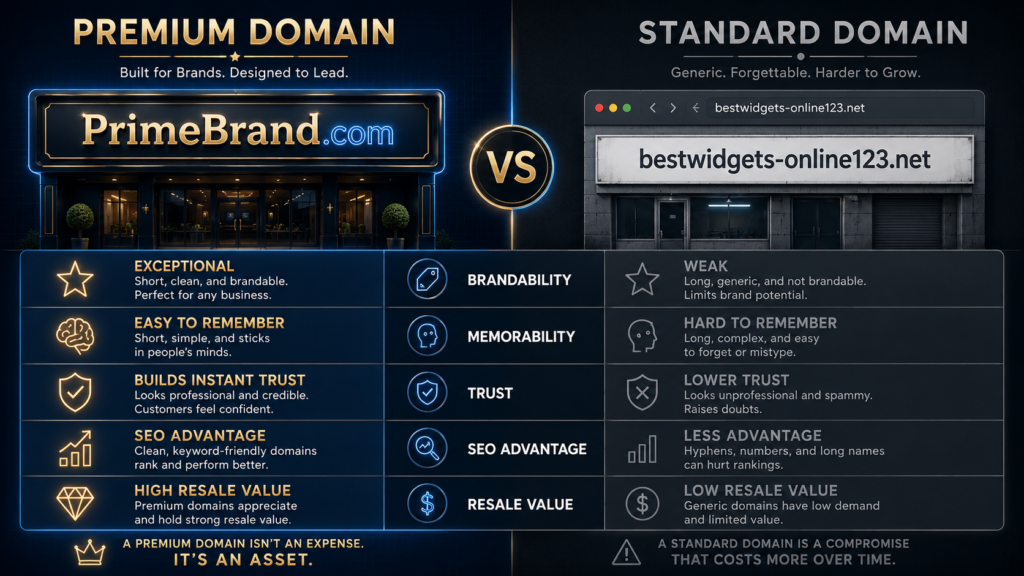
A standard domain may be newly registered for a low annual fee. A premium domain is usually already owned and priced based on higher perceived value.
Neither option is automatically right. The decision depends on the business, budget, timeline, and market.
Premium Domain vs Standard Domain
| Feature | Premium Domain | Standard Domain |
|---|---|---|
| First impression | Stronger, cleaner, more established | Depends heavily on name quality |
| Availability | Usually already owned | Often available to register |
| Cost | Higher upfront price | Lower upfront cost |
| Memorability | Often stronger | Can be weak or awkward |
| Brandability | Usually better | Varies widely |
| Trust signal | More polished | May feel generic |
| SEO advantage | Indirect; can support clicks and relevance | Mostly depends on execution |
| Resale value | Possible if name is strong | Usually low unless name improves in demand |
| Best for | Serious brands, startups, ecommerce, authority websites | Testing ideas, small experiments, temporary projects |
| Main risk | Overpaying | Building on a weak name |
A standard domain is fine for experiments. A premium domain makes more sense when the buyer is serious about building a long-term brand.
Premium Domain vs Authority Website
A premium domain is the address and identity layer. An authority website includes structure, content, internal linking, topical strategy, and monetization direction.
Comparison Chart: Domain Name vs Authority Website
| Buyer Need | Premium Domain Name | Authority Website |
|---|---|---|
| I need a strong brand name | Best fit | Helpful if included |
| I need a website structure | Not enough by itself | Best fit |
| I already have content and product plans | Best fit | May be more than needed |
| I need SEO architecture | Only the foundation | Stronger option |
| I want a faster launch | Helps with naming | Helps with site execution |
| I want a digital asset to develop | Good starting point | Bigger starting point |
| I want monetization paths included | Not usually | Usually yes |
If you want the full website foundation rather than only the name, visit Authority Brands. If you are unsure whether to buy only a name or a full site, read domain name vs website.
How to Choose a Domain Name
The keyword “how to choose a domain name” has strong search demand because it sits at the exact moment where buyers move from idea to ownership. The wrong name can trap a business. The right name can make future marketing easier.
Choose a Name That Passes the Spoken Test
Say the domain out loud. Can someone spell it without asking twice? If not, expect lost traffic and confused referrals.
Avoid Clever Spellings That Need Explanation
Dropping vowels, replacing letters, or forcing unusual spellings can work for some brands, but it often creates friction.
A name should not need a lecture.
Match the Domain to the Business Model
A review site, ecommerce store, SaaS tool, local service business, and newsletter do not need the same type of name.
- Ecommerce needs trust and product fit
- SaaS needs clarity and modernity
- Affiliate sites need topical authority
- Local businesses need service relevance
- Media brands need flexibility
Think About the Next Five Years
A name that fits one blog post may not fit a business. Choose a premium domain that can grow with product lines, content categories, services, and partnerships.
Avoid Trademark Trouble
Do not buy names that are confusingly similar to existing brands. A domain can be available and still be unsafe.
Prefer Clean Extensions for Serious Brands
For mainstream businesses, .com often remains the safest choice. For specific verticals, extensions such as .ai, .io, .app, .shop, or country-code domains may work when they match the audience and market.
Keep It Easy to Type
Hyphens, numbers, repeated letters, and awkward plurals create errors. The best premium domains reduce friction.
Make Sure the Name Carries Meaning
A domain should point toward a feeling, category, benefit, or identity. Empty names can work with large branding budgets, but most buyers need the domain to help them.
For a dedicated naming framework, read how to choose a domain name.
Where and How do I buy premium domain names?
To buy a domain name, you usually follow one of two paths:
- Register an available domain through a domain registrar.
- Buy an already-owned premium domain through a marketplace, broker, or direct negotiation.
Premium domains usually require the second path.
Explore our complete catalog of ultra premium domains
Basic Steps to buy premium domain names
| Step | What to Do |
|---|---|
| 1 | Define the business use case |
| 2 | Search for premium domain names for sale |
| 3 | Compare names by brandability, clarity, and price |
| 4 | Check trademark risk |
| 5 | Review domain history if SEO matters |
| 6 | Confirm transfer terms |
| 7 | Use secure checkout or escrow |
| 8 | Move the domain to your registrar account |
| 9 | Set up DNS, email, hosting, and website |
| 10 | Build the brand around the name |
If you are still at the beginner stage, how to buy a website name covers the process in simpler language.
Premium Domain Costs
Premium domain costs vary because domain value is not based on one simple metric.
Common Price Factors
| Price Factor | Effect on Value |
|---|---|
| Shortness | Shorter names often cost more |
| Extension | .com usually carries strong commercial demand |
| Industry | Finance, health, software, ecommerce, legal, and AI can command higher prices |
| Search demand | Keyword-rich names may attract SEO buyers |
| Brandability | Flexible names can appeal to more buyers |
| Comparable sales | Past sales influence seller expectations |
| Seller urgency | A seller with a small portfolio may sell for less |
| Scarcity | One-of-one names can command premium pricing |
| Clean history | No spam or abuse improves confidence |
| Revenue or traffic | Existing traffic may increase price |
Premium Domain Cost Chart
| Domain Type | Typical Pricing Logic | Best Buyer |
|---|---|---|
Brandable two-word .com | Name quality and market fit | Startups, ecommerce, agencies |
Short invented brand .com | Scarcity and memorability | Funded startups, software brands |
| Exact-match category domain | Search and commercial intent | Lead gen, affiliate, service businesses |
| SEO-focused domain | Keyword value and topical fit | SEO operators, authority site builders |
| Industry-specific domain | Niche buyer demand | Specialized businesses |
| Aged domain | History, links, and risk profile | SEO experts only |
| Alternative extension domain | Extension relevance and brand fit | Tech, AI, apps, ecommerce niches |
The right price is not just what the seller asks. It is what the domain is worth to your business after considering time saved, brand impact, acquisition cost, and development plans.
For deeper valuation logic, read how to value digital assets.
Why Are Premium Domain Names So Expensive?
Premium domain names are expensive because they combine scarcity, buyer demand, brand utility, and commercial potential.
A premium domain can be expensive for the same reason a prime storefront address is expensive. The location is limited. The better address gets more attention, more trust, and more strategic use.
Main Reasons Premium Domains Cost More
| Reason | Explanation |
|---|---|
| Scarcity | There is only one exact domain in each extension |
| Brand value | A strong name can become a company identity |
| Buyer demand | Multiple businesses may want the same name |
| Search relevance | Some names match high-value keywords |
| Memorability | Easy names are harder to find |
| Trust | Better names can improve perceived legitimacy |
| Resale potential | Strong names may hold value |
| Strategic fit | The perfect name can solve a major branding problem |
The mistake is assuming every expensive domain is premium. Some are simply overpriced. A real premium domain should have buyer logic behind the price.
How to Buy Premium Domains Cheap
Buying premium domains cheap is possible, but buyers need patience and judgment.
1. Look for Undervalued Brandable Names
Not every strong name is obviously priced. Some sellers underprice names because they do not see the business use case.
2. Avoid Emotional Bidding
A domain may feel perfect, but there is usually another option. Set a maximum price before negotiation.
3. Consider Slightly Longer Names
Ultra-short names can be expensive. A clear two-word brandable .com may be more affordable and more meaningful.
4. Explore Non-Obvious Categories
Names in hot sectors cost more. Look at adjacent categories where demand is rising but not overheated.
5. Compare Multiple Extensions Carefully
Alternative extensions may be cheaper, but only choose them when they fit the market. A cheap extension that weakens trust is not a bargain.
6. Watch for Expiring or Marketplace Listings
Some quality domains appear through expiring listings, auctions, or marketplace repricing.
7. Buy Before You Build Too Much Else
Once a business becomes attached to a name, the seller has more leverage. If the domain matters, buy early.
8. Do Not Chase “Cheap” at the Cost of Quality
A cheap bad name is expensive later. Rebranding costs can exceed the price of buying a better domain at the start.
Premium Domains and SEO
A premium domain does not automatically rank. Search engines evaluate content quality, relevance, technical health, links, user satisfaction, and trust signals.
However, a premium domain can indirectly support SEO.
How Premium Domains Can Help SEO Indirectly
| SEO Area | How a Premium Domain Helps |
|---|---|
| Click-through rate | A trustworthy name may attract more clicks |
| Brand searches | Memorable names can create repeat search demand |
| Link earning | Strong brands are easier to reference |
| User trust | Visitors may stay longer when the site feels credible |
| Topical clarity | Relevant names can reinforce site purpose |
| Content branding | A good name makes editorial assets feel more authoritative |
Keyword domains can still work when they are developed properly. But a keyword in the domain is not a shortcut. A weak site on a keyword domain is still a weak site.
For search-focused naming strategy, read SEO domain names.
Trends and Latest Technology in Premium Domains
Premium domains continue to matter because the web keeps getting noisier. More businesses, creators, tools, marketplaces, and niche websites launch every year. As that noise grows, clean names become more valuable.
Trend 1: .com Still Holds Strong Brand Power
Recent domain market reporting continues to show .com as a dominant extension in registrations and buyer preference, even as newer extensions grow. This matters because many buyers still associate .com with established businesses and mainstream trust. (TechRadar)
Trend 2: .ai Demand Has Reshaped Tech Naming
The rise of AI companies has increased interest in .ai domains. Reporting on the .ai market has shown major growth in registrations and high-value purchases, including large transactions by tech founders. (Business Insider)
Trend 3: Brand Protection Is Becoming More Important
Domain squatting, typo domains, and lookalike brand registrations are becoming bigger concerns for companies. This increases the importance of owning the right primary domain and considering defensive registrations around important brands. (TechRadar)
Trend 4: Premium Domains Are Being Judged by Use Case
Buyers are becoming more practical. They want names that support a startup, ecommerce store, authority website, SaaS tool, newsletter, or lead generation business. The era of buying random “cool” names without a business model is weaker.
Trend 5: Domain + Website Bundles Are Gaining Appeal
Many buyers no longer want only a domain. They want a domain connected to a niche website plan, topical map, monetization model, and launch structure. That is why Schopping connects premium domains with the broader digital assets ecosystem.
Upcoming Models in Premium Domains
1. Premium Domain + Starter Website
A premium domain paired with a basic website structure helps buyers see the business immediately. This is useful for new websites where the buyer wants more than a name but less than a fully operating business.
2. Premium Domain + Authority Brand
This model combines a strong domain with niche positioning, homepage structure, pillar pages, clusters, monetization routes, and internal linking. See Authority Brands for this direction.
3. SEO Domain + Topical Map
This model is built for search operators. The domain is selected for topical relevance and then paired with content clusters, commercial pages, and authority-building structure.
4. Domain Portfolio Bundles
Instead of one domain, a buyer may purchase several related domains around one category. This can support brand protection, redirects, microsites, or future product lines.
5. Premium Domain + Lead Generation Model
Service niches often benefit from strong domains because user trust matters. A premium service domain can be developed into a lead capture website for clinics, agencies, lawyers, consultants, or home services.
6. Premium Domain + Ecommerce Brand
A product-focused domain can become a store, private label brand, marketplace, or affiliate commerce property.
Risks Before Buying a Premium Domain
Premium domains can be valuable, but buyers should not purchase blindly.
Risk 1: Trademark Conflict
The most serious risk is buying a domain that conflicts with another company’s trademark. Even if the domain is available for purchase, it may not be safe to use.
Risk 2: Overpaying for a Weak Name
Some sellers price domains as premium even when the name is long, awkward, confusing, or commercially weak.
Risk 3: Bad Domain History
A domain may have been used for spam, scams, adult content, malware, or manipulative SEO. This can affect reputation and development plans.
Risk 4: Wrong Extension for the Audience
An extension may look trendy but confuse the target audience. Always match the extension to buyer expectations.
Risk 5: Narrow Naming
A domain that is too specific may limit future growth. A name that fits one product may not fit the larger business.
Risk 6: No Development Plan
Buying a domain without a plan can turn it into an idle expense. Before purchase, know whether it will become a website, landing page, authority brand, ecommerce store, or redirect.
Risk 7: Transfer and Payment Problems
High-value domain purchases should use secure checkout, reputable marketplace infrastructure, or escrow.
Premium Domain Buyer Checklist
Use this checklist before buying.
| Question | Yes/No |
|---|---|
| Is the domain easy to spell? | |
| Is it easy to say out loud? | |
| Does it fit the business model? | |
| Does it work for new websites and future growth? | |
| Is the extension appropriate? | |
| Is the price supported by quality? | |
| Is there obvious trademark risk? | |
| Does the domain have clean history? | |
| Can it support email and branding? | |
| Do you know what you will build on it? | |
| Does it connect to a revenue path? | |
| Would you still like it six months from now? |
Domain Valuation Framework
A premium domain should be valued by usefulness, scarcity, and fit.
Premium Domain Valuation Chart
| Valuation Factor | Low Value Signal | High Value Signal |
|---|---|---|
| Length | Long and awkward | Short or clean phrase |
| Spelling | Confusing | Obvious and easy |
| Pronunciation | Hard to say | Smooth and natural |
| Extension | Weak fit | Trusted or niche-relevant |
| Market | No buyer demand | Commercial category |
| Brandability | Generic or clumsy | Memorable and flexible |
| SEO relevance | No topic alignment | Strong category or keyword fit |
| Legal safety | Obvious conflict | Clean and distinct |
| Development potential | No clear use | Multiple business models |
| Resale potential | Few possible buyers | Many potential buyers |
A premium domain is strongest when it can be used by more than one business model. If it only works for one tiny use case, value becomes fragile.
Best Premium Domain Categories
Brandable Premium Domains
These names are flexible, memorable, and designed to become businesses. They work well for startups, ecommerce brands, software companies, agencies, and media brands.
Explore: brandable domain names
SEO Premium Domains
These names align with search intent, keywords, or topical markets. They can support affiliate sites, authority websites, directories, and lead generation.
Explore: SEO domain names
Ecommerce Premium Domains
These names support product stores, niche shops, comparison websites, shopping guides, and private label brands.
Local Service Premium Domains
These names work for attorneys, clinics, contractors, consultants, real estate, repairs, senior services, and other lead generation businesses.
Startup Premium Domains
These names are built for future companies. They may be invented, short, modern, and highly brandable.
Authority Website Domains
These names support long-term content sites, comparison engines, buying guides, reviews, and niche media brands.
Explore: starter authority sites
How Premium Domains Fit Inside Digital Assets
Premium domains are one category of digital asset. They are often the first asset a business owns, but not the last.
A premium domain can become:
- A new website
- A brand homepage
- An ecommerce store
- An authority website
- A lead generation site
- A newsletter hub
- A digital product brand
- An affiliate website
- A marketplace
- A portfolio asset
- A future acquisition target
That is why premium domains belong inside the larger Digital Assets structure. The domain gives the address. The website gives the experience. The content gives the authority. The traffic gives the opportunity. The monetization gives the asset business value.
For buyers comparing asset types, types of digital assets explains how domains, websites, authority brands, and online businesses relate to each other.
Commercial Buyer Paths
Path 1: Buy a Premium Domain Name
Best for buyers who already know what they want to build.
Recommended next steps:
- Choose the domain
- Secure the purchase
- Set up email
- Build homepage
- Publish brand pages
- Add products, services, or content
Path 2: Buy a Premium Domain and Build a New Website
Best for founders, ecommerce sellers, and service providers.
Recommended next steps:
- Buy domain
- Build website structure
- Add trust pages
- Add product or service pages
- Start content and SEO
- Set up analytics and conversion tracking
Path 3: Buy a Ready-to-Launch Authority Brand
Best for buyers who want a domain plus website foundation.
Recommended next steps:
- Review niche
- Review site structure
- Improve homepage
- Publish pillar and cluster pages
- Add monetization
- Grow traffic
Explore our exquisite Authority Brands
Path 4: Build From Scratch
Best for small experiments or buyers with very limited budget.
Recommended next step: read buy website vs build website.
FAQs
What is a premium domain name?
A premium domain name is a domain that has higher value because it is memorable, brandable, commercially useful, scarce, or attached to a strong extension. It may be short, easy to spell, easy to pronounce, keyword-relevant, or valuable to a specific business category.
A premium domain is different from a regular available domain because someone has usually already recognized its value and listed it for resale. The buyer is not just paying for registration. The buyer is paying for name quality, market fit, scarcity, and the business advantage of starting with a stronger digital address.
Why are premium domain names so expensive?
Premium domain names are expensive because strong names are limited. There is only one exact version of a domain in each extension. If the name is short, trusted, brandable, commercially relevant, and useful to many buyers, its value rises.
The price also reflects what the name can do for a business. A premium domain can improve first impression, trust, advertising presentation, direct recall, and future resale potential. However, buyers should be careful. A high price does not automatically mean high quality. A real premium domain should have clear business logic behind its value.
Are premium domain names worth the higher price for new websites?
Premium domain names can be worth the higher price when they make a new website easier to trust, remember, advertise, and grow. A new website has no reputation yet, so the domain name often carries the first impression. If the name is clean, brandable, commercially relevant, and easy to share, it can reduce friction across search results, paid ads, email outreach, referrals, and direct traffic. However, not every expensive domain is worth buying. The price only makes sense when the domain supports a real business model, has low legal risk, and gives the buyer a stronger starting point than a cheaper alternative.
How to buy premium domains cheap?
To buy premium domains cheap, look for undervalued names, consider strong two-word brands, compare multiple marketplaces, avoid emotional bidding, and explore niches before they become crowded. Sometimes the best deal is not the cheapest domain but the domain that avoids future rebranding costs.
Cheap premium domains often require patience. The buyer may need to watch expiring listings, negotiate with sellers, or identify names with hidden business value. Avoid buying poor names just because they are affordable. A weak domain can cost more later through lost trust, confusing branding, and expensive rebranding.
How do I choose a domain name for my business?
To choose a domain name for your business, start with clarity. The name should be easy to say, easy to spell, memorable, and aligned with your business model. Avoid names that are too narrow, too clever, too long, or too similar to existing brands.
A good business domain should work across your website, email, social profiles, ads, invoices, and future products. Think beyond today’s launch. Choose a name that can grow with the business over several years.
How do I buy a domain name for a new website?
To buy a domain name for a new website, first decide whether you want an available domain or a premium domain. Available domains can be registered through a registrar. Premium domains are usually already owned and must be purchased through a marketplace, broker, or direct seller.
Before buying, check spelling, extension, trademark risk, domain history, renewal cost, and transfer process. After purchase, connect the domain to hosting, set up DNS, create business email, and build the website structure.
How to Purchase a Website Domain
To purchase a website domain, first identify whether the domain is available or already owned.
If it is available, you can register it. If it is premium, you may need to buy it from the current owner or marketplace.
What You Should Confirm Before Purchase
| Check | Why It Matters |
|---|---|
| Exact spelling | Prevents buying a typo |
| Extension | .com, .ai, .shop, etc. affect buyer perception |
| Renewal fee | Some extensions have higher annual renewal costs |
| Transfer lock | Recently registered domains may have transfer restrictions |
| Trademark risk | Avoid legal conflict |
| Past use | Some domains have spam or reputation history |
| Email setup | Business email should work after purchase |
| Website plan | The domain needs a purpose after purchase |
Buying the domain is only the start. The real value begins when the name becomes a working website, brand, email system, content hub, store, or lead engine.
People Also Ask
What makes a premium domain name valuable?
A premium domain name becomes valuable when it combines brandability, memorability, commercial relevance, extension strength, scarcity, and buyer demand. A name that is short, clear, easy to spell, and useful to a profitable market is more likely to have premium value.
The strongest names also offer flexibility. They can support a website, product line, service business, ecommerce store, or future authority brand. A domain that solves a real business problem is usually more valuable than a name that only sounds interesting.
What is the difference between a domain name and a website domain?
A domain name is the address people use to reach a site, such as example.com. A website domain usually means the same thing in everyday language: the domain connected to a website.
Technically, a website includes hosting, files, design, content, and functionality. The domain is the address that points users to that website. A premium domain can exist before the website is built, which is why many buyers secure the domain before launching new websites.
What is a fully qualified domain name?
A fully qualified domain name is the complete domain address that identifies a specific location in the domain name system. For example, www.example.com is a fully qualified domain name because it includes the host, domain, and top-level domain.
Most business buyers do not need to focus heavily on this term when choosing a premium domain, but it becomes relevant during technical setup, DNS configuration, email routing, and hosting.
How to choose a good domain name for a blog?
To choose a good domain name for a blog, pick a name that can grow beyond the first topic. Many bloggers choose names that are too narrow, then struggle when the site expands.
A strong blog domain should be memorable, easy to spell, niche-relevant, and broad enough for future content clusters. If the blog may become an authority website, avoid names that feel too casual, too personal, or too limited unless personal branding is the strategy.
How to purchase a website domain safely?
To purchase a website domain safely, buy through a trusted registrar, marketplace, or escrow process. Confirm the exact spelling, extension, renewal cost, transfer process, and seller ownership before payment.
For premium domains, also check trademark risk and past domain use. If the domain previously hosted spam or questionable content, it may create problems for future branding or SEO. A safe purchase is not only about payment security. It is also about buying a clean name with a clear business purpose.
Buy the Name That Makes the Website Easier to Trust
A premium domain is not decoration. It is the front door of a digital business.
For new websites, the domain name carries unusual weight because the brand has not yet built history. A strong name can make the first impression cleaner, the offer easier to trust, and the future website easier to remember. A weak name creates friction that compounds quietly across search, advertising, email, referrals, and customer trust.
The best premium domain names for sale are not simply short or expensive. They are names with commercial use, brand strength, audience fit, and development potential.
Browse Schopping’s premium domain names for sale to find names that can become serious digital assets. For buyers who want the domain plus a complete website foundation, explore Authority Brands and the broader Digital Assets hub.