Amazon Affiliate Disclosure:
Schopping may participate in affiliate programs, including the Amazon Services LLC Associates Program and other affiliate advertising programs. This means we may earn a commission when visitors click certain links and make qualifying purchases, at no extra cost to the buyer. Our editorial focus remains on helping readers understand digital assets, domain names, authority websites, and online business opportunities with clear, practical guidance.
Updated on July, 2026.
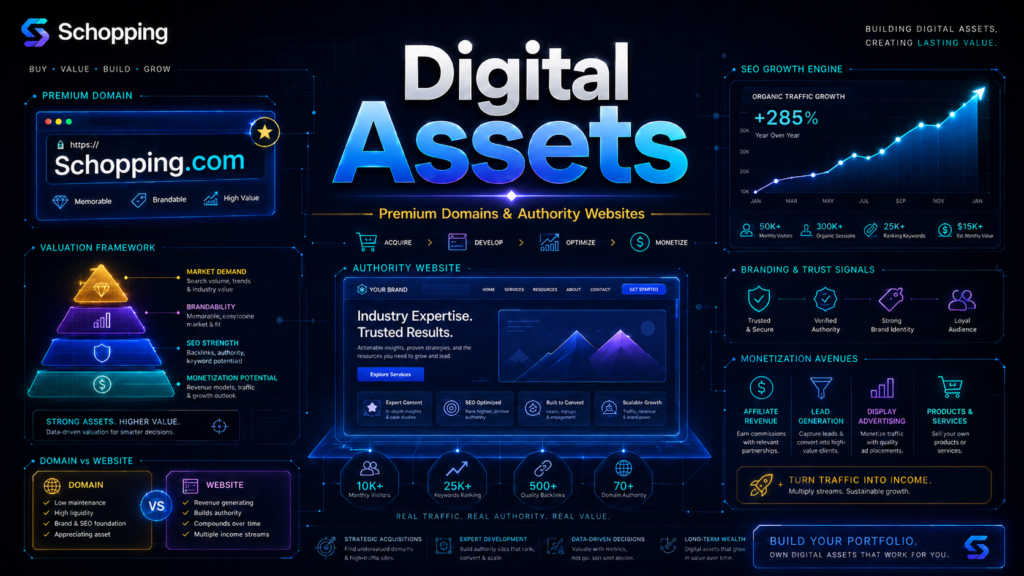
Digital assets are no longer just files, logos, usernames, or web addresses sitting quietly on the internet. For founders, investors, affiliate marketers, local business owners, creators, and online operators, the right digital asset can become the starting point of a business, the shortcut to brand trust, or the foundation of a long-term online property.
On Schopping, the focus is practical: premium domain names and ready-to-launch authority websites. These are digital assets that help buyers move faster than starting from an empty page. A strong domain gives a business a memorable identity. A starter authority site gives that identity structure, topical direction, and monetization potential.
This guide explains what digital assets are, how they differ from full online businesses, how premium domains and authority websites are valued, what risks buyers should watch for, and how to choose the right asset before spending money.
Quick Picks: Jump to the Section You Need
| Buyer Intent | Best Section |
|---|---|
| I am new to digital assets | What Are Digital Assets? |
| What types of digital assets are there | Types of digital assets |
| I want to buy a premium domain | Premium Domain Names as Digital Assets |
| I want a ready-made website foundation | Ready-to-Launch Authority Websites |
| I do not know whether to buy a domain or website | Premium Domain vs Authority Website |
| I want to understand valuation | How Digital Assets Are Valued |
| I want to compare costs | Digital Asset Cost Guide |
| I am worried about risk | Risks of Buying Digital Assets |
| I want beginner education | Digital Asset Learning Path |
| I want buying guidance | How to Buy Digital Assets Safely |
| I want SEO-focused assets | SEO Domain Names and Authority Brands |
What This Guide Is For
This guide is for buyers who want to understand digital assets before purchasing a premium domain name, starter authority site, brandable website, or SEO-focused online property.
It is not written for people looking for quick flips or speculative hype. The better way to think about a digital asset is this:
A digital asset is useful when it reduces friction.
It may reduce naming friction, trust friction, SEO friction, content planning friction, or launch friction. A good asset does not magically create a business. It gives the buyer a stronger place to begin.
Use this guide if you are comparing:
- A premium domain name vs a regular domain
- A domain name vs a website
- A starter authority site vs a fully operating online business
- An SEO domain vs a brandable domain
- Building a website from scratch vs buying a ready-to-launch website
- Buying a digital asset vs hiring a full agency to create one
For beginner education, Schopping’s supporting guide on what is a digital asset explains the concept from the ground up. This pillar page goes deeper into buying, valuation, risk, and business use.
Who Needs Digital Assets?
Digital assets are useful for different buyer types, but not for the same reason.
Founders Who Need a Strong Brand Name
A founder may have the product, offer, or business idea ready, but still struggle with the name. A premium domain can solve that problem faster than endless naming sessions. A clean, memorable domain can make the business feel more legitimate from the first impression.
For buyers comparing names, Schopping’s page on how to choose a domain name should be used before purchasing any brandable domain.
Affiliate Marketers and SEO Operators
Affiliate marketers often need more than a domain. They need topical direction, content architecture, commercial intent pages, informational support pages, and a structure that can grow into an authority website.
That is where ready-to-launch authority brands become useful. Instead of buying only a name, the buyer gets a brand foundation with a website concept, category structure, and SEO direction.
Local Businesses and Service Providers
A local clinic, consultant, agency, repair company, home service business, legal office, or professional service provider may need a domain that sounds trustworthy. The right domain can make paid ads, business cards, emails, referrals, and search results look more credible.
Investors and Portfolio Builders
Some buyers collect digital assets the way real estate investors collect undeveloped land, small rental properties, or commercial addresses. The key difference is that digital assets need sharper judgment. A domain with no buyer demand is not an investment. A starter website with weak positioning is not a brand. A portfolio should be built around quality, not volume.
Entrepreneurs Who Want to Start Faster
A buyer who wants to launch an online business may not want to spend months choosing a name, creating a logo, building pages, mapping content, and setting up the site. A starter authority brand can shorten that early stage.
For that use case, read how to start an online business with a website alongside this guide.
What Are Digital Assets?
Digital assets are online properties or digital resources that can hold business, brand, traffic, revenue, or strategic value. In the context of Schopping, the most important digital assets are:
- Premium domain names
- Brandable domain names
- SEO domain names
- Starter authority websites
- Ready-to-launch authority brands
- Niche website foundations
- Content site structures
- Website names and brand identities
- Pre-revenue online business assets
A domain name can be a digital asset because it controls the address, identity, and first impression of a brand. A website can be a digital asset because it contains structure, content, rankings, design, user experience, and monetization potential.
A digital asset does not have to be profitable today to be valuable. Some assets are valuable because they are rare. Others are valuable because they are useful. The strongest ones are both.
For a deeper beginner explanation, see what is a digital asset.
Why Digital Assets Matter
The internet rewards speed, clarity, trust, and positioning. A weak name, confusing website, or scattered content plan can delay a business before it ever reaches the market.
Digital assets matter because they can give a buyer:
1. Faster Market Entry
A ready domain or website foundation helps a buyer skip the slowest early-stage decisions. Instead of beginning with “What should we call this?” or “What pages do we need?” the buyer starts with an asset that already has direction.
2. Better Brand Recall
A premium domain name can be easier to remember, easier to say, and easier to trust. That matters in direct traffic, referrals, podcast mentions, social media, email outreach, and paid advertising.
3. Stronger Commercial Positioning
A good digital asset points toward a clear market. For example, a domain related to senior care, electric bikes, oral health, outdoor technology, or financial tools immediately suggests a category. That category clarity can reduce marketing confusion.
4. SEO Foundation
An SEO-focused asset can help a buyer build topical authority more intelligently. This does not mean a domain automatically ranks. Search engines still require useful content, trust signals, technical quality, and user satisfaction. But a strong structure makes SEO execution easier.
For buyers focused on search visibility, Schopping’s SEO domain names guide explains how search intent, topical relevance, and naming strategy work together.
5. Asset Optionality
Some digital assets can be developed, leased, redirected, held, sold, or used as brand infrastructure. The more useful the asset is to multiple buyer types, the more optionality it has.
Types of Digital Assets
Compare Types of Digital Assets
Select a digital asset type to compare typical cost range, maintenance level, revenue potential, buyer fit, and the main risk before choosing what to buy or build.
Domain names
Domain names are identity-first digital assets used for branding, category ownership, resale value, and online business positioning.
Buyer Insight
Choose this asset when your priority is naming strength, memorability, direct navigation, or owning a cleaner brand foundation before building a full website.
Digital assets are not a single category. They are a family of online properties, ownership rights, content systems, brand foundations, software products, audience channels, and revenue-generating structures that exist in digital form. Some are simple and low-maintenance, such as domain names. Others behave more like operating businesses, such as ecommerce stores, SaaS platforms, monetized websites, and audience-led media brands.
Understanding the main types of digital assets helps buyers avoid one of the most common mistakes in the digital asset market: comparing unlike assets as if they carry the same value logic. A premium domain is not valued like a newsletter. A content website is not judged like a SaaS tool. A digital product library is not the same as an ecommerce store. Each asset type has its own cost profile, risk level, monetization path, maintenance burden, and ideal buyer.
Below are the major digital asset types buyers, founders, creators, publishers, and online business investors should understand before entering the market.
Domain Names
Domain names are among the most foundational digital assets because they give an online business its address, identity, and first layer of brand trust. A domain may not generate revenue by itself, but it can shape how people remember, search for, and perceive a brand.
A strong domain name asset usually has one or more of the following qualities: short length, clean spelling, commercial meaning, category relevance, brandability, keyword intent, memorability, and a trusted extension. For example, a concise domain in a profitable niche can be valuable even before content, traffic, or products are added.
Domain names are best suited for founders, brand builders, domain investors, content publishers, and businesses that want a stronger launch identity. Their main risk is overpaying for a name that sounds appealing but has weak commercial use, poor memorability, awkward spelling, or limited resale demand.
Premium Domains
Premium domains are higher-value domain name assets with stronger market appeal. They may be short, exact, category-defining, highly brandable, commercially powerful, or naturally memorable. Unlike ordinary available domains, premium domains often carry strategic value because they can make a business feel more established from the first impression.
A premium domain can reduce branding friction. It can improve direct recall, strengthen paid advertising, support word-of-mouth, and make the business easier to trust. In competitive markets, the right premium domain can act like digital real estate on a valuable commercial street.
The key challenge is pricing. Premium domains can be difficult to value because their worth depends on buyer intent, market timing, industry demand, comparable sales, and brand potential. They are best for serious brand buyers, funded startups, category builders, and investors who understand naming psychology.
Website Assets
Website assets go beyond a domain name. They usually include a live website, published pages, content architecture, internal links, design, technical setup, search indexation, analytics history, and sometimes revenue. A website asset can be a blog, affiliate site, review site, directory, ecommerce store, lead-generation site, niche publication, or tool-based website.
The value of a website asset often depends on traffic quality, content depth, keyword rankings, backlink profile, conversion potential, monetization history, and the amount of work required to maintain it. A website with stable organic traffic and clean content can be more valuable than a visually beautiful site with no audience or commercial direction.
Website assets are ideal for publishers, SEO operators, affiliate marketers, niche business owners, and buyers who want a working foundation instead of starting from zero. Their main risks include traffic decline, outdated content, technical debt, weak monetization, and overdependence on one traffic source.
Starter Authority Sites
Starter authority sites sit between undeveloped domains and mature website assets. They are usually early-stage websites built around a clear niche, content structure, category plan, and monetization direction. They may not have significant revenue yet, but they provide a stronger foundation than a blank domain.
A good starter authority site usually includes a relevant domain, basic branding, core pages, category architecture, early articles, internal linking logic, and a defined topical direction. This makes it useful for buyers who want to enter a niche quickly without doing the initial setup themselves.
Starter authority sites are best for SEO builders, niche operators, affiliate publishers, and entrepreneurs who understand that the asset still requires execution. The buyer is not purchasing a finished business. They are buying a structured starting point that can be developed into a larger digital property.
Authority Brands
Authority brands are digital assets built around trust, positioning, and category ownership. They may include a strong domain, brand identity, website structure, content strategy, social handles, editorial angle, and a clear market thesis. Unlike simple websites, authority brands are designed to become recognized destinations in a niche.
An authority brand can support multiple monetization paths: affiliate revenue, display ads, sponsored content, ecommerce, lead generation, digital products, memberships, consulting, or partnerships. Its real value comes from the ability to build trust over time.
For buyers who want a stronger identity than a simple website or domain name can provide, Schopping’s authority brands category highlights digital assets built around niche trust, brand positioning, content direction, and long-term market recognition.
This type of digital asset is especially useful in competitive or trust-sensitive categories where readers need confidence before taking action. Buyers interested in authority brands should look for niche clarity, expansion room, editorial credibility, and a brand name that can survive beyond one traffic channel.
Digital Products
Digital products are non-physical assets that can be sold, downloaded, licensed, or delivered online. Common examples include ebooks, templates, online courses, spreadsheets, Notion dashboards, design files, presets, printable planners, calculators, research reports, audio files, and professional toolkits.
Their appeal comes from scalability. Once created, a digital product can often be sold repeatedly without inventory, warehousing, or traditional fulfillment. That makes digital products attractive to creators, educators, consultants, publishers, and niche website owners.
The strongest digital product assets solve a specific problem for a specific buyer. A broad “business guide” is difficult to position. A specialized template, calculator, or course for a clearly defined audience is easier to market and convert. The main risk is weak demand. A polished product has little value if the market does not urgently need it.
Content Assets
Content assets include articles, buying guides, tutorials, reviews, comparison pages, videos, scripts, podcasts, glossaries, newsletters, case studies, and editorial libraries. They are valuable when they attract traffic, educate buyers, build authority, support conversions, or strengthen a website’s topical relevance.
For SEO-driven businesses, content assets are especially important. A strong article library can help a site rank for informational, commercial, and comparison-based keywords. Product reviews and comparison pages can capture high-intent visitors, while tutorials and guides can build long-term trust.
The risk with content assets is decay. Search intent changes, product information becomes outdated, links break, rankings move, and competitors publish stronger pages. Content assets require review, updates, pruning, internal linking, and monetization improvements to remain valuable.
Audience Assets
Audience assets are built around attention, relationship, and trust. They include email lists, newsletters, communities, social media accounts, YouTube channels, podcasts, membership groups, Discord communities, WhatsApp groups, and private media channels.
The value of an audience asset is not measured only by size. A small, highly engaged email list in a profitable niche can be more valuable than a large inactive social media following. Engagement quality, buyer intent, niche focus, deliverability, platform control, and monetization history are more important than vanity metrics.
Audience assets are powerful because they reduce dependence on search engines. A business with a loyal email list or community can launch products, promote content, sell sponsorships, and drive repeat visits more directly. The major risk is platform dependency, especially when the audience lives mainly on social media platforms with changing algorithms.
Ecommerce Assets
Ecommerce assets include online stores, product catalogs, customer lists, supplier relationships, product photography, brand packaging, marketplace accounts, email flows, paid ad creatives, and checkout systems. These assets are attractive because they connect directly to product sales.
An ecommerce digital asset may be a Shopify store, WooCommerce store, Amazon storefront, Etsy shop, print-on-demand brand, dropshipping store, or digital product store. Its value depends on profit margins, product demand, customer acquisition costs, repeat purchase behavior, supplier stability, refund rates, and brand strength.
Ecommerce assets can generate strong revenue, but they are usually more operationally demanding than content sites or domain names. Buyers must understand fulfillment, customer support, inventory, advertising, product quality, platform policies, and margin pressure.
SaaS and Software Assets
SaaS and software assets include web applications, mobile apps, plugins, browser extensions, automation tools, APIs, calculators, scripts, dashboards, and subscription-based software products. These assets can be highly valuable because they may produce recurring revenue and solve repeat-use problems.
The best SaaS/software assets have clear product-market fit, active users, low churn, clean code, reliable hosting, documentation, and manageable support requirements. A small software tool that solves a painful niche problem can become a strong digital asset even without a large team.
The main risks are technical debt, security issues, weak retention, poor documentation, dependency problems, and high support demands. Buyers without technical knowledge should be cautious unless they have developer support or a proper code review process.
Data Assets
Data assets include organized information that can be used for analysis, lead generation, directories, software tools, market research, personalization, or content production. Examples include product databases, supplier lists, keyword research libraries, price comparison datasets, niche directories, review datasets, lead lists, and customer behavior data.
A data asset becomes valuable when it is accurate, structured, fresh, unique, and legally usable. Poor-quality data can create more problems than value. Outdated leads, scraped information with unclear rights, or unverified datasets can damage trust and create compliance risk.
Data assets are especially useful for B2B builders, directories, comparison websites, research products, marketplaces, and software tools. Their value depends heavily on freshness, permission, structure, and practical use.
Creative and Media Assets
Creative and media assets include logos, brand kits, photography libraries, video footage, sound effects, music files, illustration packs, UI kits, design templates, fonts, motion graphics, 3D models, and ad creatives. These assets support branding, publishing, advertising, ecommerce, and content production.
For agencies, creators, ecommerce brands, and publishers, creative assets can reduce production time and improve visual consistency. A strong brand kit or media library can make a business look more professional and help campaigns move faster.
The most important issue is licensing. Buyers must know whether the files can be used commercially, modified, resold, sublicensed, included in client work, or bundled into paid products. Creative assets with unclear rights can become risky, even when the files themselves look high quality.
Tokenized Assets
Tokenized assets are blockchain-based digital assets that may represent ownership records, memberships, collectibles, access rights, gaming items, financial instruments, or claims linked to real-world assets. This category includes NFTs, crypto assets, tokenized memberships, blockchain gaming items, and smart contract-based digital rights.
Tokenized assets are different from traditional digital assets because they often involve wallets, custody, market liquidity, smart contracts, regulatory uncertainty, and price volatility. Their value may come from scarcity, access, utility, community, speculation, or underlying rights.
This category is best suited for advanced buyers who understand both the technical and financial risks. A token may show ownership on-chain, but buyers must still understand what rights they actually receive, whether there is real demand, and how easily the asset can be sold or used.
Choosing the Right Digital Asset Type
The right digital asset depends on the buyer’s goal, skills, budget, and appetite for maintenance.
If the priority is brand identity, domain names or premium domains may offer the most leverage. If the goal is organic traffic, website assets, content assets, and starter authority sites are more relevant. If the buyer wants scalable products, digital products and SaaS tools deserve closer attention. If the business depends on trust and long-term recognition, authority brands and audience assets may create deeper value.
The smartest approach is to classify the asset before valuing it. Ask whether you are buying a name, a website, an audience, a product, a software system, a content library, a data source, or a full online business foundation. Once that is clear, the cost, risk, and opportunity become much easier to judge.
Premium Domain Names as Digital Assets
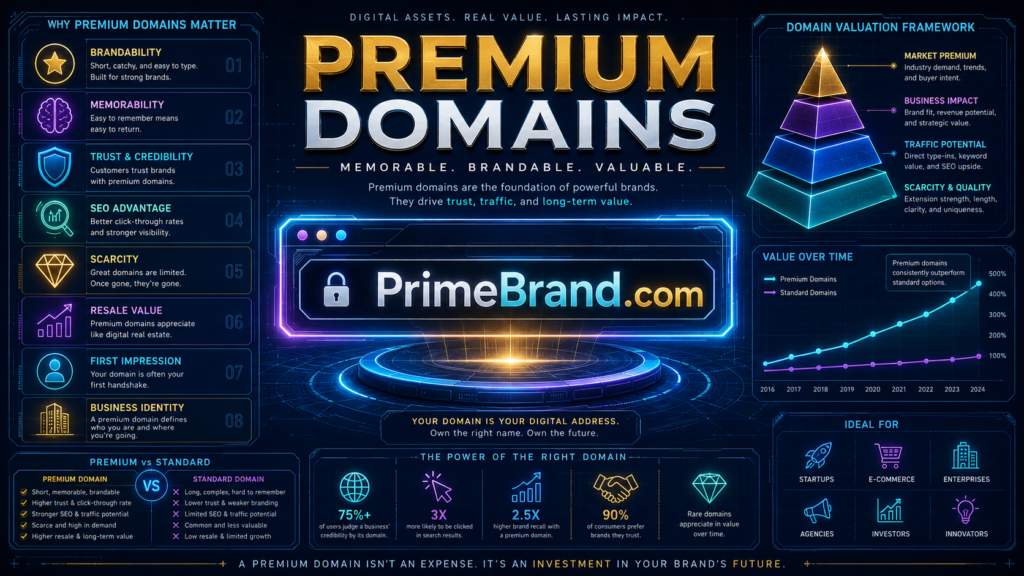
A premium domain name is a domain with unusually strong brand, commercial, memorability, category, or resale value. It may be short, exact-match, category-defining, highly brandable, or attached to a valuable industry. Businesses that want a stronger digital starting point can explore our complete catalog at premium domain names for sale to find domains with existing brand, search and commercial potential.
Premium domains are often compared to digital real estate. That comparison is imperfect, but useful. A great domain is not valuable just because it exists. It is valuable because someone can build trust, traffic, and revenue on top of it.
What Makes a Premium Domain Valuable?
A premium domain name usually has several of these qualities:
| Value Factor | Why It Matters |
|---|---|
| Short length | Easier to remember, type, share, and brand |
| Clean spelling | Reduces confusion and lost traffic |
| Commercial category | More likely to attract serious buyers |
| Brandability | Can become a company, product, or media brand |
| Extension quality | .com still carries strong buyer familiarity |
| Search relevance | May align with high-intent keywords |
| No legal conflict | Lower trademark and brand risk |
| Emotional clarity | Instantly communicates trust, luxury, speed, care, savings, health, or expertise |
The domain market continues to show strong demand for memorable names, while newer extensions such as .ai, .app, and other specialized TLDs have grown in visibility. At the same time, .com remains a dominant extension in mainstream buyer psychology and registration behavior. (TechRadar)
Premium Domains vs Ordinary Domains
An ordinary domain is available because no one else saw enough value to register or keep it. A premium domain is often already owned because it has recognized business potential.
That does not mean every expensive domain is good. Price is not proof of quality. A buyer should ask:
- Can this name support a serious business?
- Is it easy to spell after hearing it once?
- Does it pass the “radio test”?
- Is it too narrow?
- Is it too vague?
- Could another company claim trademark conflict?
- Does it fit the buyer’s future business model?
For buyers ready to browse names, visit premium domain names for sale.
Ready-to-Launch Authority Websites
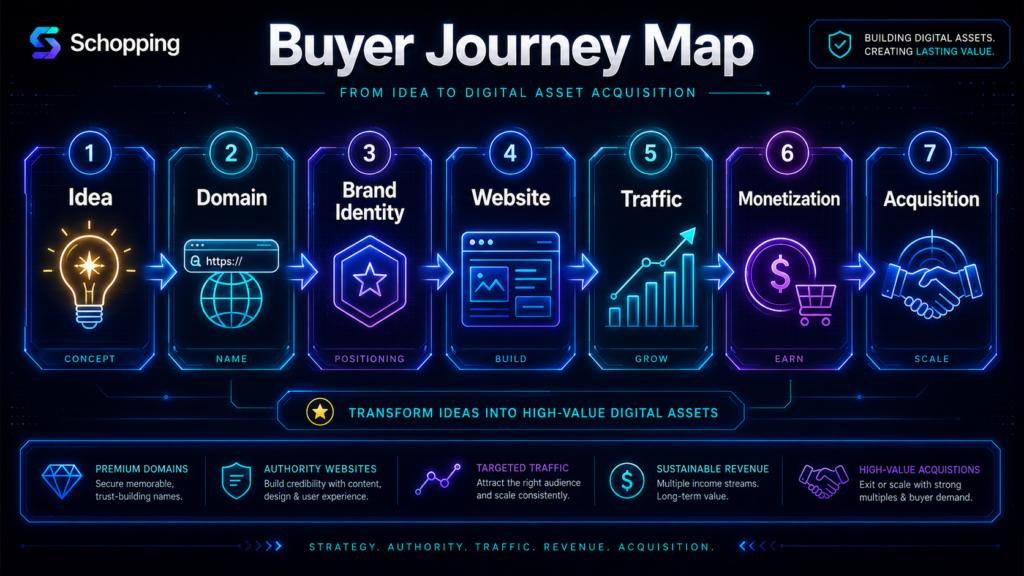
A ready-to-launch authority website is a pre-built or strategically prepared website designed around a niche, content structure, commercial intent, and long-term topical growth.
It is not the same as a random blog. A proper authority website has a reason to exist.
It should answer:
- What market does this website serve?
- What problem does it solve?
- What content clusters does it own?
- What products, services, or offers could it monetize?
- What type of buyer would want to develop it?
- What makes the brand expandable?
A good authority website is not merely “a website with articles.” It is a business foundation.
What Should a Starter Authority Site Include?
A serious starter authority site may include:
| Component | Purpose |
|---|---|
| Premium or brandable domain | Creates identity and trust |
| Clear niche positioning | Prevents scattered content |
| Homepage structure | Explains the brand quickly |
| Pillar pages | Build topical depth |
| Cluster pages | Support search visibility |
| Monetization map | Shows how the site may earn |
| Internal linking structure | Helps users and search engines navigate |
| Editorial direction | Keeps future content consistent |
| Conversion paths | Turns visitors into leads, buyers, or subscribers |
For buyers who want the website foundation rather than only the name, visit ready-to-launch authority brands or starter authority sites.
Digital Assets vs Online Business
A digital asset is not always a full online business.
This distinction matters because many buyers overpay when they confuse potential with proof.
A domain name may have potential.
A starter website may have direction.
An authority site may have topical structure.
An online business should have operations, traffic, revenue, customers, systems, and verifiable performance.
Comparison Chart: Digital Asset vs Online Business
| Category | Digital Asset | Online Business |
|---|---|---|
| Main value | Potential, identity, structure, positioning | Revenue, systems, customers, cash flow |
| Common examples | Premium domain, SEO domain, starter website, authority brand | Affiliate site, ecommerce store, SaaS, lead gen business |
| Buyer goal | Launch faster or build on better foundation | Acquire existing income stream |
| Due diligence focus | Name quality, niche potential, SEO architecture, legal risk | Revenue proof, traffic analytics, expenses, operations |
| Risk type | Execution risk | Performance and transfer risk |
| Price logic | Strategic value and build-cost replacement | Earnings multiple and business quality |
| Best for | Founders, builders, marketers, early-stage operators | Investors, operators, acquisition entrepreneurs |
For a deeper explanation, see digital assets vs online business.
Premium Domain vs Authority Website
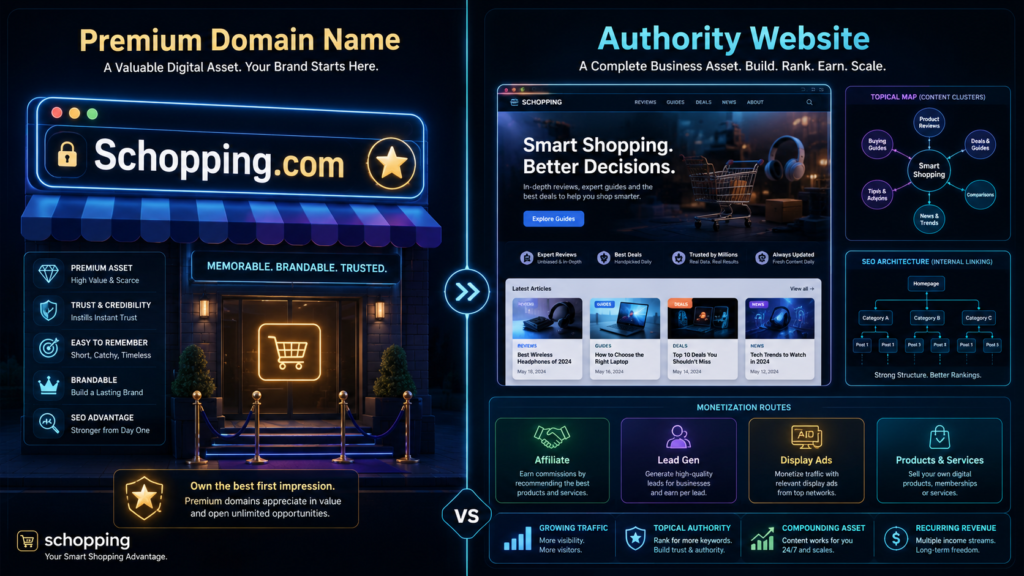
Some buyers should buy only a domain. Others should buy a full website foundation.
The right choice depends on how much structure the buyer needs.
Comparison Chart: Premium Domain Name vs Ready-to-Launch Authority Website
| Feature | Premium Domain Name | Ready-to-Launch Authority Website |
|---|---|---|
| Best for | Buyers with their own team, offer, or product | Buyers who want a faster content/business foundation |
| Main advantage | Strong identity and brand recall | Name + structure + niche direction |
| Setup work needed | High | Moderate |
| SEO readiness | Depends on domain and future build | Usually stronger if site architecture is included |
| Cost range | Can be low, mid, or very high depending on quality | Usually higher than a domain because more work is included |
| Revenue status | Usually pre-revenue | Often pre-revenue or early-stage |
| Buyer risk | Overpaying for a weak name | Buying a shallow website with poor strategy |
| Best next step | Build brand, site, offer, content | Publish, improve, monetize, expand |
A buyer who already has a business plan may only need a domain. A buyer who wants a market entry point may prefer an authority website.
For beginners deciding between both, Schopping’s domain name vs website guide is the best bridge.
Benefits of Buying Digital Assets
1. You Save Naming Time
Naming can delay a business for weeks. A premium domain solves one of the most emotionally exhausting early decisions: what the brand should be called.
2. You Reduce Launch Friction
A starter authority website gives you a working foundation. You still need execution, but the first layer is no longer blank.
3. You Can Enter a Niche Faster
If the asset already has a clear niche, content structure, and monetization direction, you can focus on execution rather than planning from scratch.
4. You Improve Perceived Trust
A strong domain can make a business look more established. This matters especially in finance, health, education, technology, senior care, ecommerce, and professional services.
5. You Build Around a Better Asset
A poor domain can cap a brand. A confusing name makes every future marketing effort harder. A strong digital asset can make future SEO, email, partnerships, and paid traffic more efficient.
6. You Create Optionality
A domain can become a brand. A website can become a business. A content structure can become a lead engine. A niche authority site can become an affiliate property, newsletter, directory, or acquisition target.
Trends and Latest Technology in Digital Assets
Digital assets are changing because online business creation is changing. Buyers no longer look only for a domain name. They increasingly want an asset that includes positioning, topical structure, search intent, and monetization logic.
Trend 1: Premium Domains Are Becoming Brand Infrastructure
A good domain is no longer just a web address. It is part of the brand’s trust layer. It affects email credibility, investor perception, direct traffic, customer memory, and paid advertising performance.
Trend 2: Short, Memorable Names Still Matter
Even as new domain extensions grow, short and memorable names remain highly desirable because they are easier to say, type, remember, and turn into a company. Recent domain trend reports continue to highlight the strength of .com alongside growing interest in newer extensions such as .ai and other specialized TLDs. (TechRadar)
Trend 3: Buyers Want Niche Authority, Not Empty Websites
A website with no strategy is just a shell. Buyers increasingly care about topical maps, pillar pages, internal linking, keyword clusters, and monetization paths.
This is why ready-to-launch authority brands are more useful than generic starter websites.
Trend 4: SEO Assets Are Being Judged More Strictly
Buyers are more cautious about aged domains, expired domains, backlink profiles, thin content, and inflated traffic claims. A clean, well-positioned asset can be more attractive than a messy site with suspicious numbers.
Trend 5: Brandable + Commercial Is the Strongest Combination
A name that is only brandable may sound good but lack buyer urgency. A name that is only keyword-based may feel stiff. The strongest digital assets often combine brandability with commercial meaning.
Example patterns:
- Short brand + high-value industry
- Clear category + flexible expansion
- Memorable name + obvious monetization angle
- Niche authority site + buyer intent content
Upcoming Models in Digital Assets
In this market, “models” means emerging asset formats and business models, not physical product models.
1. Starter Authority Brands
These are pre-built brand foundations designed for buyers who want a faster path into a niche. They may include the domain, website, niche positioning, content architecture, and monetization ideas.
Internal anchor: starter authority sites
2. Premium Domain + Website Bundle
Instead of selling a domain alone, the asset includes a simple but polished website structure. This helps buyers visualize the business faster.
3. SEO Domain + Topical Map
This model focuses on buyers who want search-driven growth. The domain is paired with a keyword strategy, pillar pages, cluster pages, and content roadmap.
Internal anchor: SEO domain names
4. Niche Website Business Models
These are website assets designed around a clear monetization route, such as affiliate reviews, lead generation, directories, newsletters, or comparison content.
Internal anchor: niche website business models
5. Buy vs Build Decision Assets
Some buyers do not want a finished business. They want a better starting point than building from zero. That is why comparison content such as buy website vs build website supports buyer education.
How Digital Assets Are Valued
Digital asset valuation is part logic, part market demand, part buyer fit.
There is no universal calculator that can perfectly value a premium domain or starter authority website. Automated appraisal tools may provide rough ranges, but they cannot fully understand buyer urgency, brand fit, industry timing, legal risk, or strategic usefulness.
Digital Asset Valuation Framework
| Valuation Layer | What to Examine | Why It Matters |
|---|---|---|
| Identity value | Is the name memorable, clean, and credible? | Strong identity improves trust |
| Category value | Does it fit a profitable niche? | Better niches create buyer demand |
| Commercial intent | Can the asset lead to revenue? | Revenue potential supports price |
| SEO potential | Does it support search strategy? | Search demand can compound value |
| Build replacement cost | What would it cost to recreate? | Helps compare buy vs build |
| Strategic scarcity | Are similar names/assets available? | Scarcity can raise value |
| Risk profile | Legal, SEO, technical, and reputation risks | Lower risk improves buyer confidence |
| Buyer fit | Does it solve this buyer’s exact problem? | Fit can matter more than generic value |
Simple Valuation Formula
A practical way to think about value:
Digital Asset Value = Strategic Usefulness + Scarcity + Build Cost Saved + Monetization Potential – Risk
This is not a mathematical price formula. It is a decision framework.
Valuation by Asset Type
| Asset Type | Main Value Driver | Common Mistake |
|---|---|---|
| Premium domain | Name quality, buyer demand, brand fit | Paying for length alone |
| Brandable domain | Memorability and identity | Buying a name that sounds nice but means nothing |
| SEO domain | Search intent and topical relevance | Assuming keywords guarantee rankings |
| Starter authority site | Structure and niche direction | Buying thin content without strategy |
| Revenue website | Verified earnings and stability | Trusting screenshots without proof |
| Niche website | Monetization clarity | Choosing a niche with no buyer intent |
For more depth, read how to value digital assets.
Digital Asset Cost Guide
Digital asset prices vary widely. A buyer should not ask only, “How much does it cost?” The better question is:
“What problem does this asset solve, and how expensive would that problem be to solve from scratch?”
Cost Comparison Chart
| Digital Asset Type | Typical Cost Logic | Buyer Should Pay For | Buyer Should Avoid |
|---|---|---|---|
| Regular domain | Registration fee | Basic availability | Weak names with no strategy |
| Premium domain | Scarcity, brand value, category demand | Clean, memorable, commercially useful names | Inflated pricing without buyer fit |
| Brandable domain | Naming quality and identity | Short, flexible, polished names | Awkward spellings |
| SEO domain | Keyword relevance and topical potential | Search intent and clean history | Spammy expired domains |
| Starter authority site | Domain + site + structure | Niche map, pillar pages, monetization direction | Generic template sites |
| Ready-to-launch authority brand | Brand + website + strategic foundation | Market clarity and expansion potential | Shallow sites with no editorial plan |
| Revenue website | Earnings multiple | Verified traffic and profit | Unverified claims |
Hidden Costs Buyers Forget
Buying the asset is only one part of the budget. Buyers may also need:
- Hosting
- WordPress setup or maintenance
- Design improvements
- Content expansion
- SEO tools
- Email setup
- Logo and brand assets
- Legal checks
- Analytics setup
- Affiliate program approvals
- Technical cleanup
- Link building or digital PR
- Editorial management
A cheap asset can become expensive if it needs everything rebuilt. A more expensive asset can be reasonable if it saves months of setup and gives the buyer a better foundation.
How to Buy Digital Assets Safely
Buying digital assets requires due diligence. The level of research depends on the price and complexity of the asset.
Step 1: Define the Asset Type
Are you buying:
- A domain name?
- A website name?
- A starter site?
- A ready-to-launch authority brand?
- A revenue-generating online business?
- A niche website model?
Different assets require different checks. A domain purchase is not the same as buying a website with traffic and revenue.
Step 2: Check Strategic Fit
Ask whether the asset fits your actual goal.
A premium domain may be beautiful, but useless to your business. A starter website may look polished, but not match your skill set. A niche may have search volume, but no monetization.
Step 3: Review Legal Risk
Before buying a domain or brand, check for obvious trademark conflicts, confusing similarity, restricted terms, and regulated niches. Legal risk can destroy an otherwise attractive asset.
Step 4: Review SEO History
For SEO domains and websites, inspect the asset history. Look for signs of spam, irrelevant redirects, adult content, gambling history, hacked pages, toxic backlinks, or sudden traffic drops.
Step 5: Verify Ownership and Transfer Process
Make sure the seller can transfer the domain, website files, hosting access, content rights, analytics access, and related brand materials.
Step 6: Use a Secure Payment Method
Higher-value domain and website deals should use secure marketplace payment, escrow, or a platform that protects both buyer and seller.
Step 7: Plan the First 90 Days
Do not buy a digital asset and leave it idle. Decide what happens immediately after purchase:
- Will you launch content?
- Build product pages?
- Add affiliate offers?
- Create lead forms?
- Redirect the domain?
- Build an email list?
- Improve design?
- Publish comparison pages?
For a complete buyer path, read how to buy digital assets.
Risks of Buying Digital Assets
Digital assets can be powerful, but the wrong purchase can become a silent liability.
Risk 1: Overpaying for Potential
Potential is not proof. A seller may price an asset based on what it “could become,” but the buyer still has to execute.
Risk 2: Trademark Problems
A domain that sounds similar to an existing brand may create legal problems. Even if the name is available, it may not be safe to use.
Risk 3: Weak Monetization
A niche may look exciting but have poor buyer intent. Traffic without monetization can become an expensive hobby.
Risk 4: Bad SEO History
Some domains have been used for spam, redirects, low-quality link schemes, or hacked content. A buyer should inspect history before purchase.
Risk 5: Template Website Trap
A site may look finished but contain shallow content, weak structure, generic design, and no real strategy. A ready-to-launch authority website should have depth, not just pages.
Risk 6: Platform Dependence
Some websites depend heavily on one affiliate program, one traffic source, one social account, or one ranking page. That concentration increases risk.
Risk 7: Buyer-Skill Mismatch
A buyer may purchase an asset that requires skills they do not have. For example, an affiliate authority site may require SEO writing, technical maintenance, link acquisition, conversion optimization, and program management.
SEO Domain Names and Authority Brands
SEO domain names can be valuable when they align with a real search market. But buyers should avoid a common misunderstanding:
A keyword in the domain is not a business strategy.
A strong SEO domain works best when paired with:
- Clear topical map
- Useful pillar content
- Commercial pages
- Internal linking
- Editorial consistency
- Trust signals
- Strong user experience
- Monetization plan
An authority brand goes one step further. It combines SEO potential with brand expansion. Instead of being locked into one keyword, it can grow into guides, reviews, tools, newsletters, directories, services, and buyer education.
This is the difference between a narrow keyword site and a real authority brand.
For buyers focused on search-led growth, Schopping’s guides on SEO domain names and ready-to-launch authority brands should be read together.
How Digital Assets Create Revenue
A digital asset does not automatically generate income. It creates the conditions for revenue when developed correctly.
Common Revenue Models
| Revenue Model | Best Asset Fit | Example Use |
|---|---|---|
| Affiliate marketing | Authority websites, review sites, comparison sites | Product recommendations |
| Lead generation | Service domains, local niche websites | Appointment forms, quote requests |
| Display advertising | Informational authority sites | High-volume content |
| Sponsored content | Niche media brands | Brand partnerships |
| Digital products | Educational brands | Courses, templates, guides |
| Ecommerce | Product-focused domains | Niche product stores |
| Newsletter monetization | Expert-led authority brands | Sponsorships, paid subscriptions |
| Directory model | Local or professional niche sites | Listings and featured placements |
| Service business | Premium category domains | Consulting, clinics, agencies |
For business model planning, use niche website business models.
Buy Website vs Build Website
The buy vs build decision depends on time, budget, skill, and urgency.
Building From Scratch Makes Sense When:
- You have a strong brand idea already
- You want full creative control
- Your budget is limited
- You have SEO and website skills
- You are not in a hurry
- You want to test slowly
Buying a Digital Asset Makes Sense When:
- You want to launch faster
- You value a better domain
- You need a structured website foundation
- You want a niche direction already mapped
- You are entering a competitive market
- You understand how to develop the asset after purchase
Buy vs Build Chart
| Decision Factor | Build From Scratch | Buy Digital Asset |
|---|---|---|
| Upfront cost | Lower | Higher |
| Time to launch | Slower | Faster |
| Brand quality | Depends on available names | Often stronger |
| SEO structure | Must be planned | May already exist |
| Control | Full control | Must adapt existing asset |
| Risk | Execution risk | Purchase + execution risk |
| Best for | Patient builders | Faster movers |
For more comparison detail, read buy website vs build website.
How to Choose the Right Digital Asset
The right asset should match your business model, budget, and execution ability.
Use This Buyer Filter
Before buying, score the asset from 1 to 5 on each point:
| Question | Score |
|---|---|
| Is the name easy to remember? | 1–5 |
| Is the niche commercially useful? | 1–5 |
| Does the asset fit my business plan? | 1–5 |
| Is the legal risk low? | 1–5 |
| Is the SEO history clean? | 1–5 |
| Can I monetize this within 6–12 months? | 1–5 |
| Does the asset save meaningful time? | 1–5 |
| Would I still want it if I could not resell it quickly? | 1–5 |
Score Interpretation
| Score Range | Meaning |
|---|---|
| 32–40 | Strong candidate |
| 24–31 | Worth deeper review |
| 16–23 | Risky or unclear |
| Under 16 | Usually avoid |
This simple framework helps buyers avoid emotional purchases.
Internal Learning Path for Digital Asset Buyers
To build topical understanding, follow this Schopping path:
- Start with what is a digital asset
- Compare categories with types of digital assets
- Learn buyer process through how to buy digital assets
- Study pricing with how to value digital assets
- Understand the difference through digital assets vs online business
- Learn domain basics with how to buy a website name
- Compare identity levels through domain name vs website
- Improve naming decisions with how to choose a domain name
- Explore naming categories through brandable domain names
- Study search-focused assets with SEO domain names
- Explore pre-built site foundations through starter authority sites
- Learn business formation through how to start an online business with a website
- Compare execution options with buy website vs build website
- Study monetization through niche website business models
You can also return to the Schopping homepage to browse digital assets, premium domains, and ready-to-launch authority brand opportunities.
Digital Asset Buyer Checklist
Before buying any digital asset, use this checklist.
| Check | Why It Matters |
|---|---|
| Confirm exact asset included | Avoid misunderstanding what is being sold |
| Check domain ownership | Ensure seller controls the domain |
| Review trademark risk | Avoid legal problems |
| Inspect domain history | Identify spam or reputation issues |
| Review backlink profile | Avoid toxic SEO baggage |
| Check site content quality | Avoid thin or duplicated content |
| Confirm transfer process | Prevent technical delays |
| Estimate rebuild cost | Compare buying vs building |
| Match asset to monetization | Avoid buying something you cannot use |
| Plan first 90 days | Turn asset into action |
Common Buyer Mistakes
Buying a Name Because It Sounds Expensive
Some names sound premium but are difficult to spell, too abstract, or commercially weak.
Choosing a Niche Without Revenue Intent
A niche can have traffic but no buyers. A profitable digital asset needs a path from visitor attention to money.
Ignoring Legal Risk
A domain can be registered and still be legally dangerous. Always check obvious trademark issues.
Confusing a Starter Site With a Finished Business
A starter site gives you a foundation. It does not replace execution.
Buying Too Many Assets
A small number of quality assets is usually better than a large portfolio of weak names and unfinished sites.
Not Knowing the Next Step
Never buy a digital asset without knowing what you will do with it after transfer.
Comparison Chart: Best Digital Asset by Buyer Type
| Buyer Type | Best Digital Asset | Why |
|---|---|---|
| Startup founder | Premium domain name | Strong identity and credibility |
| Affiliate marketer | Ready-to-launch authority website | Faster SEO and content foundation |
| Local business owner | Category-relevant domain | Trust and service clarity |
| SEO operator | SEO domain or authority brand | Search-focused growth potential |
| Beginner entrepreneur | Starter authority site | Easier than starting from zero |
| Investor | Premium domain portfolio | Scarcity and resale potential |
| Content publisher | Niche authority website | Editorial expansion and monetization |
| Agency owner | Brandable domain or service website | Client-facing credibility |
| Lead generation builder | Service niche website | Conversion and inquiry potential |
Where Schopping Fits
Schopping is designed as a marketplace and editorial hub for buyers who want practical digital assets, not abstract internet collectibles.
The core categories are:
- Premium domain names for sale for buyers who want a strong name
- Ready-to-launch authority brands for buyers who want a website foundation
- Starter authority sites for buyers who want to build niche websites
- SEO domain names for buyers focused on search-led assets
- Brandable domain names for buyers who want naming flexibility
The goal is not to make digital assets sound effortless. The goal is to help buyers choose better starting points.
FAQs
What are digital assets in online business?
Digital assets in online business are internet-based properties that can hold brand, traffic, revenue, or strategic value. Examples include premium domain names, websites, authority brands, affiliate sites, ecommerce stores, newsletters, digital products, content libraries, and SEO-focused domains.
For Schopping, the most important digital assets are premium domains and ready-to-launch authority websites. A premium domain gives a business a stronger identity. An authority website gives the buyer a structured foundation for content, search visibility, and monetization.
The key point is that a digital asset should be useful. A domain no one wants, a website with no strategy, or a content shell with no market direction may technically be digital, but it may not be a valuable asset.
Are premium domain names worth buying for a new business?
Premium domain names can be worth buying when they improve trust, memorability, brand positioning, or commercial clarity. A strong domain can help customers remember the business, make email communication look more credible, and reduce friction in advertising and referrals.
However, a premium domain is not automatically worth its asking price. The buyer should evaluate spelling, extension, industry fit, trademark risk, audience clarity, and resale potential. The best premium domain is not always the shortest or most expensive one. It is the one that fits the business model and creates an advantage the buyer can actually use.
What is the difference between a domain name and a ready-to-launch authority website?
A domain name is the address and identity layer of a business. A ready-to-launch authority website includes the domain plus website structure, niche positioning, content direction, internal linking, and often monetization planning.
A domain is best for buyers who already know what they want to build. A ready-to-launch authority website is better for buyers who want a faster start and need a strategic foundation. The website still requires work after purchase, but it gives the buyer more than a blank domain.
How do you value a digital asset before buying it?
To value a digital asset, examine its usefulness, scarcity, niche demand, commercial potential, SEO quality, legal safety, and replacement cost. A premium domain may be valued based on brandability and buyer demand. A starter authority site may be valued based on domain quality, structure, content depth, and monetization direction.
Buyers should avoid relying only on automated valuation tools. A digital asset is worth more when it solves a real problem for a specific buyer. It is worth less when its value depends only on vague future potential.
What is the best digital asset to buy for beginners?
For beginners, the best digital asset is usually one that comes with clear direction. A random premium domain may be hard to develop if the buyer has no business plan. A ready-to-launch authority website or starter authority site may be easier because it includes niche focus, page structure, and a clearer path toward monetization.
Beginners should avoid expensive assets unless they understand the market, the risks, and the work required after purchase. A smaller, focused asset with a clear niche is often better than a large, vague opportunity.
People Also Ask
How do I buy digital assets safely without getting scammed?
To buy digital assets safely, verify ownership, inspect the asset history, check for legal conflicts, confirm exactly what is included, and use a secure payment process. For domain names, make sure the seller controls the domain and can transfer it through a trusted registrar or marketplace. For websites, ask for access proof, content rights, analytics, revenue records if applicable, and a clear handover process.
Avoid rushed deals, vague screenshots, inflated traffic claims, and sellers who cannot explain the asset clearly. A legitimate asset should be understandable. If the value story sounds confusing, the risk is usually higher.
Should I buy a premium domain or build a website first?
If brand identity is the bottleneck, buy the premium domain first. If the business concept, niche, and monetization path are already clear, the domain becomes the foundation for everything else.
If you are still exploring niches, a ready-to-launch authority website may be more useful because it gives you structure as well as a name. The right decision depends on whether you need identity, strategy, or execution speed.
A buyer with a team may only need the domain. A solo buyer may benefit from a site foundation.
Are SEO domain names still useful?
SEO domain names can still be useful when they align with real search intent and are developed into helpful websites. The domain itself does not guarantee rankings, but a relevant name can support topical clarity, click confidence, and brand-position fit.
The risk is buying a keyword domain and assuming search traffic will follow. Search visibility requires useful content, technical quality, trust signals, internal linking, and consistent publishing. An SEO domain should be treated as a foundation, not a shortcut.
Can a starter authority site become a real online business?
Yes, a starter authority site can become a real online business if it is developed with strong content, monetization, traffic strategy, and user trust. It may begin as a pre-revenue digital asset, but it can grow into an affiliate site, lead generation site, niche media brand, directory, newsletter, or ecommerce support platform.
The important word is “developed.” A starter site does not become valuable by sitting untouched. The buyer must publish, improve, promote, measure, and monetize it.
What should I check before buying a ready-to-launch authority website?
Before buying a ready-to-launch authority website, check the domain quality, niche demand, content structure, page depth, internal linking, design quality, SEO history, monetization plan, and transfer details. Also check whether the site is built around a real audience or just a generic template.
A strong authority website should have a clear editorial direction. You should be able to look at the site and understand what it can become within 6 to 12 months.
Digital Assets Are Starting Points, Not Magic Assets
The best digital assets do not replace business judgment. They sharpen it.
A premium domain name can give a founder a stronger identity. A ready-to-launch authority website can give an operator a faster path into a niche. An SEO domain can support search strategy. A starter authority site can help a buyer avoid the blank-page stage.
But the asset is only the beginning.
Value is created when the buyer matches the asset with execution: useful content, trustworthy design, careful SEO, smart monetization and a real audience. That is why Schopping’s digital asset structure is built around both sides of the market: the asset itself and the buyer education needed to use it well.
To browse purchase-ready powerful domain name opportunities, visit premium domain names for sale.