
Amazon Affiliate Disclosure
Schopping may participate in affiliate programs, including the Amazon Services LLC Associates Program. This means Schopping may earn a commission when an individual clicks certain links and completes a qualifying purchase, at no additional cost to that person. Editorial judgment, research logic, and asset evaluation remain independent.
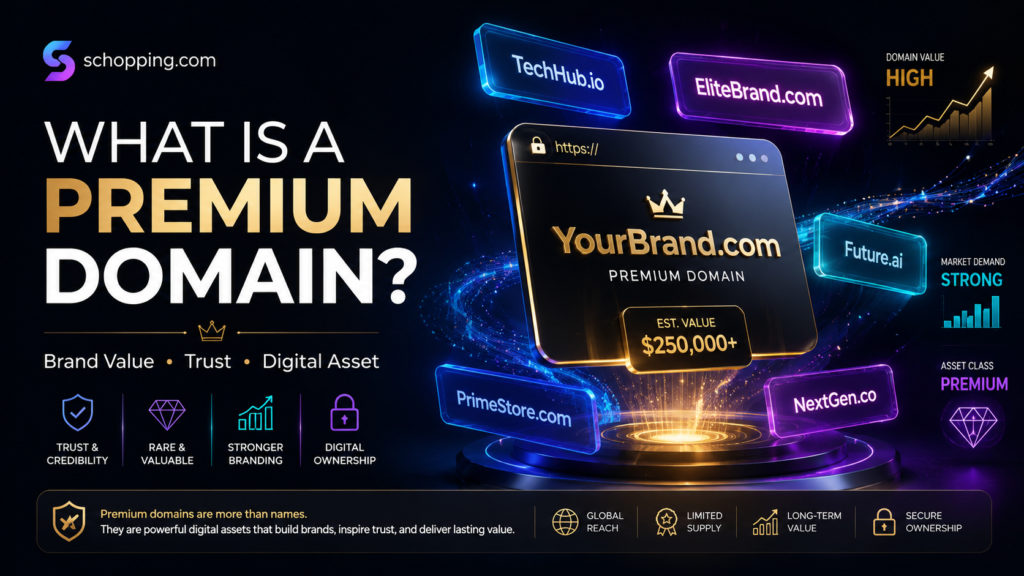
A premium domain is not just a web address with a higher price tag. It is a digital identity asset with unusual commercial strength: short, memorable, brandable, trustworthy, easy to say, easy to type, and often connected to a valuable market category. On Schopping, premium domains are treated as part of the larger digital asset economy because the right name can shape perception before a person ever sees the homepage.
In a crowded online market, a domain name is often the first business signal. It can make a company feel established, reduce friction in advertising, improve recall, support direct traffic, and give a founder or operator a cleaner foundation for brand growth. A weak name makes people work harder. A premium name does the opposite. It feels obvious, natural, and already familiar.
This guide explains what a premium domain is, who needs one, how premium domain value works, how it compares with a regular domain, what benefits it can create, and why premium domains are becoming more important as digital brands, authority websites, ecommerce platforms, software products, creator businesses, and online service companies compete for attention.
Quick Picks
Use this quick navigation menu to move directly to the part of the guide that matches your question.
| Section | What You’ll Learn |
|---|---|
| What Is a Premium Domain? | The clear definition and core meaning |
| Premium Domain vs Regular Domain | The practical difference between ordinary names and valuable names |
| Who Needs a Premium Domain? | Which founders, brands, investors, and operators benefit most |
| Value & Benefits | Why premium domains can create business leverage |
| What Makes a Domain Premium? | The traits that increase domain value |
| The Premium Domain Value Framework | A practical scoring method for evaluating a name |
| Types of Premium Domains | Exact-match, brandable, short, category, geo, and extension-based names |
| How Premium Domains Support SEO | What domains can and cannot do for organic search |
| C.L.E.A.R Test | 5-part simple way to evaluate domains |
| How to Evaluate Premium Domains for Sale | What to check before acquiring a name |
| Upcoming Trends in the Domain Industry | Where the market is moving next |
| Common Mistakes | Errors that weaken judgment |
| FAQs | Detailed answers to common questions |
| Editorial Insights | Strategic perspective on premium domain value |
What Is a Premium Domain?
A premium domain is a domain name that carries higher-than-average value because of its branding power, commercial meaning, rarity, search relevance, memorability, trust signal, or resale potential.
A regular domain may simply be available for registration. A premium domain usually has something stronger: it feels like a natural brand, category, product, service, marketplace, media property, or authority destination.
Examples of premium domain traits include:
- Short length
- Clear spelling
- Strong commercial keyword
- Easy pronunciation
- High brand recall
- Clean extension, especially .com
- Category ownership potential
- Natural fit for a business model
- Low confusion risk
- Strong visual identity potential
- Trustworthy appearance in ads, emails, and search results
A premium domain can be a one-word name, a two-word phrase, a category-defining term, a brandable invented word, an exact-match commercial phrase, a short acronym, or a highly relevant domain in an emerging industry.
The simplest way to understand it is this:
A normal domain gives a website a location.
A premium domain gives a business a stronger identity.
That difference matters because online trust is formed quickly. A person may not consciously analyze a domain name, but the name still affects whether the website feels legitimate, memorable, specialized, and worth clicking.
For anyone studying Premium Domain opportunities, the real question is not only “Is this name available?” The deeper question is: “Can this name carry a serious brand, attract attention, and hold value over time?”
Premium Domain vs Regular Domain
The difference between a premium domain and a regular domain is not always technical. Both can point to a website. Both can host email. Both can be connected to a business. The difference is strategic value.
A regular domain is usually chosen because it is available. A premium domain is valuable because it is desirable.
| Factor | Regular Domain | Premium Domain |
|---|---|---|
| Availability | Often hand-registered at standard cost | Often already owned, listed, brokered, or priced higher |
| Brand strength | May feel average or improvised | Feels polished, memorable, and market-ready |
| Length | Often longer or less direct | Usually shorter, cleaner, or more powerful |
| Trust signal | Depends heavily on design and content | Creates early credibility before the page loads |
| Marketing use | May require more explanation | Easier to use in ads, pitches, packaging, and email |
| Resale potential | Usually limited | Can appreciate if category demand rises |
| Recall | Easy to forget if generic or awkward | Easier to remember and repeat |
| Commercial meaning | May be vague | Often connected to a business category, product, or strong brand idea |
| Strategic role | Website address | Brand asset |
A premium domain does not automatically create a successful business. It is not a shortcut around product quality, content depth, customer trust, or execution. But it can reduce friction. It can make everything around the business cleaner: the name, the pitch, the advertising, the email address, the search result, the social handle strategy, and the long-term brand story.
A regular domain often says, “This was available.”
A premium domain often says, “This was chosen carefully.”
That distinction can be worth a great deal in competitive digital markets.
Who Needs a Premium Domain?
Not every project needs a premium domain. A local hobby blog, private portfolio, or early experiment may be fine with a simple available name. But for commercial websites, authority brands, serious ecommerce concepts, marketplaces, software platforms, affiliate projects, media properties, and category-specific ventures, a premium domain can be a serious advantage.
To gain exclusive assess to ultra premium domain names, explore our guide to Atom Premium Domains.
1. Founders Building a Serious Brand
A founder launching a startup, ecommerce store, SaaS product, newsletter, marketplace, or service business needs a name that can survive growth. Many early names feel acceptable at the start but become limiting later.
A premium domain helps a founder avoid three common problems:
- The name is too long to remember
- The domain looks less trustworthy than competitors
- The brand feels smaller than the market it wants to enter
A strong name gives a founder confidence in outreach, investor conversations, landing pages, product packaging, email signatures, and paid campaigns.
2. Companies Entering Competitive Markets
In markets like finance, health, ecommerce, software, travel, education, real estate, creator tools, and digital services, perception matters immediately. A company using a weak domain may appear temporary, even when the product is strong.
A premium domain can help a company look established from day one. That does not replace proof, but it strengthens the first impression.
3. Authority Website Operators
An authority website depends on trust, topical focus, and repeat recognition. A premium domain can make the website easier to position as a serious information destination.
For example, a domain that clearly signals a niche can help readers understand the site’s purpose before reading a single article. That is valuable for editorial brands, review websites, comparison hubs, educational portals, and affiliate publishing businesses.
4. Ecommerce and Marketplace Builders
An ecommerce website needs a name that people can type, remember, and trust with payment details. A domain that sounds like a real brand can make the store feel less disposable.
A premium domain can also support product expansion. A narrow name may trap the store inside one small category. A stronger name may allow wider growth.
5. Investors and Digital Asset Holders
Some individuals acquire premium domains because they believe the name itself has long-term value. Like land in a valuable location, a domain can become more desirable as the category grows.
The logic is simple: there is only one exact domain at one extension. If the phrase, industry, or brand concept becomes more commercially important, demand can rise while supply remains fixed.
6. Agencies, Consultants, and Service Providers
An agency or consultant with a premium domain can appear more focused and authoritative. This matters in service categories where trust is difficult to earn and many competitors look similar.
A clear domain can make proposals, cold outreach, ads, and referrals stronger because the name is easier to remember and repeat.
7. Businesses Planning a Rebrand
A rebrand is not just a design change. It is often a repositioning exercise. A company may outgrow a long, awkward, local, confusing, or dated name.
A premium domain can become the center of a cleaner brand architecture.
Value and Benefits of a Premium Domain
A premium domain has value because it can influence attention, trust, memory, positioning, conversion, and optionality. These benefits are not abstract. They affect how people behave.
1. Instant Brand Credibility
A strong domain can make a business feel more legitimate before the website is evaluated. This is especially important when a person sees the domain in:
- Search results
- Ads
- Email addresses
- Social profiles
- Podcasts
- Product packaging
- Business cards
- Investor decks
- Marketplace listings
A premium domain can create a quiet authority signal. It tells the visitor that the brand took itself seriously enough to secure a strong identity.
2. Higher Recall and Word-of-Mouth Potential
A domain that is short, intuitive, and easy to pronounce is easier to remember. This matters because not all traffic comes from clicking links.
Some people hear a brand name in conversation. Some see it briefly in a video. Some remember it later after reading an article. Some type it directly into a browser.
If the name is difficult, the business loses invisible opportunities. If the name is clear, memory works in its favor.
3. Better Advertising Efficiency
Paid advertising is expensive because every click has a cost. A stronger domain can support ad performance in subtle ways.
A clean domain may improve:
- Click confidence
- Brand recognition
- Landing page trust
- Repeat visits
- Direct search behavior
- Email response rates
The domain is not the whole campaign, but it is part of the signal. A person is more likely to click a name that feels relevant and trustworthy.
4. Category Positioning
Some premium domains allow a business to sound like a category leader rather than a participant. This is especially true for exact-match, category, and authority-style names.
A domain like this can frame the brand as a destination. It tells the market, “This is where this topic lives.”
That positioning is difficult to buy later once the category becomes crowded.
5. Long-Term Asset Value
A premium domain can remain valuable even if the first business model changes. A website design may become outdated. A product line may shift. A content strategy may change. But a strong domain can continue to hold strategic value.
This is why premium domains are often discussed inside the broader world of Premium Domains and digital assets. They are not just marketing tools. They can be owned, held, developed, leased, redirected, sold, or used as the foundation of a larger brand.
6. Cleaner Email and Outreach Identity
A premium domain also affects email credibility. A business email from a strong domain can feel more professional than one from a long, awkward, or low-trust name.
For outreach, partnerships, PR, hiring, supplier relationships, and enterprise conversations, the email domain matters. It is part of the first impression.
7. Strategic Optionality
A premium domain creates options. It can be used for:
- A main business
- A media brand
- A lead-generation property
- A product line
- A newsletter
- A marketplace
- A comparison website
- A redirect to a parent company
- A future acquisition target
- A brand protection asset
Optionality is one reason strong domains retain value. The name may be useful to more than one type of operator.
What Makes a Domain Premium?
A domain becomes premium when several value signals come together. One trait alone may not be enough. A domain can be short but meaningless. It can contain a keyword but sound awkward. It can be brandable but hard to spell. It can be exact-match but trapped in a weak extension.
The strongest premium domains balance multiple strengths.
1. Shortness
Short domains are valuable because they reduce friction. They are easier to type, easier to say, easier to remember, easier to design around, and easier to place on marketing assets.
Shortness does not mean the shortest name is always best. A clear two-word domain can outperform a confusing four-letter acronym. But all else equal, compact names are usually stronger.
2. Memorability
A premium domain sticks in the mind. It has rhythm, clarity, or meaning. It does not require repeated explanation.
Memorability comes from:
- Familiar words
- Clean spelling
- Strong sound
- Natural phrase structure
- Clear category relevance
- Visual simplicity
- Low confusion with other brands
If someone hears the name once and can type it later, the domain has memory power.
3. Brandability
Brandable domain names do not merely describe a business. They can become a business identity.
A brandable domain may be invented, suggestive, metaphorical, compact, or category-adjacent. The best brandable domains leave room for expansion while still feeling meaningful.
A strong brandable domain should pass the “radio test”: if someone hears it spoken aloud, can they spell it correctly without confusion?
4. Commercial Intent
Some words have more economic weight than others. Domains connected to high-value categories usually carry more value because the business opportunity behind them is larger.
Commercial intent may be connected to:
- Finance
- Insurance
- Health
- Ecommerce
- Software
- Legal services
- Real estate
- Education
- Travel
- Luxury goods
- Technology
- B2B services
- Professional tools
A premium domain often sits near money. It may describe a product, service, market, problem, or desire that people actively spend on.
5. Extension Strength
The extension matters. A .com domain remains the most widely recognized global commercial extension. For many businesses, it still carries the strongest trust signal.
That said, premium names can exist in other extensions when the extension fits the category. For example, certain technology, artificial intelligence, creator, local, or industry-specific extensions may have value when used strategically.
Still, extension quality must be judged carefully. A strong word in a weak extension may not outperform a good .com name.
6. Clean History
A domain’s past can affect its future. A premium domain should ideally have a clean history with no serious spam, trademark conflict, malware, deceptive use, or reputation damage.
Before acquiring a premium domain, it is wise to review:
- Historical website snapshots
- Indexing status
- Backlink profile
- Brand conflicts
- Trademark risk
- Prior use cases
- Email reputation signals
- Search engine visibility
A beautiful name with a damaged history may require repair work.
7. Market Relevance
A domain is more valuable when it connects to an active or growing market. Timing matters. A domain tied to a rising industry can become more important as demand increases.
Examples include categories around:
- Artificial intelligence
- Senior care
- Telemedicine
- Creator tools
- Remote work
- Ecommerce infrastructure
- Digital assets
- Wellness technology
- Financial education
- Cybersecurity
- Energy storage
- Robotics
- Longevity
- Niche marketplaces
A premium domain is strongest when it is not only good today, but also positioned for where demand is moving.
The Premium Domain Value Framework
A premium domain should not be judged emotionally alone. A name may feel attractive, but value comes from how well it performs across practical business dimensions.
Use this framework to evaluate a domain before treating it as premium.
| Scoring Area | What to Ask | Why It Matters |
|---|---|---|
| Clarity | Does the name make sense immediately? | Clear names reduce explanation cost |
| Memory | Can someone remember it after hearing it once? | Recall supports direct traffic and referrals |
| Commercial relevance | Is the name tied to a valuable market? | Strong markets create stronger demand |
| Brand flexibility | Can the name support expansion? | Flexible names survive business evolution |
| Extension strength | Is the extension trusted for the use case? | Trust affects perception and conversion |
| Spelling ease | Can people spell it without help? | Spelling friction loses traffic |
| Length | Is the name concise? | Short names are easier to use everywhere |
| Distinctiveness | Does it stand apart from competitors? | Distinction improves brand ownership |
| Legal safety | Is trademark risk low? | Legal conflict can destroy value |
| History | Is the domain reputation clean? | Past abuse can create future problems |
| Monetization fit | Can the domain support a real business model? | Value depends on commercial usefulness |
| Exit potential | Would another company want it later? | Resale demand supports asset value |
The 5-Part Premium Domain Test
A simple way to evaluate a domain is the C.L.E.A.R. test
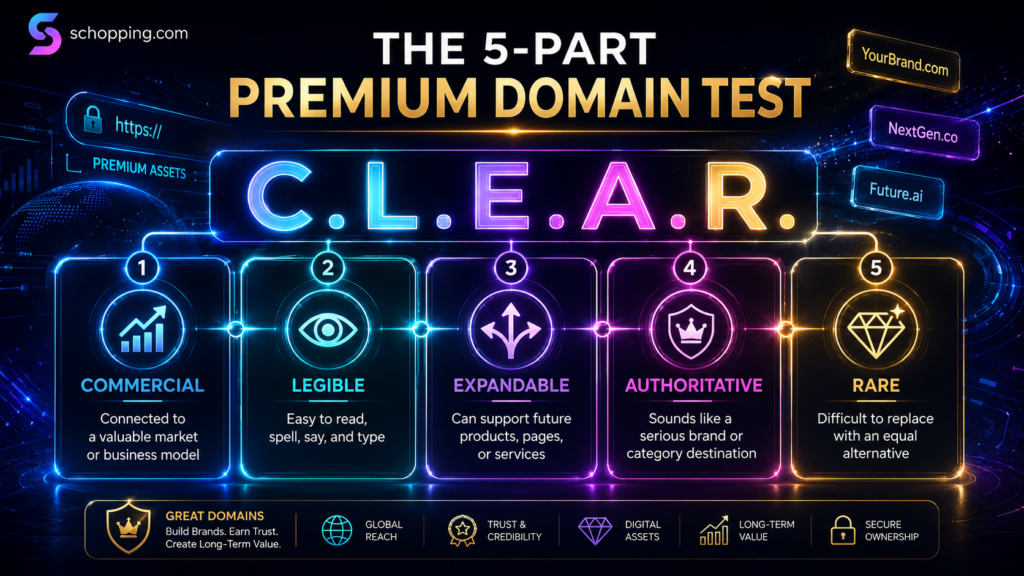
| Letter | Meaning | Evaluation Question |
|---|---|---|
| C | Commercial | Is the domain connected to a valuable market or business model? |
| L | Legible | Is it easy to read, spell, say, and type? |
| E | Expandable | Can it support future products, pages, or services? |
| A | Authoritative | Does it sound like a serious brand or category destination? |
| R | Rare | Is the name difficult to replace with an equal alternative? |
A domain that scores well across all five areas is more likely to deserve premium treatment.
Types of Premium Domains
Premium domains are not all valuable for the same reason. Different names carry different kinds of strategic power.
1. Exact-Match Premium Domains
An exact-match premium domain uses a phrase that directly matches a product, service, or search intent.
Examples of exact-match structures include:
- Best + product category
- Product + reviews
- Service + location
- Problem + solution
- Category + guide
- Industry + marketplace
Exact-match domains can be useful for editorial websites, affiliate properties, comparison pages, lead-generation websites, and niche authority brands.
The benefit is clarity. The limitation is flexibility. A narrow exact-match domain may be powerful inside one topic but restrictive if the brand expands too far.
2. Brandable Premium Domains
Brandable domain names are valuable because they sound like real companies. They may not contain a direct keyword, but they have naming strength.
A brandable premium domain may be:
- Short
- Invented
- Smooth-sounding
- Visually clean
- Emotionally suggestive
- Easy to say
- Distinct from competitors
Brandable names often work well for startups, product companies, apps, marketplaces, and consumer brands.
3. Category Premium Domains
A category domain describes an entire market rather than one small product.
These domains can become valuable because they allow a business to own a broad topic. A category domain can support a media hub, ecommerce platform, review center, marketplace, or educational brand.
Category domains are powerful when the market is large enough and the name is broad enough to hold authority.
4. Short Acronym Domains
Short acronym domains can be valuable when they are extremely rare, pronounceable, or connected to multiple possible meanings.
Three-letter and four-letter domains can be desirable because many organizations use initials. However, not all acronyms are equal. Pronounceability, letter quality, extension, and use-case flexibility all matter.
5. Geo Premium Domains
A geo premium domain includes a city, country, region, or local market term. These names can be valuable for service businesses, directories, tourism, real estate, local healthcare, logistics, and marketplaces.
Geo domains work best when the location has strong commercial demand and the domain clearly matches a service or category.
6. Industry-Specific Premium Domains
Some names are valuable because they match an emerging industry. These can include technology, health, finance, education, energy, creator economy, digital infrastructure, and specialized B2B categories.
The risk is timing. Emerging industries can grow quickly, but some trends fade. A premium industry domain should be judged by durable demand, not hype alone.
How Premium Domains Support SEO
A premium domain does not guarantee rankings. Search engines do not reward a domain simply because it was expensive. A weak website on a premium domain can still fail.
However, premium domains can support SEO indirectly in meaningful ways.
1. Better Click Confidence
A clear, trustworthy domain can improve how people respond to search results. If two results appear similar, the name can influence which one feels safer or more relevant.
2. Stronger Topical Positioning
A category-relevant domain can help visitors immediately understand what the website covers. This can support brand clarity, navigation expectations, and topical trust.
3. Easier Link Attraction
People are more likely to reference a website that sounds authoritative, clean, and useful. A strong domain can make outreach and natural citation easier, especially if the content quality is high.
4. More Direct Search Behavior
If people remember the domain, they may search for the brand name directly later. Brand search behavior can become a sign of market recognition.
5. Cleaner Internal Brand Architecture
A premium domain gives the website a stronger center. This helps when organizing categories, guides, reviews, tools, product pages, and editorial sections.
What a Premium Domain Cannot Do Alone
A premium domain cannot replace:
- Helpful content
- Technical SEO
- Strong internal linking
- Fast page experience
- Original insights
- Product quality
- Clear monetization
- Trust pages
- Brand consistency
- User satisfaction
The domain opens the door. The website must earn the room.
How to Evaluate Premium Domains for Sale
When reviewing premium domains for sale, the goal is not to find the flashiest name. The goal is to find the name with the strongest fit for the intended business model.
1. Define the Use Case First
Before evaluating a domain, define what it needs to do.
Ask:
- Is this for a brand, media property, ecommerce store, lead-generation site, marketplace, SaaS product, or investment hold?
- Does the name need to be narrow or expandable?
- Is search intent important?
- Does the brand need to sound premium, technical, friendly, clinical, luxury, or practical?
- Will the domain be spoken aloud often?
- Will it be used in paid ads?
- Will it appear in email outreach?
The same domain can be excellent for one use case and poor for another.
2. Check Name Friction
Name friction is anything that makes the domain harder to use.
Common friction points include:
- Hyphens
- Numbers
- Strange spellings
- Awkward plurals
- Confusing pronunciation
- Multiple possible spellings
- Overly long phrases
- Unclear meaning
- Extension mismatch
- Trademark risk
A premium domain should remove friction, not create it.
3. Study Comparable Names
Comparable analysis helps determine whether a domain is genuinely valuable or merely expensive. Look at similar names in the same category, extension, length, and commercial intent.
A strong comparison looks at:
- Similar word count
- Similar extension
- Similar industry
- Similar search intent
- Similar brand use case
- Similar sale history where available
- Similar development potential
The goal is not to copy market pricing blindly. The goal is to understand relative strength.
4. Estimate Business Utility
A premium domain should be judged by what it can help build.
Ask:
- Could this name support a serious homepage?
- Could it become a newsletter, marketplace, or authority site?
- Would it look credible in an email address?
- Would it be easy to mention in a podcast or video?
- Could it appear on packaging?
- Would another company in the same category want it later?
- Does it reduce marketing explanation?
A name with clear business utility deserves more attention than a name that only looks clever.
5. Check Legal and Reputation Risk
A domain can look premium but still be risky. Always consider legal and history-related issues.
Review:
- Trademark conflicts
- Prior website use
- Spam history
- Blacklist issues
- Backlink quality
- Existing brand confusion
- Social handle conflicts
- Email deliverability concerns
A domain that creates legal uncertainty may be less valuable than it appears.
6. Evaluate Price Against Opportunity
Premium domain pricing should be considered in relation to opportunity.
A $5,000 domain may be expensive for a hobby project but inexpensive for a serious ecommerce brand. A $50,000 domain may seem high, but if it improves brand positioning, advertising efficiency, investor perception, and future resale value, it may be rational for the right company.
The better question is not “Is this domain cheap?”
The better question is “Does this domain create more strategic value than it costs?”
Premium Domain Value by Business Model
Different business models extract value from premium domains in different ways.
| Business Model | Premium Domain Advantage | Main Value Driver |
|---|---|---|
| Ecommerce store | Trust, recall, product positioning | Conversion and repeat visits |
| Authority website | Topical clarity and editorial credibility | Search visibility and loyal readership |
| SaaS platform | Brand confidence and investor-ready identity | Adoption and positioning |
| Marketplace | Category authority | Network trust |
| Affiliate website | Higher perceived expertise | Click confidence and content trust |
| Lead-generation site | Trust and local/category relevance | Form submissions and inquiries |
| Newsletter | Memory and shareability | Subscriber growth |
| Consulting agency | Professional impression | Outreach response and referrals |
| Product brand | Packaging and word-of-mouth | Brand equity |
| Domain investment | Scarcity and future demand | Resale or leasing potential |
This is why a premium domain should never be evaluated in isolation. Its value depends on the business engine attached to it.
The Psychology Behind Premium Domains
Premium domains work because people make quick judgments online. They judge names before they judge content. They judge trust before they read policies. They judge clarity before they compare features.
A premium domain can create four psychological effects.
1. Familiarity
A clean domain feels easier to trust because it looks natural. People are more comfortable with names that feel familiar, even if they are seeing them for the first time.
2. Authority
A category-defining domain can create the impression that the website belongs in the space. It sounds less like an outsider and more like a destination.
3. Simplicity
Simple names reduce mental effort. When the name is easy, the visitor can focus on the offer.
4. Confidence
A strong domain suggests investment. It signals that the project is not casual, temporary, or careless.
These effects are subtle, but in competitive markets, subtle advantages compound.
Premium Domains as Digital Assets
A premium domain can be understood as a digital asset because it has ownership, scarcity, utility, and transferability.
Unlike a social media handle, a domain is not fully dependent on one platform’s rules. Unlike an ad campaign, it does not disappear after the budget ends. Unlike a logo, it can carry direct navigation value. Unlike a website design, it can remain useful across many redesigns.
A premium domain can be:
- Developed into a business
- Parked for future use
- Redirected to an existing brand
- Used for a product launch
- Held as a strategic asset
- Sold to another operator
- Leased in some cases
- Used defensively to protect a brand
This is why domain strategy belongs inside digital asset planning. A name is not only a label. It can become the container for future value.
Premium Domain vs Brandable Domain Names
A brandable domain can be premium, but not every premium domain is brandable in the same way.
| Type | Description | Best Use |
|---|---|---|
| Premium domain | Any domain with higher-than-average commercial, branding, or asset value | Broad use across business models |
| Brandable domain | A domain that can become a distinctive brand identity | Startups, products, ecommerce, apps |
| Exact-match domain | A domain matching a search phrase or category | Authority sites, lead generation, affiliate pages |
| Category domain | A domain that names a broad market | Marketplaces, media brands, comparison hubs |
| Short domain | A compact name, acronym, or rare word | Enterprise brands, investors, rebrands |
A brandable domain is about identity. An exact-match domain is about clarity. A category domain is about authority. A short domain is about scarcity.
The best premium domains often combine two or more of these strengths.
Upcoming Trends in the Domain Industry
The domain industry is changing because the internet itself is changing. Search behavior, brand discovery, artificial intelligence, creator commerce, cybersecurity, and global entrepreneurship are all reshaping what makes a domain valuable.
1. Stronger Demand for Category Ownership
As more markets become crowded, companies want names that feel authoritative. Category-level domains can help a brand appear more established and easier to understand.
In competitive markets, a domain that clearly owns a topic can be more valuable than a vague brand name.
Explore our Authority Brands section, where you will find websites like Telegeriatric.com and Geronutrition.com, as ready to launch brands.
2. Continued Strength of .com
Alternative extensions continue to grow, but .com remains deeply trusted in global commerce. For many businesses, especially those seeking international credibility, .com still provides the cleanest default.
A non-.com domain can work when the extension supports the brand logic, but .com remains the benchmark.
3. Rise of AI-Related Domains
Artificial intelligence has increased demand for domains connected to automation, agents, data, models, copilots, workflow tools, and machine intelligence. Some .ai names have become especially desirable.
However, not every AI-related domain is valuable. The best names are not only trendy; they are commercially usable.
4. More Value in Trust-Centric Names
As scams, phishing, fake stores, and impersonation risks grow, trust will become a stronger part of domain value. Names that look professional, clean, and credible may matter more as people become cautious online.
A domain that feels safe can support conversion in ways that are difficult to measure directly.
5. Growth of Niche Authority Brands
The internet is moving toward specialized expertise. Instead of broad general websites, many successful digital properties focus on a narrow but valuable niche.
This creates demand for domains that can support authority pages, comparison centers, product review hubs, and educational destinations.
6. Premium Domains as Acquisition Assets
Companies may increasingly acquire developed websites and domain-based brands instead of starting from zero. A strong domain with content, traffic, trust pages, and monetization potential may be viewed as a packaged digital asset.
7. More Emphasis on Domain Security
Domain ownership is becoming a security issue, not just a branding issue. A compromised domain can disrupt email, website access, customer trust, and business operations.
Premium domain owners should use stronger security practices, including registrar lock, two-factor authentication, reliable registrar selection, clean DNS management, and renewal monitoring.
8. Shorter Names for Mobile and Voice Behavior
As people search, speak, and type across mobile devices, wearables, cars, smart speakers, and voice interfaces, simple names gain more practical value.
A domain that is easy to say and spell will continue to outperform names that require explanation.
Common Mistakes When Evaluating Premium Domains
Premium domain evaluation requires discipline. The most common mistakes come from emotional reactions, hype, or incomplete research.
Mistake 1: Assuming Expensive Means Premium
A domain can be overpriced without being premium. Price is a claim. Value requires evidence.
Always evaluate the name’s clarity, market relevance, extension, brandability, and business use case.
Mistake 2: Ignoring Extension Fit
A strong phrase in a weak or mismatched extension may not carry the expected trust. Extension fit matters, especially for serious commercial websites.
Mistake 3: Choosing Clever Over Clear
Clever names can be memorable, but they can also confuse people. A premium domain should make the business easier to understand, not harder.
Mistake 4: Overvaluing Search Keywords Alone
A keyword domain can be valuable, but only if it also works as a brand, destination, or commercial asset. Search terms alone do not guarantee authority.
Mistake 5: Forgetting Legal Risk
A name that overlaps with an existing trademark can become a liability. Legal clarity is part of domain value.
Mistake 6: Ignoring the Business Model
A premium domain needs a use case. Without a business model, even a good name may sit unused.
Mistake 7: Buying for Hype Instead of Durability
Trends can create opportunity, but durable value comes from long-term demand. A premium domain should be able to survive beyond one news cycle.
Practical Checklist Before Acquiring a Premium Domain
Use this checklist before committing to a premium domain.
Use this simple checklist to judge whether a premium domain has real business value, brand strength, long-term flexibility, and enough trust potential to support a serious digital asset.
- ✓ Is the name easy to say aloud? Supports referrals, podcasts, videos, sales calls, and word-of-mouth discovery.
- ✓ Is it easy to spell? Reduces lost traffic, typing mistakes, and confusion when people search for the brand later.
- ✓ Is the extension appropriate? Affects trust, credibility, memorability, and how serious the domain feels in its market.
- ✓ Does it match the intended business model? Prevents strategic mismatch between the domain name, offer, audience, and monetization plan.
- ✓ Is the market commercially valuable? Supports future demand, advertising potential, partnerships, resale interest, and brand growth.
- ✓ Can the brand expand? Avoids early limitations if the website later adds products, services, guides, or new categories.
- ✓ Is there trademark risk? Protects the project from legal problems, forced rebranding, domain disputes, and reputation damage.
- ✓ Is the domain history clean? Prevents reputation issues from spam history, low-quality backlinks, malware use, or past abuse.
- ✓ Does it look credible in an email address? Supports outreach, partnerships, supplier conversations, investor contact, and professional communication.
- ✓ Would another company want it later? Indicates resale potential, strategic demand, and long-term digital asset strength.
- ✓ Does the price make sense relative to opportunity? Keeps the acquisition rational by comparing cost against brand value, market size, and future upside.
- ✓ Can the name support content, products, or services? Connects the domain identity to real execution, not just naming appeal.
A premium domain should pass both the emotional test and the business test. It should feel strong and make strategic sense.
How a Premium Domain Creates Compounding Value
The value of a premium domain often grows through compounding. The name gives the project a stronger start. Better perception supports more clicks. More clicks support more engagement. Better engagement supports more trust. More trust supports more links, mentions, subscribers, or sales. Over time, the domain becomes more than a name. It becomes the address of accumulated reputation.
This is why premium domains can become difficult to replace after a brand grows.
Changing domains later can create:
- SEO migration risk
- Brand confusion
- Email disruption
- Lost backlinks
- Lost direct traffic
- Customer uncertainty
- Design and packaging costs
- Legal and operational complexity
A strong domain chosen early can prevent expensive rebranding later.
When a Premium Domain Is Worth Paying More For
A premium domain may be worth paying more for when it improves the economics or strategic position of the project.
It is especially worth considering when:
- The website is commercial
- The category is competitive
- Trust affects conversion
- The brand will run ads
- The name will appear in outreach
- The business needs investor or partner credibility
- The domain can support long-term expansion
- The name is rare and difficult to replace
- The category is growing
- The domain could retain resale value
It may not be worth paying more when the project is temporary, experimental, non-commercial, highly uncertain, or unlikely to benefit from brand strength.
A premium domain is not a vanity purchase when it reduces friction across the entire business. But it becomes vanity when the name is acquired without a clear strategy.
Editorial Comparison: Premium Domain vs Naming From Scratch
Some people assume they should always invent a new name because it costs less. That can work. Many strong brands are built on invented names. But naming from scratch has hidden costs.
| Option | Advantages | Trade-Offs |
|---|---|---|
| Hand-registering a new domain | Low cost, easy to start | Often longer, less trusted, harder to remember |
| Inventing a brandable name | Flexible, unique, creative | May require more education and marketing |
| Acquiring a premium domain | Stronger identity, trust, recall, asset value | Higher upfront cost |
| Using a niche exact-match domain | Clear search and topic relevance | May limit expansion |
| Using an alternative extension | More availability, sometimes modern | May lose trust or traffic to .com version |
The right choice depends on ambition. A small test project can begin with a modest name. A serious digital property deserves a stronger identity from the start.
FAQs About Premium Domains
What is a premium domain in simple terms?
A premium domain is a web address with higher-than-normal value because it is short, memorable, brandable, commercially relevant, or tied to a valuable keyword or market. It is often already owned, priced above standard registration cost, or listed through a marketplace, broker, registrar, or private owner.
The value comes from practical business advantages. A premium domain can make a website easier to trust, easier to remember, easier to advertise, and easier to position as a serious brand. It does not guarantee success, but it can give a business a cleaner and stronger foundation.
Why are premium domains for sale so expensive?
Premium domains for sale can be expensive because supply is limited and demand can be high. There is only one exact version of a domain at a specific extension. If many companies, founders, investors, or website operators could benefit from the same name, the price rises.
The price may reflect short length, .com extension, commercial keyword value, brandability, prior inquiries, comparable sales, category demand, or future resale potential. A premium domain is often priced like a strategic asset rather than a standard registration.
Is a premium domain good for SEO?
A premium domain can support SEO indirectly, but it does not guarantee rankings. Search engines reward helpful content, technical quality, authority, relevance, user satisfaction, and trust signals. A premium domain can help by improving brand recall, click confidence, link attraction, and topical clarity.
For example, a clear category domain may help people understand the website’s focus quickly. A memorable brand name may increase direct searches. But the website still needs strong content, internal linking, page speed, structured navigation, and genuine usefulness.
What is the difference between a premium domain and a brandable domain name?
A premium domain is any domain with above-average strategic or commercial value. A brandable domain name is a domain that can become a distinctive brand identity. Many brandable names are premium, but some premium domains are valuable because of keywords, category relevance, shortness, or exact-match intent rather than pure branding.
A brandable name is often best for startups, apps, ecommerce brands, and product companies. A keyword or category premium domain may be better for authority websites, comparison pages, lead-generation projects, and niche commercial hubs.
Should a new business invest in a premium domain?
A new business should consider a premium domain when the name will affect trust, advertising, partnerships, conversion, or long-term brand value. If the business is serious, commercially focused, and operating in a competitive category, a premium domain can reduce friction and prevent future rebranding problems.
However, a premium domain should match the business model. A strong name without execution is still only a name. The best decision combines brand ambition, market size, budget, legal clarity, and realistic growth plans.
People Also Ask About Premium Domains
What makes a domain name valuable in 2026?
A domain name becomes valuable when it combines scarcity, clarity, trust, commercial relevance, and brand potential. In 2026, value is increasingly shaped by short names, strong .com identity, category ownership, AI-related demand, security awareness, niche authority brands, and names that work well across search, social, email, and mobile behavior.
The best domains are not just trendy. They are durable. They can support a real business, survive market changes, and remain useful even if the first business model evolves.
Are premium domains only for large companies?
No. Premium domains are useful for large companies, but they can also benefit solo founders, small teams, investors, ecommerce operators, consultants, affiliate publishers, newsletter owners, and niche authority website builders.
The key is not company size. The key is whether the domain meaningfully improves trust, recall, positioning, or business opportunity. A small operator in a valuable niche may benefit greatly from a strong domain because the name helps the project look serious from the beginning.
How do I know if a premium domain is overpriced?
A premium domain may be overpriced if the name is hard to spell, too long, legally risky, extension-weakened, commercially vague, historically damaged, or poorly matched to the intended use case. Price should be compared with similar names, market size, business utility, extension strength, and realistic monetization potential.
A good premium domain price should make sense in relation to the opportunity it creates. If the name does not improve trust, recall, positioning, or future optionality, the price may be difficult to justify.
Can a premium domain increase conversion rates?
A premium domain can help conversion by improving trust and reducing hesitation. A person may feel more comfortable clicking, subscribing, contacting, or purchasing from a website with a clean and credible domain. This is especially important in categories involving money, health, technology, education, marketplaces, reviews, and ecommerce.
That said, conversion also depends on the offer, design, speed, copy, pricing, reviews, guarantees, and user experience. The domain creates the first signal. The page must complete the trust journey.
Is a .com premium domain better than other extensions?
A .com premium domain is often stronger for global commercial use because .com remains widely recognized, easy to remember, and trusted by mainstream audiences. Many people still assume a serious business owns the .com version of its name.
Other extensions can work when they fit the category, audience, or brand logic. Technology, artificial intelligence, local, nonprofit, and industry-specific projects may use alternative extensions effectively. But when trust, resale value, and broad recognition matter, .com usually remains the strongest default.
Editorial Insights
A premium domain is not magic. It will not write the content, build the product, close the sale, or earn trust by itself. But it can give a serious project a stronger starting point and a stronger long-term identity.
The true value of a premium domain lies in what it removes: doubt, confusion, friction, forgetfulness, awkwardness, and weak positioning. The best names feel simple because the strategy behind them is strong. They make the business easier to understand, easier to remember, and easier to take seriously.
As digital markets become more crowded, names will matter more, not less. A brand may compete with thousands of search results, social posts, marketplaces, newsletters, and automated content streams. In that environment, a premium domain becomes a signal of clarity.
For anyone building a digital business, media property, ecommerce brand, authority website, or long-term online asset, the right domain is not just a web address. It is the front door of the brand, the anchor of trust, and sometimes the most durable asset the project owns.
To explore more digital asset opportunities and brand-building ideas, return to Schopping and study how premium names, authority websites, and online business assets can work together inside a stronger ownership strategy.