
Updated on July, 2026.
The Black Hornet 4 is not a consumer drone, a creator drone, or a recreational quadcopter. It belongs to a far more specialized category of UAS technology: the soldier-borne nano drone. Designed for elite military units, tactical teams, reconnaissance operators, and security forces, the Black Hornet 4 represents one of the most advanced examples of how small unmanned aerial systems can change decision-making at ground level.
At Schopping.com, we usually examine drones through the lens of buyer intent, imaging capability, portability, and real-world usefulness. The Black Hornet 4 demands a different kind of analysis. This is not a drone built for cinematic travel footage or social media content. It is built for information dominance. In modern tactical environments, the ability to see around a corner, beyond a wall, over a ridgeline, through a compound, or across a dangerous approach can mean the difference between confident movement and blind exposure.
For readers exploring advanced nano drones, the Black Hornet 4 is a reminder that drone technology exists on a broad spectrum. At one end are content creation tools: camera drones, FPV drones, travel drones, and aerial photography systems. At the other end are mission-specific platforms built for defense, intelligence, surveillance, reconnaissance, search, rescue, and public safety. The Black Hornet 4 sits firmly in that second category. It is not designed to make footage beautiful; it is designed to make uncertainty visible.
This comprehensive review provides an in-depth analysis of the Black Hornet 4, the latest evolution in nano drone UAS technology from Teledyne FLIR Defense. Often referred to as the BH4, this ultra-light reconnaissance system builds on the legacy of the Black Hornet 3 while addressing the harsher realities of modern field operations: contested environments, GPS-denied movement, poor weather, low visibility, urban warfare, concealed threats, and the constant need for immediate situational awareness.
In the high-stakes world of modern warfare and covert operations, information is the most valuable currency. A soldier, squad leader, or tactical operator does not always need a large drone in the sky. Sometimes the most valuable aircraft is the one that can be carried on the body, launched quickly, heard by almost no one, seen by almost no one, and flown close enough to provide useful intelligence without exposing the operator.
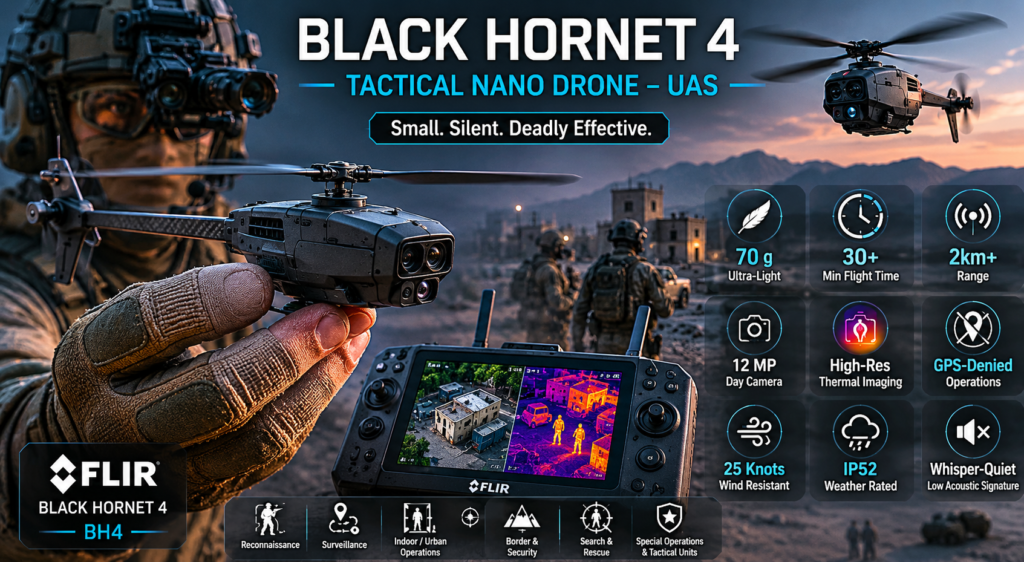
That is the core idea behind the Black Hornet 4. It is a flying sensor, not a flying camera in the ordinary sense. Weighing roughly 70 grams, it is small enough to be carried by an individual operator but capable enough to deliver real-time visual and thermal intelligence. Its role is not to replace larger UAVs. Its role is to give small units their own immediate aerial viewpoint without waiting for external drone support, vehicle-mounted systems, or higher-level intelligence assets.
The psychological value of the Black Hornet 4 is also important. In tactical environments, uncertainty creates paralysis. A doorway, rooftop, treeline, alley, window, vehicle, or compound may conceal danger. Traditional movement requires direct exposure before confirmation. A nano UAS changes that equation. It allows the operator to externalize risk by sending a sensor forward before sending a human body. In that sense, the Black Hornet 4 is not only a reconnaissance tool; it is a tactical anxiety-reduction system. It gives the user a controlled way to transform unknown space into known space.
This is why the Black Hornet family became so influential in the Soldier Borne Sensor category. Earlier battlefield drones often required specialist teams, larger launch areas, heavier cases, more setup time, and greater acoustic or visual signatures. The Black Hornet concept changed the scale of aerial reconnaissance. It made drone-based awareness personal, portable, and immediate. Instead of asking, “Can command provide overhead support?” a small unit could ask, “Can we see for ourselves right now?”
The Black Hornet 4 advances that concept with improved imaging, greater endurance, stronger environmental performance, and better suitability for modern contested environments. Its daytime camera gives operators sharper visual intelligence, while its thermal imaging capability supports night operations, low-light scanning, heat-signature detection, and target awareness in conditions where normal eyesight is limited. For military reconnaissance, border security, special operations, urban combat, and high-risk search missions, that combination is extremely valuable.
Unlike ordinary nano drones, the BH4 is not defined by entertainment value. It is not about tricks, racing, family fun, or casual aerial photography. It is defined by tactical utility. Can it reveal a threat? Can it reduce exposure? Can it help a unit choose a safer route? Can it confirm movement beyond a wall? Can it operate when GPS is unreliable? Can it function in wind and rain? Can it provide real-time intelligence without giving away the operator’s position?
These are the questions that matter.
The Black Hornet 4 is also part of a larger trend in defense technology: miniaturization without loss of mission value. Modern operators increasingly need lightweight systems that do not slow them down. Every gram matters. Every battery matters. Every device must justify its place in the kit. A 70-gram nano drone that provides day and thermal reconnaissance can earn its place because it gives the soldier something no rifle optic, radio, or handheld camera can provide: an elevated, mobile, remote viewpoint.
This review examines the Black Hornet 4 through that operational lens. Although it belongs to a far more specialized class than conventional cameras, drones and field-production equipment, its imaging architecture also illustrates how advanced aerial systems are reshaping the wider world of Creator Gear. We will examine its design philosophy, nano-drone architecture, imaging system, thermal capability, flight endurance, contested-environment performance, weather resistance, battlefield use cases, advantages over larger UAS platforms, limitations, and the type of individual or organization that can genuinely benefit from this level of technology.
The Black Hornet 4 is not for everyone. It is a highly specialized tactical nano UAS built for qualified defense, military, and security users. But as a case study in where drone technology is going, it is one of the most important nano drones in the world. It proves that the future of UAV reconnaissance is not always bigger, heavier, louder, or more complex. Sometimes the most powerful drone is the one small enough to disappear.
1. Unmatched Military UAV Stealth: The Science of Low Signatures
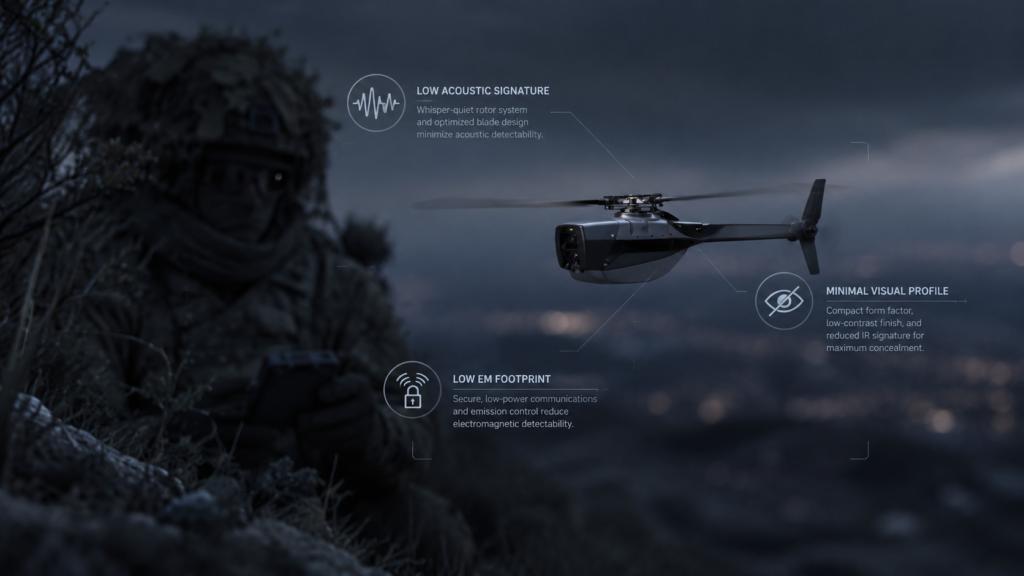
The primary mission of the Black Hornet 4 is simple but extremely difficult: see without being seen. In tactical reconnaissance, stealth is not only about invisibility in the cinematic sense. It is about reducing every detectable signature that could reveal the drone, the operator, or the unit using it. For a military UAV, especially a tactical nano drone, stealth depends on three major factors: visual signature, acoustic signature, and electromagnetic signature.
This is where the Black Hornet 4 separates itself from consumer quadcopters and even many compact professional drones. Most small drones are still easy to identify once they are close enough. They create a recognizable buzzing sound, show visible movement against the sky, and rely on radio links that may be detectable or vulnerable in contested environments. The Black Hornet 4 is engineered around a different battlefield logic. It is not designed to impress from a distance; it is designed to disappear into the operational background.
For readers comparing compact drone categories, it is useful to understand the difference between civilian nano drones and tactical nano UAS platforms. Consumer nano drones are usually built for portability, fun, beginner flying, indoor practice, travel content, or casual aerial photography. The Black Hornet 4 uses the nano-drone form factor for reconnaissance, surveillance, target awareness, and soldier-borne intelligence. It shows how the same miniaturization trend can serve very different markets.
A useful comparison can also be made with the Parrot ANAFI USA sUAS minidrone UAV. The ANAFI USA is a secure, portable enterprise and public safety drone designed for thermal inspection, first response, and secure professional missions. The Black Hornet 4 goes even smaller and more tactical, focusing on dismounted reconnaissance, low-signature flight, and immediate squad-level awareness.
Acoustic Discretion
Traditional quadcopters often produce a sharp, high-frequency buzz because four small propellers are spinning rapidly at once. In quiet environments, that sound can be instantly recognizable. It does not take much drone experience to hear the difference between wind, insects, distant vehicles, and a quadcopter hovering nearby.
The Black Hornet 4 uses a different airframe logic. Its single-rotor helicopter-style design gives it a lower and less familiar acoustic profile than many quadcopters. Instead of announcing itself with the typical multi-rotor whine, it is designed to blend more naturally into background environmental noise, especially in wind, urban clutter, moving vehicles, distant machinery, or battlefield ambience.
For tactical teams, this matters because sound can compromise the mission. A drone that can be heard too easily may alert a target, change behavior, trigger concealment, or reveal that a unit is observing from nearby. A low-acoustic-signature nano UAV allows operators to gather information while reducing the chance of detection.
Visual Stealth
Visual stealth is equally important. A drone does not need to be literally invisible to be operationally hard to detect. It only needs to be small enough, distant enough, dark enough, and visually irregular enough to disappear against a complex background.
The Black Hornet 4’s extremely small body gives it a major advantage. Against a gray sky, broken terrain, urban walls, treelines, rooftops, smoke, dust, or mountain shadows, a palm-sized aircraft becomes very difficult to track with the naked eye. Unlike larger quadcopters, which create a clear silhouette, the Black Hornet 4 can operate as a near-background object in many environments.
This is one of the reasons nano UAS platforms are valuable in urban reconnaissance. In streets, alleys, courtyards, compounds, ruins, and dense terrain, small size is not merely convenient. It is a survival feature. A small drone can inspect a corner, window, doorway, rooftop, ridgeline, or open courtyard without drawing the same attention as a larger UAV.
Electromagnetic Signature and Secure Communications
In modern contested environments, stealth is not only about what humans can hear or see. It is also about what sensors can detect. Electronic warfare, signal interception, jamming, spoofing, and radio-frequency detection have become central concerns for military drone operations.
The Black Hornet 4 is designed for GPS-denied and contested environments, which means the system must remain useful even when ordinary positioning and communications assumptions are challenged. Secure communications, resistant navigation, frequency management, and encrypted links are all part of the broader low-signature profile.
A tactical nano drone must protect the operator in two ways. First, it must avoid being easily discovered in the air. Second, it must reduce the risk of revealing where the operator is located. A drone that can be detected electronically may expose the unit using it. This is why electromagnetic discipline matters as much as camera quality in military UAS design.
2. Next-Gen Optics: 12MP Daylight and High-Resolution Thermal Imaging
One of the most important upgrades in the Black Hornet 4 is its sensor payload. For a tactical nano drone, camera quality is not about cinematic beauty. It is about identification, confirmation, and decision-making. A reconnaissance drone must help the operator answer urgent questions: Is someone present? Is a vehicle active? Is a doorway clear? Is there movement behind cover? Is heat visible through smoke or darkness? Is a route safe enough to approach?
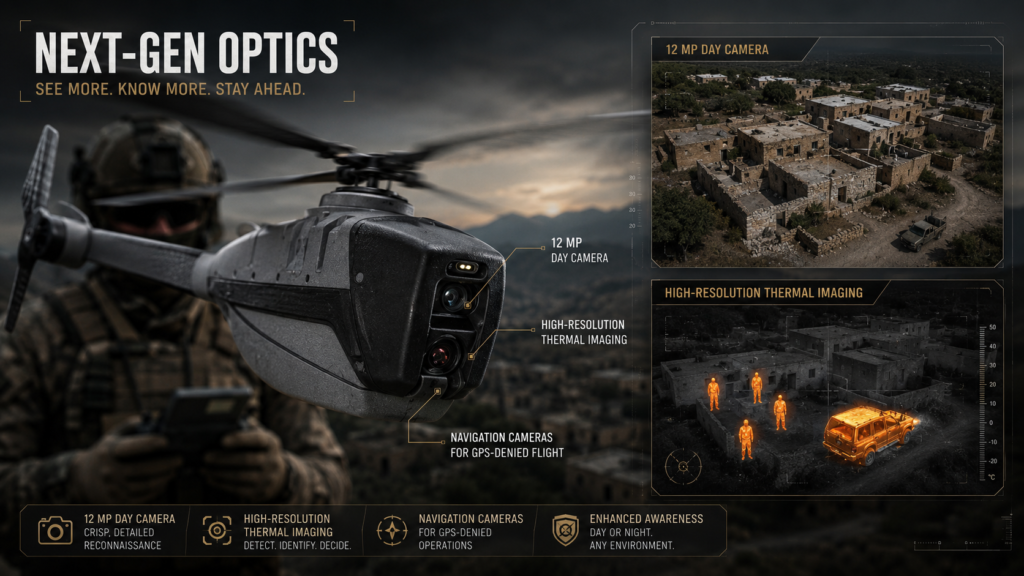
The Black Hornet 4’s imaging system is designed to support day and night situational awareness. It combines a 12-megapixel daytime camera with a high-resolution thermal imager, giving operators a dual-sensor reconnaissance tool inside an ultra-light nano UAS platform.
Electro-Optical Day Camera
The upgraded 12MP daytime camera is a major improvement for a drone in this class. In tactical use, a sharper electro-optical sensor helps operators interpret the scene with more confidence. Details matter. A blurry shape may create uncertainty, while a clearer image can help confirm whether an object is a person, vehicle, weapon, doorway, window, obstacle, or piece of infrastructure.
For reconnaissance teams, this is critical because drone imagery is often used under pressure. The operator may not have time to analyze a perfect still image. The feed needs to be clear enough to support quick decisions in real time.
The daytime camera helps with:
Route reconnaissance before movement.
Compound, rooftop, and window inspection.
Vehicle detection and object identification.
Over-the-wall and around-the-corner awareness.
Urban surveillance from a safer position.
Post-event damage or effect assessment.
Border, checkpoint, and perimeter observation.
Unlike creator drones, which are often judged by color science, dynamic range, cinematic motion, and social media output, the Black Hornet 4’s day camera is judged by tactical clarity. The question is not “Does the image look beautiful?” The question is “Does the image reduce uncertainty?”
High-Resolution Thermal Imaging
The thermal imaging system is one of the strongest reasons the Black Hornet 4 matters. Thermal cameras detect heat rather than visible light, allowing operators to identify people, animals, recently used vehicles, running engines, warm equipment, heat leaks, fire risks, and other thermal signatures in darkness or poor visibility.
In tactical and rescue environments, thermal imaging changes what the operator can know. At night, a normal camera may struggle. In smoke, shadow, light foliage, or low-contrast terrain, the human eye may miss what a thermal sensor can detect. A thermal nano drone gives small units a way to scan spaces that are visually confusing or dangerous.
Thermal capability is especially valuable for:
Night reconnaissance.
Search and rescue.
Detecting hidden personnel.
Identifying active vehicles or machinery.
Scanning buildings, compounds, and terrain.
Observing through smoke or low visibility.
Supporting perimeter security.
Monitoring heat sources after an event.
This is where the Black Hornet 4 becomes more than a miniature aircraft. It becomes a mobile sensor node. It allows a soldier or tactical operator to send vision and heat detection into a space before entering it physically.
Navigation Cameras and Obstacle Awareness
The Black Hornet 4 also includes additional navigation sensors used to support stable flight, obstacle awareness, and operation in GPS-denied environments. This is important because the environments where a military nano drone is most valuable are often the environments where ordinary drones struggle: indoors, under cover, between buildings, near walls, around corners, under trees, near vehicles, or in areas where satellite positioning is degraded.
Obstacle avoidance and assisted navigation make a tactical nano UAS more usable under stress. The operator may be wearing gloves, carrying equipment, receiving radio traffic, and making quick decisions. The drone must reduce pilot workload rather than add to it.
3. Enhanced Range and Performance: Breaking the 3 km Barrier
Range and endurance have always been difficult challenges for nano drones. A smaller drone has less room for battery capacity, antenna systems, processing hardware, and environmental protection. Every gram must be justified. If the aircraft becomes too light, it may struggle in wind. If it becomes too heavy, it loses the core advantage of being soldier-carried and easy to deploy.
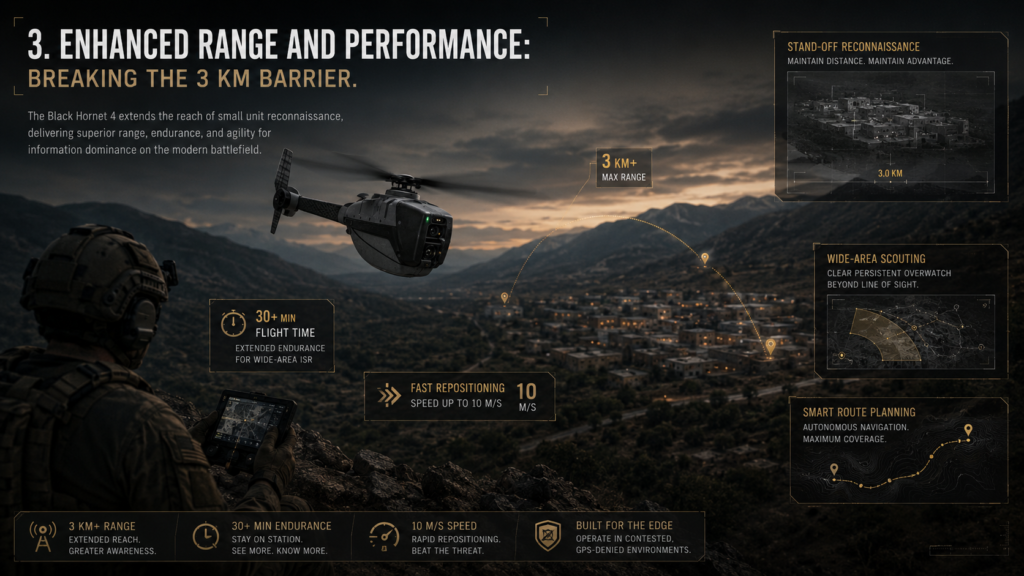
The Black Hornet 4 improves this balance by delivering more than 30 minutes of flight time and, in newer public materials, more than 3 kilometers of range. For a 70-gram tactical nano UAS, that is a serious performance profile.
Tactical Range
A 3 km-plus communication range gives the operator meaningful stand-off distance. In practical terms, this means a squad can scout a road, village, compound, ridgeline, alley network, field approach, or multi-block urban area without immediately exposing itself.
The value of range is not only distance. It is decision space. More range gives the unit more time to observe, compare routes, check suspicious areas, and reduce risk before committing personnel. In reconnaissance, the best movement is informed movement. A drone that extends vision also extends tactical patience.
For urban operations, range can help operators scan across blocks, rooftops, courtyards, and intersections. For rural or mountainous operations, it can help inspect terrain beyond direct line of sight. For security forces, it can support perimeter awareness without sending personnel into exposed positions.
Flight Endurance
The Black Hornet 4’s 30+ minute endurance is important because reconnaissance is rarely instant. Operators often need time to launch, climb, move toward the target area, observe, reposition, inspect details, return, and preserve enough battery for safe recovery.
Short flight time creates rushed decision-making. Longer endurance allows for a more methodical scan. For a nano UAS, more than 30 minutes can be enough to support meaningful over-the-hill observation, compound assessment, search activity, or route review.
This endurance is also valuable when paired with a ground control system that supports multiple drones. In a two-drone workflow, one aircraft can fly while another charges or remains ready, helping maintain operational rhythm.
Speed and Repositioning
Speed matters when the situation changes. A slow drone may be useful for inspection, but tactical reconnaissance often requires rapid repositioning. If a target moves, a route changes, smoke expands, a vehicle appears, or a unit shifts direction, the drone must be able to respond.
The Black Hornet 4’s performance profile supports quick movement while still maintaining the low-signature advantages of a nano platform. It is not a racing drone, and it should not be judged like one. Its speed is valuable because it allows the sensor to move where the operator needs it, when the operator needs it.
4. Durability and Environmental Resilience
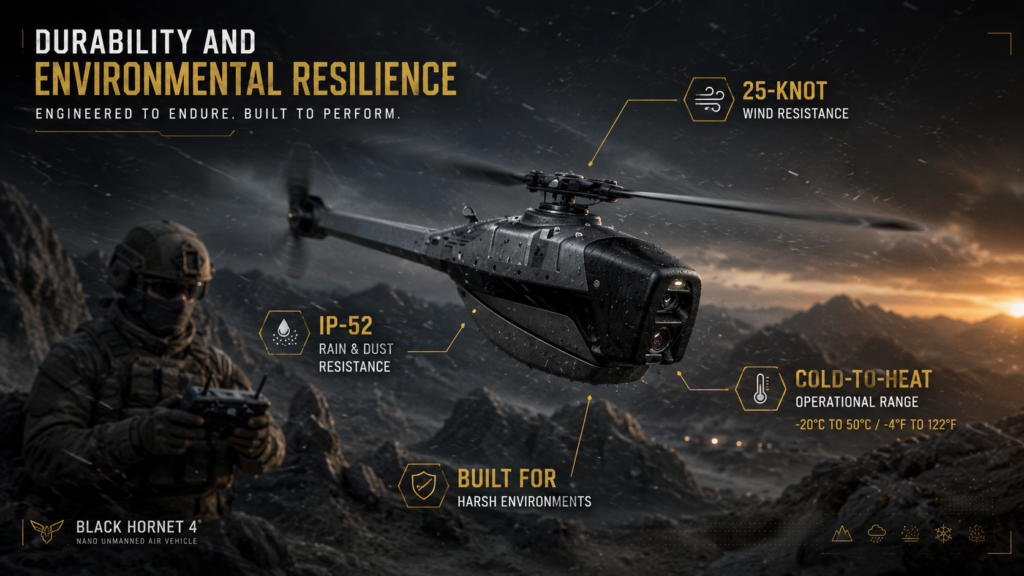
Many consumer drones are fair-weather machines. They perform well in calm conditions, clear skies, and controlled environments, but they become unreliable in rain, wind, dust, cold, heat, or battlefield stress. The Black Hornet 4 is designed for a different reality.
Military and tactical users cannot assume perfect conditions. Missions may occur in rain, desert heat, freezing mountain air, dust, smoke, urban debris, darkness, or high wind. A tactical nano drone that only works in ideal weather would have limited value. The Black Hornet 4 is built to survive demanding conditions while remaining small enough to carry on the body.
Wind Resistance
For a 70-gram aircraft, wind tolerance is a major engineering challenge. Teledyne FLIR’s public materials describe the Black Hornet 4 as capable of functioning in 25-knot winds, with newer updates emphasizing operation in wind and rain. This is significant because wind is one of the biggest enemies of nano UAS platforms.
Wind resistance matters in real missions because exposed areas are rarely calm. Ridgelines, open roads, rooftops, coastlines, desert corridors, and mountain passes can all produce unstable air. A drone that cannot hold position becomes less useful for observation. A drone that can maintain control in difficult wind becomes a more dependable reconnaissance asset.
Rain and Dust Resistance
The Black Hornet 4 is also designed for weather tolerance, including rain operation. This matters because military, rescue, and security missions do not pause just because conditions are uncomfortable. Rain can reduce visibility, complicate movement, and increase risk. A nano drone that can still fly in those conditions gives operators another way to understand the environment.
Dust and debris resistance are equally important. In urban operations, desert environments, disaster zones, and military movement, dust can affect sensors, motors, and visibility. A ruggedized nano UAS must handle more than clean air.
Temperature Extremes
The Black Hornet 4 is designed for harsh operational environments, including cold and hot conditions. This matters because tactical drones are often used in places where consumer electronics would struggle: winter terrain, exposed mountains, desert heat, vehicle storage, field packs, and rough deployment cycles.
The key benefit is trust. Operators need equipment that works when carried, transported, launched, recovered, and reused in difficult conditions. A fragile nano drone is interesting. A rugged nano drone is operationally valuable.
5. Technical Specifications Comparison: Black Hornet 3 vs Black Hornet 4
The Black Hornet 4 is best understood as an evolutionary upgrade over the Black Hornet 3. The earlier BH3 helped establish the modern soldier-borne sensor category by proving that a tiny drone could provide real-time situational awareness to small units. The BH4 expands that idea with stronger imaging, more endurance, better environmental resilience, and improved flight performance.
| Feature | Black Hornet 3 | Black Hornet 4 |
|---|---|---|
| Approximate Weight | Around 33 g class | Around 70 g |
| Max Range | Around 2 km class | More than 3 km in newer updates |
| Flight Time | Around 25 minutes | More than 30 minutes |
| Day Camera | Lower-resolution earlier-generation imaging | 12 MP daytime camera |
| Thermal Imaging | Earlier-generation thermal capability | High-resolution thermal imager |
| Wind Tolerance | Lower wind tolerance | 25-knot wind operation |
| Rain Operation | More limited | Designed to function in wind and rain |
| Obstacle Avoidance | Limited compared with newer system | Advanced obstacle avoidance capabilities |
| Primary Role | Soldier-borne reconnaissance | Enhanced tactical nano UAS for contested environments |
| Best Use Case | Squad-level awareness | Day/night reconnaissance, GPS-denied environments, harsh conditions |
The most important upgrade is not only one specification. It is the combined effect of better imaging, longer range, stronger endurance, improved environmental tolerance, and contested-environment performance. The Black Hornet 4 gives small units a more capable aerial sensor without moving into a larger drone class.
6. The Ground Control System: User-Centric Tactical Design
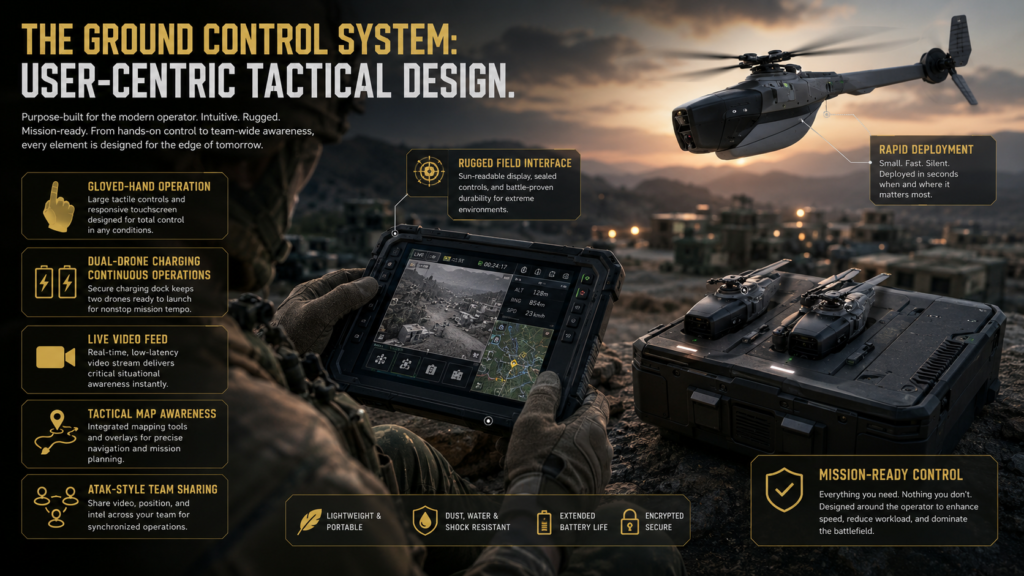
A drone is only as useful as the system that controls it. In military and security environments, the ground control system must be simple, rugged, fast, and usable under pressure. The operator may be wearing gloves, carrying a weapon, working in poor light, receiving instructions, moving with a team, or operating in cold, rain, dust, or stress. The interface cannot feel like a hobby app.
The Black Hornet 4 system is designed around field usability. Its ground control system supports rapid operation, mission viewing, charging, and integration into tactical awareness workflows. The purpose is to make the drone a natural extension of the operator rather than a distraction.
Gloved-Hand Operation
A tactical controller must be usable with gloves because real operators rarely work in ideal touchscreen conditions. Cold weather, protective gear, field equipment, and mission tempo all require a control interface that is practical rather than delicate.
This matters because the best sensor is useless if it takes too long to operate. A soldier-borne nano drone must launch quickly, deliver useful imagery, and return without forcing the user into a complicated setup process.
Two-Drone Operational Rhythm
The Black Hornet system concept supports continuous or near-continuous use by allowing one drone to fly while another is prepared or charging. This is important because small-unit reconnaissance often benefits from repeated observation. One launch may answer a single question, but multiple launches can support route movement, perimeter checks, target confirmation, search activity, or changing conditions.
A two-drone rhythm also reduces downtime. Instead of treating the nano UAS as a one-time tool, teams can use it as part of an ongoing tactical information loop.
Tactical Network Integration
Compatibility with battlefield awareness tools and tactical networks increases the value of the drone feed. The information gathered by a nano UAS should not remain trapped with one operator if the wider team needs it. When imagery can be shared across a unit or command structure, the drone becomes part of a larger intelligence picture.
This is where the Black Hornet 4 moves beyond being a personal flying camera. It becomes a sensor in a connected tactical system.
7. The Force Multiplier for 2026
The Black Hornet 4 is not a toy, a gadget, or a conventional consumer drone. It is a force multiplier. Its value comes from the way it changes the relationship between the operator and the unknown.
In dismounted operations, the unknown is dangerous. A corner may hide a threat. A ridge may conceal movement. A building may contain occupants. A vehicle may still be warm. A route may be exposed. A courtyard may look empty from the ground but reveal activity from above. Without aerial reconnaissance, teams often have to move first and learn second. With a tactical nano UAS, they can observe first and move with more confidence.
That is the real purpose of the Black Hornet 4. It reduces blind movement. It extends the human senses. It gives small units an aerial viewpoint without requiring a large drone team, vehicle support, or high-visibility aircraft. Its value is not only technical; it is psychological and operational.
By providing over-the-hill, around-the-corner, and beyond-line-of-sight visibility, the Black Hornet 4 helps eliminate the “deadly unknown.” Its small size, low signature, high-resolution day camera, thermal imaging, 30+ minute endurance, GPS-denied capability, weather tolerance, and ruggedized design make it one of the most important nano UAS platforms in the military drone market.
For 2026, the broader lesson is clear: the future of UAV technology is not only about bigger drones, longer wings, heavier payloads or cinematic 8K cameras. Some of the most important innovation is happening at the smallest scale, where portability, intelligence and situational awareness matter more than sheer size. The Black Hornet 4 proves that a 70-gram drone can change how soldiers, tactical teams and security forces understand the space around them, reflecting the kind of advanced product innovation explored across Schopping.
In the nano UAV market, that is what leadership looks like: not just flight, but immediate, low-signature intelligence.