
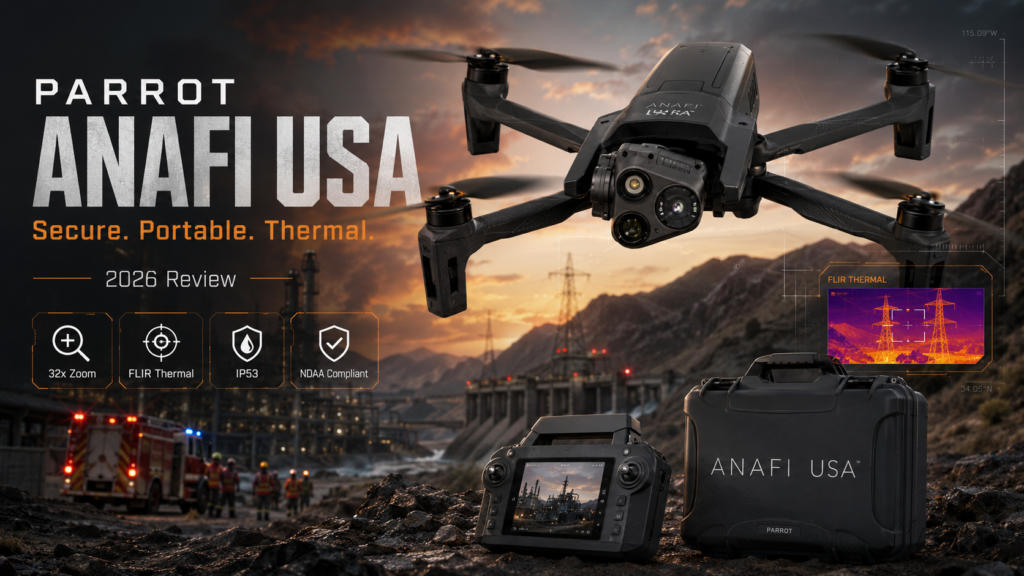
In the rapidly evolving world of sUAS, or small unmanned aerial systems, the Parrot ANAFI USA occupies a very specific place in the drone market. It is not a casual toy drone. It is not a cinematic creator drone built only for travel videos. It is not a heavy enterprise platform that requires a large deployment kit. Instead, the ANAFI USA sits in a rare middle ground: a secure, portable, ruggedized professional minidrone designed for public safety teams, government agencies, first responders, firefighters, industrial inspectors, tactical operators, and enterprise users who need fast aerial intelligence without carrying a large aircraft system.
At Schopping.com, we usually evaluate drones through the lens of usefulness, portability, buyer intent, image quality, and real-world workflow. The Parrot ANAFI USA Nano Drone requires an even deeper lens because it is not only about aerial photography. It is about secure visual data, tactical awareness, thermal detection, inspection safety, and trusted deployment. For buyers comparing advanced creator gear, this drone represents a different kind of creative and operational tool: less about cinematic lifestyle footage and more about mission-critical visibility.
Within the broader drones category, most consumer drones are purchased for photography, travel filmmaking, YouTube content, real estate videos, or recreational flight. The ANAFI USA is built for a more serious purpose. It is designed for users who need a lightweight UAV drone that can launch quickly, observe safely from a distance, detect heat signatures, inspect infrastructure, capture high-resolution imagery, and protect sensitive mission data. It has the portability of a compact drone but the intent of an enterprise aerial intelligence platform.
People exploring nano drones usually value portability, fast setup, low-friction flying, and easy transport. The ANAFI USA takes some of that same compact-drone philosophy and pushes it into a professional environment. It is not a toy-grade nano drone, but it does prove that serious enterprise drone capability no longer has to come in a huge airframe.
So, does the Parrot ANAFI USA still live up to the hype in 2026? The answer depends on what you expect from it. If you want the longest range, the highest thermal resolution, or the most powerful heavy-duty enterprise drone, larger platforms may outperform it. But if your priority is secure deployment, low weight, thermal capability, quiet operation, rugged portability, and trusted compliance, the ANAFI USA remains one of the most distinctive professional UAV drones available.
This review breaks down its security profile, camera system, thermal imaging, zoom performance, portability, durability, software ecosystem, real-world use cases, and how it compares against larger enterprise drones like the DJI Matrice 30T. For readers researching professional UAV platforms, aerial imaging equipment, thermal inspection technology, and field-ready content production tools, explore our Creator Gear section for in-depth reviews, buying guides, and comparisons covering drones, cameras, lenses, audio equipment, and professional creator technology.
1. Introduction: The Rise of the Secure Parrot UAV
The Parrot ANAFI USA was created for a very specific problem: professional drone users needed a secure, portable, reliable UAV platform that could meet strict government and defense expectations while still being small enough for rapid field deployment. In an industry where drones often raise concerns about data privacy, supply chain security, firmware control, and sensitive imagery, the ANAFI USA was positioned as a trusted alternative for agencies and enterprises that cannot treat drone data casually.
This is where the ANAFI USA separates itself from standard consumer drones. A normal camera drone is judged by its video resolution, flight time, tracking modes, and price. A secure enterprise drone is judged by a different standard: who made it, where the data goes, how the storage is protected, whether the firmware can be trusted, how quickly it can be deployed, and whether the aircraft can be used in sensitive environments.
The Parrot ANAFI USA was designed for public safety teams, U.S. government users, industrial inspection crews, and enterprise drone operators who need a trusted sUAS platform. It is part of the broader movement toward secure drone procurement, especially in sectors where foreign-manufactured technology can create compliance, policy, or data-sovereignty concerns.
For a firefighter, the value is immediate thermal visibility. For a search-and-rescue team, the value is rapid aerial awareness. For a utility inspector, the value is zooming into power lines, towers, and infrastructure from a safer distance. For law enforcement or tactical teams, the value is quiet observation and secure data handling. For government buyers, the value is compliance and trust.

- This drone with a camera equipped with f/2.4 wide angle ASPH lens, HDR, and up to 2.8 times digital zoom captures specta…
- The ANAFI Parrot Drone can have up to 25 minutes of filmed flight time thanks to an intelligent Li-Po battery that optim…
- With its ultra-compact and lightweight carbon frame (320 g), this quadcopter drone unfolds in less than 3 seconds, reach…
The ANAFI USA is not merely a flying camera. It is a portable intelligence-gathering system built around three ideas: see farther, deploy faster, and protect the data.
2. Technical Specifications at a Glance
Before examining the real-world performance, it helps to understand the technical foundation of the Parrot ANAFI USA. This drone is built around a compact 500 g airframe, but it carries an unusually capable imaging payload for its size.
| Feature | Parrot ANAFI USA Specification |
|---|---|
| Drone Type | Professional secure sUAS / enterprise minidrone |
| Weight | 500 g |
| Flight Time | Up to 32 minutes |
| Deployment Time | About 55 seconds from case to flight |
| Weather Rating | IP53 dust and rain resistance |
| Operating Temperature | Extreme temperature operating range |
| Camera Payload | Dual 21 MP visual sensors plus FLIR Boson thermal sensor |
| Zoom | Up to 32x hybrid zoom |
| Thermal Imaging | FLIR Boson thermal camera |
| Transmission | Secure Wi-Fi-based transmission system |
| Primary Users | Public safety, firefighters, inspectors, government agencies, first responders, enterprise operators |
| Key Strengths | Security, portability, thermal imaging, zoom, rapid deployment, quiet operation |
| Key Limitations | Lower thermal resolution than larger enterprise drones, shorter range than some heavy platforms |
These specifications show why the ANAFI USA has remained relevant. It is not trying to replace every enterprise drone. It is trying to be the secure, compact, fast-deployment drone that a professional can carry into the field and launch without turning the operation into a full aircraft setup.
3. Design Philosophy: Why This Drone Exists
The Parrot ANAFI USA is built around a different philosophy from mass-market photography drones. Most consumer camera drones are built for creators who want beautiful footage. The ANAFI USA is built for operators who need useful information.
That distinction matters. A creator drone asks: how cinematic is the footage? A public safety drone asks: can it help us understand the scene faster? A consumer drone asks: does it make travel videos look professional? An inspection drone asks: can it identify damage, heat, cracks, equipment issues, missing components, or risk without putting a person in danger?
This is why the ANAFI USA uses a compact but specialized imaging payload. Its 32x zoom allows operators to stand off from a target while still capturing detail. Its thermal sensor allows teams to detect heat signatures, hotspots, people, animals, machinery heat, fire risk, and hidden temperature patterns. Its lightweight body makes it easy to transport. Its security features make it suitable for sensitive missions.
A useful comparison can also be made with the Black Hornet 4, which goes even smaller and more tactical, focusing on low-signature flight, dismounted reconnaissance and immediate squad-level awareness.
The drone is best understood as a field tool. It is designed for the person who arrives at a scene, needs aerial awareness quickly, and cannot afford a complicated setup.
4. Triple-Sensor Payload: Zoom, Wide Imaging, and Thermal Precision
The most important part of the Parrot ANAFI USA is its camera payload. This is where the drone justifies its professional positioning. While many compact drones rely on a single visual camera, the ANAFI USA combines multiple imaging systems to support both standard observation and specialized mission work.
Its triple-sensor payload includes high-resolution visual imaging and thermal imaging, giving operators the ability to switch between normal visual detail and heat-based detection. This makes it valuable for situations where the human eye cannot see enough from the ground.
32x Hybrid Zoom
The ANAFI USA’s 32x hybrid zoom is one of its defining features. In practical terms, zoom changes how safely a drone can be used. Without strong zoom, operators may need to fly closer to a building, tower, person, vehicle, roofline, electrical structure, wildfire zone, or hazardous area. With strong zoom, they can maintain greater distance while still collecting usable imagery.
This matters in several scenarios:
Utility inspectors can examine high-voltage lines or tower components without flying too close to dangerous infrastructure.
Public safety teams can observe a scene from farther away without escalating presence.
Firefighters can inspect rooflines, smoke conditions, hotspots, and structural risk from a safer position.
Search-and-rescue teams can scan difficult terrain while maintaining a wider operational viewpoint.
Industrial users can capture details from hard-to-access areas without sending personnel into risky locations.
The psychological value of zoom is also important. A strong zoom lens gives the operator control without intrusion. It creates distance while preserving visibility. For mission-critical drone work, that combination is powerful.
Visual Imaging Quality
The ANAFI USA is not primarily a cinematic drone, but its visual imaging system is highly capable for inspection, observation, documentation, and situational awareness. The 21 MP sensors help deliver detailed stills and usable video, especially when the goal is to identify, document, or inspect rather than produce dramatic social media footage.
This is an important difference from typical camera drone reviews. In professional inspection work, the best image is not always the most beautiful image. It is the image that answers the operational question. Is there damage? Is there heat? Is someone present? Is a roof compromised? Is equipment failing? Is a line sagging? Is smoke coming from behind a wall? Is there movement in the field?
The ANAFI USA is built to answer those questions.
FLIR Boson Thermal Imaging
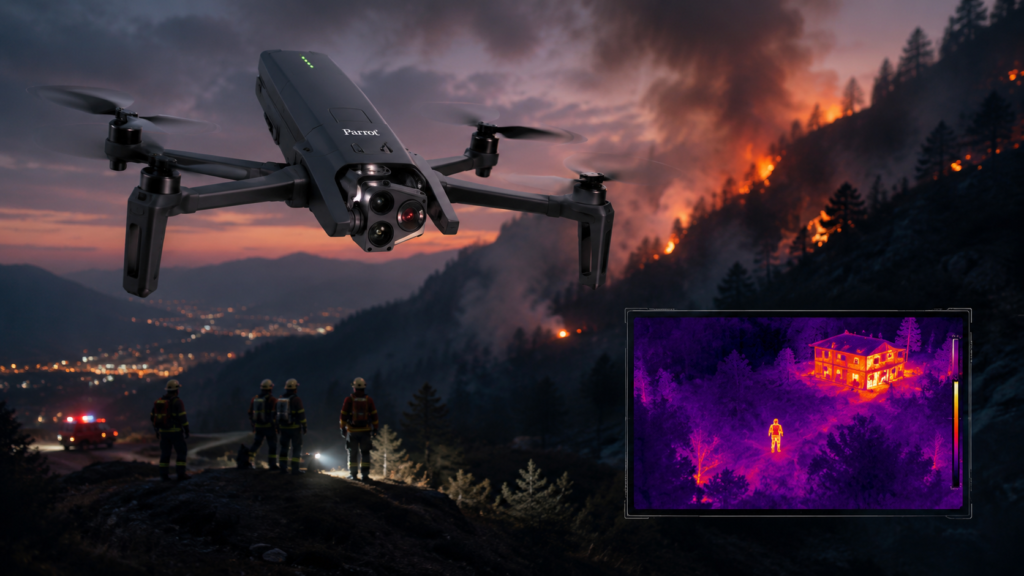
The integrated FLIR Boson thermal camera gives the ANAFI USA its strongest public safety and inspection value. Thermal imaging allows operators to detect heat patterns that are invisible to the naked eye. This can be useful in search and rescue, firefighting, law enforcement, industrial inspection, solar panel checks, building diagnostics, wildlife monitoring, and emergency response.
For firefighters, thermal imaging can help identify hotspots, smoldering areas, heat trapped behind structures, or temperature changes that may signal danger. For search-and-rescue teams, it can help locate a person in low visibility, at night, in brush, or across difficult terrain. For industrial teams, it can help detect overheating equipment, electrical faults, pipeline issues, or abnormal thermal signatures.
The thermal resolution is not as high as some larger enterprise drones, but that is part of the trade-off. The ANAFI USA prioritizes compact deployment, security, and portability over maximum sensor size. For many field teams, that balance is exactly the point.
5. Portability and Rapid Deployment
Portability is one of the biggest reasons to consider the ANAFI USA. Many enterprise drones are capable, but they are not always convenient. Larger systems may require bigger cases, more setup time, heavier batteries, dedicated crews, and more careful launch conditions. The ANAFI USA is built to reduce that friction.
Its foldable frame gives it a compact footprint, making it easier to carry in vehicles, response kits, inspection bags, and field packs. For emergency teams, this matters because a drone that takes too long to deploy may miss the critical moment. For inspectors, it means the drone can be taken to more sites without disrupting the workflow.
The ability to move from case to flight quickly is a major advantage. A first responder arriving at a scene does not want to spend several minutes assembling equipment. A firefighter may need immediate roof visibility. A police or rescue team may need fast situational awareness. A utility inspector may need to check a dangerous structure before a human approaches it.
The ANAFI USA’s portability is not just about convenience. It changes how often the drone can be used. Heavy enterprise drones are sometimes reserved for major operations. A compact enterprise drone is more likely to be used routinely because it is easier to bring, launch, recover, and store.
6. Hand Launch and Field Recovery
One of the most practical advantages of the ANAFI USA is its ability to operate in constrained environments. In the field, a perfect launch site is not always available. Emergency scenes are messy. Construction sites are uneven. Forested areas are tight. Maritime environments may not offer stable ground. Disaster zones may be filled with debris.
Hand launch and hand recovery can be valuable in those conditions. It allows the operator to deploy without a clean landing pad or wide-open flat surface. This is especially useful for maritime teams, wooded search areas, roadside operations, dense urban spaces, and industrial environments where ground conditions are unpredictable.
This small detail can make a major difference in real deployment. A drone that needs ideal conditions may stay in the case. A drone that can launch from a hand can become a practical everyday tool.
7. Security Features: Why Trust Is the Core
The ANAFI USA’s biggest differentiator is not simply its camera. It is security. In government, public safety, infrastructure, and enterprise environments, drones collect sensitive visual data. That data may include emergency scenes, critical infrastructure, private property, tactical positions, accident sites, industrial systems, law enforcement activity, or confidential inspection footage.
For these users, data security is not a luxury feature. It is a requirement.
NDAA and TAA Compliance
The ANAFI USA’s compliance positioning is one of the reasons it is considered by government agencies and security-conscious organizations. NDAA and TAA compliance can matter for procurement, policy, and operational trust. Buyers in public sector environments often need equipment that satisfies internal rules and federal procurement expectations.
This gives the ANAFI USA an advantage in categories where many popular consumer and enterprise drones may face restrictions or extra scrutiny.
Secure Data Handling
The ANAFI USA includes strong encryption features designed to protect captured data. In sensitive missions, this matters because a lost drone should not automatically mean exposed imagery. The idea is simple: if the aircraft or storage is physically compromised, the data should still remain protected.
For first responders, inspectors, and government operators, this is a major trust signal. It means the drone is designed not only for flight performance but also for responsible information handling.
Signed Firmware and Controlled Software Integrity
Signed firmware helps protect the aircraft from unauthorized software modification. This is important because drones are not just flying cameras; they are connected computing devices with sensors, radios, storage, and control systems. In sensitive environments, firmware integrity is essential.
A secure UAV platform must reduce the risk of tampering, unauthorized access, and untrusted software behavior. This is one of the reasons the ANAFI USA is positioned differently from standard consumer drones.
No Hardcoded Geofencing
The ANAFI USA does not rely on the same style of restrictive hardcoded no-fly zone controls that many consumer drones use. For professional first responders, that matters. A fire, rescue operation, disaster event, or emergency scene may require immediate flight in places where consumer drones might delay or restrict access.
This does not mean operators can ignore aviation laws or local rules. It means the drone is built to trust trained professionals rather than block them automatically in urgent scenarios. For public safety, that can be critical.
8. Real-World Performance
On paper, the ANAFI USA is impressive. In real-world use, its value depends on how well it balances stability, image quality, noise, endurance, and durability.
Flight Stability
For a 500 g professional drone, the ANAFI USA performs strongly in field conditions. It is not as wind-dominant as a much heavier aircraft, but it is stable enough for inspection, public safety, and observation work in many operational environments. Its hybrid stabilization system helps keep imagery usable even when conditions are less than perfect.
For inspection teams, stable footage matters because shaky video can hide details. For search-and-rescue teams, stable control matters because operators need to scan terrain carefully. For firefighters, stability matters because thermal and visual interpretation must be fast and reliable.
Wind Resistance
The ANAFI USA can handle challenging wind conditions for its size, but buyers should understand the trade-off. A 500 g drone will never have the same physical authority as a 3 kg or 4 kg enterprise aircraft in rough weather. However, the ANAFI USA’s advantage is that it gives strong capability in a body that can be carried and deployed quickly.
For many agencies, that is a worthwhile compromise. They may not need the biggest drone for every mission. They need the drone that can be launched quickly and provide useful visibility before the situation changes.
Noise Profile
Quiet operation is one of the ANAFI USA’s underrated strengths. In public safety, tactical observation, wildlife monitoring, and urban inspection, noise can matter. A loud drone can disturb people, alert subjects, or create unnecessary attention. A quieter drone can observe with less disruption.
For inspection work, lower noise also makes the aircraft less intrusive around facilities, neighborhoods, or work crews.
Weather Resistance
The IP53 rating gives the ANAFI USA more confidence in light rain, dust, and field conditions than typical consumer drones. This does not make it waterproof, and it should not be treated like a fully weatherproof aircraft. But for professional users, IP53 resistance adds practical durability.
Fire scenes, construction sites, disaster zones, utility corridors, forests, and roadside environments are rarely clean. Dust, light moisture, debris, and temperature changes are common. The ANAFI USA is built with those realities in mind.
9. Software Ecosystem: FreeFlight 6 USA
The Parrot ANAFI USA is operated through the FreeFlight 6 USA ecosystem, which is designed for professional rather than purely recreational flying. The interface focuses on mission utility, camera control, flight management, and access to the drone’s core imaging tools.
For enterprise users, the software experience matters because the drone must be repeatable. It should support predictable flight behavior, efficient mission setup, and reliable control over imaging settings.
Flight Planning and Waypoints
Waypoint and flight planning tools are valuable for inspection and mapping-style workflows. They allow operators to create repeatable routes, which can be useful for comparing infrastructure over time, documenting progress, or checking the same site under different conditions.
Repeatability is a serious advantage in commercial drone use. A one-time aerial view is useful. A consistent aerial record is more valuable.
Developer Access and Integration
Parrot’s open ecosystem is another reason the ANAFI USA appeals to enterprise users. Developers and organizations can integrate drone workflows into broader software stacks, mapping platforms, inspection tools, fleet systems, and documentation pipelines.
This matters for organizations that do not want drone footage to sit isolated on a memory card. They want aerial data to become part of a larger operational system.
10. Best Use Cases for the Parrot ANAFI USA
The ANAFI USA is not designed for everyone. It is best suited for users who need a combination of security, portability, zoom, thermal imaging, and mission readiness.
Search and Rescue
Search-and-rescue teams can use the ANAFI USA to scan terrain, locate heat signatures, assess hazards, and improve situational awareness. Its portability makes it especially useful when teams need to move quickly through rough ground or deploy from vehicles.
Firefighting
Fire departments can use the thermal camera to locate hotspots, check roof conditions, monitor fire spread, assess structural heat, and improve firefighter safety. The drone can provide overhead perspective without putting personnel into high-risk zones.
Law Enforcement and Public Safety
Public safety teams can use the ANAFI USA for scene assessment, crowd monitoring, accident reconstruction, tactical observation, and emergency response support. Its quiet operation and secure data handling make it especially relevant for sensitive work.
Utility and Infrastructure Inspection
Utility companies can use the zoom system to inspect towers, lines, substations, wind turbines, rooftops, bridges, and difficult-to-access structures. The ability to maintain distance while capturing detail improves safety and efficiency.
Industrial Inspection
Industrial teams can use thermal and visual imaging to inspect equipment, identify overheating components, check facilities, monitor sites, and document issues without sending workers into risky areas.
Government and Defense-Sensitive Operations
For government buyers, the ANAFI USA’s compliance and security profile may be its strongest selling point. It offers a trusted option for missions where procurement rules and data protection are central concerns.
11. Parrot ANAFI USA vs. DJI Matrice 30T
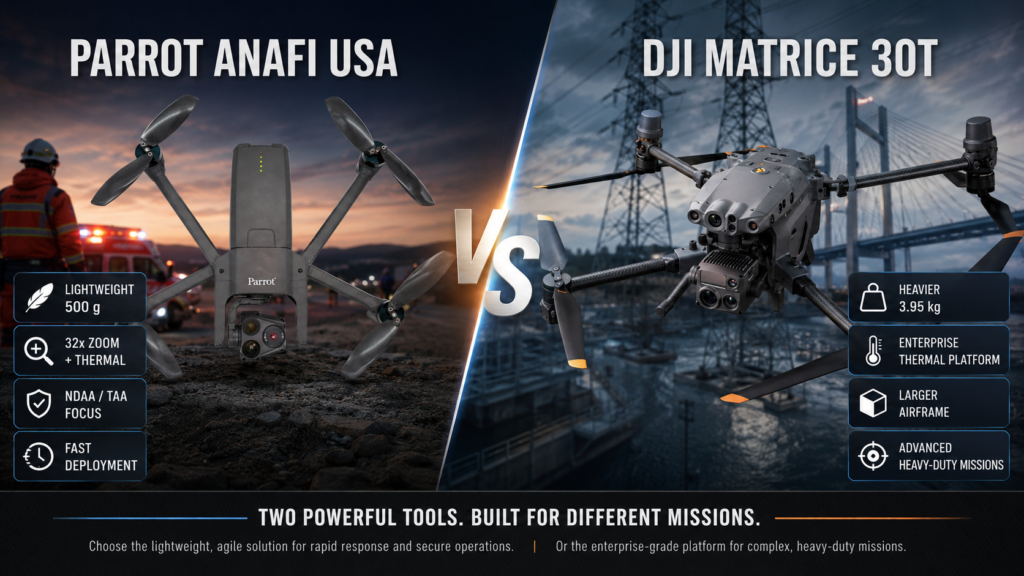
The DJI Matrice 30T is a larger, more powerful enterprise drone, and it has advantages in several areas. It offers a more heavy-duty platform, stronger enterprise ecosystem in many markets, and higher-end multi-sensor performance. For teams that need maximum enterprise capability and can manage the size, cost, and operational footprint, the M30T is a serious platform.
However, the Parrot ANAFI USA competes differently. It does not try to beat the Matrice 30T by being bigger. It competes by being lighter, quieter, more portable, and more compliance-focused for buyers who need trusted procurement.
| Category | Parrot ANAFI USA | DJI Matrice 30T |
|---|---|---|
| Best For | Secure portable missions, public safety, rapid deployment, inspections | Heavy enterprise missions, longer-range operations, advanced payload work |
| Weight Class | Very lightweight at around 500 g | Much heavier enterprise platform |
| Portability | Excellent | Portable for enterprise, but far larger |
| Thermal Imaging | Integrated FLIR Boson thermal sensor | Higher-resolution thermal system |
| Zoom | Strong 32x hybrid zoom | Strong enterprise zoom capabilities |
| Security Positioning | NDAA/TAA compliance and secure procurement focus | Strong enterprise features, but may face restrictions in some government sectors |
| Deployment Speed | Very fast | Requires more setup |
| Noise | Quieter and less intrusive | Larger and more noticeable |
| Best Buyer | Agencies and teams prioritizing secure lightweight deployment | Teams prioritizing maximum enterprise capability |
The right choice depends on the mission. If you need a heavy-duty all-in-one enterprise platform and have the budget, crew, and operational structure to support it, the Matrice 30T may be stronger. If you need a secure, lightweight, quiet, rapidly deployable drone for sensitive missions, the ANAFI USA makes more sense.
12. Is the Parrot ANAFI USA Good for Creators?
For pure cinematic creators, the ANAFI USA is not usually the first recommendation. A creator focused on YouTube travel films, wedding footage, real estate reels, or lifestyle content may prefer a dedicated prosumer camera drone with stronger cinematic color profiles, larger imaging sensors, and creator-focused automated shooting modes.
However, the ANAFI USA can still serve a specific type of creator: documentary filmmakers, field journalists, inspection content producers, public safety educators, technical YouTubers, industrial media teams, and creators who work around infrastructure, emergency response, or tactical environments.
It is a professional documentation drone more than a beauty-shot drone. If your work involves evidence, inspection, security, thermal imaging, or serious field reporting, the ANAFI USA may be more useful than a typical cinematic drone.
13. Is the Parrot ANAFI USA a Nano Drone?
The ANAFI USA is often discussed alongside compact drones because of its portability, but it is not a casual nano drone. It weighs more than the typical sub-250 g consumer category and is built for enterprise missions rather than recreational flight.
That said, it shares the same core appeal that makes nano drones popular: easy transport, fast launch, compact storage, and reduced operational friction. It is best described as an enterprise minidrone, not a toy drone or beginner quadcopter.
For buyers coming from nano drones, the ANAFI USA represents a major step upward in capability. It adds thermal imaging, security features, professional zoom, ruggedization, and mission-ready software.
14. Pros and Cons
Pros
NDAA and TAA compliant for security-sensitive buyers.
Blue sUAS positioning makes it relevant for government and public safety procurement.
Lightweight 500 g airframe is highly portable.
32x hybrid zoom allows safer stand-off observation.
Integrated FLIR Boson thermal camera supports firefighting, SAR, and inspections.
IP53 rating improves field durability.
Fast deployment makes it useful in emergency scenarios.
Quiet operation is valuable for public safety and discreet observation.
No hardcoded geofencing supports professional emergency response flexibility.
Secure data handling helps protect sensitive mission imagery.
Cons
Thermal resolution is lower than some larger enterprise drones.
Transmission range is shorter than certain heavy enterprise platforms.
Not ideal as a pure cinematic creator drone.
Higher cost than consumer camera drones.
Lightweight body cannot match heavier drones in extreme wind.
Smaller ecosystem than DJI in some commercial markets.
15. Who Should Buy the Parrot ANAFI USA?
The Parrot ANAFI USA is best for buyers who care about security, portability, and mission readiness more than cinematic lifestyle footage. It is an excellent fit for:
First responders who need rapid aerial awareness.
Fire departments that need thermal imaging and hotspot detection.
Search-and-rescue teams working in difficult terrain.
Government agencies with procurement and data-security concerns.
Utility inspectors examining power lines, towers, rooftops, and infrastructure.
Industrial teams needing portable thermal and visual inspection.
Public safety operators who need a quiet, secure, quick-launch UAV.
Field teams that cannot carry a large enterprise drone everywhere.
It is not the best choice for casual hobbyists, budget buyers, toy drone users, or creators who only want cinematic travel footage. Those users are better served by consumer camera drones, mini drones, or prosumer photography drones.
16. Final Verdict: Why You Buy the Parrot ANAFI USA
You buy the Parrot ANAFI USA because you need trust in the air
You buy it because your drone footage may contain sensitive information. You buy it because you need thermal imaging in a lightweight body. You buy it because your team may not have time to unpack a heavy enterprise system. You buy it because zoom matters, safety matters, deployment speed matters, and data security matters.
The ANAFI USA is not the biggest enterprise drone. It is not the flashiest creator drone. It is not the cheapest way to get aerial footage. Its value is more specific: it gives professional operators a secure, rugged, lightweight UAV platform with serious imaging capability in a compact frame.
For first responders, firefighters, inspectors, and government users, that balance is powerful. The Parrot ANAFI USA remains one of the strongest examples of how a minidrone can become a mission-critical tool when security, portability, zoom, and thermal imaging are engineered into the same aircraft.