
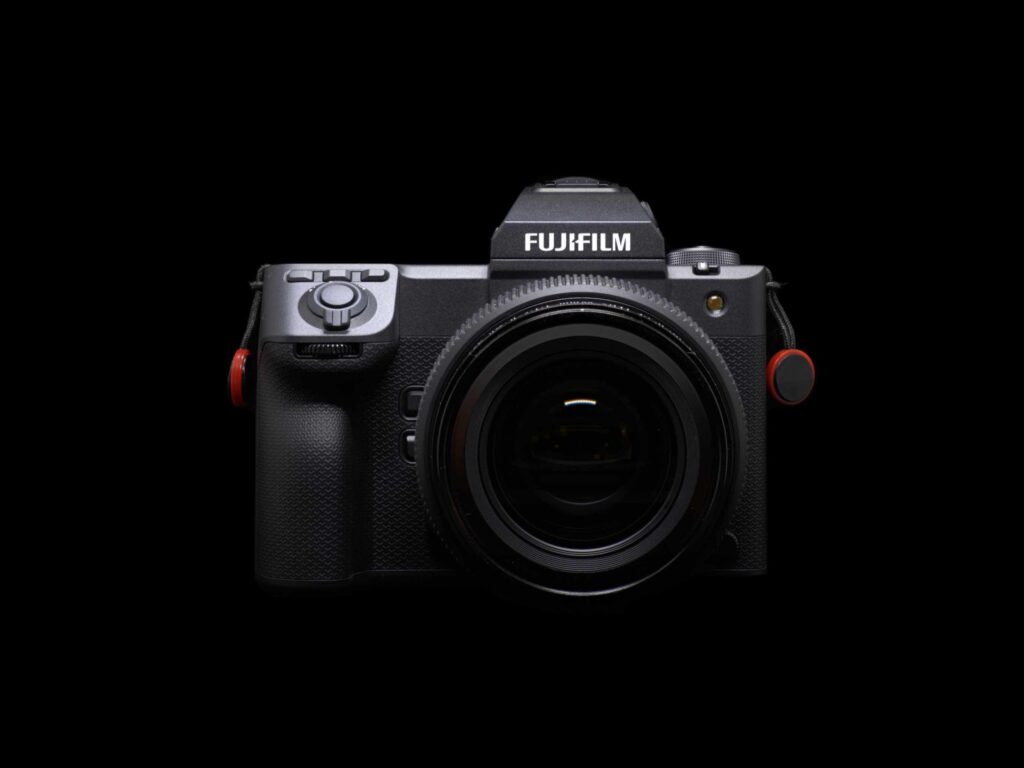
For years, medium format cameras carried a reputation for being slow, expensive, and mostly reserved for controlled studio photography. The Fujifilm GFX100 II changes that conversation completely. It brings a 102MP large-format sensor into a body built for modern professional photographers, commercial creators, hybrid shooters, and visual storytellers who need extreme detail without sacrificing speed, autofocus confidence, or video capability.
This is not just another flagship camera update. The Fuji GFX100 II feels like Fujifilm’s clearest statement that medium format photography can now compete in fast-moving professional environments: fashion shoots, product campaigns, landscape work, editorial assignments, studio portraits, high-resolution commercial photography, and cinematic creator workflows. For readers exploring premium imaging tools across cameras, drones, microphones, lighting, and studio equipment, Schopping’s broader creator gear hub is a useful place to compare how this camera fits into a complete production setup.
In this Fujifilm GFX100 II review, we examine whether its 102MP sensor, improved image processor, faster shooting performance, advanced autofocus, in-body stabilization, 8K video capability, and medium format color depth make it one of the best professional cameras for photographers who want uncompromising image quality. And if you are comparing high-end camera systems as part of a wider buying journey, the Schopping homepage connects this review with our broader guides on creator gear, tech products, lifestyle equipment, outdoor tools, wellness gadgets, luxury products, and digital assets.
1. The Core Specifications: A Giant Leap Forward
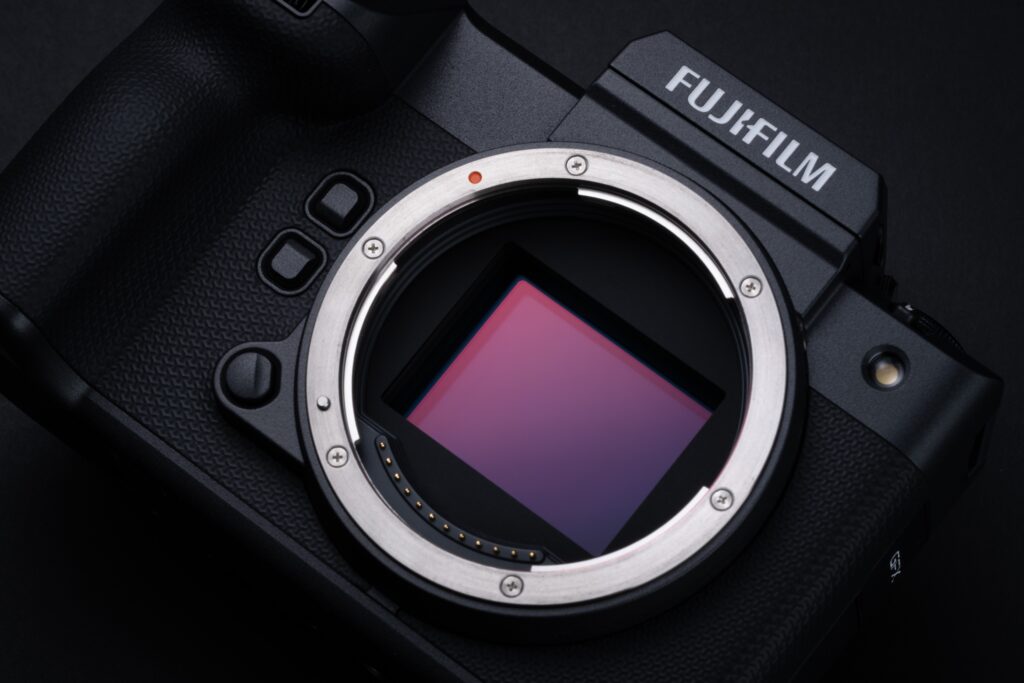
Before we get into the “feel” of the camera, let’s look at the raw power under the hood. The GFX100 II is built around the newly developed GFX 102MP CMOS II HS sensor and the X-Processor 5. This combination is the engine that drives every improvement over its predecessor.
Key Specifications at a Glance
| Feature | Specification |
| Sensor | 102MP BSI-CMOS (43.8 x 32.9mm) |
| Processor | X-Processor 5 |
| ISO Range | 80 – 12,800 (Expandable to 40 – 102,400) |
| IBIS | 5-axis, up to 8.0 stops of compensation |
| Continuous Shooting | 8.0 fps (Mechanical Shutter) |
| Video | 8K/30p, 4K/60p, 10-bit 4:2:2 Internal |
| EVF | 9.44M-dot OLED, 1.0x Magnification |
| Card Slots | 1x CFexpress Type B, 1x SD UHS-II |
2. Sensor Innovation: Not Just More Pixels
While 102 megapixels is a familiar number from the original Fujifilm GFX100 II and the GFX100S II, the “HS” (High Speed) designation in the GFX100 II’s sensor makes a world of difference.
Improved Signal Readout
The sensor’s readout speed has been doubled. This affects everything from the refresh rate of the electronic viewfinder (EVF) to the reduction of rolling shutter in video. For the photographer, this means a more “live” feeling when looking through the lens—a common complaint with older medium format bodies.
Base ISO 80
One of the most requested features was a lower native ISO. The Fuji GFX100 II delivers with a base ISO of 80. By lowering the base sensitivity, Fujifilm has managed to squeeze even more dynamic range out of the sensor. If you are a landscape photographer shooting in high-contrast environments, the ability to pull detail from deep shadows without introducing noise is unparalleled in this price bracket.
3. Autofocus: AI Comes to Medium Format
Historically, autofocus was the Achilles’ heel of the FujiFilm GFX system. The Fujifilm GFX100 II changes the narrative by inheriting the AI-powered subject detection algorithms from the high-speed X-H2S and X-T5.
Deep Learning Subject Tracking
The camera can now intelligently identify and track:
- Humans (Face and Eye)
- Animals and Birds
- Cars, Motorcycles, and Bicycles
- Airplanes and Trains
In our testing, the “stickiness” of the AF-C (Continuous Autofocus) is a revelation. While it may not yet match the “instantaneous” feel of a Sony A1 or Nikon Z9, it is comfortably faster and more reliable than any medium format camera has any right to be. You can now confidently use this camera for fashion shows, high-end weddings, and even some sports—genres that were previously off-limits for 100MP sensors.
4. Build Quality and Ergonomics: Professionalism Personified
Fujifilm opted for a new design language with the Fuji GFX 100 II. The body is wrapped in BISHAMON-TEX leather, providing a premium grip and a rugged aesthetic.
The Modular Viewfinder
One of the standout design features is the removable 9.44 million-dot EVF. With 1.0x magnification, Fujifilm GFX100 II is arguably the best viewfinder on the market today. It is crisp, bright, and—most importantly—lag-free. You can also purchase a tilt adapter that allows the EVF to rotate, which is a lifesaver for studio work or low-angle macro photography.
Handling and Top LCD
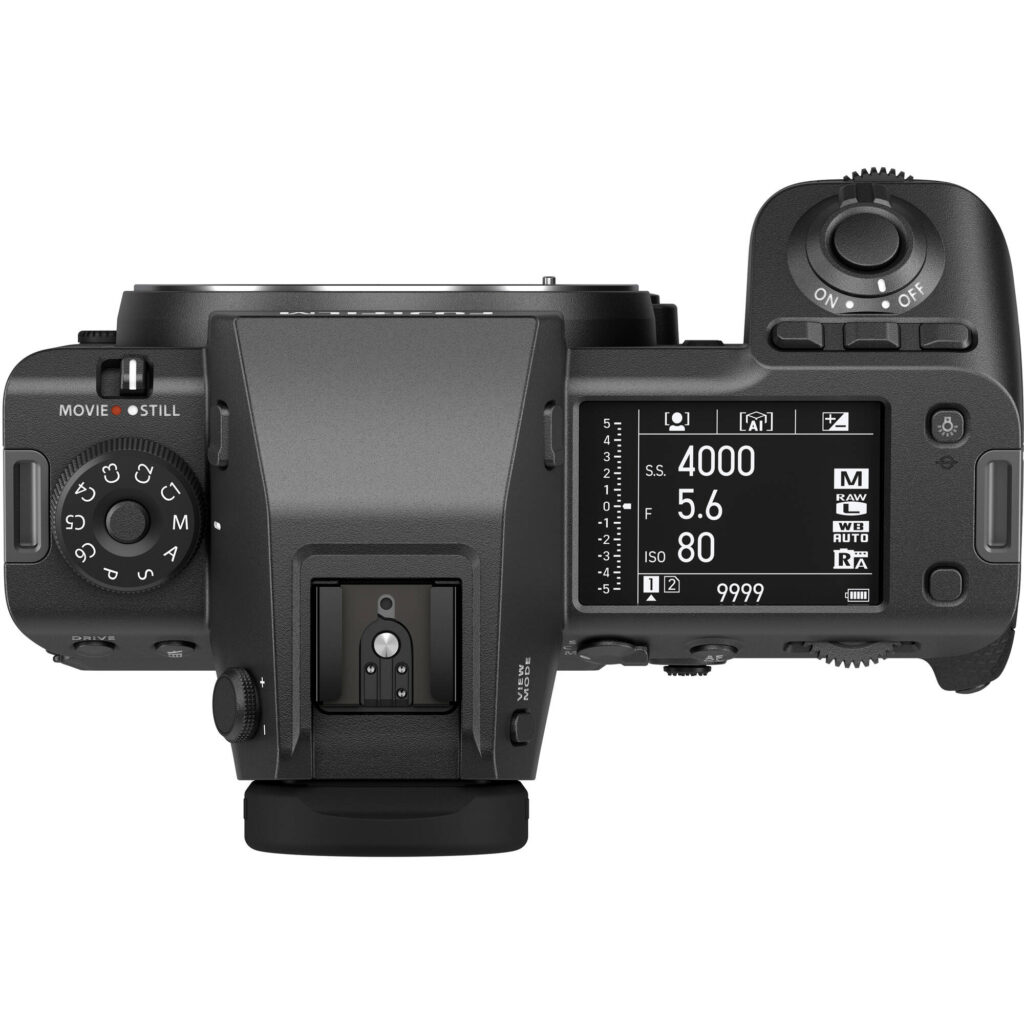
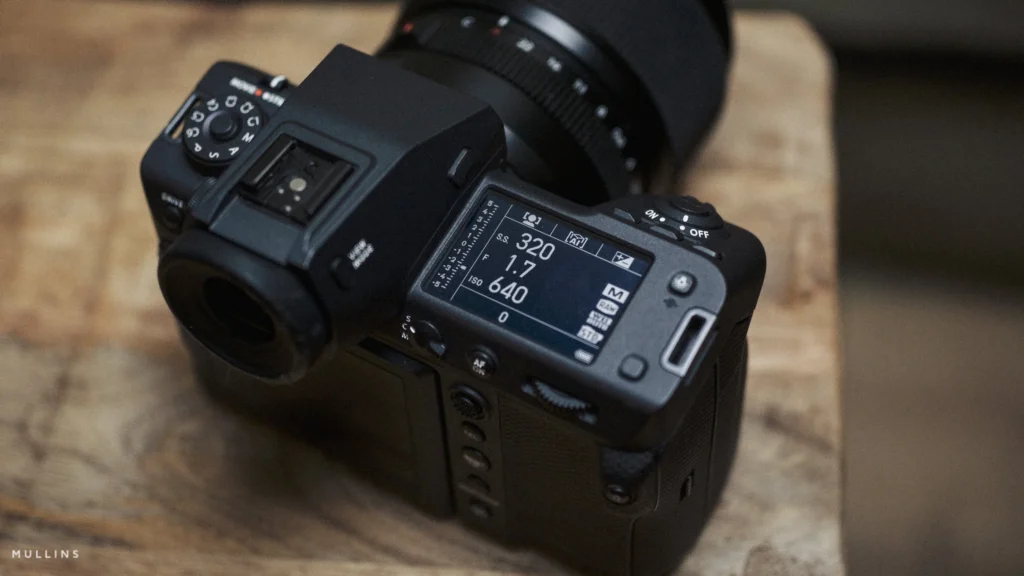
The Fujifilm GFX100 II top plate features a massive, slanted sub-LCD that displays your settings clearly, even in bright sunlight. The button layout is intuitive, with three programmable Fn buttons near the shutter release, allowing for quick adjustments to ISO, White Balance, or AF modes without taking your eye off the EVF.
5. The Video Powerhouse: A Hybrid Like No Other
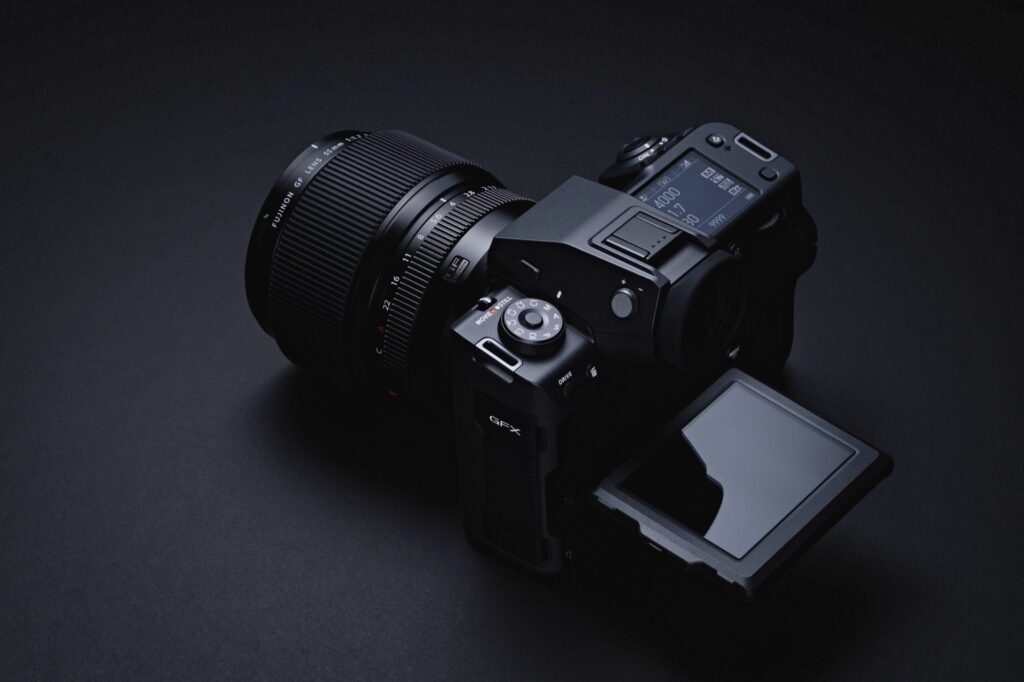
The GFX100 II is arguably the first medium format camera that can truly be called a “cinema camera.”
8K and Beyond
The Fujifilm GFX100 II camera records 8K/30p video internally at 4:2:2 10-bit. But the real magic is in the versatility. It supports multiple cine-lens formats, including Premista, 35mm, and Anamorphic (with in-camera de-squeeze).
Professional Workflow
Fujifilm GFX100 II, comes with a full-sized HDMI Type-A port, an Ethernet port and the ability to record directly to an external SSD via USB-C, the GFX100 II integrates seamlessly into a professional film set. It also supports F-Log2, which provides over 14 stops of dynamic range, giving colorists incredible flexibility in post-production.
6. Image Quality: The Fujifilm GFX100 II Color Science
Resolution is only half the story. The way Fujifilm renders color is why many professionals refuse to switch brands.
REALA ACE Film Simulation
The Fuji GFX100 II introduces REALA ACE, a film simulation based on the legendary color negative film. It offers a faithful color reproduction with a slightly harder tonality, making it perfect for product photography and high-end portraits where accuracy is paramount.
Pixel Shift Multi-Shot
For those who find 102MP insufficient, the Fujifilm GFX100 II offers a 400-megapixel Pixel Shift mode. By shifting the sensor slightly between shots, the camera captures full color data for every pixel, resulting in a file with zero moiré and staggering detail. This is a game-changer for archival work and fine-art reproduction.
7. The Lens Ecosystem: Making the Most of 102MP
A sensor is only as good as the glass in front of it. Fujifilm GFX100 II GF lens lineup has matured significantly.
- GF 55mm f/1.7 R WR: The “must-have” prime lens. It offers a standard field of view with an ultra-fast aperture that produces a “3D” look that is unique to medium format.
- GF 110mm f/2 R LM WR: Widely considered one of the best portrait lenses ever made.
- GF 30mm f/5.6 T/S: A tilt-shift lens that makes the GFX100 II a formidable tool for architectural photographers.
8. Pros and Cons: A Fair Assessment
The Pros
- Incredible Detail: The 102MP sensor is the gold standard for resolution.
- Speed: 8fps and AI-autofocus make it versatile for moving subjects.
- Video Mastery: 8K internal recording and SSD support.
- Superb IBIS: 8 stops of stabilization make handheld medium format shooting a reality.
- Top-tier EVF: The 9.44M-dot viewfinder is a joy to use.
The Cons
- Price: At approximately $8,499 (body only), it is a serious investment.
- File Size: 102MP RAW files will eat through storage quickly and require a powerful PC for editing.
- Size and Weight: Despite the “smaller” body compared to the original GFX100, it is still a substantial piece of equipment.
9. Final Verdict: Who Should Buy the Fuji GFX100 II?
The Fujifilm GFX100 II is not a camera for everyone. It is overkill for the casual hobbyist and too heavy for the average traveler. However, if you are a professional whose income depends on image quality—whether in commercial, fashion, landscape, or fine-art photography—this is the most complete tool available today.

- GFX100 II’s new 102MP sensor and X-Processor 5 combination deliver astounding performance when it is needed most. Enhanc…
- Internally record 4:2:2, 10-bit Apple ProRes, or use HDMI to record 12-bit 4:2:2 Apple ProRes RAW or Blackmagic RAW in r…
- GFX100 II provides specified crops and aspect ratios for multiple cinema formats, which includes full-width GF Format, F…
It successfully bridges the gap between the “heavy-duty” medium format systems (like Phase One or Hasselblad) and the “agile” full-frame mirrorless systems (like the Sony A7R V). It is a camera without compromise.
Is it worth the upgrade?
Medium Format Comparison: GFX 100 II vs. The GFX Family
| Feature | GFX 100 II | GFX 100S | GFX 100 (Original) | GFX 50S II |
| Sensor Resolution | 102MP (HS Version) | 102MP | 102MP | 51.4MP |
| Processor | X-Processor 5 | X-Processor 4 | X-Processor 4 | X-Processor 4 |
| Continuous Shooting | 8.0 fps | 5.0 fps | 5.0 fps | 3.0 fps |
| Max Video Res | 8K/30p, 4K/60p | 4K/30p | 4K/30p | 1080p (Full HD) |
| IBIS (Stabilization) | Up to 8.0 Stops | Up to 6.0 Stops | Up to 5.5 Stops | Up to 6.5 Stops |
| AF System | AI Subject Tracking | Contrast/Phase | Contrast/Phase | Contrast Detect |
| EVF Resolution | 9.44M-dot | 3.69M-dot | 5.76M-dot | 3.69M-dot |
| Body Style | Modular / Compact | Fixed / Compact | Integrated Grip (Large) | Fixed / Compact |
| Card Slots | 1x CFexp B, 1x SD | 2x SD UHS-II | 2x SD UHS-II | 2x SD UHS-II |
| Base ISO | ISO 80 | ISO 100 | ISO 100 | ISO 100 |
Key Takeaways from the Comparison
- The Speed Gap: The jump from the GFX 50S II (3.0 fps) to the GFX 100 II (8.0 fps) is massive, effectively making medium format viable for action for the first time.
- Video Evolution: The GFX 50S II is strictly a stills-focused camera (Full HD only). While the GFX 100 and 100S introduced 4K, only the GFX 100 II offers professional 8K and high-speed 4K/60p.
- The Sensor Advantage: While the original GFX 100 and 100S share a similar 102MP sensor, the “HS” (High Speed) sensor in the GFX 100 II provides the faster readout necessary for the new AI autofocus and reduced rolling shutter.
- The EVF Revolution: The 9.44M-dot viewfinder in the GFX 100 II is nearly triple the resolution of the GFX 100S, providing an experience much closer to an optical viewfinder.
If you are coming from the original GFX 100, GFX 100S or a GFX50S II, the answer is a resounding yes. The improvements in autofocus, video, and EVF quality are transformational. If you already own a GFX100S, the decision is harder—unless you need the 8K video or the significantly faster burst rates.
Ready to Elevate Your Photography?
The Fuji GFX100 II is more than just a camera; it’s a gateway to a higher level of creative expression.
Below is an expanded, SEO-enhanced version of the FAQ and People Also Ask sections for a Fujifilm GFX 100 II review, incorporating trending long-tail keywords, comparison terms, professional photography search phrases, detailed answers, charts, and tables.
Frequently Asked Questions (FAQs)
What is the main difference between the Fujifilm GFX 100 II and the GFX 100S?
The biggest difference between the Fujifilm GFX 100 II vs GFX 100S lies in processing speed, autofocus intelligence, video capabilities, and overall professional workflow performance.
The GFX 100 II introduces a new 102MP CMOS II HS sensor paired with the X-Processor 5. This combination doubles sensor readout speed, significantly reducing rolling shutter and improving responsiveness across photography and video applications.
| Feature | GFX 100 II | GFX 100S |
|---|---|---|
| Sensor | 102MP CMOS II HS | 102MP BSI CMOS |
| Processor | X-Processor 5 | X-Processor 4 |
| Burst Shooting | 8 fps | 5 fps |
| Video Resolution | 8K/30p | 4K/30p |
| AI Subject Detection | Yes | No |
| EVF Resolution | 9.44M dots | 3.69M dots |
| Base ISO | 80 | 100 |
| SSD Recording | Yes | No |
For photographers searching terms like:
- best medium format camera for professionals
- GFX 100 II vs GFX 100S image quality
- medium format camera for commercial photography
- Fujifilm GFX 100 II review
the newer model represents a substantial upgrade rather than a minor refresh.
Performance Improvement Chart
| Category | Improvement |
|---|---|
| Autofocus Tracking | ★★★★★ |
| Video Production | ★★★★★ |
| Burst Shooting | ★★★★☆ |
| Viewfinder Experience | ★★★★★ |
| Dynamic Range | ★★★★☆ |
Does the Fuji GFX 100 II support internal 8K video recording?
Yes. The Fujifilm GFX 100 II records 8K 30p internally in 4:2:2 10-bit, making it one of the most advanced medium format cinema-capable cameras available.
Professional creators can capture:
| Recording Mode | Supported |
|---|---|
| 8K/30p | Yes |
| 4K/60p | Yes |
| F-Log2 | Yes |
| ProRes External Recording | Yes |
| SSD Recording via USB-C | Yes |
| Timecode Sync | Yes |
This makes the camera attractive for:
- high-end commercial filmmaking
- luxury product videography
- fashion campaign production
- documentary filmmaking
- cinematic wedding films
Many creators searching for:
- best medium format camera for video
- 8K medium format camera
- Fujifilm GFX 100 II video review
- cinema camera alternative
consider the GFX 100 II among the strongest hybrid cameras currently available.
Is the autofocus fast enough for sports photography?
The GFX 100 II is the fastest autofocus medium format camera Fujifilm has ever produced.
Its AI-powered subject detection recognizes:
- Humans
- Animals
- Birds
- Cars
- Motorcycles
- Trains
- Airplanes
Autofocus Suitability Chart
| Photography Type | Rating |
|---|---|
| Portraits | Excellent |
| Weddings | Excellent |
| Fashion | Excellent |
| Wildlife | Very Good |
| Motorsports | Very Good |
| Professional Soccer | Good |
| Olympic Sports | Moderate |
Although cameras such as the Sony A1 II and Canon EOS R3 remain superior for elite action photography, the GFX 100 II dramatically narrows the gap between medium format and full-frame systems.
What is the benefit of the new Base ISO 80?
The introduction of native ISO 80 delivers cleaner files and improved highlight retention.
Benefits include:
| Advantage | Impact |
|---|---|
| Increased Dynamic Range | More shadow detail |
| Better Highlight Recovery | Improved skies and bright areas |
| Reduced Noise | Cleaner large prints |
| Enhanced Color Depth | Better tonal transitions |
Landscape photographers searching:
- best camera for dynamic range
- medium format landscape photography
- camera for large fine art prints
will appreciate the extra image quality headroom provided by ISO 80.
Can I use the GFX 100 II for handheld shooting?
Absolutely.
The camera includes up to 8 stops of In-Body Image Stabilization (IBIS), allowing photographers to shoot a 102-megapixel sensor handheld in many situations where a tripod was once mandatory.
Typical Handheld Performance
| Lens Equivalent | Traditional Safe Speed | With IBIS |
|---|---|---|
| 35mm | 1/40 sec | 1 sec+ |
| 50mm | 1/60 sec | 1 sec |
| 80mm | 1/100 sec | 1/4 sec |
| 120mm | 1/125 sec | 1/8 sec |
This is especially useful for:
- travel photography
- environmental portraits
- documentary work
- wedding photography
- handheld landscape photography
Does it have a Pixel Shift mode for higher resolution?
Yes.
Pixel Shift Multi-Shot technology captures multiple frames and combines them into a staggering 400-megapixel image.
Resolution Comparison
| Mode | Output Resolution |
|---|---|
| Standard | 102MP |
| Pixel Shift | 400MP |
Ideal applications include:
- museum archiving
- artwork reproduction
- ultra-large commercial prints
- cultural heritage documentation
- luxury product photography
This feature frequently appears in searches such as:
- highest resolution camera available
- 400 megapixel camera
- pixel shift photography guide
What memory cards does the GFX 100 II use?
The camera features dual media slots:
| Slot | Type |
|---|---|
| Slot 1 | CFexpress Type B |
| Slot 2 | UHS-II SD |
For demanding workflows:
| Activity | Recommended Card |
|---|---|
| 8K Recording | CFexpress Type B |
| Continuous Bursts | CFexpress Type B |
| RAW Photography | CFexpress Type B |
| Backup Recording | UHS-II SD |
Professional users should invest in high-speed CFexpress cards for maximum performance.
Is the viewfinder removable?
Yes.
The 9.44-million-dot electronic viewfinder is modular and detachable.
Benefits include:
- Reduced camera size during travel
- Flexible studio configurations
- Compatibility with tilt adapters
- Enhanced low-angle shooting
EVF Feature Overview
| Feature | Included |
|---|---|
| Removable Design | Yes |
| 9.44M Dot Resolution | Yes |
| 1.0x Magnification | Yes |
| Optional Tilt Adapter | Yes |
This design echoes Fujifilm’s flagship medium format heritage.
What is REALA ACE?
REALA ACE is one of Fujifilm’s newest Film Simulations.
It delivers:
| Characteristic | Result |
|---|---|
| Accurate Color | Natural reproduction |
| Slightly Increased Contrast | More depth |
| Controlled Saturation | Realistic appearance |
| Professional Tonality | Editorial-ready output |
Popular uses include:
- fashion photography
- travel photography
- commercial portraits
- editorial work
Many photographers describe it as a modern evolution of classic Fujifilm color science.
How large are the 102MP RAW files?
The extraordinary resolution comes with substantial file sizes.
Storage Planning Chart
| File Type | Approximate Size |
|---|---|
| JPEG | 20-50 MB |
| Lossless RAW | 120-180 MB |
| Uncompressed RAW | 200-250 MB |
| Pixel Shift Output | Several GB |
Example Storage Requirements
| Capacity | Approximate RAW Images |
|---|---|
| 128 GB | 700-900 |
| 512 GB | 3,000-4,000 |
| 1 TB | 6,000-8,000 |
For professional workflows, a fast workstation, SSD storage, and high-capacity backup system are highly recommended.
People Also Ask (PAA)
Is the Fujifilm GFX 100 II worth it for professional photographers?
For commercial, advertising, fashion, fine-art, portrait, luxury product, and landscape photographers, the GFX 100 II is among the most capable cameras available.
Best Suited For
| Genre | Suitability |
|---|---|
| Commercial Advertising | Excellent |
| Fashion Photography | Excellent |
| Portrait Photography | Excellent |
| Fine Art | Excellent |
| Product Photography | Excellent |
| Sports Photography | Good |
The combination of medium format depth, 102MP resolution, AI autofocus, and professional video features makes it a strong investment for image makers who monetize quality.
How does the GFX 100 II perform in low light compared to full-frame?
Contrary to common assumptions, modern medium format cameras perform extremely well in low light.
Low-Light Comparison
| Aspect | GFX 100 II | Premium Full Frame |
|---|---|---|
| Dynamic Range | Higher | |
| Detail Retention | Higher | |
| Noise Control | Similar | |
| Autofocus Speed | Slightly Lower | |
| Color Depth | Higher |
While some stacked full-frame cameras focus faster in darkness, the GFX 100 II often delivers richer tonal information and smoother transitions.
What are the best lenses for the Fujifilm GFX 100 II?
Top-performing GF lenses include:
| Lens | Best For |
|---|---|
| GF 55mm f/1.7 R WR | Portraits |
| GF 80mm f/1.7 R WR | Professional Portraits |
| GF 110mm f/2 R LM WR | Studio Work |
| GF 45-100mm f/4 | Versatility |
| GF 20-35mm f/4 | Landscapes |
| GF 120mm Macro | Product Photography |
These lenses fully resolve the demanding 102MP sensor.
Can the GFX 100 II shoot anamorphic video?
Yes.
The camera supports anamorphic recording modes and monitoring tools.
Features include:
- Anamorphic de-squeeze monitoring
- Professional video assist tools
- F-Log2 recording
- Timecode synchronization
This makes it increasingly popular among cinematic filmmakers seeking medium format aesthetics.
How long does the battery last on the Fuji GFX 100 II?
Under standard CIPA testing, expect approximately 540 shots per charge.
Real-World Battery Life
| Usage Type | Estimated Shots |
|---|---|
| Studio Work | 700-1000 |
| Mixed Photography | 500-700 |
| Continuous Bursts | 400-500 |
| Video Production | Varies |
USB-C power delivery can extend operation significantly.
Is medium format better than full-frame for portraits?
For pure image quality, many portrait photographers prefer medium format.
Portrait Advantages
| Feature | Medium Format Benefit |
|---|---|
| Tonal Gradation | Excellent |
| Subject Separation | Excellent |
| Skin Rendering | Excellent |
| Color Depth | Excellent |
| Print Quality | Excellent |
The larger sensor often creates a unique three-dimensional look that portrait specialists value.
What is the flash sync speed of the GFX 100 II?
The camera supports a mechanical flash synchronization speed of up to 1/125 second.
However, compatible leaf-shutter lenses can achieve much faster synchronization speeds.
Flash Performance Overview
| Flash Mode | Speed |
|---|---|
| Standard Sync | 1/125 sec |
| Leaf Shutter Sync | Much Higher |
| Studio Flash Support | Yes |
| TTL Support | Yes |
This flexibility makes it highly capable for commercial lighting setups.
Does the GFX 100 II have a global shutter?
No.
The camera uses a high-speed rolling shutter sensor rather than a true global shutter design.
Sensor Comparison
| Technology | GFX 100 II |
|---|---|
| Global Shutter | No |
| Rolling Shutter | Yes |
| Fast Sensor Readout | Yes |
| Reduced Distortion | Yes |
The faster readout substantially reduces artifacts compared to previous GFX models.
How much does the Fujifilm GFX 100 II weigh?
The body weighs approximately 948 grams including battery and memory card.
Weight Comparison
| Camera | Weight |
|---|---|
| GFX 100 II | 948 g |
| GFX 100S II | 883 g |
| Sony A1 II | ~743 g |
| Canon EOS R5 II | ~746 g |
The added weight contributes to improved handling and professional durability.
Is there a crop factor when shooting 4K video on the GFX 100 II?
Most 4K recording modes utilize a large portion of the medium format sensor, preserving the signature medium format look.
Video Crop Overview
| Mode | Crop |
|---|---|
| 4K Standard | Minimal |
| 4K HQ Oversampled | Minimal |
| 8K Recording | Full Sensor Readout |
| High Frame Rate Modes | Slight Crop Possible |
This allows filmmakers to retain shallow depth of field, wide-angle perspectives, and exceptional image quality that distinguish medium format video from traditional full-frame systems.