Amazon Affiliate Disclosure: Schopping may earn a commission when you purchase through qualifying affiliate links. This does not change the price you pay and does not influence our editorial judgment.
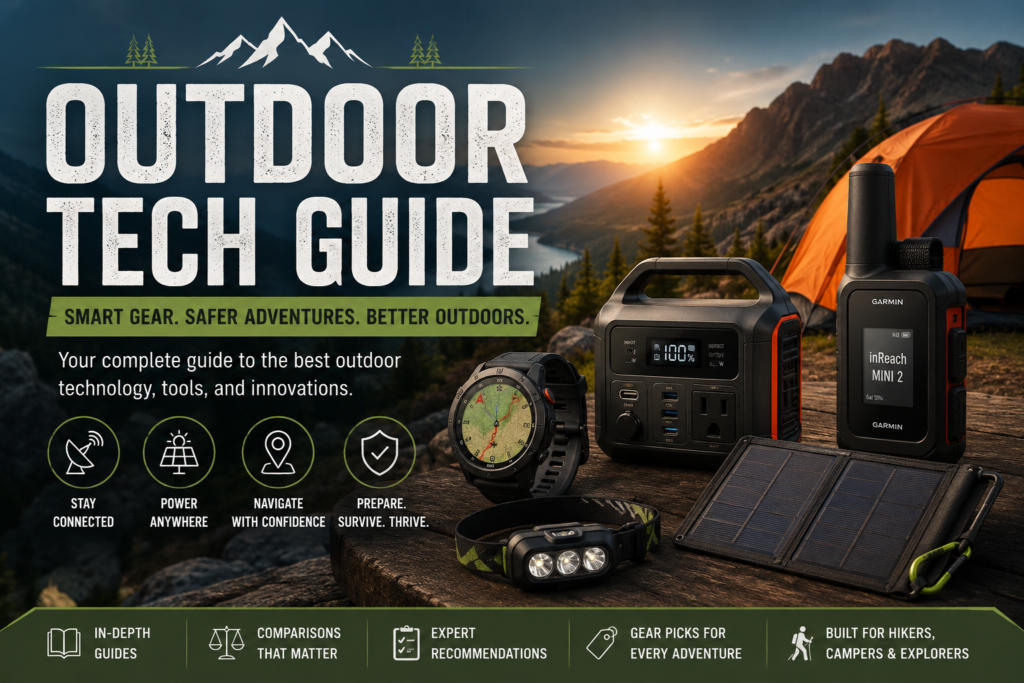
Outdoor technology is no longer just about carrying a flashlight, a power bank, and a GPS app. A serious outdoor tech guide now has to answer a deeper question: what technology actually improves safety, comfort, navigation, energy independence, and decision-making when you are away from predictable infrastructure?
The modern outdoor setup sits between two worlds. On one side, there is classic self-reliance: map reading, weather awareness, first-aid judgment, and practical packing. On the other side, there is smart outdoor gear: satellite communicators, portable solar panels, GPS watches, rugged power banks, action cameras, emergency radios, water-purification tools, and low-power lighting systems.
The mistake many people make is treating outdoor technology like a shopping list. They add more gadgets, more cables, more screens, and more weight. The better approach is to build an outdoor tech system. Each device should solve a real field problem: getting found, staying powered, navigating correctly, seeing after dark, preserving warmth, filtering water, documenting the trip, or receiving emergency information when the mobile network disappears.
For Schopping’s broader equipment hub, start with the main Outdoor Tech section before moving deeper into this buying guide. For the main site experience and broader shopping intelligence, visit the Homepage.
Quick Jump
| Section | Best For | Jump Link |
|---|---|---|
| What Is This Outdoor Tech Guide For? | Understanding the purpose of the page | Jump |
| Who Needs an Outdoor Tech Guide? | Matching gear to user type | Jump |
| Benefits of Outdoor Tech | Why tech matters outdoors | Jump |
| Outdoor Tech Buying Framework | The S.C.H.O.P Framework | Jump |
| Outdoor Tech Categories | Core gear types explained | Jump |
| Camping Tech Gear | Campsite comfort and power | Jump |
| Best Tech for Hiking | Trail-focused devices | Jump |
| How Satellite Communicators Work | Off-grid messaging and SOS | Jump |
| Solar Power for Camping | Charging and energy planning | Jump |
| Survival Tech Guide | Emergency-first equipment | Jump |
| GPS vs Satellite Communicator | Navigation vs communication | Jump |
| Best Outdoor Gadgets by Use Case | Matching products to scenarios | Jump |
| Outdoor Tech Setup by Trip Type | Day hike, camping, overlanding | Jump |
| Outdoor Tech Mistakes | What to avoid | Jump |
| Upcoming Trends & Latest Tech | Where outdoor gear is moving | Jump |
| Editorial Insights | Strategic closing guidance | Jump |
| FAQs | Search-optimized answers | Jump |
| People Also Ask | PAA-style answers | Jump |
What Is This Outdoor Tech Guide For?
This outdoor tech guide is designed to help a person choose useful technology for camping, hiking, backpacking, road trips, overlanding, fishing, hunting, emergency preparedness, and off-grid travel.
It is not a hype list of shiny gadgets. The purpose is to separate meaningful outdoor technology from unnecessary gear that adds cost, complexity, and weight without improving the outdoor experience.
A strong outdoor tech setup should answer five field questions:
| Field Question | Outdoor Tech That Helps | Why It Matters |
|---|---|---|
| Where am I? | GPS device, GPS watch, offline maps | Prevents route confusion |
| Can I contact help? | Satellite communicator, PLB, emergency radio | Supports emergency response outside cell coverage |
| Can I stay powered? | Power bank, portable power station, solar panel | Keeps critical devices alive |
| Can I see and move safely? | Headlamp, lantern, backup light | Reduces night-time risk |
| Can I handle changing conditions? | Weather radio, sensors, rugged smartwatch | Improves decision-making |
The best outdoor technology does not replace outdoor skill. It extends it. A satellite communicator does not make a reckless route safe. A solar panel does not fix poor battery planning. A GPS watch does not replace awareness of terrain, fatigue, daylight, and weather. The right technology supports judgment instead of pretending to substitute for it.
Who Needs an Outdoor Tech Guide?
An outdoor tech guide is useful for any person who spends time beyond ordinary home, road, or city infrastructure. The deeper the trip goes into low-signal, low-light, low-power, or high-weather-risk environments, the more important the tech system becomes.
1. Casual Campers
A casual camper usually needs comfort, lighting, charging, and basic emergency readiness. The most useful items are often simple: a reliable lantern, a rugged power bank, a compact weather radio, a rechargeable headlamp, and a multi-port charger.
For casual camping, the danger is overbuying. A person may not need an expensive satellite device or a large power station for a short campground stay with vehicle access. The better investment may be a clean lighting setup, safe battery storage, and a backup charging plan.
2. Hikers and Day-Trail Users
Hikers need navigation, battery efficiency, weather awareness, and safety signaling. A phone with offline maps can work well for short, familiar trails, but it becomes fragile when the battery drains, the screen breaks, weather turns, or the path becomes unclear.
For hiking, the most valuable technology is often the gear that remains useful when the phone fails: a GPS watch, emergency whistle, headlamp, small power bank, offline navigation device, or satellite communicator for remote routes.
3. Backpackers and Thru-Hikers
Backpackers face stricter weight and power limits. Every device must justify its place. The main priorities are low weight, battery life, durability, charging efficiency, and redundancy.
For this group, a great outdoor tech setup may include a lightweight power bank, compact satellite messenger, ultralight headlamp, offline map app, GPS watch, small solar panel for longer routes, and a strict cable system that avoids carrying three different charging standards.
4. Overlanders and Vehicle Campers
Vehicle-based travelers can carry heavier technology: portable power stations, solar panels, fridge systems, tire inflators, dash cams, recovery lights, GPS tablets, air compressors, and multi-device charging hubs.
The challenge for vehicle campers is not weight. It is system design. Power input, power output, cable management, waterproofing, storage, and redundancy matter more than owning the most expensive unit.
5. Emergency Preparedness Users
Some individuals want outdoor tech for storms, power outages, evacuations, wildfire risk, remote work backup, or home emergency kits. In this case, the gear should be simple enough to use under stress.
The strongest preparedness setup often includes a portable power station, solar panel, NOAA/weather radio where relevant, headlamps, rechargeable batteries, USB-C cables, water filtration, and a communication plan.
Benefits of Outdoor Tech
Outdoor technology is useful when it improves real field outcomes. The best outdoor gadgets create advantages in five areas: safety, navigation, power, comfort, and confidence.
Safety Benefit
The most important outdoor tech benefit is not entertainment. It is the ability to make better decisions when conditions become uncertain.
Satellite communicators can provide two-way messaging and SOS features beyond cell service, depending on the device and subscription. Garmin’s inReach category, for example, is built around off-grid messaging, location sharing, and SOS communication. NOAA also explains that 406 MHz emergency beacons are designed to alert search-and-rescue authorities when activated.
Navigation Benefit
Navigation technology reduces uncertainty. Offline maps, GPS watches, handheld GPS units, and route-planning apps help a person track position, distance, elevation, and estimated return time.
The real value is not just knowing where you are. It is knowing when to turn around.
A hiker who can see that sunset is two hours away, elevation gain is steeper than expected, and battery reserve is low can make a safer decision before the situation becomes dramatic.
Power Benefit
Power is the bloodstream of modern outdoor tech. Without battery planning, even expensive devices become dead weight.
Portable power stations and camping power banks have become a larger category as outdoor travel, emergency backup, and mobile work have grown. Recent market coverage continues to frame portable power and camping power banks as expanding categories, while 2026 outdoor gear awards and reviews also highlight portable power as a major outdoor segment.
Comfort Benefit
Technology can make outdoor time more comfortable without ruining the natural experience. Better lighting reduces campsite stress. Small fans help in warm tents. Heated gear may help in cold conditions. Compact sleep tech can improve rest. Solar cooking tools, rechargeable lanterns, and efficient coolers can make camp life smoother.
The goal is not to turn a campsite into a living room. The goal is to reduce avoidable friction.
Confidence Benefit
Good outdoor tech gives a person more confidence because the system has been thought through. The confidence does not come from owning gadgets. It comes from knowing what each item does, how long it lasts, how it charges, and what backup exists if it fails.
Outdoor Tech Buying Framework
The best way to choose outdoor technology is to think in layers, not products.
The S.C.H.O.P. Framework for Outdoor Tech
| Layer | Meaning | Main Question | Example Gear |
|---|---|---|---|
| S | Safety | Can I call for help or signal distress? | Satellite communicator, PLB, emergency radio |
| C | Charging | Can I keep critical devices powered? | Power bank, solar panel, power station |
| H | Hardware Durability | Can it survive weather, dust, drops, and cold? | Rugged GPS, waterproof lights, sealed batteries |
| O | Orientation | Can I navigate and track my route? | GPS watch, offline maps, compass backup |
| P | Practical Comfort | Does it improve camp function without excess weight? | Lantern, water filter, camp fan, camera |
A person should not start with “What is the coolest gadget?” The better question is: “Which layer is weakest in my current setup?”
For example, someone with a great phone, camera, and speaker may still have no emergency communication outside mobile coverage. Another person may own a satellite communicator but forget to bring enough power to keep the phone alive for mapping. A vehicle camper may own a large power station but lack a simple headlamp when leaving camp after dark.
Outdoor technology works best when the full system is balanced.
Outdoor Tech Categories
Outdoor tech can be organized into seven practical categories.
| Category | Main Purpose | Best For | Common Mistake |
|---|---|---|---|
| Navigation Tech | Location and route awareness | Hiking, backpacking, overlanding | Depending only on live mobile data |
| Communication Tech | Messaging and emergency contact | Remote trails, solo trips | Forgetting subscription or registration |
| Power Tech | Charging and energy storage | Camping, photography, emergency kits | Underestimating cold-weather battery drain |
| Lighting Tech | Visibility and campsite function | All outdoor users | Carrying only one light |
| Weather Tech | Forecasting and alerts | Camping, storms, remote travel | Ignoring local terrain effects |
| Water & Food Tech | Purification, cooking, cooling | Camping, backpacking | Choosing convenience over reliability |
| Capture Tech | Photo, video, drone, action footage | Travel, creators, scouting | Carrying camera gear without power planning |
The strongest setup rarely requires every category. It requires the right category mix for the trip.
Camping Tech Gear
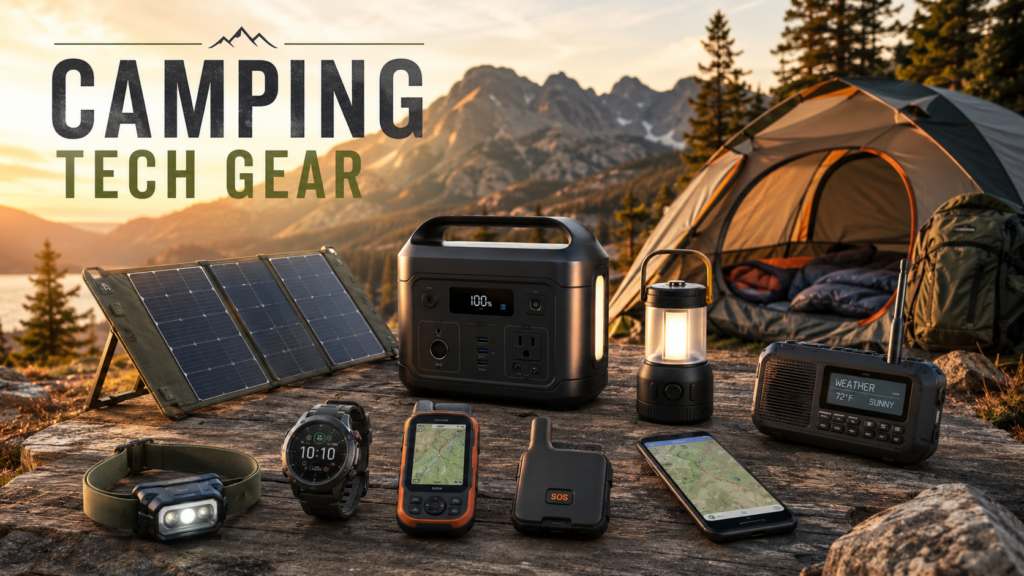
Camping tech gear focuses on comfort, lighting, cooking support, charging, weather awareness, and campsite organization.
Camping is different from hiking because weight is usually less restrictive, especially when the person is staying near a vehicle. That allows for more capable power systems, larger lanterns, better food storage, and multi-device charging.
Essential Camping Tech Gear
| Camping Need | Recommended Tech | Why It Helps |
|---|---|---|
| Night lighting | Rechargeable lantern + headlamp | Covers both campsite and personal movement |
| Device charging | Power bank or power station | Keeps phones, lights, cameras, and GPS alive |
| Weather awareness | Weather radio or alert-capable device | Helps with storm planning |
| Food storage | Electric cooler or efficient passive cooler | Supports longer stays |
| Cooking support | Electric kettle, solar cooker, induction-compatible power setup | Useful for controlled campsites |
| Sleep comfort | Compact fan, sleep earbuds, heated pad where safe | Improves rest in harsh conditions |
A good camping setup should be calm. Too many gadgets can create cable clutter, charging anxiety, and setup fatigue. The better campsite system has zones: lighting zone, charging zone, cooking zone, sleeping zone, and emergency zone.
Camping Power Planning Chart
| Trip Length | Suggested Power Setup | Notes |
|---|---|---|
| 1 night | 10,000–20,000 mAh power bank | Enough for phone, headlamp, small accessories |
| 2–3 nights | 20,000–30,000 mAh power bank or compact power station | Better for two people or camera use |
| 3–5 nights | Portable power station + solar panel | Useful for lights, phones, cooler, camera batteries |
| 5+ nights | Power station + solar + strict energy budget | Requires input/output planning |
Best Tech for Hiking
The best tech for hiking is not the gear with the largest screen or longest feature list. It is the gear that stays useful when the trail becomes tiring, wet, confusing, dark, or remote.
Hiking technology must be light, readable, efficient, durable, and easy to operate with cold hands or low patience. This is where many stylish gadgets fail. A touchscreen that works beautifully at home may become frustrating in rain, snow, sweat, or bright sunlight.
Core Hiking Tech Stack
| Priority | Gear | Why It Matters |
|---|---|---|
| Navigation | Offline maps, GPS watch, handheld GPS | Reduces route uncertainty |
| Communication | Satellite communicator for remote areas | Helps when cell service disappears |
| Lighting | Headlamp with spare battery or backup light | Essential if the hike runs late |
| Power | Lightweight power bank | Protects phone and navigation uptime |
| Weather | Weather app before departure + emergency radio where relevant | Supports go/no-go decisions |
| Documentation | Action camera or phone camera | Optional unless content capture matters |
Hiking Tech Weight Logic
For hiking, every extra item has a hidden cost. Weight affects fatigue. Fatigue affects judgment. Judgment affects safety.
That means outdoor tech for hiking should be judged by its value-per-ounce.
| Device | Field Value | Weight Tolerance |
|---|---|---|
| Headlamp | Very high | Always worth carrying |
| Small power bank | High | Worth carrying on most hikes |
| Satellite communicator | Very high in remote areas | Worth it when outside reliable coverage |
| Drone | Low to moderate | Only for planned photography |
| Bluetooth speaker | Low | Usually unnecessary on trails |
| Large camera kit | Moderate to high | Worth it only for photography-focused trips |
How Satellite Communicators Work
Satellite communicators are designed for places where normal mobile service is unreliable or unavailable. They connect through satellite networks rather than cell towers, allowing certain devices to send messages, share location, and trigger SOS support depending on the model and plan.
This is different from a normal GPS receiver. GPS can help a device determine location, but GPS alone does not send a message to anyone. A satellite communicator adds communication.
What a Satellite Communicator Does
| Function | What It Means | Why It Matters |
|---|---|---|
| Two-way messaging | Send and receive text-style messages | Lets contacts know what is happening |
| Location sharing | Shares coordinates or route updates | Helps others track progress |
| SOS activation | Sends emergency request through supported response system | Critical in remote emergencies |
| Weather access | Some devices can request forecasts | Helps with trip decisions |
| Phone pairing | Many devices pair with apps | Easier typing and map interaction |
Modern satellite communicators are often discussed alongside dedicated hiking gadgets, GPS watches, and emergency tools because they address one of the biggest outdoor weaknesses: no mobile network. OutdoorGearLab’s 2026 satellite communicator coverage, Garmin’s official inReach pages, and NOAA’s emergency beacon resources all point to the same underlying demand: remote communication and emergency signaling matter when normal infrastructure is absent.
Satellite Communicator vs PLB
A satellite communicator and a personal locator beacon are not the same thing.
| Device Type | Best For | Strength | Limitation |
|---|---|---|---|
| Satellite communicator | Messaging, tracking, SOS | Two-way communication on many models | Usually requires subscription |
| PLB | Emergency distress signaling | Dedicated emergency beacon function | Typically no casual messaging |
| GPS watch with satellite features | Wearable safety and tracking | Convenient on-wrist access | Smaller screen and battery trade-offs |
| Smartphone satellite SOS | Basic emergency use in supported regions | No extra device for some users | Coverage and feature limits vary |
For remote trips, the best choice depends on risk. A solo hiker in deep backcountry has different needs than a family at a maintained campground.
Solar Power for Camping
Solar power for camping is useful when the trip is long enough for battery storage alone to become limiting. Solar does not replace power banks or power stations. It refills them.
The biggest misconception is expecting a small solar panel to behave like a wall outlet. Outdoor solar performance depends on panel size, sunlight angle, weather, shade, cable efficiency, and the charging behavior of the device being powered.
Solar Camping Setup
| Component | Purpose | Practical Advice |
|---|---|---|
| Solar panel | Captures energy | Choose based on trip length and sunlight exposure |
| Power bank | Stores small-device power | Best for phones, headlamps, GPS units |
| Power station | Stores larger energy | Best for coolers, cameras, laptops, camp lighting |
| Charge controller/system | Manages input | Usually integrated in modern systems |
| Cables/adapters | Connects devices | Standardize around USB-C when possible |
Solar Power Decision Table
| Scenario | Solar Needed? | Better Setup |
|---|---|---|
| One-night campground trip | Usually no | Power bank |
| Weekend camping with phones only | Maybe | Larger power bank |
| Multi-day camping with camera gear | Yes | Solar panel + power station |
| Overlanding with fridge | Yes | Solar + vehicle charging + power station |
| Emergency home backup | Yes | Power station + solar panel |
Solar works best when treated as part of a charging rhythm. Charge during daylight. Store energy in a battery. Use that battery at night. Avoid charging every device directly from the panel unless the system is stable and designed for it.
Survival Tech Guide
A survival tech guide should begin with one uncomfortable truth: survival technology is only useful if it works under pressure.
In an emergency, a person may be cold, tired, injured, wet, panicked, or unable to think clearly. That means survival tech should be simple, rugged, easy to activate, and stored in predictable locations.
Survival Tech Priorities
| Priority | Gear | Why It Matters |
|---|---|---|
| Emergency signaling | PLB, satellite communicator, whistle, mirror | Helps others locate you |
| Light | Headlamp, backup flashlight, lantern | Prevents movement in darkness |
| Power | Rugged power bank, spare batteries | Keeps critical devices alive |
| Water | Filter, purifier, purification tablets | Supports basic survival |
| Weather | Emergency radio, weather alerts | Helps avoid exposure risk |
| Heat | Electric hand warmer, fire starter, emergency blanket | Helps manage cold stress |
| Location | GPS, offline maps, physical map, compass | Reduces disorientation |
The Redundancy Rule
Survival tech should follow a two-layer rule:
| Function | Primary Tool | Backup Tool |
|---|---|---|
| Navigation | GPS/offline maps | Paper map and compass |
| Communication | Satellite communicator | PLB or emergency signal tools |
| Lighting | Headlamp | Small flashlight |
| Fire/heat | Stove or lighter | Waterproof matches/fire starter |
| Power | Power bank | Spare batteries or solar refill |
The backup does not need to be expensive. It needs to work when the primary tool fails.
GPS vs Satellite Communicator
The keyword GPS vs satellite communicator represents one of the most important outdoor-tech comparisons.
People often confuse GPS with satellite communication because both involve satellites. But they solve different problems.
GPS vs Satellite Communicator Comparison
| Feature | GPS Device | Satellite Communicator |
|---|---|---|
| Main job | Shows location and navigation data | Sends messages/location/SOS through satellite network |
| Communication ability | Usually none by itself | Yes, depending on model and plan |
| Emergency support | May show coordinates | Can trigger supported SOS services |
| Subscription | Usually not required for basic GPS | Often required |
| Best for | Navigation | Remote communication and safety |
| Weakness | Cannot contact help alone | May have messaging delays, subscription costs, sky-view limits |
A GPS device answers: “Where am I?”
A satellite communicator answers: “Can I tell someone where I am and what is happening?”
For a short local trail, GPS may be enough. For remote hiking, solo travel, off-road routes, wilderness photography, or areas with poor cell coverage, a satellite communicator can become a serious safety tool.
Best Outdoor Gadgets by Use Case
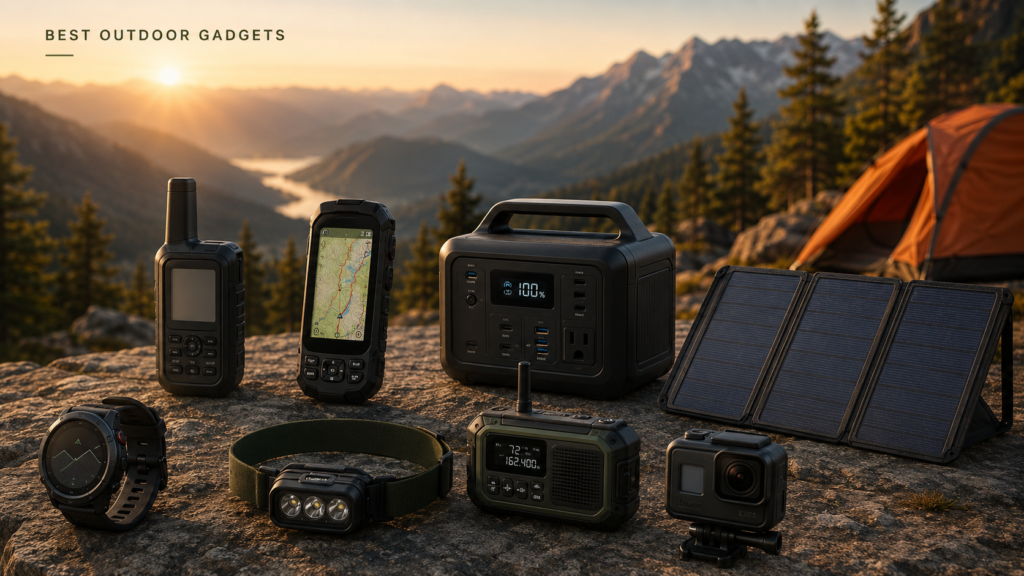
The phrase best outdoor gadgets can become too broad unless the gear is organized by real outdoor situations. A campsite, hiking trail, emergency kit, and overlanding vehicle all need different technology.
Best Outdoor Gadgets by Scenario
| Use Case | Best Outdoor Gadgets | Why They Fit |
|---|---|---|
| Day hiking | Headlamp, small power bank, offline maps, GPS watch | Lightweight and practical |
| Remote hiking | Satellite communicator, GPS device, emergency beacon, power bank | Safety and navigation focused |
| Family camping | Lanterns, power station, weather radio, electric cooler | Comfort and group utility |
| Backpacking | Ultralight headlamp, compact solar panel, small communicator | Weight-conscious reliability |
| Overlanding | Power station, solar panel, GPS tablet, tire inflator, dash cam | Vehicle-based self-sufficiency |
| Emergency kit | Radio, power bank, solar charger, water purifier, lighting | Home and evacuation readiness |
| Outdoor content creation | Action camera, drone where allowed, mic, camera power system | Documentation and storytelling |
The best outdoor gadget is not the most impressive object in a product photo. It is the device that solves a specific problem without creating three new ones.
Outdoor Tech Setup by Trip Type
Different trips need different levels of technology. The easiest way to avoid overpacking is to build from the trip type.
1. One-Day Hike Setup
| Gear | Recommended? | Notes |
|---|---|---|
| Phone with offline maps | Yes | Download maps before leaving |
| Headlamp | Yes | Even for day hikes |
| Small power bank | Yes | Especially for navigation-heavy trips |
| GPS watch | Optional | Useful for distance/elevation |
| Satellite communicator | Depends | Recommended for remote or solo hikes |
| Camera/drone | Optional | Only if content capture is planned |
2. Weekend Camping Setup
| Gear | Recommended? | Notes |
|---|---|---|
| Lantern | Yes | Choose rechargeable or hybrid battery |
| Headlamps | Yes | One per person |
| Power bank | Yes | Minimum for phones and lights |
| Power station | Optional | Useful for families, coolers, cameras |
| Weather radio | Optional to recommended | More important in storm-prone areas |
| Solar panel | Optional | Useful if staying beyond two nights |
3. Backpacking Setup
| Gear | Recommended? | Notes |
|---|---|---|
| Lightweight power bank | Yes | Balance capacity and weight |
| Headlamp | Yes | Choose efficient low mode |
| Satellite communicator | Recommended | Especially for solo or remote routes |
| GPS watch/offline maps | Recommended | Route tracking and elevation |
| Solar panel | Depends | More useful on long, sunny routes |
| Camera gear | Optional | Must justify weight |
4. Overlanding Setup
| Gear | Recommended? | Notes |
|---|---|---|
| Portable power station | Yes | Core vehicle-camp energy source |
| Solar panel | Yes | Extends off-grid stay |
| GPS tablet/device | Recommended | Useful for route planning |
| Satellite communicator | Recommended | Important beyond cell coverage |
| Tire inflator | Recommended | Practical recovery support |
| Dash/action camera | Optional | Useful for documentation |
Outdoor Tech Mistakes
Outdoor technology can become a liability when it is chosen poorly or used carelessly.
Mistake 1: Depending Only on a Phone
A phone is powerful, but it is also fragile. It can run out of battery, lose signal, overheat, freeze, break, or become hard to use in rain. A phone should be part of the system, not the whole system.
Mistake 2: Carrying Gadgets Without Testing Them
A satellite communicator should be paired and tested before the trip. Offline maps should be downloaded before losing service. A power station should be charged. A headlamp should be checked at night. A solar panel should be tested in real sun, not only unboxed at home.
Mistake 3: Ignoring Cable Compatibility
Many outdoor tech failures are not dramatic. They are small and annoying: the wrong cable, a loose adapter, a missing wall plug, a charging port that only works one way, or a cable that fails in cold weather.
Standardizing around USB-C where possible reduces friction.
Mistake 4: Overvaluing Features and Undervaluing Runtime
A device with ten advanced features may be worse than a simpler device with excellent battery life. Outdoor conditions reward endurance.
Mistake 5: Buying for the Imagined Trip Instead of the Real Trip
A person planning normal weekend camping may not need expedition-grade gear. A person planning remote solo routes should not rely on casual gadgets. The correct setup is based on actual terrain, weather, distance, signal coverage, and personal skill.
Upcoming Trends and Latest Tech
Outdoor technology is moving toward smaller, smarter, more integrated systems. Recent 2026 gear coverage highlights strong interest in portable power stations, action cameras, drones, accessible outdoor equipment, and compact camping upgrades, showing that outdoor tech is expanding beyond niche enthusiast gear into broader lifestyle and safety use.
1. Satellite Safety Moving Into Wearables
Satellite communication is no longer limited to large handheld devices. More watches and compact devices are adding emergency and messaging features. The trend is clear: safety tools are becoming smaller and easier to keep on the body.
2. Portable Power Becoming a Core Outdoor Category
Portable power stations are becoming central to camping, overlanding, remote work, and emergency backup. The next stage is not just higher capacity. It is smarter energy management, faster solar input, safer batteries, and better app-based monitoring.
3. Solar Gear Becoming More Practical
Solar panels are becoming lighter, more foldable, and more integrated with power stations. The key improvement is usability. A solar system that is technically powerful but annoying to set up will lose to a slightly less powerful system that a person actually uses every day.
4. Rugged Smartwatches Becoming Outdoor Control Centers
GPS watches now combine route tracking, health metrics, weather tools, elevation data, training insights, and sometimes emergency features. For hikers and trail runners, the watch is becoming a dashboard for the body and the environment.
5. Outdoor Cameras Getting Smaller and More Stabilized
Action cameras and compact drones continue to shape outdoor content. The important shift is that footage quality is no longer the only factor. Stabilization, battery strategy, low-light performance, waterproofing, mounting, and fast file transfer matter more in the field.
6. Accessibility and Inclusive Outdoor Tech
Outdoor gear is also becoming more inclusive. Recent award coverage has highlighted accessible outdoor innovation, showing that modern outdoor design is beginning to consider more body types, mobility needs, and adaptive use cases.
Editorial Insights
The best outdoor tech setup is not the one with the most devices. It is the one with the fewest weak points.
A strong outdoor system should let a person navigate clearly, communicate when needed, stay powered, see after dark, respond to weather, and reduce unnecessary discomfort. Everything else is optional.
For short trips, keep the setup simple: phone, offline maps, headlamp, power bank, basic emergency tools. For remote trips, add communication and redundancy. For vehicle-based camping, build a real power system. For backpacking, obsess over weight and runtime. For emergency readiness, choose devices that are easy to operate under stress.
Outdoor technology is entering a more mature phase. The future will not only be about brighter lights, bigger batteries, or sharper cameras. The real movement is toward dependable systems that help ordinary people make better decisions outside.
FAQs
What is the best outdoor tech guide for beginners?
The best outdoor tech guide for beginners is one that starts with safety, navigation, lighting, and power before moving into comfort gadgets or camera gear. A beginner does not need the most advanced outdoor technology on the first trip. They need a reliable setup that handles the most common outdoor problems: getting lost, running out of battery, being caught after dark, losing cell service, or dealing with weather changes.
A simple beginner outdoor tech setup may look like this:
| Beginner Need | Recommended Tech | Why It Matters |
|---|---|---|
| Navigation | Phone with offline maps | Helps follow route without live data |
| Backup power | 10,000–20,000 mAh power bank | Keeps phone and light charged |
| Lighting | Headlamp | Essential after sunset |
| Emergency awareness | Weather app before trip, radio for longer camping | Reduces weather surprise |
| Remote safety | Satellite communicator for isolated areas | Helps outside cell coverage |
For most beginners, the smartest approach is to buy fewer items and learn them well. A basic headlamp used correctly is more valuable than an expensive gadget sitting uncharged in a backpack.
What tech do I need for camping?
For camping, the most useful tech includes lighting, charging, weather awareness, food storage support, and emergency communication if the campsite is remote. The exact setup depends on whether the person is camping near a vehicle, hiking into a site, or staying off-grid for several days.
| Camping Style | Recommended Tech |
|---|---|
| Campground camping | Lantern, headlamp, power bank, charging cables |
| Family camping | Power station, lanterns, electric cooler, weather radio |
| Remote camping | Satellite communicator, solar panel, GPS, emergency radio |
| Minimalist camping | Headlamp, small power bank, offline maps |
| Long-stay camping | Solar panel, power station, backup batteries |
The mistake is treating camping tech as luxury only. Some items are comfort tools, but others are safety tools. Lighting, charging, and weather awareness can directly affect how smoothly the trip goes.
Are the best outdoor gadgets worth it?
The best outdoor gadgets are worth it when they solve a field problem better than a simpler alternative. A satellite communicator can be worth it for remote travel. A headlamp is worth it for almost every outdoor trip. A portable power station may be worth it for vehicle camping, but unnecessary for a short day hike.
Use this value chart:
| Gadget Type | Worth It When | Less Useful When |
|---|---|---|
| Satellite communicator | Remote, solo, or high-risk trips | Urban parks or maintained campgrounds |
| Power station | Vehicle camping, family trips, long stays | Backpacking or short hikes |
| GPS watch | Frequent hiking/training | Rare casual walks |
| Solar panel | Multi-day off-grid trips | One-night trips |
| Action camera | Content creation or documentation | Weight-sensitive hiking |
A gadget becomes worth it when its usefulness is greater than its weight, cost, learning curve, and charging demand.
Is camping tech gear different from hiking tech gear?
Yes. Camping tech gear usually focuses on comfort and campsite function, while hiking tech gear focuses on weight, navigation, safety, and battery efficiency.
| Category | Camping Tech Gear | Hiking Tech Gear |
|---|---|---|
| Power | Larger power bank or power station | Lightweight power bank |
| Lighting | Lantern + headlamp | Headlamp + backup mini light |
| Navigation | Optional at camp | Essential on trail |
| Comfort | Fan, cooler, camp speaker, sleep gear | Minimal comfort items |
| Safety | Weather radio, emergency light | Satellite communicator, GPS, whistle |
A camping setup can tolerate more weight. A hiking setup cannot. That is why a device that makes sense at a campsite may be a poor choice in a backpack.
How much should a person spend on outdoor tech?
A person should spend based on trip risk, not gadget excitement. A short campground stay may only require a modest budget for lights and charging. Remote solo hiking may justify a higher spend on satellite communication, navigation, and reliable power.
| Budget Level | Suggested Focus |
|---|---|
| Low budget | Headlamp, power bank, offline maps, basic emergency tools |
| Mid budget | Better lighting, GPS watch, larger power bank, weather radio |
| Higher budget | Satellite communicator, portable power station, solar panel |
| Expedition budget | Redundant communication, rugged GPS, power system, backup devices |
A smart outdoor tech budget prioritizes failure points first. Spend on the gear that protects safety, navigation, and power before buying entertainment or content gear.
People Also Ask
What is outdoor tech?
Outdoor tech refers to electronic, smart, rugged, or power-assisted gear designed for use outside normal indoor infrastructure. It includes GPS devices, satellite communicators, power banks, solar panels, headlamps, action cameras, emergency radios, smartwatches, water purifiers, and portable power stations.
| Outdoor Tech Type | Main Purpose |
|---|---|
| GPS and mapping | Navigation |
| Satellite devices | Communication and emergency support |
| Power banks and solar | Energy supply |
| Headlamps and lanterns | Visibility |
| Weather radios | Alerts and information |
| Cameras and drones | Documentation |
Outdoor tech is best understood as a support system. It helps a person manage uncertainty outdoors.
What is the most useful outdoor gadget?
The most useful outdoor gadget for most people is a reliable headlamp because it solves a universal outdoor problem: darkness. A phone is powerful, but a headlamp leaves both hands free, works during camp tasks, helps with trail movement, and can become critical during delays.
For remote trips, a satellite communicator may become the most important gadget. For vehicle camping, a power station may provide the greatest overall benefit. Use case matters.
| User Type | Most Useful Gadget |
|---|---|
| Day hiker | Headlamp |
| Remote hiker | Satellite communicator |
| Family camper | Lantern or power station |
| Backpacker | Lightweight power bank |
| Outdoor creator | Action camera |
| Emergency prep user | Radio + power bank |
The best answer depends on the environment and risk level.
Do I need a GPS if I have a phone?
A person may not need a separate GPS for simple trails with clear routes and reliable phone battery. However, a dedicated GPS device or GPS watch becomes more useful when the trail is remote, long, poorly marked, cold, wet, or outside cell coverage.
A phone can navigate well with offline maps, but it has weaknesses: battery drain, fragile screen, water exposure, overheating, freezing, and distraction.
| Situation | Phone Only | Dedicated GPS Helpful? |
|---|---|---|
| City park walk | Usually enough | No |
| Short marked trail | Usually enough | Optional |
| Long mountain hike | Risky alone | Yes |
| Remote backpacking | Not ideal alone | Yes |
| Off-road travel | Limited | Yes |
A phone is excellent, but outdoor navigation should have backup layers.
Is a satellite communicator better than GPS?
A satellite communicator is not simply “better” than GPS because it does a different job. GPS helps determine location. A satellite communicator helps send messages, location updates, or SOS requests through a satellite network.
For navigation, GPS is the main tool. For remote communication, a satellite communicator is the stronger tool.
| Need | Better Tool |
|---|---|
| Knowing current location | GPS |
| Following a route | GPS/offline maps |
| Sending check-in messages | Satellite communicator |
| Requesting emergency help outside cell coverage | Satellite communicator or PLB |
| Sharing location with family | Satellite communicator |
The strongest outdoor safety setup may use both.
Is solar power for camping worth it?
Solar power for camping is worth it when the trip lasts long enough that stored battery power may run low. It is especially useful for multi-day camping, overlanding, emergency backup, camera-heavy trips, and powering devices beyond phones.
Solar is less useful for one-night trips, shaded campsites, rainy routes, or small devices that can be handled by a power bank.
| Trip Type | Solar Worth It? |
|---|---|
| One-night camping | Usually no |
| Weekend camping | Sometimes |
| Multi-day camping | Yes |
| Overlanding | Yes |
| Backpacking under heavy tree cover | Limited |
| Emergency home backup | Yes |
Solar works best when paired with storage. The panel collects energy. The power bank or power station makes that energy usable when needed.