
Amazon Affiliate Disclosure
Schopping.com may participate in affiliate programs, including the Amazon Services LLC Associates Program. This means we may earn a commission when readers click certain links and make qualifying purchases. This does not change the price you pay, and it does not influence our editorial approach to digital assets, online businesses, domain names, or brand-building opportunities.
Quick Picks: Jump to the Digital Asset Type You Need
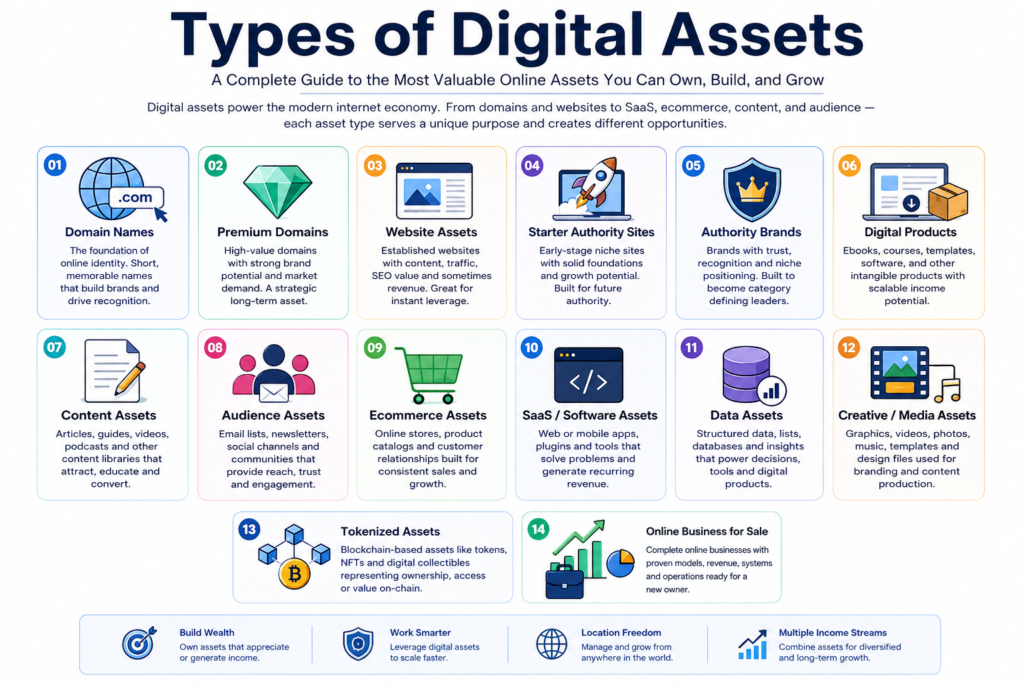
Use this guide as a practical map. Digital assets are not all the same. Some are simple ownership assets, like domain names. Others are operating assets, like content sites, ecommerce stores, newsletters, apps, or monetized communities.
Choose Your Buyer Goal
Select what you want to achieve, and this guide will match you with the most suitable digital asset type, why it fits, and where to continue reading.
Premium domain names
Premium domain names are ideal when the buyer wants to start with a memorable, brandable, and commercially flexible identity. A strong domain can improve trust, make marketing cleaner, and give the project a sharper category position from day one.
Why Understanding the Types of Digital Assets Matters
The phrase types of digital assets sounds simple until you try to buy one.
A domain name, a niche website, an email newsletter, a digital product, an ecommerce store, a YouTube channel, and a SaaS tool can all be called digital assets. Yet they behave very differently. Some are raw strategic assets. Some are income-producing properties. Some depend heavily on search engines, algorithms, audience trust, or technical maintenance. Others are valuable because they hold a name, a niche, a brand identity, or a route into a market.
That distinction matters.
A buyer looking for a memorable brand name should not evaluate a domain the same way they evaluate a content website. A founder buying a starter authority site should not judge it like a fully operating online business. A creator buying a newsletter should care about engagement quality more than subscriber volume. A brand owner buying a digital product library should examine licensing, originality, positioning, and customer demand.
Schopping.com’s digital assets hub is built around that practical difference. This page explains the major categories clearly, so entrepreneurs can understand what they are looking at before comparing prices, negotiating deals or choosing between building and buying.
For a broader entry point into this asset category, visit the Schopping digital assets hub.
What This Guide Is For
This guide is designed to help you understand the main categories of digital assets before you move into deeper buying, valuation, or brand-selection decisions.
It does not try to teach every detail of how to buy, appraise, or negotiate a deal. Those are separate buyer-education topics. Instead, this page answers a more foundational question:
What kinds of digital assets exist, and which type matches your goal?
By the end, you should be able to separate:
- Naming assets from operating assets
- Pre-revenue assets from revenue-generating assets
- Traffic assets from audience assets
- Product assets from platform assets
- Brandable assets from SEO-driven assets
- Low-maintenance assets from assets that require daily management
That clarity helps prevent one of the most common buyer mistakes: paying operating-business prices for an asset that is really only an idea, a name, a shell, or an early-stage foundation.
Who Needs This Guide?
This page is useful for several types of buyers and builders.
Entrepreneurs Looking for a Faster Start
If you want to launch a business online, buying the right digital asset can reduce the distance between idea and market. A strong domain, a starter site, or a small content property can give you a base to build from instead of starting with a blank page.
Domain Buyers and Brand Builders
If your priority is naming, positioning, credibility, or category ownership, domain name assets are often the first place to look. A premium domain can shape how customers understand the business before they read a single sentence.
For buyers exploring naming assets directly, Schopping’s premium domain names for sale page is the most relevant commercial destination.
Investors Studying Online Business Assets
Some buyers treat digital assets like small online properties. They look for content, traffic, revenue, search visibility, backlinks, products, or communities that can be improved over time.
Content Publishers and Affiliate Site Owners
Publishers often buy website assets, expired domains, topical content libraries, or starter authority sites to accelerate niche coverage. The goal is usually topical authority, search traffic, affiliate income, display advertising, or lead generation.
Creators and Operators
Creators may treat email lists, social accounts, podcasts, communities, online courses, and digital templates as assets. These may not look like traditional businesses, but they can hold real commercial value when audience trust is strong.
Benefits and Use Cases of Digital Assets
Digital assets are valuable because they can compress time.
A strong domain can save months of naming frustration. A starter authority site can shorten the publishing setup phase. A newsletter can provide direct access to a specific audience. A digital product can generate scalable revenue without physical inventory. A SaaS product can create recurring revenue if the problem is painful enough and retention is healthy.
The main use cases include:
Faster Market Entry
Instead of registering a weak available domain, designing a brand from zero, and waiting for search engines to understand the site, a buyer can acquire a more mature foundation. This is especially useful in competitive categories where trust and recall matter.
Brand Positioning
Digital assets can create instant framing. A clean domain, a focused content site, or a niche authority brand tells visitors what the business is about before the sales page begins.
Revenue Expansion
Some assets already produce income through affiliate programs, ads, sponsorships, product sales, subscriptions, or leads. Others are not yet monetized but can be developed into revenue channels.
Search Visibility
SEO-oriented digital assets can support organic traffic growth when they have relevant content, clean architecture, topical focus, and legitimate authority signals.
Audience Ownership
Email lists, private communities, and paid memberships reduce dependence on search engines and social algorithms. They give brands a more direct relationship with readers, buyers, and supporters.
Product Leverage
Digital products can be sold repeatedly without physical stock. Templates, ebooks, software tools, calculators, courses, and downloadable resources can become high-margin assets when paired with traffic or audience trust.
The Main Types of Digital Assets
1. Domain Name Assets
A domain name is often the cleanest form of digital asset ownership. It may not have content, traffic, or revenue, but it can hold strategic value through language, category fit, memorability, brevity, commercial intent, and brand potential.
A domain is not just an address. In the right market, it becomes a positioning tool.
Common Types of Domain Name Assets
| Domain Type | Description | Best For |
|---|---|---|
| Premium domains | Short, memorable, commercially strong names | Brand launches, acquisitions, authority positioning |
| Brandable domains | Invented, suggestive, or emotionally memorable names | Startups, apps, ecommerce brands, creator-led businesses |
| Exact-match domains | Domains matching a product, service, or keyword | SEO-oriented businesses, lead generation, niche commerce |
| Category domains | Names that define an industry or vertical | Authority sites, marketplaces, directories |
| Aged domains | Older domains with history | SEO projects, brand trust, redirects when appropriate |
| Geo domains | Location-specific names | Local services, tourism, real estate, directories |
Why Domain Name Assets Matter
A good domain can reduce friction. It is easier to remember, easier to type, easier to trust, and easier to build into a brand. The best domain name assets are not merely available names; they are names that can carry commercial meaning.
For buyers who want a stronger naming asset with marketplace-level credibility, Schopping’s Atom premium domains section features brandable digital assets built for sharper positioning, cleaner launch identity, and long-term online business growth.
A weak name can make even a good business feel forgettable. A strong domain can make a young business feel established earlier.
When a Domain Is the Right Asset
Choose a domain name asset when your biggest need is identity, category clarity, brand recall, or strategic ownership. If you already know the business model but need a better name, a domain may be the highest-leverage purchase.
2. Website Assets
Website assets are more developed than domain names. They usually include content, design, structure, search indexation, plugins, analytics history, and sometimes revenue.
A website asset can be a blog, affiliate site, local lead-generation site, ecommerce store, directory, review site, tool site, or niche publication.
What Makes a Website Asset Valuable?
The value is usually connected to several signals:
- Clean site structure
- Original content depth
- Organic traffic quality
- Keyword rankings
- Revenue history
- Niche relevance
- Backlink profile
- Conversion potential
- Technical condition
- Brand expansion room
A website asset is closer to a property than a name. It can require updates, maintenance, content planning, security, analytics review, and monetization work.
Add this section after the “Website Assets” section or just before the “Comparison Chart”. It fits naturally because it bridges asset types with buyer intent without overlapping too much with your “how to buy” or “valuation” pages.
Online Business for Sale: When a Digital Asset Becomes a Business Opportunity
Not every digital asset is just a name, file, website, or content library. Some assets cross into a more commercially developed stage for entrepreneurs to buy online business for sale. This usually means the asset is already structured around revenue, traffic, customers, products, leads, subscribers, or repeatable operations.
When buyers search for websites for sale or online businesses for sale, they are usually not looking for a blank domain or a simple landing page. They want something with a working commercial foundation. That could be a niche content website earning affiliate income, an ecommerce store with existing customers, a digital product brand, a lead-generation site, a newsletter business, a SaaS tool, or a starter authority brand with a clear monetization path.
The important distinction is this: a digital asset can hold potential, but an online business should show a path toward performance.
For buyers comparing domains, starter sites, websites, and brand-ready assets, the broader digital assets marketplace at Schopping helps organize these opportunities by asset type, business model, and growth potential.
What Counts as an Online Business for Sale?
An online business for sale may include several connected digital assets working together. Instead of selling only one item, the seller may be transferring a full operating package.
This can include:
- A domain name and live website
- Published content and site architecture
- Affiliate accounts or monetization channels
- Ecommerce products or supplier relationships
- Email subscribers or customer lists
- Social media accounts connected to the brand
- Digital products, templates, or downloadable resources
- Analytics history, traffic data, and revenue records
- Brand files, logos, design systems, and content guidelines
A buyer who wants to buy online business for sale listings should look beyond the surface. A beautiful website does not automatically mean a strong business. The real value comes from the quality of traffic, the reliability of revenue, the clarity of the niche, and the amount of work required to keep the business growing.
Common Types of Online Businesses for Sale
| Online Business Type | What the Buyer Usually Gets | Best For |
|---|---|---|
| Content websites | Articles, rankings, traffic, affiliate or ad revenue | SEO publishers and niche investors |
| Ecommerce stores | Product pages, customer data, supplier systems, brand assets | Operators who understand fulfillment and margins |
| Digital product businesses | Ebooks, templates, courses, downloads, sales pages | Creators, educators, and niche publishers |
| Lead-generation sites | Local or niche landing pages, inquiry forms, search traffic | Service businesses and B2B buyers |
| Newsletter businesses | Subscriber list, email archive, sponsorship potential | Media buyers and audience builders |
| SaaS or tool websites | Software, users, subscriptions, codebase | Technical founders and product operators |
| Authority brands | Domain, positioning, content structure, niche identity | Buyers seeking long-term brand equity |
The best online businesses for sale are not always the biggest. A small, focused property in a profitable niche can outperform a larger but unfocused website. Buyers should pay close attention to whether the business has a clean identity, a defensible audience, and a believable growth path.
Why Buyers Choose an Online Business Instead of Starting From Zero
Buying an existing online business can save time, but only if the asset is genuinely useful. A strong acquisition can help a buyer skip the early uncertainty of naming, setup, publishing, testing, and first-stage monetization.
The main advantages include:
- Faster entry into a proven niche
- Existing website structure and content base
- Early traffic or revenue history
- Better credibility than a brand-new launch
- Monetization systems that can be improved
- Existing customer, subscriber, or reader data
- A foundation for expansion into products, services, or affiliate partnerships
This is why some buyers prefer websites for sale over undeveloped domains. A domain gives you identity. A website gives you structure. An online business gives you a working commercial system — or at least the beginning of one.
What Makes an Online Business Worth Buying?
A high-quality online business should have more than traffic screenshots and optimistic claims. Buyers should look for durable signals.
Strong buying signals include:
- Clear niche focus
- Original content or differentiated product value
- Stable or explainable traffic sources
- Clean revenue history
- Low dependency on one platform
- Simple operating requirements
- Strong domain and brand positioning
- Transferable systems and documentation
- Expansion potential without needing a complete rebuild
This is where authority brands become especially important. A simple website may generate traffic, but an authority brand can create trust, repeat visits, direct searches, partnerships, and higher-value monetization. Buyers who want a more strategic asset should review Schopping’s Authority Brands section for brand-led digital asset opportunities.
Red Flags When Reviewing Websites for Sale
Many buyers are attracted to online businesses for sale because the listing looks polished. But polished does not always mean profitable, stable, or transferable.
Watch for:
- Revenue from only one temporary source
- Traffic spikes with no clear explanation
- Thin content built only for search engines
- Unverified earnings claims
- Overreliance on one affiliate program
- Social accounts with low engagement
- Poor backlink quality
- Trademark or brand-name conflicts
- No documentation for operations
- Technical issues hidden behind a nice design
A serious buyer should ask whether the business can survive after transfer. If the seller’s personal involvement, private network, or hidden ad strategy is the real engine, the buyer may not be acquiring a durable asset.
Online Business for Sale vs Digital Asset for Sale
The terms overlap, but they are not identical.
| Category | Main Meaning | Example |
|---|---|---|
| Digital asset for sale | A sellable online property or component | Domain, content site, template library, data asset |
| Website for sale | A live website with pages, structure, and sometimes traffic | Affiliate site, blog, directory, ecommerce site |
| Online business for sale | A digital property with commercial activity or business model | Store, SaaS, newsletter, lead-gen site, monetized content brand |
A digital asset may become an online business when it has a repeatable way to create value. That value can come from traffic, sales, leads, subscribers, recurring revenue, or brand demand.
Where This Fits in a Buyer’s Strategy
If you are only looking for a memorable name, start with domain assets. If you want a structured publishing foundation, look at starter authority sites. If you want traffic and monetization potential, explore websites for sale. If you want a larger commercial base, an online business for sale may be the better category.
The smartest buyers do not simply ask, “Is this business available?”
They ask, “What exactly am I buying — a name, a website, an audience, a revenue stream, or a brand system?”
That question separates casual browsing from strategic acquisition.
Website Assets vs Domain Assets
| Factor | Domain Name Asset | Website Asset |
|---|---|---|
| Main value | Name, brand, category ownership | Content, traffic, revenue, structure |
| Maintenance | Low | Medium to high |
| Revenue | Usually none by itself | Possible |
| Evaluation style | Brand, language, market fit | Traffic, income, SEO, operations |
| Buyer skill needed | Naming and positioning | SEO, content, monetization, technical management |
| Risk profile | Overpaying for weak naming | Traffic loss, content decay, technical debt |
3. Starter Authority Sites
A starter authority site sits between a simple domain and a mature website. It may not produce meaningful revenue yet, but it has a clear niche, content plan, site architecture, early pages, and monetization direction.
This type of digital asset is useful for buyers who want a structured beginning without paying for a fully established business.
What a Starter Authority Site Usually Includes
- Niche-focused domain
- WordPress or CMS setup
- Core pillar pages
- Early cluster articles
- Basic design system
- Internal linking structure
- Affiliate or lead-generation direction
- Category architecture
- Initial branding
Why Buyers Like Starter Authority Sites
The hardest part of building a content business is often not publishing one article. It is deciding the structure, choosing the niche angle, creating the topical map, setting up the foundation, and building the first layer of credibility.
A starter authority site gives buyers a launchpad.
For buyers comparing pre-built assets with self-built websites, Schopping’s starter authority sites page is the natural next step.
4. Authority Brand Assets
An authority brand is broader than a domain or website. It may include a strong name, topical identity, content direction, visual branding, social handles, editorial positioning, and expansion potential.
Authority brands are built around trust.
They are especially useful in categories where buyers need confidence before clicking, subscribing, requesting a quote, or purchasing a product. Examples include finance, health, technology, luxury, education, elder care, creator gear, and professional services.
What Can Be Included in an Authority Brand Asset?
- Premium or brandable domain
- Logo and visual identity
- Website foundation
- Content architecture
- Social media naming consistency
- Category positioning
- Tagline and brand language
- Monetization plan
- Editorial direction
Why Authority Brands Can Be Powerful
A plain website can rank. An authority brand can be remembered.
That difference matters when a market becomes crowded. Search traffic may bring the first visit, but brand trust brings repeat visits, direct searches, backlinks, partnerships, and premium monetization.
5. Digital Product Assets
Digital products are assets that can be sold, licensed, bundled, or used as lead magnets. They are often high-margin because they do not require physical inventory.
Examples include:
- Ebooks
- Online courses
- Templates
- Spreadsheets
- Notion dashboards
- Design files
- Stock photos
- Lightroom presets
- Printable planners
- Research reports
- Audio packs
- Software scripts
- Calculators
- Downloadable toolkits
What Makes a Digital Product Asset Valuable?
A digital product is valuable when it solves a clear problem for a specific user. A generic ebook has limited value. A precise, outcome-driven product can become a strong revenue engine.
For example, a “business planner” is broad. A “profit-tracking spreadsheet for Amazon affiliate site owners” is sharper. Specificity improves conversion because the buyer can immediately see the use case.
Best Use Cases
Digital product assets work well for creators, niche publishers, educators, consultants, and ecommerce brands that want to add non-physical revenue streams.
6. Content Assets
Content assets are articles, guides, videos, product reviews, comparison pages, tutorials, glossaries, scripts, newsletters, podcasts, and research libraries.
Content becomes an asset when it attracts attention, earns trust, supports search visibility, or converts readers into customers.
Types of Content Assets
| Content Asset Type | Strategic Value |
|---|---|
| SEO articles | Organic discovery and topical authority |
| Product reviews | Affiliate revenue and buyer intent capture |
| Comparison pages | Commercial decision-making traffic |
| Tutorials | Trust building and repeat visits |
| Glossaries | Topical breadth and internal linking |
| Video libraries | Engagement and platform reach |
| Email sequences | Nurturing and conversion |
| Case studies | Proof, credibility, sales support |
Why Content Assets Are Different
Content can decay. Rankings change, product details become outdated, links break, screenshots age, and search intent evolves. A content asset needs maintenance to stay valuable.
The strongest content assets are built around durable search intent, not temporary hype.
7. Audience Assets
Audience assets are digital properties built around attention and trust. They may not always generate revenue directly, but they can become powerful commercial channels.
Examples include:
- Email lists
- Newsletters
- Private communities
- Social media accounts
- YouTube channels
- Podcasts
- Discord or Slack groups
- WhatsApp communities
- Membership groups
What Makes an Audience Asset Valuable?
The key metric is not only size. A large inactive list can be weaker than a small list with high engagement.
Important signals include:
- Open rates
- Click-through rates
- Reply behavior
- Audience niche
- Purchase intent
- Trust level
- Consistency of engagement
- Platform dependency
- Monetization history
Risks With Audience Assets
Audience assets are fragile when they depend on rented platforms. A social media account can lose reach overnight. A newsletter list is more controllable, but it still requires permission quality, deliverability, and consistent value.
8. Ecommerce Digital Assets
An ecommerce digital asset can be a store, product catalog, brand, supplier relationship, customer list, design system, product photography library, or marketplace account.
These assets can be attractive because they connect directly to commerce. But they also come with operational complexity.
Examples of Ecommerce Assets
- Shopify stores
- WooCommerce stores
- Amazon storefronts
- Etsy shops
- Digital product stores
- Dropshipping stores
- Print-on-demand stores
- Product photography libraries
- Customer email lists
- Brand packaging files
- Supplier databases
What Buyers Should Examine
Ecommerce assets require a sharper review of margins, refund rates, supplier dependency, ad costs, customer acquisition, product quality, platform policies, and inventory obligations.
A store with revenue is not automatically a good asset. Profit, repeat purchase behavior, and operational simplicity matter more than top-line sales.
9. SaaS and Software Assets
Software assets include SaaS products, mobile apps, web apps, browser extensions, plugins, scripts, automation tools, calculators, APIs, and micro-tools.
These can be highly valuable because software can produce recurring revenue and strong retention. But software assets also carry technical risk.
What Makes Software Assets Valuable?
- Clear problem-solution fit
- Active users
- Low churn
- Stable codebase
- Clean documentation
- Recurring revenue
- Low support burden
- Defensible feature set
- Reliable hosting and integrations
- Strong onboarding
Common Risks
Software assets can suffer from outdated code, security issues, dependency problems, poor documentation, weak retention, or hidden support costs.
A SaaS asset with recurring revenue may look attractive, but the real question is whether users stay because the product solves a painful problem.
10. Data Assets
Data assets include organized, usable, permission-safe information that can support business decisions, content, lead generation, personalization, or product development.
Examples include:
- Lead databases
- Product databases
- Price comparison datasets
- Niche directories
- Keyword research libraries
- Market research files
- Customer behavior data
- Review datasets
- Supplier databases
Why Data Assets Matter
Data can create leverage when it is accurate, structured, unique, and legally usable. A niche directory, for example, can become the foundation of a lead-generation site, marketplace, comparison platform, or research product.
Data Asset Warning
Not all data is safe to buy or use. Buyers must examine consent, privacy rules, source legitimacy, freshness, and permitted use. A cheap database can become expensive if it creates compliance problems.
11. Creative and Media Assets
Creative assets include digital files used in branding, publishing, advertising, design, video production, and product presentation.
Examples include:
- Logos
- Brand kits
- Photography libraries
- Video footage
- Music files
- Sound effects
- Illustration packs
- Design templates
- UI kits
- Fonts
- 3D models
- Motion graphics
- Ad creatives
Best Use Cases
Creative assets are useful for ecommerce stores, content creators, publishers, agencies, and digital product sellers. They can reduce production time and create a more professional customer experience.
What to Check Before Buying
Licensing is the central issue. Buyers should verify whether the asset can be used commercially, modified, resold, sublicensed, or included in paid products.
12. Tokenized and Blockchain-Based Digital Assets
Tokenized assets, NFTs, crypto assets, and blockchain-based ownership records form a separate category within the digital asset world. They can represent access, membership, collectibles, financial instruments, art, gaming items, or real-world asset claims.
This category is fast-moving and requires extra caution.
Examples
- NFTs
- Tokenized memberships
- Digital collectibles
- Crypto tokens
- Stablecoin-based assets
- Tokenized real-world asset claims
- Blockchain gaming items
- Smart contract-based rights
Buyer Considerations
This category can offer programmability, transferability, global access, and transparent ownership records. It can also carry major risks involving volatility, regulation, liquidity, custody, scams, and unclear legal rights.
For Schopping’s “types of digital assets” page, tokenized assets should be explained as one category rather than becoming the entire article. Most buyers exploring Schopping’s digital asset ecosystem will likely care more about domains, websites, brands, content, and online business foundations.
Types of Digital Assets by Value, Cost and Risk
Compare Types of Digital Assets
Select a digital asset type to compare typical cost range, maintenance level, revenue potential, buyer fit, and the main risk before choosing what to buy or build.
Domain names
Domain names are identity-first digital assets used for branding, category ownership, resale value, and online business positioning.
Buyer Insight
Choose this asset when your priority is naming strength, memorability, direct navigation, or owning a cleaner brand foundation before building a full website.
Cost Guide: How Much Do Digital Assets Cost?
Digital asset pricing depends on the category. A domain name may be priced based on brand strength. A website may be priced based on profit. A newsletter may be priced based on subscriber quality. A SaaS product may be priced based on recurring revenue and churn.
Typical Pricing Logic by Asset Type
| Asset Type | Common Pricing Basis |
|---|---|
| Domain names | Brandability, length, extension, commercial intent, comparable sales |
| Websites | Monthly profit, traffic quality, content value, growth potential |
| Starter sites | Build cost, niche quality, content depth, domain strength |
| Digital products | Production quality, demand, sales history, licensing rights |
| Newsletters | Subscriber count, engagement, niche value, revenue history |
| SaaS tools | Monthly recurring revenue, churn, code quality, customer base |
| Ecommerce stores | Profit, supplier stability, customer list, brand strength |
| Data assets | Uniqueness, accuracy, legal usability, update frequency |
Low-Cost Digital Assets
Low-cost assets can include unused domains, simple templates, starter content, small digital products, or early-stage sites. These are accessible but usually require work before they produce meaningful returns.
Mid-Range Digital Assets
Mid-range assets may include better domains, starter authority sites, small content websites, modest ecommerce stores, small newsletters, or digital product libraries.
High-Value Digital Assets
High-value assets include premium domains, established websites, profitable SaaS products, strong newsletters, authority brands, ecommerce brands with repeat customers, and category-defining digital properties.
Risks of Digital Assets
Digital assets can be powerful, but they are not risk-free. Many look better from the outside than they are inside.
1. Overpaying for Potential
Potential is not the same as performance. A domain may sound promising, a site may look polished, and a newsletter may have many subscribers. Buyers should separate what exists today from what might happen later.
2. Traffic Dependency
A website that relies on one search engine update, one social platform, or one paid ad channel is vulnerable. Diversified traffic is safer than a single source.
3. Revenue Quality
Revenue can be unstable. Affiliate programs change commission rates. Ad revenue fluctuates. Sponsorships may not renew. Ecommerce margins can shrink. SaaS customers may churn.
4. Technical Debt
Websites, apps, and SaaS tools can hide problems in code, hosting, plugins, security, integrations, and documentation.
5. Licensing Problems
Creative files, datasets, templates, software code, and digital products must come with clear rights. A buyer should know exactly what can be used, edited, resold, transferred, or commercialized.
6. Brand Confusion
Some digital assets use names that are too close to existing trademarks or competitors. That can create legal and positioning problems.
7. Inflated Metrics
Traffic, followers, subscribers, backlinks, and revenue screenshots can be misleading. Quality matters more than surface numbers.
Upcoming Trends and Latest Technology in Digital Assets
Digital assets are moving from simple online ownership toward more sophisticated digital property systems. The most important trends are not only about hype. They are about verification, ownership, automation, trust, and monetization.
1. Tokenization of Real-World and Online Assets
Tokenization is becoming more visible as institutions explore digital ownership records, programmable settlement, and fractional participation. For Schopping’s audience, the practical lesson is broader than blockchain: buyers increasingly want clearer proof of ownership, transferability, and asset history.
2. Brand Trust as a Digital Asset
As online scams, lookalike sites, and synthetic content increase, trusted names become more valuable. Strong domains, authority brands, verified ownership, consistent identity, and clean brand architecture will matter more.
3. Starter Sites Becoming More Productized
Instead of buying only a domain or a finished website, more buyers want structured starter assets: niche map, domain, design, content plan, monetization route, and early publishing base.
4. Digital Product Libraries as Revenue Engines
Creators and niche publishers are increasingly turning expertise into downloadable tools, calculators, ebooks, templates, and paid resource libraries. These assets work especially well when connected to search traffic or newsletter audiences.
5. Audience Portability
Brands are becoming more careful about relying only on social media platforms. Email lists, owned communities, and direct membership systems are becoming more important because they reduce algorithm dependency.
6. AI-Enhanced Asset Operations
Digital assets are increasingly managed with automation tools for analytics, content updates, customer segmentation, conversion testing, inventory feeds, and performance monitoring. The asset itself still needs strategy, but operations are becoming more efficient.
7. Micro-SaaS and Utility Tools
Small software products that solve narrow problems are becoming attractive digital assets. A calculator, plugin, browser extension, dashboard, or workflow tool can become valuable when it serves a specific professional audience.
Practical Framework: How to Choose the Right Type of Digital Asset
“The best digital asset depends on your goal“
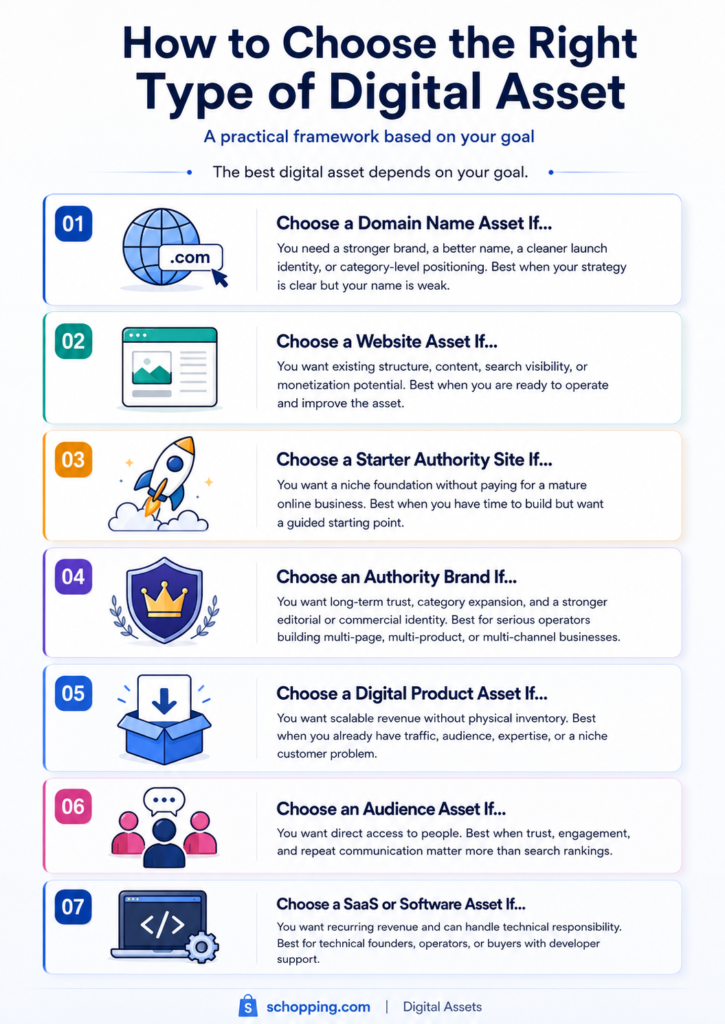
Choose a Domain Name Asset If…
You need a stronger brand, a better name, a cleaner launch identity, or category-level positioning. This is best when your strategy is clear but your name is weak.
Choose a Website Asset If…
You want existing structure, content, search visibility, or monetization potential. This is best when you are ready to operate and improve the asset.
Choose a Starter Authority Site If…
You want a niche foundation without paying for a mature online business. This is best when you have time to build but want a guided starting point.
Choose an Authority Brand If…
You want long-term trust, category expansion, and a stronger editorial or commercial identity. This is best for serious operators building multi-page, multi-product, or multi-channel businesses.
Choose a Digital Product Asset If…
You want scalable revenue without physical inventory. This is best when you already have traffic, audience, expertise, or a niche customer problem.
Choose an Audience Asset If…
You want direct access to people. This is best when trust, engagement, and repeat communication matter more than search rankings.
Choose a SaaS or Software Asset If…
You want recurring revenue and can handle technical responsibility. This is best for technical founders, operators, or buyers with developer support.
Digital Assets Are Not One Market — They Are Many
The phrase types of digital assets covers a wide range of online property. Some assets are names. Some are websites. Some are products. Some are audiences. Some are software. Some are brands waiting to be built.
That variety is exactly why buyers need a clear map before they start comparing opportunities.
A premium domain can be the seed of a brand. A starter authority site can be the foundation of a niche publication. A website asset can become a revenue property. A newsletter can become a media business. A digital product can become a high-margin income stream. A SaaS product can become a recurring-revenue company.
The smartest buyers do not ask, “Is this digital asset good?”
They ask, “Good for what?”
That question turns a broad marketplace into a strategic decision.
FAQs About Types of Digital Assets
What are the most valuable types of digital assets for online business buyers?
The most valuable types of digital assets are usually premium domain names, established websites, authority brands, SaaS products, ecommerce stores, digital product libraries, newsletters, and audience-based properties. Value depends on what the buyer can do with the asset. A premium domain may be extremely valuable to a founder who needs a category-defining brand name, while a content website may be more valuable to a publisher who understands SEO and affiliate monetization.
The strongest assets usually combine more than one advantage. For example, a website with a memorable domain, original content, organic traffic, email subscribers, and revenue history is more valuable than a site with traffic alone. Buyers should look for assets with durable demand, clean ownership, clear positioning, and room for improvement.
Are domain names considered digital assets?
Yes, domain names are one of the clearest examples of digital assets. A domain can be owned, transferred, developed, leased, or resold. Its value may come from brandability, keyword relevance, extension quality, age, memorability, commercial intent, or category fit.
However, a domain name is different from a full website. A domain is primarily an identity and location asset. A website includes content, structure, traffic, design, and possibly revenue. Buyers should not evaluate both the same way. A premium domain may justify a high price because of naming power, while a website must also be judged by performance and maintainability.
What digital assets can generate passive income?
Digital assets that can generate relatively passive income include affiliate websites, display ad sites, digital product stores, online courses, templates, paid newsletters, SaaS tools, and some ecommerce assets. The word “passive” should be used carefully, though. Most digital assets require maintenance.
Affiliate links need updates. Content needs refreshing. Software needs bug fixes. Newsletters need deliverability management. Ecommerce stores need customer support. The most stable income-producing digital assets are usually those with evergreen demand, diversified traffic, low support burden, and clear monetization.
What is the difference between digital assets and online businesses?
A digital asset may be one component of an online business, while an online business is usually a complete operating system. A domain name is a digital asset. A content library is a digital asset. A newsletter is a digital asset. A full online business may include the domain, website, traffic, products, customers, revenue, operations, supplier relationships, analytics, and brand systems.
This distinction matters because buyers sometimes confuse potential with performance. A domain may become a business, but it is not automatically a business. A starter site may become profitable, but it is not the same as buying a proven revenue-generating company.
Which types of digital assets are best for beginners?
Beginners often do best with domain names, starter authority sites, simple content websites, digital templates, or small digital product assets. These categories are easier to understand than SaaS, ecommerce operations, or complex tokenized assets.
A beginner should choose an asset that matches their skills. Someone who enjoys writing and SEO may prefer a starter content site. Someone with branding instincts may prefer domain names. Someone with design skills may prefer templates or creative assets. Someone with technical experience may prefer software tools. The best beginner asset is not the cheapest one; it is the one the buyer can realistically improve.
People Also Ask
What are examples of digital assets used in modern online businesses?
Modern online businesses use many types of digital assets, including domain names, websites, blogs, landing pages, email lists, ecommerce stores, digital products, SaaS tools, customer databases, social media accounts, brand kits, and content libraries. A single business may depend on several of these at once.
For example, an affiliate publishing business may use a premium domain, SEO content, comparison tables, email capture forms, product review pages, and downloadable buyer guides. An ecommerce business may use a Shopify store, product photography, customer lists, supplier files, ad creatives, and brand assets. The asset mix depends on the business model.
How do buyers compare premium digital assets before purchase?
Buyers compare premium digital assets by looking at ownership clarity, strategic fit, market demand, revenue potential, traffic quality, brand strength, maintenance needs, and risk. A premium domain requires a naming and market-positioning review. A website requires a deeper review of content, traffic, rankings, monetization, backlinks, and technical health.
The most important step is matching the asset to the buyer’s use case. A premium asset is not automatically worth buying just because it looks impressive. It must solve a real business problem, such as improving trust, shortening launch time, entering a niche, acquiring traffic, or creating a monetization base.
What types of digital assets have the lowest maintenance cost?
Domain names usually have the lowest maintenance cost because they mainly require annual renewal and basic portfolio management. Creative files, templates, and some digital products can also be low-maintenance once created, provided the licensing is clean and the content does not become outdated quickly.
Websites, ecommerce stores, SaaS products, and communities require more maintenance. They involve updates, security, customer support, content refreshes, analytics, platform changes, and sometimes technical troubleshooting. Buyers should always include time cost in the evaluation, not only purchase price.
Can digital assets increase in value over time?
Yes, digital assets can increase in value when their demand, authority, revenue, audience, or strategic relevance improves. A domain may become more valuable as a niche grows. A website may increase in value as traffic and profit rise. A newsletter may become more valuable as engagement deepens. A software tool may become more valuable as recurring revenue expands.
Value growth is not automatic. It usually requires better positioning, consistent operation, content improvement, audience development, monetization, or technical upgrades. Neglected assets can decline just as quickly as good assets can appreciate.
What should I check before buying any type of digital asset?
Before buying a digital asset, check ownership, transferability, revenue proof, traffic sources, legal rights, platform dependency, technical condition, content originality, licensing, audience quality, and future maintenance requirements. The exact checklist depends on the asset type.
For a domain, focus on name quality, trademark risk, extension, history, and market fit. For a website, examine analytics, revenue, backlinks, content quality, and technical health. For digital products, check licensing and originality. For SaaS, inspect code, churn, hosting, documentation, and support obligations. A good purchase starts with knowing what kind of asset you are actually buying.