Amazon Affiliate Disclosure
Schopping may earn a commission from qualifying purchases through affiliate links, including Amazon links, at no extra cost to you. Editorial recommendations are written to help individuals compare quality, usefulness, design, longevity, and value before choosing a product.
Updated on July, 2026.
When a woman searches for luxury bracelets, she is not simply looking for a piece of metal to wrap around her wrist; she is searching for a tangible extension of her identity. Within the broader world of Luxury Jewelry, bracelets hold a uniquely intimate role because they remain visible to both the wearer and the people around her throughout the day.
From a psychoanalytic perspective, jewelry can function as a “transitional object”—a bridge between our internal sense of self and the external world. Whether it is the rhythmic sparkle of a diamond tennis bracelet or the heavy, reassuring click of a gold bracelet, these pieces can satisfy deep-seated desires for security, recognition, status, and self-actualization.
At Schopping.com, we understand that a bracelet is often a reward for a milestone achieved, a symbol of a bond shared, or a form of protective “armor” worn to strengthen confidence in professional and social settings. As part of a thoughtfully expressed Luxury lifestyle, the right bracelet can communicate personal taste, achievement, and identity without relying on words. In this guide, we explore luxury bracelet categories across different materials, styles, occasions, and price levels, helping you choose a piece that resonates with your personal narrative—whether you seek a high-end investment bracelet or budget-friendly elegance.
Quick Picks: Navigate the Complete Luxury Bracelets Guide
Use this complete navigation to move directly to the bracelet category, material comparison, buying advice, or pricing question most relevant to you.
Core Luxury Bracelet Categories
| Article Section | Best For | Quick Editorial Take |
|---|---|---|
| Diamond Bracelets: The Symbol of Permanence | Milestones, anniversaries and heirloom jewelry | Choose stone matching and cut quality before chasing the highest total carat weight. |
| 14K and 18K Gold-Plated Bracelets: Accessible Luxury | Affordable gold styling and trend experimentation | Best for shoppers who want the visual warmth of gold without paying for solid precious metal. |
| The Prestige of Real Gold Bracelets: Solid 14K and 18K Gold | Daily fine jewelry and long-term ownership | Solid 14K gold favors durability; solid 18K gold offers richer color and greater gold purity. |
| Tennis Bracelets: The Symmetry of Sophistication | Everyday sparkle, formal wear and anniversary gifts | A strong diamond tennis bracelet combines matched stones, fluid links and a secure clasp. |
| Featured Spotlight: The Iconic Cartier Love Bracelet | Heritage design and recognizable luxury | Buy the bracelet, not merely the packaging: authentication, condition and provenance are essential. |
| Budget-Friendly Bracelets: The Joy of Everyday Self-Care | Affordable fashion, gifting and identity experimentation | Prioritize clasp strength, comfort and material disclosure over decorative excess. |
| High-End Bracelets: The Royal Family Collection | Generational jewelry and collector-level craftsmanship | True luxury is defined by material integrity, construction and provenance—not price alone. |
Handcrafted Gold and High-Jewelry Navigation
| Article Section | Best For | Quick Editorial Take |
|---|---|---|
| The AceTex Revolution: Handcrafted Excellence | Heavy-gauge gold and handmade jewelry | Look for solid construction, controlled finishing and bracelet weight that feels substantial without becoming uncomfortable. |
| Signature Link Styles: Miami Cuban and Curb Bracelets | Bold gold bracelets and visible craftsmanship | Miami Cuban links provide density and authority; curb links offer a slightly more versatile classical profile. |
| Diamond Bracelets and Rare Gemstones | High-carat diamonds, emeralds, rubies and sapphires | Gemstone value depends on color, treatment, matching, origin and documentation—not carat weight alone. |
| Artisanal Provenance: The Hand of the Maker | Collectors and bespoke-jewelry buyers | Hallmarks, workshop records, invoices and gemological reports strengthen authenticity and future heirloom value. |
| The Investment Mindset: Jewelry as a Hard Asset | Buyers comparing gold value with jewelry value | Separate melt value from retail, designer and collector value before describing a bracelet as an investment. |
| Social Signalling: The Silent Handshake of Luxury | Quiet luxury and statement jewelry | The most sophisticated pieces communicate through weight, proportion and finish rather than oversized branding. |
| How to Choose a High-End Bracelet | Serious luxury-bracelet buyers | Evaluate purpose, gold purity, comfort, clasp security, documentation and craftsmanship before purchasing. |
| High-End Bracelets for Women | Diamond bangles, gold cuffs and heirloom designs | Women’s luxury bracelets need not be delicate; substantial pieces can communicate authority and independence. |
| High-End Bracelets for Men | Cuban, curb, Figaro and structural gold links | Proportion matters more than maximum width; the bracelet should balance naturally with the wrist and watch. |
| Bespoke and Custom Gold Bracelets | Personalized milestone and family jewelry | Custom work is strongest when gold weight, dimensions, gemstones, clasp construction and engraving are specified in writing. |
| Caring for Heirloom-Quality Bracelets | Protecting valuable gold and gemstone jewelry | Schedule inspections, avoid abrasive polishing and store diamonds away from polished gold surfaces. |
| Building a Family Provenance Record | Preserving generational history | Keep receipts, appraisals, photographs, service records and the story behind the bracelet together. |
| The Royal Family Standard | Understanding high-jewelry quality | Exceptional materials matter most when paired with credible provenance and disciplined craftsmanship. |
| Luxury Designed to Outlive Its First Owner | Heirloom and legacy buying | The strongest luxury bracelet remains wearable, repairable and meaningful beyond its original owner. |
Bracelet Selection, FAQs and Buying Answers
| Article Section | Best For | Quick Editorial Take |
|---|---|---|
| Find Your Perfect Bracelet at Schopping | Matching a bracelet to lifestyle and personal meaning | The right bracelet should support the wearer’s routine, identity and long-term expectations. |
| Frequently Asked Questions About Luxury Bracelets | Pricing, authenticity, sizing and product comparisons | Use this section for direct answers about tennis bracelets, gold value, Cartier pricing and women’s bracelet sizes. |
1. Diamond Bracelets: The Symbol of Permanence
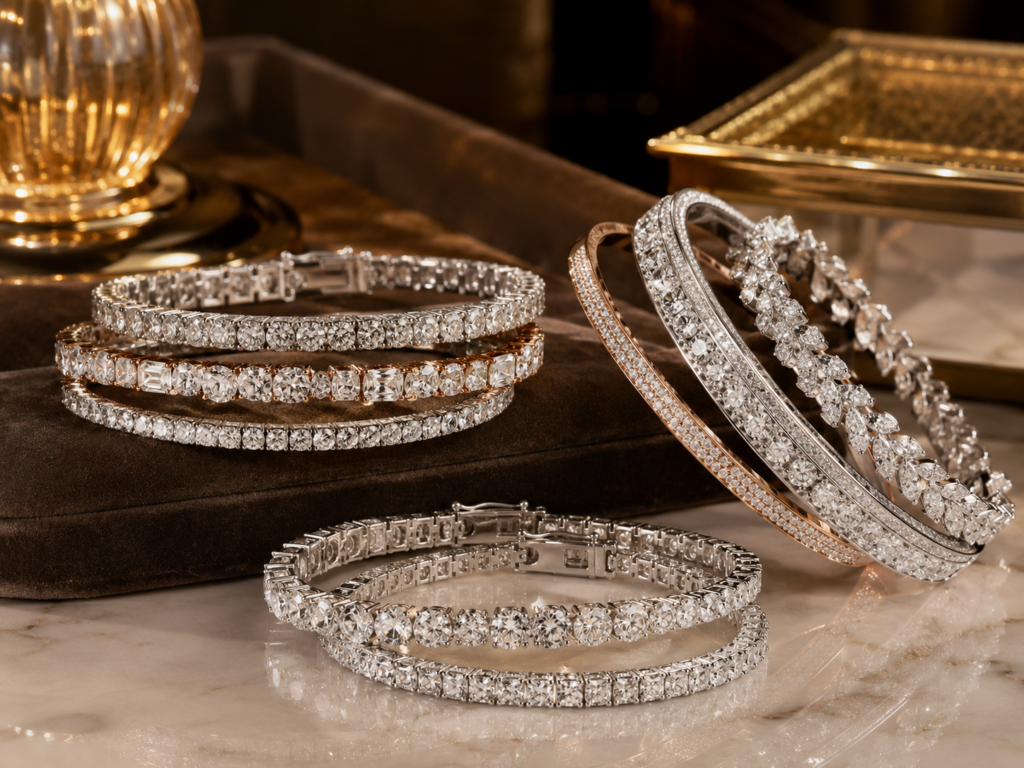
Diamond bracelets occupy a distinctive place in the world of luxury jewelry. Unlike trend-driven accessories that may lose their appeal after a season, a finely made diamond bracelet communicates permanence, refinement, and enduring personal value. Diamonds form under extraordinary heat and pressure over immense spans of geological time, which gives them a symbolic power that extends far beyond brilliance alone.
When a woman wears a diamond bracelet, she is not simply displaying a precious gemstone. She is wearing an object associated with resilience, commitment, achievement, and continuity. In a culture shaped by fast fashion and rapidly changing aesthetics, diamonds remain reassuringly stable. Their appeal does not depend on a passing color trend, social-media moment, or seasonal silhouette.
This is why diamond bracelets for women are often chosen to commemorate meaningful transitions: an anniversary, promotion, wedding, personal victory, inheritance, or major life milestone. The bracelet becomes more than an ornament. It becomes a wearable record of permanence.
The Psychology Behind Diamond Bracelets
From a psychoanalytic perspective, diamonds can represent the “Ideal Self”—the strong, luminous, and seemingly unbreakable version of the person we aspire to become. Their clarity suggests mental precision, while their hardness symbolizes endurance under pressure. Their ability to reflect light from multiple angles can also mirror the complexity of identity: one person, many dimensions.
Because a bracelet remains within the wearer’s field of vision, it has a more personal psychological presence than jewelry worn only for others to see. A diamond tennis bracelet catches the eye while the wearer types, gestures, drives, or reaches for something. That repeated sparkle can function as a subtle reminder of confidence, self-worth, and earned success.
For some women, a luxury diamond bracelet serves as a form of emotional reinforcement. It may symbolize independence, financial accomplishment, or the decision to invest in oneself rather than wait for jewelry to be given as a gift.
Diamond Tennis Bracelets: Timeless Symmetry and Controlled Brilliance
The diamond tennis bracelet is one of the most recognizable and versatile bracelet styles. Its continuous line of individually set diamonds creates a balanced rhythm around the wrist, offering brilliance without the visual weight of a large statement cuff.
What makes a diamond tennis bracelet so enduring is its symmetry. Each stone contributes to a unified design, creating a sense of order, continuity, and completeness. This makes the style appropriate for both formal occasions and elevated everyday wear.
A classic white gold diamond tennis bracelet produces a clean, modern appearance, while a yellow gold diamond bracelet introduces warmth and traditional luxury. Rose gold creates a softer, more romantic effect, especially when paired with smaller diamonds or delicate stacking bracelets.
The best diamond tennis bracelets balance stone quality with secure construction. Buyers should look beyond total carat weight and consider diamond cut, color, clarity, setting quality, clasp security, and flexibility. A bracelet with well-matched stones and excellent craftsmanship may appear more luxurious than a higher-carat piece with inconsistent diamonds.
Choosing Diamond Quality for a Bracelet
The traditional four Cs—cut, color, clarity, and carat weight—remain important when evaluating real diamond bracelets. However, the way these characteristics affect appearance can differ from their role in engagement rings.
Cut has the greatest influence on sparkle. Well-cut diamonds return light more effectively, creating the fire and brilliance expected from fine diamond jewelry.
Color determines how white or warm a diamond appears. Near-colorless diamonds can offer an excellent balance of beauty and value, especially when set in yellow or rose gold.
Clarity refers to internal and external imperfections. Because bracelet diamonds are usually smaller than center stones used in rings, minor inclusions may not be visible without magnification.
Carat weight measures the total weight of the diamonds. A higher total carat weight can create greater wrist presence, but stone consistency and craftsmanship remain equally important.
Buyers comparing natural diamond bracelets and lab-grown diamond bracelets should also consider their priorities. Natural diamonds may appeal to collectors who value rarity and geological origin, while lab-grown diamond bracelets can provide a larger visual impact at a lower price. Both options can deliver impressive brilliance when the diamonds are well cut and securely set.
Are Diamond Bracelets a Good Investment?
High-quality diamond bracelets can retain meaningful value, particularly when they feature natural diamonds, precious metals, documented grading, excellent craftsmanship, and recognizable designer provenance. However, jewelry should not be evaluated in the same way as stocks or liquid financial assets.
Retail markups, changing demand, diamond specifications, condition, and resale channels all influence how much a bracelet may recover on the secondary market. Rare antique pieces, signed designer bracelets, and exceptional natural diamonds may perform better than mass-produced designs.
The more accurate description is that a fine diamond bracelet can become an emotional asset with potential material value. It offers enjoyment while being worn, may carry significant sentimental meaning, and can eventually become an heirloom passed from one generation to the next.
To protect long-term value, retain purchase receipts, grading reports, appraisals, warranty information, and original packaging. Professional cleaning, routine clasp inspections, and appropriate insurance are also important for valuable pieces.
How to Style a Diamond Bracelet
A singular diamond bracelet creates a focused, authoritative look. Worn alone, a substantial tennis bracelet or diamond cuff becomes the visual center of the wrist, making it particularly effective for formal events, executive dressing, or minimalist eveningwear. For a coordinated fine-jewelry look, pair the bracelet with understated Luxury Necklaces that repeat its metal tone, diamond shape, or level of brilliance without competing for attention.
For a softer luxury aesthetic, pair a delicate diamond bracelet with fine gold chains of different textures. The contrast between polished metal, subtle movement, and controlled sparkle creates a layered look that feels personal rather than overly coordinated.
A diamond bracelet can also be worn beside a luxury watch, although spacing and proportion matter. A slim tennis bracelet usually pairs more comfortably with a structured watch than a wide diamond cuff. To prevent scratching, choose rounded settings and avoid stacking pieces that press sharply against one another.
For everyday elegance, smaller diamonds set in a low-profile bezel or prong design offer practicality without losing refinement. For celebrations, higher-carat bracelets, diamond bangles, and architectural cuffs provide greater visual presence.
A Bracelet That Outlives the Moment
The enduring attraction of diamond bracelets lies in their ability to unite emotional meaning with lasting beauty. They can mark commitment without being bridal, represent success without appearing excessively loud, and add brilliance without surrendering sophistication.
Whether selected as a diamond anniversary bracelet, a personal milestone gift, an heirloom piece, or an investment in everyday luxury, the right design should feel connected to the wearer’s identity. Its value is not measured only by carat weight or market price, but by the memories, achievements, and personal transformations it comes to represent.


2. 14K and 18K Gold-Plated Bracelets: Accessible Luxury
Gold possesses an almost primal visual appeal. Across civilizations, it has been associated with sunlight, divinity, prosperity, protection, and social distinction. Its warm reflection against the skin can make even a restrained bracelet feel ceremonial, which helps explain why gold bracelets remain central to both fine jewelry and contemporary fashion.
For shoppers who love the appearance of gold but do not want to commit to the price of solid precious metal, 14K gold-plated bracelets and 18K gold-plated bracelets provide an accessible entry into luxury styling. These pieces place a thin layer of real gold over a base metal such as brass, stainless steel, or sterling silver, creating the color and visual richness of gold at a considerably lower cost.
Gold-plated jewelry is especially attractive to the modern “hedonic shopper”—someone who values the immediate emotional pleasure of a beautiful accessory. A new gold bracelet can refresh an outfit, lift the mood, or provide a sense of personal renewal without becoming a major financial purchase.
This is the appeal of accessible luxury: the wearer receives the visual language of fine jewelry while retaining the freedom to experiment with different bracelet styles, textures, widths, and stacking combinations.
What Is a Gold-Plated Bracelet?
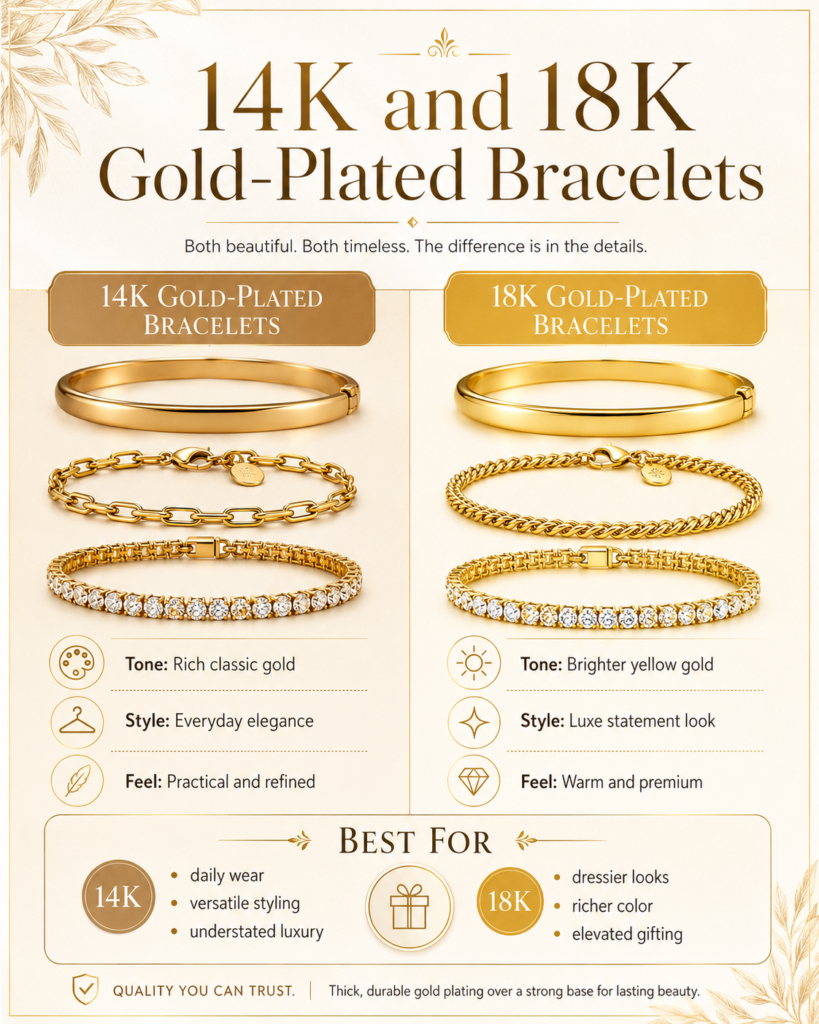
A gold-plated bracelet is created by bonding a thin layer of gold onto another metal through an electroplating process. The “14K” or “18K” designation describes the purity of the gold used in the outer coating, not the composition of the entire bracelet.
A 14K gold-plated bracelet uses plating made from gold that is approximately 58.3% pure, while an 18K gold-plated bracelet uses an outer gold layer that is approximately 75% pure. The core beneath that plating may be brass, stainless steel, copper, sterling silver, or another jewelry-grade material.
This distinction matters because gold-plated jewelry does not have the same intrinsic metal value, lifespan, or wear characteristics as a solid gold bracelet. Its quality depends heavily on:
- The thickness of the gold coating
- The preparation of the base metal
- The type of metal beneath the plating
- The quality of the electroplating process
- The presence of a protective topcoat
- How frequently the bracelet is worn
- Exposure to water, perfume, sweat, lotions, and household chemicals
A well-made plated bracelet can retain its appearance for a meaningful period, but all plating gradually wears with friction and repeated exposure.
The 18K Gold-Plated Bracelet Experience
An 18K gold-plated bracelet usually displays a deeper, warmer, and more saturated yellow tone than a 14K-plated design. Its richer coloration is associated with traditional high-purity gold jewelry, giving it a visually opulent character.
This makes 18K gold-plated bracelets particularly effective for:
- Eveningwear and formal outfits
- Warm or neutral skin tones
- Statement cuffs and bold chain bracelets
- Vintage-inspired jewelry
- Special-occasion accessories
- Layered looks built around deep yellow gold
The appeal is primarily sensory and aesthetic. The richer color can make a plated bracelet look substantial and luxurious, especially when paired with polished surfaces, sculptural links, pavé stones, pearls, or black enamel.
An 18K gold-plated bracelet is therefore a strong choice for the shopper who wants maximum warmth and visual richness without purchasing solid 18K gold.
However, higher-purity gold is naturally softer than lower-purity gold. In plated jewelry, practical durability depends less on the karat label alone and more on the thickness and quality of the coating. A thick, professionally applied 18K layer may outlast a cheaply produced 14K coating, while an extremely thin layer of either type may fade quickly.
The Versatility of 14K Gold-Plated Bracelets
A 14K gold-plated bracelet generally has a slightly lighter or more restrained yellow tone. Its appearance often feels contemporary, understated, and easy to integrate into everyday wardrobes.
The subtle coloration of 14K gold plating works particularly well with:
- Minimalist chain bracelets
- Slim bangles
- Office and professional clothing
- Mixed-metal jewelry stacks
- Casual everyday outfits
- Watches with pale gold hardware
- Delicate gemstone and charm bracelets
Although 14K solid gold is harder than solid 18K gold because it contains a greater proportion of strengthening alloys, this comparison should not be applied too literally to plated bracelets. The lifespan of a 14K gold-plated bracelet still depends primarily on plating thickness, base-metal quality, construction, and care.
Its advantage is often aesthetic rather than structural: 14K plating provides a balanced gold tone that feels polished without appearing overly formal.
Gold Plating, Gold Vermeil and Gold-Filled Bracelets
Not every gold-finished bracelet is made in the same way. Understanding the terminology can help shoppers compare quality and price more accurately.
| Bracelet Type | Construction | Typical Price Level | Expected Wear |
|---|---|---|---|
| Gold plated | Thin gold coating over a base metal | Lowest | Best for occasional or rotational wear |
| Gold vermeil | Gold coating over sterling silver, usually with a defined minimum thickness | Moderate | Better for shoppers wanting a precious-metal base |
| Gold filled | A substantially thicker gold layer mechanically bonded to a base metal | Moderate to high | Often more durable than standard plating |
| Solid 14K gold | Gold alloy containing approximately 58.3% pure gold | High | Suitable for frequent, long-term wear |
| Solid 18K gold | Gold alloy containing approximately 75% pure gold | Higher | High-purity luxury with a richer gold tone |
Gold vermeil bracelets can be appealing to people who prefer sterling silver beneath the gold surface, while gold-filled bracelets generally provide a thicker gold layer than standard electroplating. Solid gold remains the premium option for long-term ownership, repairability, and intrinsic precious-metal value.
Why Choose a Gold-Plated Bracelet?
Gold-plated bracelets are not simply substitutes for solid gold. They serve a different purpose within a jewelry wardrobe.
Lower Cost of Entry
Plating allows shoppers to enjoy the appearance of yellow gold without paying for the precious-metal weight of an entire bracelet. This is particularly valuable for chunky chain bracelets, wide cuffs, and oversized bangles that would be considerably more expensive in solid gold.
Greater Freedom to Experiment
Because the financial commitment is lower, shoppers can explore different designs without treating every purchase as a permanent investment. A woman may own a sleek 14K gold-plated bangle for work, an 18K gold-plated cuff for eveningwear, and a collection of delicate chain bracelets for layering.
Access to Trend-Led Designs
Statement links, sculptural forms, mixed materials, charms, and seasonal silhouettes are often more practical in plated jewelry. The shopper can participate in a trend without paying the price associated with a heavy solid-gold piece.
Visually Luxurious Styling
Well-designed gold plating can produce a convincing and sophisticated finish. Construction, weight, polish, clasp quality, and proportion often determine whether an affordable bracelet looks refined or inexpensive.
The Gold Bracelet Stacking Trend
Gold-plated bracelets are especially suited to the continuing “wrist stack” or “wrist party” trend. Instead of relying on one dominant piece, the wearer combines several bracelets to create a personal composition of textures, shapes, and symbolic details.
A successful bracelet stack may combine:
- A slim gold bangle
- A paperclip chain bracelet
- A delicate diamond or cubic zirconia tennis bracelet
- A sentimental charm bracelet
- A rope or snake-chain design
- A structured luxury watch
From a psychological perspective, stacking reflects the layered nature of identity. One bracelet may represent professional confidence, another romantic attachment, and another a memory, belief, or personal milestone. Together, they form a wearable autobiography.
For an elegant stack, vary the widths while keeping one visual element consistent. That unifying feature might be gold tone, gemstone color, chain scale, or overall level of polish.
Avoid stacking too many highly detailed bracelets together. Allow one piece to lead visually while the others create rhythm and contrast.
How to Care for Gold-Plated Bracelets
Gold-plated jewelry requires more deliberate care than solid gold because the outer layer can gradually wear away.
To preserve a gold-plated bracelet:
- Put it on after applying perfume, makeup, sunscreen, and lotion.
- Remove it before swimming, showering, exercising, or sleeping.
- Avoid contact with chlorine, salt water, cleaning products, and hand sanitizer.
- Wipe the bracelet gently with a soft, dry cloth after wearing it.
- Store it separately to reduce friction and scratching.
- Do not use abrasive polishing compounds or stiff brushes.
- Have a valuable or sentimental piece professionally replated when necessary.
Skin chemistry also affects how quickly plating changes. Perspiration, acidity, humidity, and frequency of wear can cause the same bracelet to age differently from one person to another.
The Prestige of Real Gold Bracelets: Solid 14K and 18K Gold
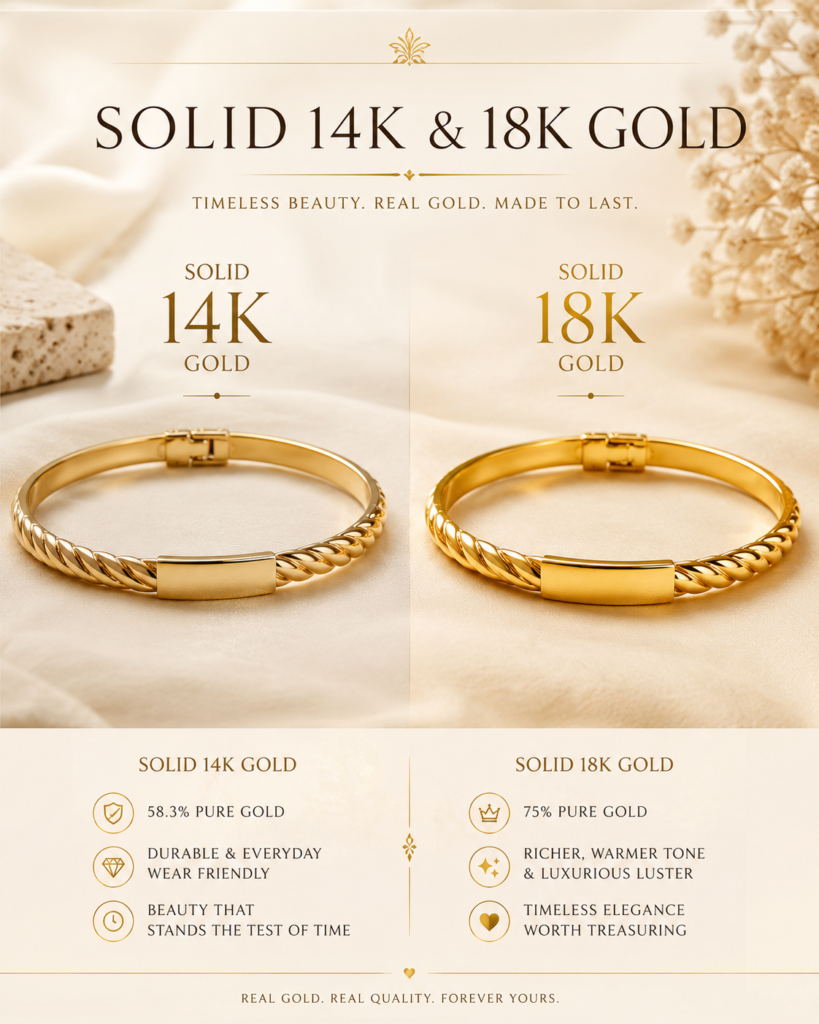
When a shopper begins searching for real gold bracelets, the motivation often shifts from temporary styling to long-term ownership. She may no longer be looking only for an attractive accessory. She may be looking for a piece with precious-metal content, enduring emotional relevance, repair potential, and the ability to become part of a personal or family legacy.
Psychoanalytically, solid gold can satisfy the human desire for continuity and security. Its weight is tangible. Its value is materially grounded. Unlike surface plating, the gold is present throughout the bracelet rather than existing as an outer decorative layer.
This gives a solid gold bracelet a particular emotional authority. It is not merely made to resemble wealth, permanence, or tradition; it is physically constructed from a material that has represented those ideas for thousands of years.
Solid gold alloys can still scratch, develop patina, and occasionally show mild discoloration depending on their alloy metals and exposure. However, they do not lose a thin exterior gold layer in the way plated pieces do. They can usually be professionally polished, repaired, resized, restored, and passed to another generation.
Solid 14K Gold Bracelet: The Workhorse of Luxury
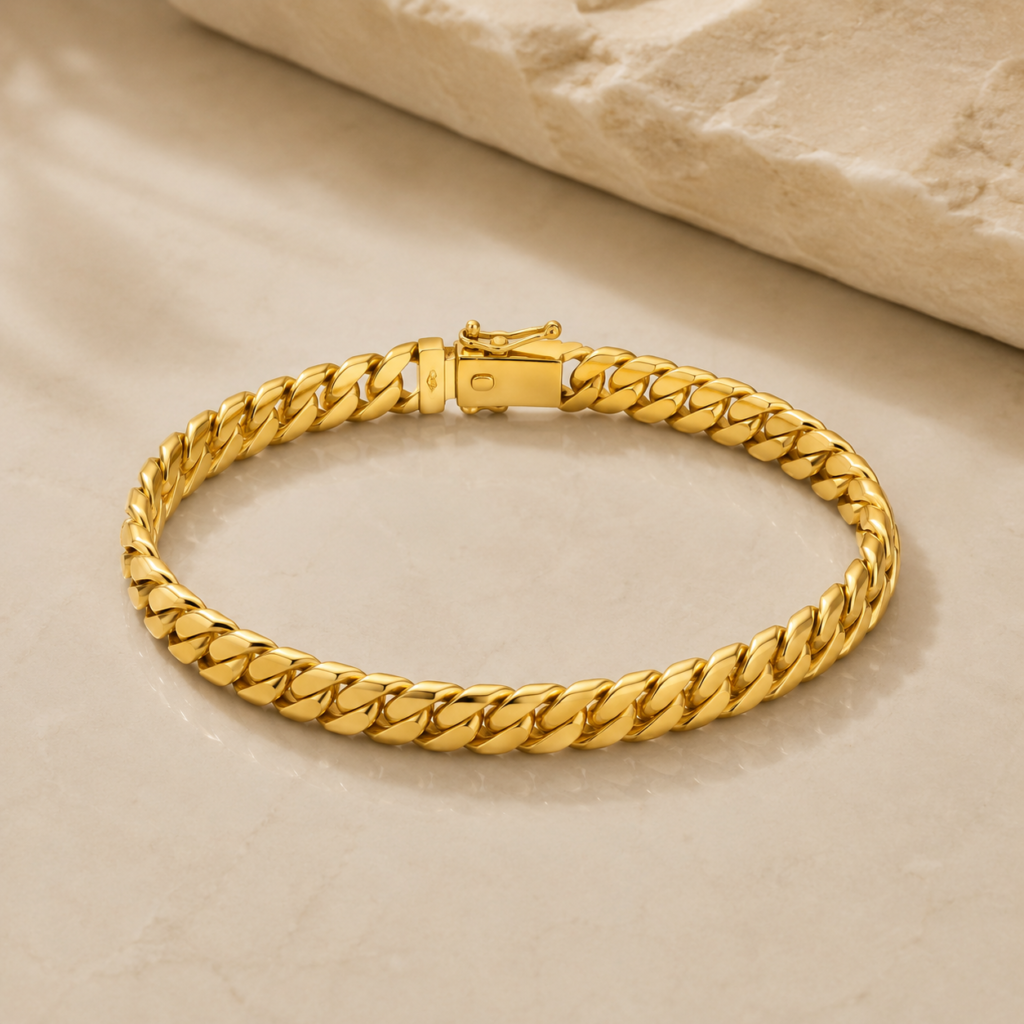
A solid 14K gold bracelet contains approximately 58.3% pure gold, with the remainder composed of strengthening metals such as silver, copper, zinc, or palladium. This alloy balance makes 14K gold one of the most practical options for bracelets intended for frequent wear.
Bracelets experience more contact than many other jewelry categories. They move against desks, sleeves, bags, watches, and surrounding bracelets. As a result, durability matters.
The relative hardness of 14K gold makes it particularly suitable for:
- Everyday chain bracelets
- Gold bangles for women
- Charm bracelets
- Diamond tennis bracelets
- Bracelets worn beside a watch
- Active professional lifestyles
- Pieces intended for frequent use
A solid 14K gold bracelet can function as the “workhorse of luxury”: precious enough to carry lasting value, but durable enough to accompany the wearer through ordinary life.
Its gold color is often slightly softer and less saturated than 18K yellow gold. For many women, that restraint is an advantage. It allows the bracelet to move easily between casual clothing, officewear, evening dressing, and mixed-metal combinations.
Solid 18K Gold Bracelet: Richness, Purity and Sensory Prestige
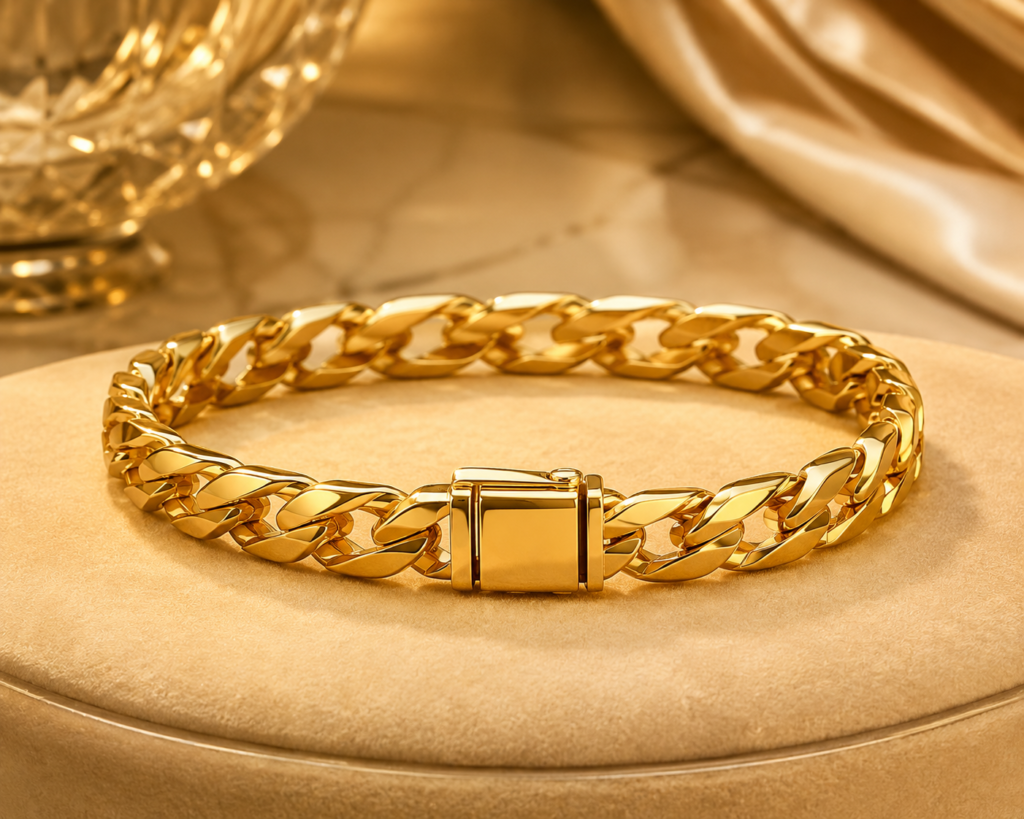
A solid 18K gold bracelet contains 75% pure gold. This higher gold content gives yellow-gold pieces a deeper, richer, and more unmistakably luxurious hue.
The appeal of 18K gold is partly visual and partly tactile. It offers the “sensory purist” a more concentrated precious-metal experience: richer color, substantial presence, and the prestige associated with higher gold purity.
Solid 18K gold bracelets are particularly compelling in:
- Wide statement cuffs
- Heirloom bangles
- Designer link bracelets
- Fine gemstone settings
- Bridal and anniversary jewelry
- Limited-edition artisan pieces
- Traditional high-jewelry designs
Because 18K gold contains more pure gold, it is generally softer than 14K gold and may acquire fine scratches more readily. That does not make it unsuitable for wear, but it does mean the design and lifestyle of the wearer should be considered.
A delicate 18K bracelet may be better reserved for intentional wear, while a substantial, well-engineered 18K chain can still provide excellent longevity.
Solid 14K Gold vs Solid 18K Gold Bracelets
| Feature | Solid 14K Gold Bracelet | Solid 18K Gold Bracelet |
|---|---|---|
| Pure gold content | Approximately 58.3% | 75% |
| Gold color | Lighter and more restrained | Deeper and richer |
| Relative hardness | More resistant to everyday scratching and denting | Softer due to higher gold purity |
| Best suited to | Daily wear and active lifestyles | Fine jewelry and high-purity luxury |
| Typical price | Lower than comparable 18K pieces | Higher due to greater gold content |
| Precious-metal value | Strong | Greater gold content by weight |
| Styling character | Contemporary and versatile | Traditional, warm and opulent |
Neither option is universally superior. The better choice depends on budget, wear frequency, skin sensitivity, preferred gold color, design, and the symbolic role the bracelet is expected to play.
Choose 14K gold when daily practicality is central. Choose 18K gold when purity, depth of color, and a more elevated precious-metal experience matter most.
Are Real Gold Bracelets a Good Investment?
Solid gold bracelets possess intrinsic metal value because they contain measurable quantities of gold. Their material value can rise or fall alongside the gold market, although resale prices also depend on purity, weight, craftsmanship, condition, brand, and dealer margins.
A plain, heavy solid-gold bangle may derive much of its resale value from gold weight. A signed designer bracelet may command additional value based on provenance, scarcity, and collector demand. A gemstone bracelet must also be assessed according to stone quality and setting craftsmanship.
However, retail jewelry should not automatically be treated as a guaranteed financial investment. Buyers usually pay for design, manufacturing, branding, retail presentation, and distribution in addition to the raw metal. Those premiums may not be fully recovered during resale.
The strongest case for buying a real gold bracelet is therefore a combination of:
- Daily or ceremonial enjoyment
- Durable precious-metal construction
- Emotional and symbolic value
- Potential heirloom relevance
- Recoverable material value
- Long-term repairability
This makes solid gold jewelry both a personal luxury and a form of wearable wealth, even when it is not purchased primarily for financial return.
Gold Bracelets as Milestone and Legacy Jewelry
Real gold bracelets are frequently chosen to mark important life transitions: graduations, promotions, marriages, anniversaries, births, business achievements, and significant birthdays.
These purchases often occur at moments when identity is changing. The bracelet acts as a physical marker between the person one was and the person one has become.
A promotion bracelet may represent authority. A gold bangle purchased after a difficult period may symbolize survival. A bracelet received after the birth of a child may eventually be passed to that child. Through repeated wear, the object accumulates memory.
This is where the value of solid gold becomes more than economic. Its physical durability supports emotional continuity. A real gold bracelet can survive changing trends and accompany several chapters of a woman’s life without losing its essential material identity.
How to Choose Between Gold-Plated and Solid Gold Bracelets
Choose a gold-plated bracelet when you want:
- A lower-cost fashion accessory
- Several styles for rotation
- A trend-led or statement design
- An occasional-wear bracelet
- The look of gold without a major purchase
Choose a solid 14K gold bracelet when you want:
- A durable everyday piece
- A balance of luxury and practicality
- Real precious-metal content
- A bracelet suitable for frequent wear
- A long-term piece at a comparatively accessible fine-jewelry price
Choose a solid 18K gold bracelet when you want:
- A richer yellow-gold color
- Higher gold purity
- A prestigious fine-jewelry experience
- An heirloom or milestone piece
- Greater intrinsic gold content
The correct choice is not determined by price alone. It depends on what the bracelet is expected to provide: temporary pleasure, styling versatility, everyday resilience, symbolic permanence, or generational legacy.
From Accessible Gold to Enduring Value
The gold bracelet category spans two distinct but equally meaningful forms of luxury.
Gold-plated bracelets offer experimentation, emotional uplift, and visual richness without imposing a large financial barrier. They allow the wearer to change her aesthetic, build expressive stacks, and enjoy the warmth of gold as part of daily fashion.
Solid 14K and 18K gold bracelets serve a different psychological and material purpose. They provide precious-metal substance, longevity, repairability, and the possibility of inheritance. Their appeal is rooted not only in how they look, but in what they are.
Whether a woman chooses an affordable 18K gold-plated bracelet, a durable solid 14K gold bracelet, or a high-purity solid 18K gold bracelet, the most satisfying piece will be the one that aligns with her lifestyle, values, and personal definition of luxury.



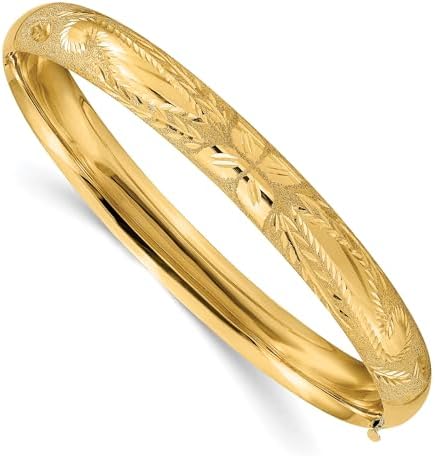


3. Tennis Bracelets: The Symmetry of Sophistication
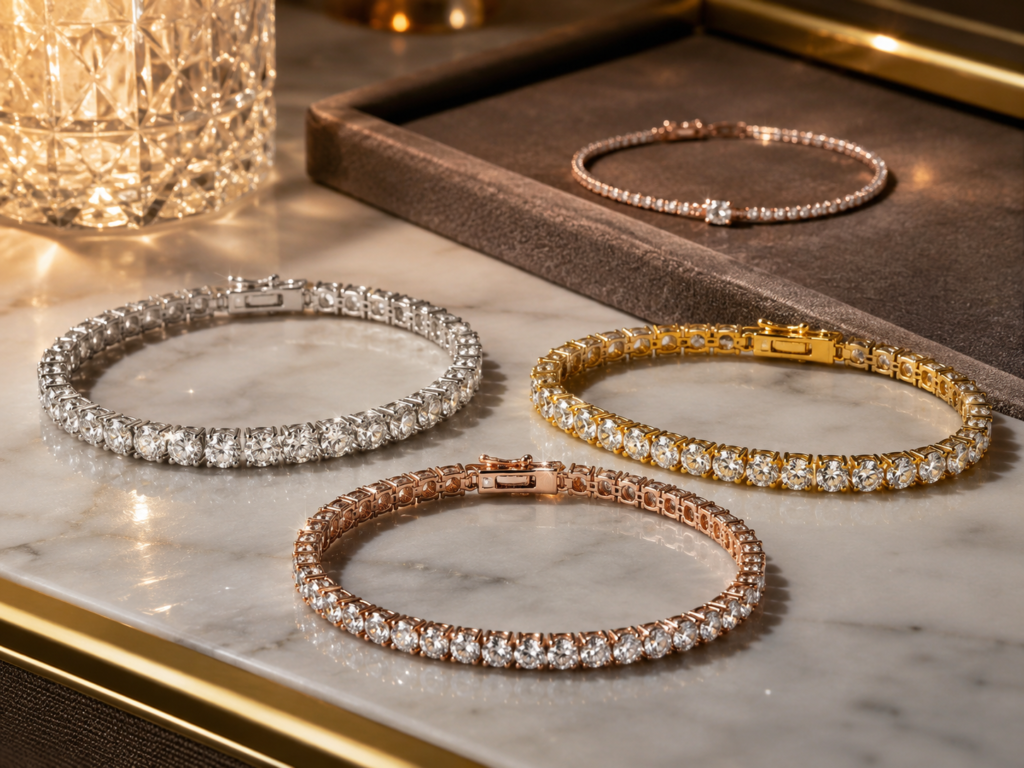
Few pieces of fine jewelry balance refinement, versatility, and emotional symbolism as naturally as the tennis bracelet. Defined by a flexible, uninterrupted row of individually set gemstones, this slender bracelet creates a continuous ribbon of light around the wrist. Its beauty does not depend on a dramatic centerpiece. Instead, its visual power comes from precision, repetition, and the disciplined symmetry of evenly matched stones.
A classic diamond tennis bracelet can be worn with a tailored suit in the morning, a silk dress in the evening, or a simple white shirt on an ordinary day. It is formal without being ceremonial, luxurious without appearing excessive, and recognizable without relying on prominent branding.
This adaptability has made tennis bracelets for women enduring choices for anniversaries, weddings, birthdays, promotions, childbirth celebrations, and personal milestone purchases. They can symbolize continuity between two people, but they are increasingly bought as self-gifts representing independence, achievement, and long-term self-investment.
Why Is It Called a Tennis Bracelet?
The style existed long before it acquired its modern name. Continuous diamond-line bracelets were traditionally described as diamond line bracelets or, in some contexts, eternity-style bracelets.
The name “tennis bracelet” is widely associated with professional tennis player Chris Evert. During a match at the 1978 U.S. Open, her diamond bracelet reportedly broke or came loose, prompting play to pause while the jewelry was located. The incident connected an established fine-jewelry design with an unexpected image of movement, athleticism, and composed femininity.
That story transformed the bracelet’s cultural identity. It was no longer viewed only as an evening accessory reserved for formal society. It became a symbol of active elegance—fine jewelry sophisticated enough for important occasions, yet fluid and secure enough to move with the wearer.
The episode also revealed one of the most important practical qualities of a tennis bracelet: it must combine beauty with engineering. A bracelet composed of valuable stones is only as dependable as its links, settings, clasp, and safety mechanism.
The Psychology of Symmetry and Repetition
Tennis bracelets appeal to the human preference for visual order. The repeated arrangement of similarly sized stones creates rhythm, balance, and predictability. Each gemstone is distinct, yet no single stone dominates the design.
Psychologically, this pattern can feel calming because the eye is not forced to search for a focal point. It moves naturally around the bracelet, following an unbroken sequence of light.
The continuous line also carries symbolic meaning. It can represent:
- Lasting commitment
- Emotional continuity
- Recurring love and devotion
- Personal discipline
- Stability during change
- The accumulation of small achievements
This symbolism helps explain why diamond tennis bracelets remain popular as anniversary gifts and commemorative jewelry. Rather than representing one isolated moment, the design suggests that meaningful relationships and identities are formed through a continuous series of experiences.
From a psychoanalytic perspective, the ordered row of stones may also represent an integrated self. Each facet reflects light differently, yet every stone remains part of a coherent whole. The bracelet becomes a visual expression of complexity contained within structure.
Why Tennis Bracelets for Women Remain So Versatile
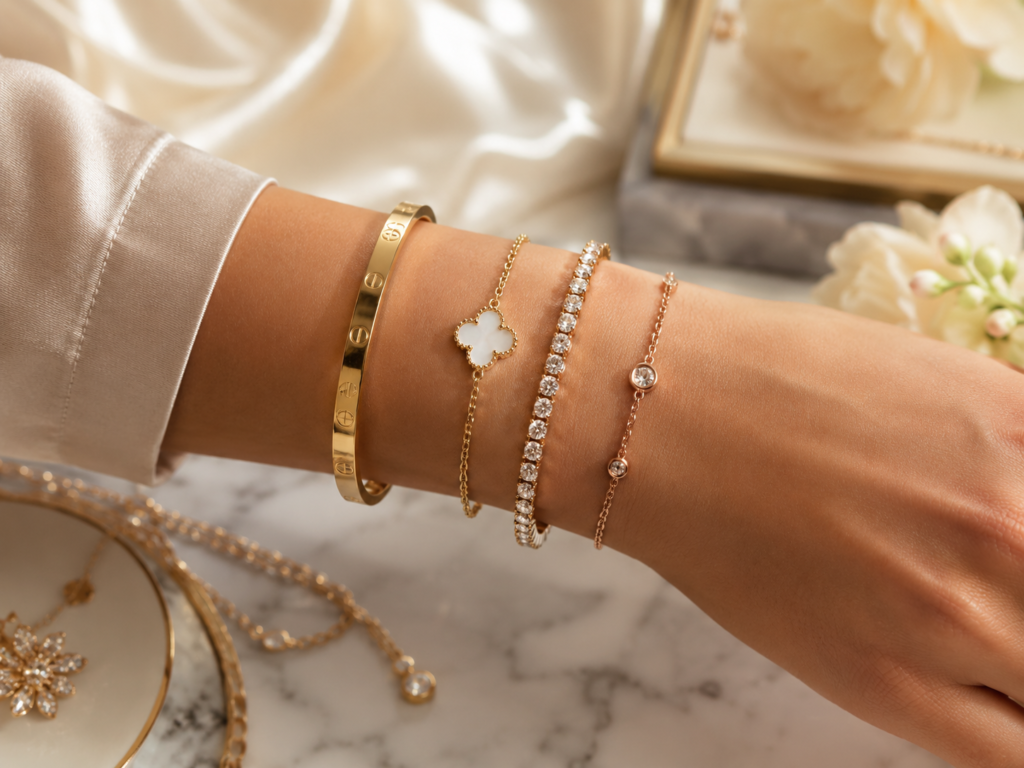
The versatility of a tennis bracelet begins with its proportions. It generally sits close to the wrist, allowing it to provide substantial brilliance without the bulk of a wide cuff or oversized chain.
A classic design can transition easily between different settings:
| Setting | How to Style a Tennis Bracelet |
|---|---|
| Professional workplace | Wear a slim bracelet alone or beside a restrained watch |
| Everyday luxury | Pair it with knitwear, a white shirt, denim, or neutral tailoring |
| Formal evening event | Choose a higher-carat design as the central wrist accessory |
| Wedding or anniversary | Coordinate it with diamond stud earrings or a pendant |
| Layered jewelry look | Combine it with narrow gold bangles or delicate chains |
| Minimalist wardrobe | Let one uninterrupted line of diamonds provide the main detail |
This ability to cross dress codes gives the tennis bracelet a high cost-per-wear potential. Unlike jewelry that is restricted to weddings, galas, or seasonal trends, a well-proportioned diamond bracelet can become part of a woman’s regular visual identity.
The Anatomy of a High-Quality Tennis Bracelet
A tennis bracelet may appear simple, but its construction requires exacting craftsmanship. Each stone must be individually mounted while the links remain flexible enough to follow the wrist.
A finely made bracelet should feel fluid rather than rigid. It should drape over the wrist and carpal bones without twisting, pinching, catching on fabric, or forming awkward angles.
Important construction features include:
Individually Articulated Links
Each setting is connected to the next through a flexible joint. These connections allow the bracelet to bend naturally while maintaining an even line of stones.
The articulation should be smooth but not loose. Excessive movement can indicate wear, while stiffness may prevent the bracelet from sitting comfortably.
Secure Gemstone Settings
The stones may be held in place with prongs, bezels, channels, or shared settings. Each method produces a different balance of brilliance, security, and visual continuity.
Prong settings expose more of the diamond to light, maximizing sparkle. Bezel settings surround the stone with metal and can offer greater protection. Channel-set designs create a smooth surface that is less likely to catch on clothing.
A Reliable Clasp
A luxury tennis bracelet should not depend on a basic clasp alone. Box clasps are common because they create a smooth, integrated appearance, but they should be supported by one or two additional security elements.
A well-designed bracelet may include:
- A concealed box clasp
- A figure-eight safety latch
- A side safety lock
- A secondary safety chain
- A tightly fitted tongue mechanism
These features are especially important in high-carat natural diamond tennis bracelets, where clasp failure could result in significant financial loss.
Consistent Stone Matching
The diamonds or gemstones should be closely matched in cut, color, size, and clarity. Even minor inconsistencies can interrupt the continuous visual rhythm.
A bracelet with moderate-sized, well-matched stones may look more refined than a heavier bracelet assembled from diamonds with uneven color or poor cutting.
Diamond Quality in a Tennis Bracelet
The traditional four Cs—cut, color, clarity, and carat weight—remain important when comparing diamond tennis bracelets, but they should be evaluated in relation to the design as a whole.
Cut and Brilliance
Cut determines how effectively a diamond reflects light. Because a tennis bracelet depends on repeated sparkle, poorly cut stones can make the entire bracelet appear flat.
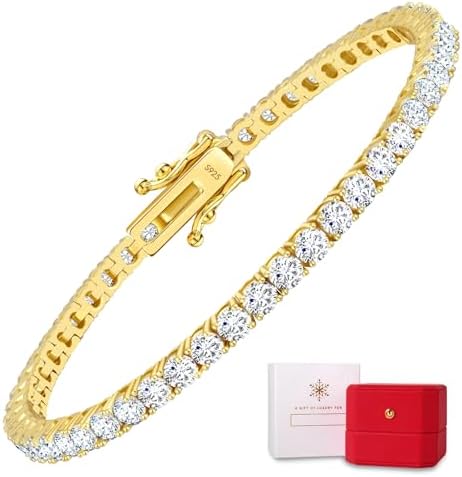
Round brilliant diamonds remain the most common choice because they offer strong light performance and create a smooth, classical line. Emerald-cut, princess-cut, oval, and baguette diamond tennis bracelets provide more distinctive alternatives.
Color Consistency
Individual diamonds should appear consistent when viewed together. A single warmer or greyer stone can become visible when placed beside closely matched diamonds.
Near-colorless grades can offer a strong balance between beauty and price, especially in yellow gold or rose gold settings, where slight warmth may be less noticeable.
Clarity
Tennis bracelets typically use multiple smaller diamonds rather than one large center stone. Minor inclusions may therefore be difficult to see without magnification.
Eye-clean diamonds can provide excellent visual quality without requiring the highest laboratory clarity grades. Matching and brilliance are often more important than purchasing technically flawless stones.
Total Carat Weight
The carat figure for a tennis bracelet usually refers to the combined weight of all stones. A higher total carat weight may mean larger diamonds, a greater number of stones, or both.
Two bracelets with the same total weight may look different depending on wrist size, setting style, stone count, and bracelet length. Buyers should therefore evaluate visual coverage rather than relying solely on the carat number.
Natural vs Lab-Grown Diamond Tennis Bracelets
The growth of lab-grown diamonds has created more choice within the tennis bracelet category.
A natural diamond tennis bracelet contains stones formed within the earth over geological time. These designs may appeal to buyers who value rarity, traditional provenance, and established resale recognition.
A lab-grown diamond tennis bracelet uses diamonds created in controlled laboratory environments. They possess essentially the same optical and chemical properties as natural diamonds but usually cost less at the point of purchase.
The lower price can allow shoppers to select:
- A higher total carat weight
- Larger individual diamonds
- Better cut or clarity specifications
- A wider bracelet design
- A platinum or higher-karat gold setting
The decision depends on personal priorities. Buyers seeking geological rarity and conventional heirloom status may favor natural diamonds. Those prioritizing visible size, brilliance, and budget efficiency may prefer lab-grown diamonds.
Certification, seller transparency, and accurate disclosure remain essential in either case.
Gold Tennis Bracelets and Metal Choices
The metal affects both the appearance and durability of a tennis bracelet.
White Gold Tennis Bracelets
A white gold diamond tennis bracelet creates a cool, continuous appearance because the metal visually blends with the diamonds. It is one of the most traditional choices for maximizing the impression of uninterrupted brilliance.
White gold is commonly rhodium plated to produce a bright white finish. That surface may require periodic replating as it wears.
Yellow Gold Tennis Bracelets
A yellow gold tennis bracelet introduces contrast between the warm metal and white diamonds. This style feels classical, expressive, and particularly effective when coordinated with other yellow gold jewelry.
A 14K yellow gold tennis bracelet generally offers greater resistance to everyday wear, while an 18K version provides a richer gold tone and higher gold content.
Rose Gold Tennis Bracelets
Rose gold softens the formality of a diamond line bracelet. Its pink-toned alloy creates a romantic and contemporary effect that pairs well with warm skin tones, morganite, pink sapphires, and champagne diamonds.
Platinum Tennis Bracelets
Platinum offers a naturally white appearance, substantial weight, and excellent setting security. It is denser and typically more expensive than gold, making it attractive for high-value natural diamond bracelets intended for long-term ownership.
Gemstone Tennis Bracelets Beyond Diamonds
Although the classic version uses diamonds, the continuous-line construction also works beautifully with colored gemstones.
Popular alternatives include:
- Sapphire tennis bracelets
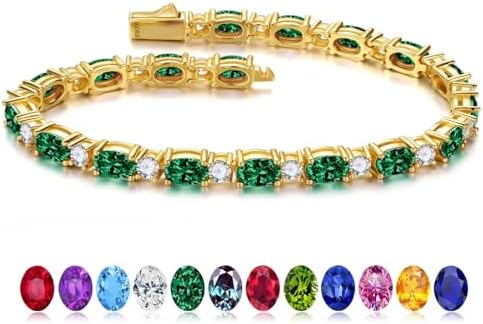
- Emerald tennis bracelets
- Ruby tennis bracelets
- Moissanite tennis bracelets
- Cubic zirconia tennis bracelets
- Multicolored gemstone bracelets
- Diamond-and-sapphire combinations
A sapphire tennis bracelet can offer deep color and strong durability, while emerald versions create a more delicate, vintage-inspired appearance. Moissanite tennis bracelets provide intense brilliance at a more accessible price, although their fire and optical character differ from those of diamonds.
Colored gemstones can also make the symbolism more personal. Birthstones, anniversary stones, and colors associated with family members can transform the bracelet into a private narrative rather than a purely decorative piece.
How Should a Tennis Bracelet Fit?
A properly fitted tennis bracelet should move slightly on the wrist without sliding over the hand. It should not feel tight when the wrist bends, nor should it rotate so freely that the clasp repeatedly moves to the top.
A common guideline is to allow enough space for one finger to fit comfortably between the bracelet and the wrist.
Too-tight sizing may strain the links and clasp. Excessive looseness can cause the bracelet to catch on objects, turn repeatedly, or receive unnecessary impact.
To determine the correct size:
- Measure the wrist with a flexible measuring tape.
- Keep the tape close to the skin without pulling tightly.
- Add approximately 0.25 to 0.5 inches, depending on the desired fit.
- Consider the width and depth of the bracelet.
- Confirm whether the design can be professionally shortened or extended.
A jeweler should perform alterations because resizing usually requires removing or adding individual gemstone links while preserving the bracelet’s structural balance.
How to Style a Diamond Tennis Bracelet
A tennis bracelet can communicate very different moods depending on how it is worn.
Worn Alone: Focused Authority
A substantial diamond tennis bracelet worn by itself creates a controlled, confident statement. This approach works well with tailored clothing, monochromatic eveningwear, and minimalist silhouettes.
Because no competing jewelry surrounds it, the symmetry and brilliance receive full visual attention.
Paired With a Watch: Structured Luxury
A slim tennis bracelet can soften the mechanical character of a luxury watch. For balance, position the bracelet on the outside of the watch and avoid combinations that force the pieces to rub heavily against one another.
Rounded settings and appropriate sizing can help reduce scratching.
Layered With Gold Bracelets: Personal Expression
Pairing a diamond line bracelet with gold bangles, chain bracelets, or sentimental charms creates a more expressive wrist stack.
Allow the tennis bracelet to provide sparkle while the other pieces introduce texture and movement. A successful combination might include one diamond bracelet, one smooth bangle, and one fine chain.
Double Tennis Bracelet Styling
Wearing two tennis bracelets can create an elevated evening look. They may match exactly or differ in stone size, metal color, or gemstone type.
For example, a diamond bracelet can be paired with an emerald or sapphire tennis bracelet to introduce color without disrupting the linear structure.
Caring for a Tennis Bracelet
Because tennis bracelets contain multiple hinges, settings, and stones, they require more inspection than a simple metal bangle.
To protect the bracelet:
- Check the clasp before every wear.
- Have the prongs and links inspected professionally.
- Remove it before exercise, swimming, cleaning, or manual work.
- Avoid pulling it over the hand without opening the clasp.
- Store it flat in a lined jewelry compartment.
- Keep it separate from harder jewelry that may cause scratches.
- Clean it with a gentle method appropriate for its stones and metal.
Lotions, soap, and skin oils can collect beneath the settings and reduce brilliance. Professional cleaning can restore sparkle while allowing the jeweler to identify weakened prongs or stretched links.
Are Tennis Bracelets a Good Investment?
The financial value of a tennis bracelet depends on the quality and origin of the stones, precious-metal weight, craftsmanship, brand, condition, certification, and resale demand.
Natural diamond tennis bracelets from prestigious jewelry houses may retain stronger secondary-market appeal than mass-produced, unbranded designs. Signed pieces, vintage examples, and bracelets with high-quality certified diamonds may also attract collectors.
However, most retail jewelry should not be treated as a guaranteed financial investment. Design, labor, branding, and retail margins contribute to the purchase price, and these costs may not be fully recovered during resale.
The more reliable value of a well-made tennis bracelet lies in its combined benefits:
- Repeated wear across many occasions
- Emotional significance
- Precious-material content
- Repairability
- Heirloom potential
- Timeless visual relevance
It can therefore function as an emotional asset with material substance, even when its greatest return is measured through use, memory, and inheritance.
Featured Spotlight: The Iconic Cartier Love Bracelet
The Epitome of Iconic Luxury
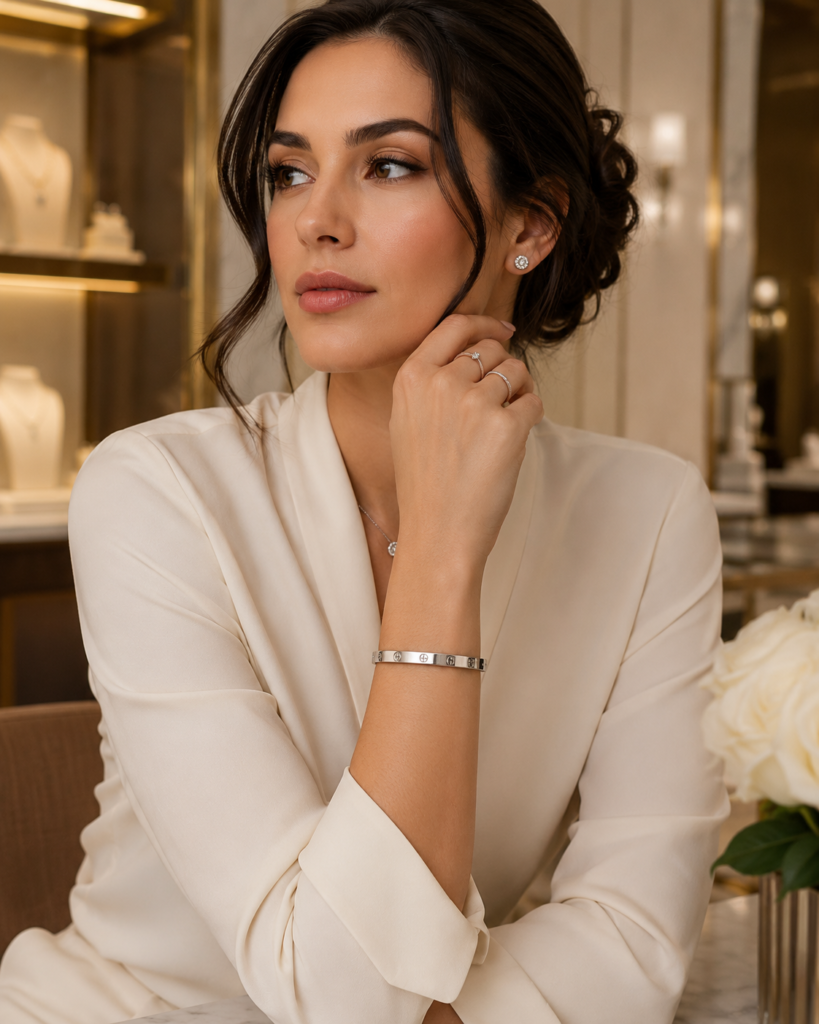
Although structurally different from a flexible tennis bracelet, the Cartier Love bracelet belongs in any serious discussion of iconic luxury bracelets for women. Where a tennis bracelet represents continuity through an uninterrupted line of gemstones, the Cartier Love bracelet expresses permanence through enclosure, structure, and ritual.
Conceived in 1969, the design transformed the traditional bangle into a cultural symbol of committed attachment. Its oval shape follows the wrist closely, while its visible screw motifs create an industrial contrast with the refinement of precious metal.
The bracelet is not merely decorated with screws. Its identity is built around the symbolic idea of being secured in place. This creates what might be described as the psychology of “locked-in” devotion: love represented not as something loose or temporary, but as a deliberate bond.
The Meaning Behind the Cartier Love Bracelet
The Cartier Love bracelet appeals to several psychological desires at once.
It conveys intimacy because the bracelet has traditionally been associated with being opened and closed using a dedicated screwdriver. It conveys permanence because it is designed to remain close to the wrist. It conveys status because its shape and motifs are immediately recognizable to people familiar with luxury jewelry.
The bracelet also demonstrates the power of quiet branding. Its status does not depend on a large logo. Recognition comes through form, proportion, screw details, and cultural history.
For the wearer, this can create a sense of belonging to an established lineage of style. The design has moved through decades of changing fashion while remaining visually consistent, allowing it to communicate both heritage and contemporary relevance.
Pre-Loved Cartier Love Bracelet in 18K White Gold
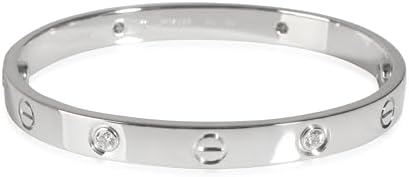
The featured pre-loved piece is an 18K white gold Cartier Love bracelet measuring approximately 19 centimeters. Presented in excellent condition and authenticated through myGemma, it offers the architectural restraint of white gold with the cultural significance of the Love collection.
Its cool-toned metal creates a discreet form of luxury. Unlike yellow gold, which immediately announces warmth and opulence, white gold allows the recognizable structure and screw motifs to carry the design.
The bracelet includes its original box, pouch, and service papers, details that can contribute to the completeness and desirability of a pre-owned luxury-jewelry purchase.
| Specification | Featured Cartier Love Bracelet |
|---|---|
| Brand | Cartier |
| Collection | Love |
| Bracelet style | Structured bangle |
| Metal | 18K white gold |
| Metal stamp | 18K |
| Approximate size | 19 cm |
| Origin | Made in France |
| Condition | Excellent, pre-loved |
| Authentication | Authenticated by myGemma |
| Inclusions | Original box, pouch, and service papers |
| Delivery security | Signature required |
Product condition, inclusions, availability, and seller terms should always be confirmed directly on the current listing before purchase.
Why Buy a Pre-Owned Cartier Bracelet?
A pre-loved Cartier bracelet can provide access to an established luxury design while supporting a more circular approach to fine-jewelry ownership.
Potential advantages include:
- A lower price than an equivalent new piece
- Access to discontinued sizes, metals, or variations
- Immediate availability
- Original packaging or historical service records
- Reduced initial depreciation compared with some new purchases
- Established secondary-market demand
Authentication is essential. Buyers should confirm serial markings, hallmarks, weight, proportions, screw construction, documentation, condition, and seller guarantees. Luxury packaging alone does not prove authenticity.
The bracelet should also be examined for over-polishing. Repeated aggressive refinishing can soften edges, reduce definition around the screw motifs, and remove small amounts of precious metal.
Cartier Love Bracelet vs Diamond Tennis Bracelet
The two bracelets express luxury through very different visual languages.
| Feature | Diamond Tennis Bracelet | Cartier Love Bracelet |
|---|---|---|
| Primary visual element | Continuous row of gemstones | Sculptural precious-metal bangle |
| Construction | Flexible, articulated links | Structured oval form |
| Symbolism | Continuity, eternity and balance | Commitment, enclosure and devotion |
| Styling effect | Light, fluid and sparkling | Architectural and recognizable |
| Typical movement | Drapes naturally over the wrist | Sits closely and maintains its shape |
| Brand dependence | Available from many jewelers | Closely tied to Cartier heritage |
| Best suited to | Versatile brilliance and formal-to-daily wear | Iconic design and heritage status |
A tennis bracelet may appeal to someone who prioritizes gemstone brilliance and fluidity. A Cartier Love bracelet may suit someone drawn to design history, recognizable form, and symbolic structure.
Many collectors wear the two together. The contrast between a flexible diamond line and a solid metal bangle creates a layered composition of light and form. Care should be taken, however, because repeated friction between diamonds and polished gold may cause surface wear.
Heritage, Exclusivity and the Desire to Belong
Owning a Cartier bracelet is partly about material quality, but it is also about participation in a cultural narrative. The wearer acquires a design associated with decades of luxury history, recognizable styling, and social distinction.
Psychoanalytically, heritage jewelry can satisfy the desire for continuity with an elite symbolic tradition. The object becomes more than a personal accessory; it functions as a sign of entry into an established aesthetic world.
Yet the strongest luxury purchases are not made for recognition alone. A Cartier Love bracelet carries greater emotional weight when its symbolism aligns with the wearer’s own experience—whether it represents commitment to a partner, devotion to family, or a promise made to oneself.
Two Visions of Permanence
The diamond tennis bracelet and Cartier Love bracelet approach permanence from opposite directions.
The tennis bracelet expresses it through repetition: stone after stone forming a continuous, luminous sequence. The Love bracelet expresses it through containment: an oval form secured around the wrist and marked by the visual language of screws.
One is fluid; the other is architectural. One catches light through movement; the other asserts presence through structure. Both have endured because they connect fine craftsmanship with recognizable psychological themes—continuity, attachment, confidence, and the desire to own something that outlasts a passing moment.






4. Budget-Friendly Bracelets: The Joy of Everyday Self-Care
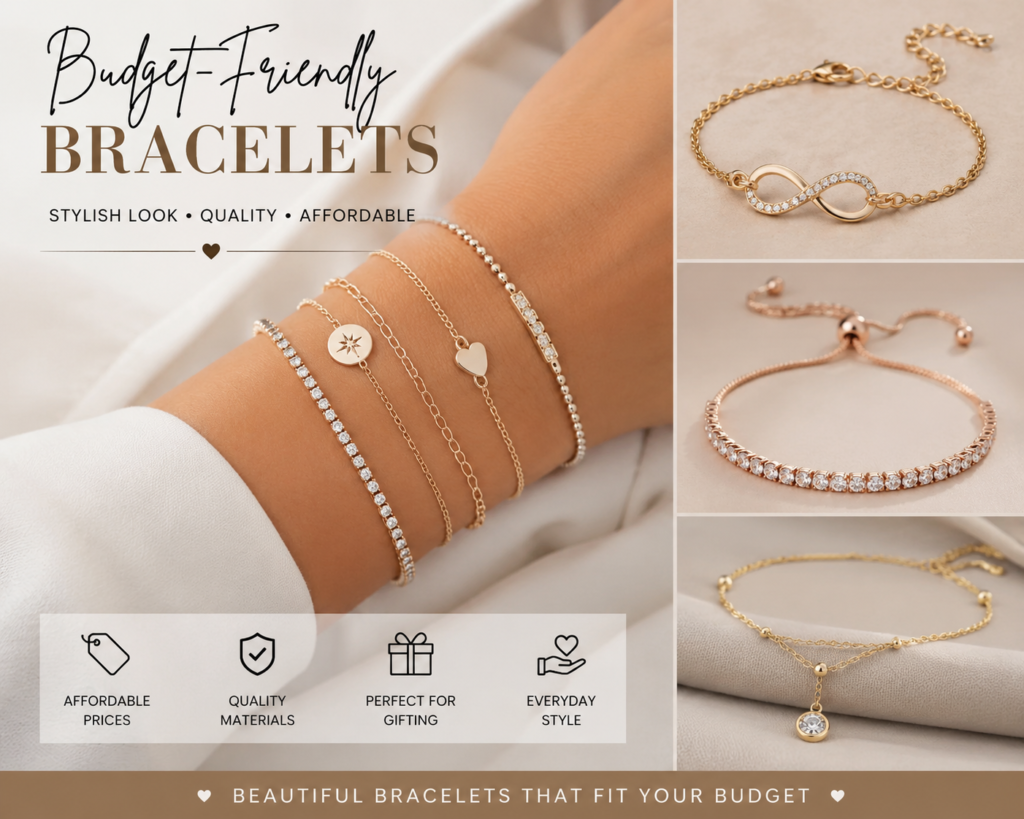
Not every bracelet needs to be an heirloom, a precious-metal investment, or a purchase reserved for a major life event. Sometimes jewelry serves a simpler and equally meaningful purpose: it refreshes an outfit, marks a small achievement, or makes an ordinary day feel more intentional.
Budget-friendly bracelets give women access to the emotional and visual pleasure of jewelry without requiring a significant financial commitment. A delicate chain bracelet can make workwear feel more polished. A colorful beaded design can bring energy to a neutral wardrobe. A charm bracelet purchased after completing a difficult project can become a modest but meaningful symbol of personal progress.
This form of affordable self-gifting is less about extravagance and more about acknowledgment. The bracelet may celebrate finishing a demanding week, beginning a new routine, reaching a fitness goal, or simply deciding that everyday life deserves beauty too.
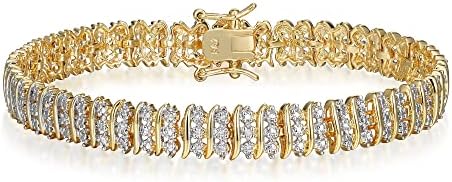
For shoppers searching for affordable bracelets for women, the modern market offers far more than disposable costume jewelry. Thoughtfully selected pieces can combine contemporary design, durable materials, secure clasps, comfortable construction, and polished finishes at accessible prices.
The Psychology of Affordable Jewelry
Jewelry often affects how a woman experiences herself before it affects how others perceive her. Because bracelets remain visible to the wearer throughout the day, they can act as small visual cues connected to mood, memory, and identity.
A bright enamel bangle may communicate playfulness. A slim silver-tone bracelet may reinforce a minimalist self-image. A chunky gold-plated chain can create a sense of confidence before a presentation or social event.
From a psychological perspective, affordable fashion jewelry allows experimentation with the “possible self”—the different identities a person may want to explore without permanently redefining her wardrobe or spending heavily.
One day, the wearer may prefer a bohemian stack of beads and charms. The next, she may choose a restrained minimalist bracelet. This flexibility makes budget jewelry especially useful during periods of personal transition, when style becomes a way of exploring change.
The pleasure should not be reduced to a momentary “dopamine hit.” A more sustainable form of self-care comes from choosing pieces intentionally—selecting bracelets that are genuinely wearable, personally expressive, and likely to remain useful beyond the initial excitement of buying them.
Why Affordable Bracelets Have Become More Sophisticated
Budget jewelry once carried an obvious visual divide between inexpensive fashion pieces and fine jewelry. That gap has narrowed considerably as brands have improved plating techniques, metal finishing, stone setting, clasp construction, and design proportions.
Today, many affordable bracelets use:
- Stainless steel
- Brass or copper alloys
- Sterling silver
- Gold plating
- Rhodium plating
- Cubic zirconia
- Crystal glass
- Enamel
- Resin or acrylic
- Freshwater pearls
- Natural or synthetic beads
- Braided leather or textile cords
The material itself does not determine whether a bracelet looks refined. Proportion, finish, weight, polish, symmetry, and construction often matter more.
A simple stainless-steel bangle with clean edges and a secure hinge may appear more expensive than a heavily decorated bracelet with uneven stones and visible glue. Likewise, a slim cubic zirconia tennis bracelet can look elegant when the settings are consistent and the metalwork is restrained.
The Best Types of Budget-Friendly Bracelets for Women
Affordable bracelets are available in nearly every major style category. The best option depends on how the bracelet will be worn, what clothing it must complement, and how much maintenance the buyer is willing to accept.

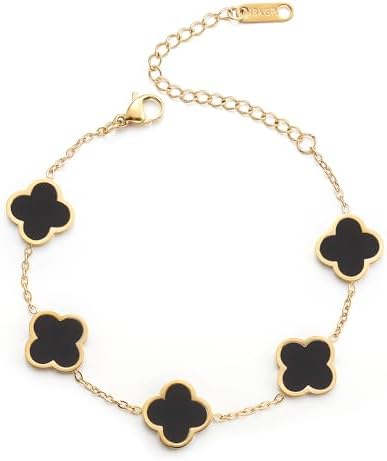


Minimalist Chain Bracelets
Minimalist chain bracelets are among the most versatile affordable jewelry options. Fine cable chains, paperclip links, snake chains, and box chains can be worn alone or layered with watches and bangles.
These bracelets work particularly well for:
- Office clothing
- Capsule wardrobes
- Everyday casual outfits
- Subtle gifting
- Women new to jewelry stacking
A minimalist bracelet should feel light but not fragile. Examine the jump rings, clasp, and connection points, as these are usually more important to longevity than the visual design.
Affordable Tennis Bracelets
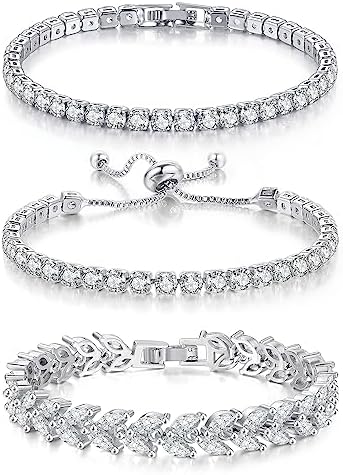
An affordable tennis bracelet typically uses cubic zirconia, crystal, moissanite, or another diamond alternative in place of natural diamonds. It provides the symmetry and continuous sparkle of a classic diamond tennis bracelet at a much lower price.
These bracelets are useful for weddings, parties, dinners, graduation events, and elevated everyday styling. They can also help a shopper test whether she enjoys the tennis-bracelet silhouette before investing in fine jewelry.
Look for evenly matched stones, flexible links, a secure box clasp, and at least one secondary safety feature. A low price should not require accepting a weak closure.
Charm Bracelets
Charm bracelets allow the wearer to build meaning gradually. Individual charms can represent travel, hobbies, initials, family members, spiritual symbols, or important dates.
Budget-friendly charm bracelets are especially suitable for younger shoppers and gift buyers because they can evolve over time. Instead of purchasing a completely new bracelet for each occasion, another charm can be added to mark a new chapter.
The strongest designs balance symbolism with restraint. Too many heavy charms can make the bracelet uncomfortable and place stress on the links.
Beaded and Bohemian Bracelets
Beaded bracelets offer color, texture, and a more relaxed visual language. They may feature glass beads, ceramic, wood, resin, freshwater pearls, seed beads, or semi-precious stones.
These pieces fit naturally into bohemian, resort, festival, and casual summer wardrobes. They are also effective for creating personalized stacks because different colors and materials can be combined without requiring exact coordination.
Check the quality of the elastic, knotting, and stringing material. A beautiful bead arrangement will not last if the bracelet is built on weak cord.
Cuff Bracelets and Statement Bangles
Affordable cuffs and bangles can create substantial visual impact without the cost of solid gold or silver. Sculptural metal shapes, hammered surfaces, enamel details, and geometric forms allow a single bracelet to become the focus of an outfit.
A statement cuff works best when the design appears deliberate rather than overcrowded. Clean contours and a smooth inner surface usually create a more luxurious impression than excessive ornamentation.
Pearl and Crystal Bracelets
Freshwater pearl and crystal bracelets provide accessible occasion jewelry. Irregular freshwater pearls can create an organic, contemporary appearance, while crystal bracelets offer light-catching sparkle for eveningwear.
Pearl bracelets should be examined for secure knotting or stringing, while crystal bracelets require attention to setting quality. Glued stones may loosen more easily than stones held by prongs or channels.
Affordable Gold-Plated and Silver-Tone Bracelets
Gold-plated bracelets allow the wearer to enjoy a warm, luxurious finish without the cost of solid gold. Silver-tone and rhodium-plated bracelets offer a cooler, more modern alternative.
These styles are popular among shoppers searching for:
- Affordable gold bracelets for women
- Gold bracelets under $50
- Silver bracelets for everyday wear
- Trendy bracelets for women
- Stackable gold bracelets
- Budget-friendly jewelry gifts
Plating quality varies widely. A well-applied coating over stainless steel or sterling silver may wear more attractively than very thin plating over an unstable base metal.
Budget Bracelet Materials Compared
| Material | Main Advantage | Potential Limitation | Best Use |
|---|---|---|---|
| Stainless steel | Durable, affordable and resistant to corrosion | Can feel heavier than delicate alloys | Everyday bracelets and bangles |
| Brass | Warm tone and easy to shape into detailed designs | May tarnish or react with some skin types | Fashion-forward statement pieces |
| Sterling silver | Precious-metal base at a lower price than gold | Requires polishing and may tarnish | Everyday fine-looking jewelry |
| Gold-plated metal | Provides the appearance of gold affordably | Plating can fade with friction and moisture | Occasional wear and trend-led designs |
| Rhodium-plated metal | Bright, cool finish with a polished appearance | Coating may eventually require renewal | Silver-tone formal and minimalist pieces |
| Cubic zirconia | Strong sparkle at a low price | Can become cloudy if not cleaned | Affordable tennis and occasion bracelets |
| Crystal glass | Available in many colors and cuts | May chip under impact | Decorative and evening bracelets |
| Freshwater pearls | Organic texture and natural variation | More sensitive to perfume and chemicals | Feminine and occasion styling |
| Resin or acrylic | Lightweight, colorful and sculptural | Can scratch more easily | Trend-focused cuffs and bangles |
How to Identify a Good-Quality Affordable Bracelet
Price alone does not reveal quality. Two bracelets sold at the same price may differ significantly in construction and longevity.
Before buying, inspect the following details:
Clasp Security
Lobster clasps should open and close smoothly. Box clasps should lock firmly without excessive movement. Hinged bangles should snap shut cleanly.
A decorative bracelet that repeatedly opens on its own is not a bargain, regardless of how attractive it looks.
Smooth Edges and Surfaces
Run a finger carefully along the bracelet. Rough prongs, unfinished edges, and sharp metal sections can catch on clothing or irritate the skin.
The underside matters as much as the visible surface because it remains in direct contact with the wrist.
Stone Alignment
Crystals and cubic zirconia should sit evenly within their settings. Crooked stones, visible adhesive, or irregular spacing can make a bracelet look inexpensive.
Link Strength
Inspect the rings and joints connecting the bracelet. Thin, partially closed jump rings are common weak points in affordable jewelry.
Plating Consistency
The color should appear even across the bracelet, including around the clasp and between the links. Dark patches, bubbling, or visible base metal may indicate poor finishing.
Comfortable Weight
A bracelet should feel substantial enough to sit properly but not so heavy that it becomes tiring. Extremely lightweight statement jewelry can sometimes look hollow or feel unstable, while excessive weight may strain the clasp.
Affordable Bracelets by Personal Style
Budget-friendly jewelry makes it possible to build a bracelet collection around different moods rather than one fixed identity.
| Personal Style | Bracelet Choices |
|---|---|
| Minimalist | Thin chain bracelets, plain bangles and bezel-set stones |
| Bohemian | Beads, braided cords, charms and mixed natural textures |
| Romantic | Pearls, heart charms, rose-gold tones and delicate crystals |
| Classic | Tennis bracelets, polished cuffs and simple gold chains |
| Bold | Chunky links, oversized cuffs and geometric bangles |
| Vintage-inspired | Filigree metalwork, antique finishes and colored crystals |
| Modern | Stainless steel, sculptural shapes and mixed-metal designs |
| Playful | Enamel, colorful beads, initials and novelty charms |
The purpose is not to follow every trend. A more useful approach is to identify which styles support the clothing already in the wardrobe.
The Art of Building a Budget Bracelet Stack
Stackable bracelets allow several inexpensive pieces to create a richer and more personal effect. The most convincing stacks appear collected rather than randomly accumulated.
Start with three components:
- A visual anchor, such as a watch, cuff, or tennis bracelet
- A textural piece, such as a rope chain or beaded bracelet
- A delicate connector, such as a slim bangle or fine chain
Varying widths creates rhythm. Combining only bracelets of the same thickness can make the stack look flat, while too many competing statement pieces may feel cluttered.
A cohesive bracelet stack may be unified by:
- One metal tone
- A repeating gemstone color
- Similar levels of polish
- A shared motif
- A controlled neutral palette
Mixed-metal stacking can also work well. Yellow gold, silver tone, and rose gold no longer need to remain separate, but one finish should usually dominate so the combination appears intentional.
Affordable Bracelets for Work and Professional Settings
Budget bracelets can add polish to professional clothing without becoming distracting.
For meetings, interviews, and office environments, select:
- Slim chain bracelets
- Narrow bangles
- Small-stone tennis bracelets
- Matte or softly polished cuffs
- Bracelets that do not make excessive noise
Avoid overly loose stacks that strike the desk while typing. A bracelet may look elegant while standing but become impractical during a full workday.
One restrained piece often communicates more authority than several highly decorative bracelets.
Budget-Friendly Bracelets for Special Occasions
Affordable jewelry is especially useful when a bracelet must coordinate with a specific dress, color palette, or event theme.
A crystal tennis bracelet can provide wedding-guest sparkle without the cost of diamonds. A pearl bracelet can complement a bridal shower outfit. A gold-plated cuff can add warmth to a formal black dress.
Because the financial commitment is lower, the buyer can choose a design tailored to the event rather than forcing one expensive bracelet to work with every outfit.
The most versatile occasion pieces use clear stones, neutral metals, pearls, or restrained geometric forms.
Affordable Bracelet Gift Ideas
Budget-friendly bracelets make effective gifts because they can feel personal without placing pressure on either the buyer or recipient.
Popular gift categories include:
- Initial bracelets
- Birthstone bracelets
- Friendship bracelets
- Charm bracelets
- Engraved bangles
- Heart bracelets
- Zodiac bracelets
- Pearl bracelets
- Adjustable chain bracelets
- Matching bracelet sets
Adjustable bracelets are useful when the recipient’s wrist size is unknown. However, sliding mechanisms should still be tested for stability because weak adjusters may loosen during wear.
Presentation also affects perceived value. A modest bracelet placed in a clean pouch or jewelry box can feel far more thoughtful than a more expensive piece handed over without care.
Best Bracelets Under $25, $50 and $100
Budget categories should be evaluated by realistic expectations.
Bracelets Under $25
At this level, prioritize design, comfort, and short-to-moderate-term wear. Beaded bracelets, stainless-steel chains, simple cuffs, and cubic zirconia pieces can offer good value.
Avoid expecting permanent plating or fine-jewelry craftsmanship.
Bracelets Under $50
This price range may offer thicker plating, better clasps, more substantial stainless steel, improved crystal settings, and entry-level sterling silver.
It is often the strongest category for trend-led bracelets that still feel polished and giftable.
Bracelets Under $100
Buyers can begin to find better sterling silver, gold vermeil, freshwater pearls, moissanite accents, and higher-quality construction.
A bracelet under $100 can provide meaningful longevity when the materials and craftsmanship are clearly disclosed.
How to Care for Budget-Friendly Bracelets
Affordable jewelry lasts longer when it is treated according to its material.
To preserve the finish:
- Remove bracelets before bathing, swimming, or exercising.
- Apply perfume, lotion, and sunscreen before putting jewelry on.
- Wipe metal and stones gently after wear.
- Store pieces separately to prevent scratching and tangling.
- Keep elastic bracelets away from heat and prolonged stretching.
- Avoid abrasive metal polishes on plated jewelry.
- Clean pearls and delicate beads only with a soft, slightly damp cloth.
Do not assume that a bracelet is waterproof simply because the product description calls it “tarnish resistant.” Water resistance, sweat resistance, and permanent color retention are different claims.
Skin Sensitivity and Affordable Jewelry
Women with metal sensitivities should examine material disclosures carefully. Terms such as “alloy,” “fashion metal,” or “gold tone” do not identify what is touching the skin.
Nickel can cause irritation in sensitive wearers. Stainless steel, sterling silver, titanium, and clearly disclosed nickel-free materials may be better choices, although individual reactions vary.
Plated bracelets can also become irritating once the outer layer wears and exposes the base metal. For frequent wear, the composition beneath the plating matters.
A low price should never require accepting persistent itching, discoloration, or discomfort.
Trend Participation Without Trend Dependence
One of the greatest advantages of affordable bracelets is the freedom to explore current aesthetics. Chunky chains, colorful enamel, celestial charms, pearl-and-metal combinations, sculptural cuffs, and mixed-metal stacks can all be tested without the pressure of making a lifetime purchase.
However, a budget bracelet collection can become cluttered when each piece is bought only because it is momentarily popular.
A stronger buying rule is to ask:
- Can this bracelet work with at least three outfits I already own?
- Is the clasp secure enough for real wear?
- Does the design reflect my style beyond the current season?
- Am I buying it to enjoy, or simply reacting to urgency and promotion?
- Is the material appropriate for how often I plan to wear it?
These questions preserve the pleasure of affordable jewelry while reducing impulsive purchases that are rarely worn.
Self-Care Without Excess Consumption
Fashion can support mood, confidence, and self-expression, but buying should not become the only form of emotional regulation. The healthiest version of jewelry self-care is intentional rather than compulsive.
A budget-friendly bracelet can be meaningful when it marks a real experience, complements a personal style, or adds beauty to daily routines. Its value does not depend on being expensive, but it should still earn its place in the wardrobe.
Instead of purchasing many nearly identical pieces, consider building a small rotation:
- One understated everyday bracelet
- One colorful or playful design
- One occasion bracelet
- One sentimental piece
- One bold statement bracelet
This creates variety without unnecessary accumulation.
Affordable Jewelry Can Still Feel Personal
Luxury is often associated with rarity and price, but personal value follows a different logic. A $30 bracelet purchased after a first professional success may carry more emotional significance than a far more expensive piece bought without a story.
Budget-friendly bracelets give women the freedom to celebrate smaller moments that traditional luxury marketing often overlooks: finishing a course, returning to work, beginning a creative project, recovering confidence, or simply choosing to dress with greater intention.
The piece does not need to become an heirloom to be worthwhile. Its purpose may be to brighten a particular season of life, help the wearer explore a new aesthetic, or provide a small daily reminder that beauty does not need to wait for a major occasion.
Everyday Luxury Without the Financial Weight
The strongest budget bracelets for women do not pretend to be something they are not. They offer thoughtful design, comfortable wear, expressive variety, and accessible pleasure.
A gold-plated chain may not carry the intrinsic value of a solid-gold bracelet. A cubic zirconia tennis bracelet may not possess the rarity of natural diamonds. Yet both can still provide elegance, confidence, and repeated enjoyment when they are well chosen.
Affordable jewelry is most satisfying when price accessibility is paired with discernment. By paying attention to materials, construction, comfort, styling potential, and personal meaning, a woman can build a bracelet collection that feels expressive rather than disposable—and luxurious in the way that matters most: because it belongs naturally to her life.
5. High-End Bracelets: The Royal Family Collection
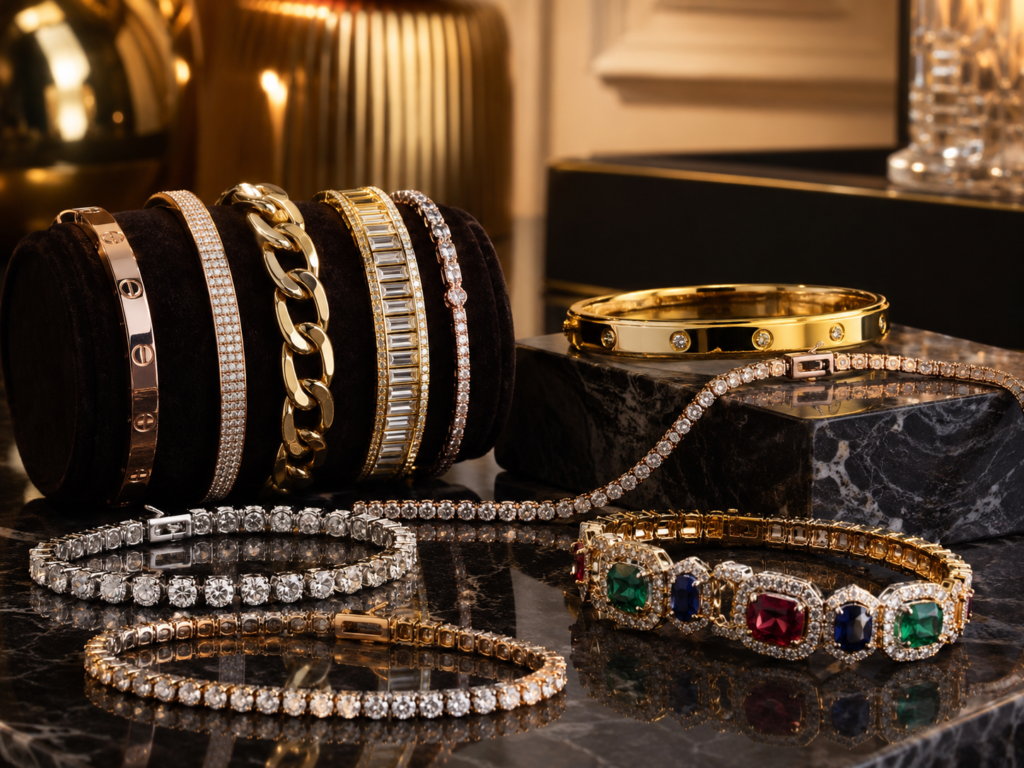
At the summit of the bracelet market are pieces created not merely for seasonal styling, but for permanence. High-end bracelets are purchased with the expectation that they will remain relevant for decades, acquire personal history, and eventually pass from one generation to the next.
These are not accessories chosen impulsively to complete a single outfit. They are substantial expressions of identity, achievement, lineage, and refined taste. A solid 18K gold bracelet, a meticulously set diamond bangle, or a handmade Cuban link bracelet can become part of a family’s visual language—worn at weddings, anniversaries, formal gatherings, professional milestones, and other moments that define a life.
Within the Royal Family Collection, luxury is measured not only by price, logo visibility, or gemstone size. It is measured through material integrity, precise construction, artisanal provenance, tactile weight, and the ability of a bracelet to retain its aesthetic authority long after short-lived trends have disappeared.
The finest luxury bracelets for women and men communicate confidence without needing to announce it. Their quality becomes visible through proportion, polish, movement, link consistency, stone matching, clasp engineering, and the physical presence of precious metal on the wrist.
What Defines a High-End Bracelet?
A high price alone does not make a bracelet luxurious. Genuine high-end jewelry results from the interaction of exceptional materials, disciplined design, and skilled craftsmanship.
A well-made luxury bracelet should demonstrate:
- Solid precious-metal construction
- Accurate gold purity and hallmarking
- Secure links, hinges, clasps, and gemstone settings
- Consistent finishing across visible and hidden surfaces
- Balanced weight and comfortable articulation
- Thoughtful proportions suited to the design
- Traceable materials and credible provenance
- Repairability and long-term service potential
- A design language capable of surviving changing trends
A bracelet may use solid 18K gold, platinum, natural diamonds, sapphires, emeralds, rubies, or other rare gemstones. Yet expensive materials cannot compensate for poor construction. A heavy bracelet with weak soldering, uneven links, or an unreliable clasp is not a strong luxury purchase.
The best high-end bracelets unite beauty with structural confidence. They feel deliberate in the hand and secure on the wrist.
High-End Bracelets as Symbols of Generational Wealth
Precious jewelry has historically served as a portable expression of wealth. Unlike property, furniture, or art that remains fixed in one location, a gold bracelet can be worn, transported, gifted, inherited, and reinterpreted by successive generations. The same legacy-building principle extends to Luxury Rings, which often preserve family identity, romantic commitment, and generational value within a smaller but highly symbolic form.
This mobility gives heirloom jewelry a distinctive emotional character. It exists simultaneously as:
- A personal adornment
- A store of material substance
- A record of family history
- A symbol of achievement
- A ceremonial object
- A future inheritance
The phrase generational wealth jewelry does not refer only to financial value. It also describes the transfer of meaning, identity, and memory.
An 18K gold bracelet inherited from a grandmother may carry evidence of her daily life in its softened edges and subtle scratches. A diamond bracelet purchased to celebrate the creation of a family business may later represent the discipline and sacrifice behind that success.
Over time, the bracelet becomes more than the sum of its gold weight and gemstones. It acquires narrative value.
The Psychology of Heirloom Jewelry
From a psychoanalytic perspective, heirloom bracelets can function as stabilizing objects. They connect the wearer to people, memories, and values that existed before the present moment.
A substantial gold bracelet may create what could be described as a sensory form of continuity. Its weight remains constant even when social roles, relationships, careers, and environments change. The object becomes a tangible reminder that the wearer belongs to a story larger than the immediate circumstances of the day.
High-end jewelry may also represent the “Ideal Self”: disciplined, enduring, composed, and resistant to fragmentation. When the bracelet is inherited, that ideal can become intergenerational. The wearer is not only expressing personal taste but carrying forward a symbolic standard established by those who came before.
This helps explain why some luxury bracelets are rarely treated as ordinary possessions. They are protected, documented, repaired, and reserved for meaningful occasions because their emotional role extends beyond decoration.
The AceTex Revolution: Handcrafted Excellence
A standout within this category is the AceTex bracelet collection, positioned around handcrafted elegance, substantial precious-metal construction, and enduring link design.
Since 1980, AceTex has cultivated an identity centered on the value of the human hand. In a jewelry market increasingly shaped by high-volume manufacturing, hollow construction, and rapidly replicated trends, the AceTex approach emphasizes weight, precision, traditional link-making, and the visible discipline of the master craftsperson.
An AceTex bracelet is designed for the buyer who notices details that mass-market jewelry often minimizes: the density of a solid link, the smoothness of an interior surface, the consistency of hand finishing, the alignment of each connection, and the controlled resistance of a well-engineered clasp.
This is jewelry associated with the Master Craftsman archetype—a belief that value emerges through patience, technical knowledge, repetition, and respect for the material.
The Human Difference in Handmade Bracelets
Handcrafted does not mean irregular or imprecise. At the highest level, handwork involves controlling tiny variations until the finished bracelet appears coherent, balanced, and effortless.
A handmade gold bracelet may involve numerous stages:
- Preparing or selecting the gold alloy
- Forming wire, sheet, or individual link components
- Shaping each link to the required dimensions
- Soldering connection points
- Interlocking and aligning the bracelet
- Filing and smoothing rough surfaces
- Creating or attaching the clasp
- Polishing the visible and internal areas
- Inspecting the piece for strength and symmetry
- Applying final hallmarks and quality controls
For diamond or gemstone bracelets, additional work is required to prepare the settings, match the stones, secure each gem, and ensure the finished bracelet remains flexible.
The result should feel unified. No individual solder joint or setting should distract from the bracelet as a whole.
Solid Gold Construction vs Hollow Gold Bracelets
One of the defining characteristics of serious luxury bracelets is the use of solid precious metal.
A solid gold bracelet is constructed from gold alloy throughout its structure. A hollow bracelet, by contrast, uses shaped gold walls around an interior cavity. Hollow construction can create a larger visual profile with less metal, making the piece lighter and less expensive.
Both forms have legitimate uses, but they offer different experiences.
| Feature | Solid Gold Bracelet | Hollow Gold Bracelet |
|---|---|---|
| Weight | Substantial and tactile | Lighter for its apparent size |
| Resistance to denting | Generally stronger | More vulnerable to crushing and dents |
| Repair potential | Often easier for skilled jewelers to restore | Repairs may be more complex |
| Gold content | Higher for comparable dimensions | Lower due to hollow interior |
| Wearing experience | Grounded, dense and luxurious | Lightweight and visually bold |
| Typical cost | Higher | More accessible |
| Long-term purpose | Better suited to heirloom ownership | Often suited to occasional styling |
The sensory difference is immediately noticeable. A heavy-gauge gold bracelet settles onto the wrist with a feeling of permanence. Its weight becomes part of the design rather than an incidental characteristic.
The Grounding Effect of Heavy Gold Bracelets
Weight has psychological as well as material significance.
A substantial 18K gold bracelet produces a constant tactile awareness. As the wearer moves, the bracelet’s presence can be felt against the wrist. This creates a form of sensory grounding—a repeated physical signal of solidity, control, and possession.
For some collectors, that weight is central to the luxury experience. A large bracelet that appears substantial but feels unexpectedly light may create a sense of visual promise without material fulfillment. A solid bracelet aligns appearance with reality.
The attraction is not simply that heavier jewelry costs more. The appeal lies in the congruence between what the bracelet communicates and what it physically contains.
Solid 18K Gold Bracelets: Purity and Presence
A solid 18K gold bracelet contains approximately 75% pure gold, with the remainder composed of alloying metals that influence strength, color, and wear characteristics.
Yellow 18K gold has a deep, saturated warmth that immediately distinguishes it from lower-karat alloys and plated finishes. The color appears particularly rich in wide cuffs, thick link bracelets, and polished bangles, where a larger metal surface allows the tone to dominate.
High-end 18K gold bracelets are valued for:
- Greater pure-gold content
- Rich yellow coloration
- Substantial precious-metal weight
- Strong cultural association with fine jewelry
- Suitability for diamonds and rare gemstones
- Long-term repair and refinishing potential
- Heirloom appeal
Because 18K gold is softer than 14K gold, it may acquire fine scratches and surface marks more readily. Within heirloom jewelry, however, these signs of wear are not always considered flaws. When maintained properly, they can become part of the bracelet’s history.
14K Gold in High-End Bracelet Design
While 18K gold is strongly associated with high luxury, solid 14K gold bracelets can also qualify as high-end pieces when craftsmanship, weight, and design are exceptional.
Fourteen-karat gold contains approximately 58.3% pure gold and a greater proportion of strengthening alloys. This makes it attractive for heavy bracelets intended for frequent wear.
A high-end 14K gold Cuban link bracelet may offer:
- Greater resistance to denting
- Stronger suitability for everyday use
- Substantial gold content
- A comparatively accessible price per gram
- Excellent performance in complex link structures
The decision between 14K and 18K gold should therefore be guided by lifestyle as well as prestige. Buyers prioritizing purity and saturated color may prefer 18K. Those seeking durability in a large, frequently worn bracelet may consider 14K the more practical form of luxury.
Signature Link Styles: Miami Cuban and Curb Bracelets
Link bracelets occupy a central place in the AceTex aesthetic because they make craftsmanship visible. Each link must be formed, joined, aligned, and finished in relation to the next.
Two of the most enduring styles are the Miami Cuban link bracelet and the curb link bracelet.
Handmade Miami Cuban Link Bracelets
A Miami Cuban link bracelet is characterized by tightly interlocking, flattened links that create a dense and rhythmic structure. The design has a strong visual presence and is often associated with success, music, entrepreneurship, and contemporary luxury culture.
A handmade Cuban bracelet demands considerable precision. Each link must be closely matched in size and angle so the finished chain lies flat rather than twisting.
Quality indicators include:
- Solid rather than hollow links
- Consistent link dimensions
- Smooth solder points
- Tight but flexible articulation
- Flat, balanced wrist positioning
- A substantial box clasp
- Additional safety locks
- Even polishing on all surfaces
The best solid gold Cuban link bracelets feel powerful without becoming crude. Their visual authority comes from disciplined repetition and density.
Curb Link Gold Bracelets
A curb link bracelet uses interlocking links that have been twisted and flattened so they sit in a uniform plane. The style can range from narrow and understated to broad and architectural.
Compared with a Miami Cuban link, a refined curb bracelet may appear slightly more open, depending on link spacing and proportions. This can make it easier to integrate into formal or mixed-style wardrobes.
Curb link bracelets are suited to buyers who want:
- A classic gold chain design
- Strong everyday versatility
- Visible craftsmanship
- A bracelet suitable for layering
- A balance between tradition and contemporary style
Both link styles can become signature pieces, but their proportions should suit the wrist. A wider bracelet creates authority and visual weight, while a narrower design offers greater subtlety and stacking flexibility.
High-End Chain Bracelet Construction
When evaluating a luxury chain bracelet, buyers should look beyond the front-facing polish.
Examine:
- The underside of the links
- The quality of soldering
- The flexibility between links
- Whether the bracelet lies flat
- The transition into the clasp
- Sharp or unfinished areas
- Hallmarks and maker’s stamps
- The weight relative to its dimensions
A bracelet that feels rigid, twists excessively, or catches on the wrist may have been poorly assembled even when the gold itself is genuine.
Diamond Bracelets and Rare Gemstones
At the highest end of the category, solid gold construction is often combined with exceptional gemstones.
A high-end diamond bracelet should demonstrate more than a large total carat weight. It should show close matching across cut, color, clarity, fluorescence, size, and visual performance.
Poorly matched stones interrupt the rhythm of a bracelet. One noticeably darker, warmer, or less brilliant diamond can weaken an otherwise expensive design.
High-Carat Diamond Bracelets
Large diamond bracelets may use:
- Round brilliant diamonds
- Emerald-cut diamonds
- Baguette diamonds
- Princess-cut diamonds
- Oval diamonds
- Marquise diamonds
- Mixed-cut compositions
Round diamonds create intense, classical brilliance. Emerald cuts produce a quieter, architectural effect. Baguettes are often used in Art Deco-inspired bracelets, where geometry and precision are more important than maximal sparkle.
Buyers should review independent grading documentation where appropriate, particularly for larger individual diamonds. For bracelets containing many smaller stones, the seller should still disclose total carat weight, approximate color and clarity ranges, treatment status, and whether the diamonds are natural or lab-grown.
Emerald, Ruby and Sapphire Bracelets
Rare gemstone bracelets introduce color, individuality, and deeper symbolic associations.
An emerald bracelet may represent renewal, wisdom, and vitality. A ruby bracelet communicates passion, power, and ceremonial richness. A sapphire bracelet often conveys loyalty, clarity, and royal restraint.
In high jewelry, gemstone value depends on more than carat weight. Important factors include:
- Color saturation
- Tone and hue
- Transparency
- Origin
- Treatment history
- Cut quality
- Consistency across multiple stones
- Laboratory documentation
Some natural inclusions are expected in gemstones such as emeralds. The goal is not always technical perfection, but beauty, character, and appropriate disclosure.
Exceptional Materials in High-End Bracelets
| Material | Luxury Appeal | Important Buying Consideration |
|---|---|---|
| 18K yellow gold | Rich color and high gold purity | Softer than lower-karat alloys |
| 18K white gold | Refined, cool-toned appearance | May require rhodium maintenance |
| 18K rose gold | Warm, romantic coloration | Alloy tone can vary by maker |
| Platinum | Dense, naturally white and prestigious | Heavier and often more expensive |
| Natural diamonds | Geological rarity and traditional status | Quality, certification and provenance |
| Lab-grown diamonds | Greater visual size for the budget | Lower secondary-market expectations |
| Emeralds | Distinctive color and historical prestige | Often treated; inclusions are common |
| Rubies | Strong symbolism and intense color | Fine untreated stones can be rare |
| Sapphires | Durable and available in varied colors | Origin and treatment affect value |
Artisanal Provenance: The Hand of the Maker
In luxury jewelry, provenance refers to the history behind the piece: who made it, where it was made, which materials were used, and how ownership or documentation can be traced.
Artisanal provenance adds a human dimension to value. A bracelet made by an identifiable workshop or master craftsperson has a story of creation rather than only a product code.
Evidence of provenance may include:
- Maker’s hallmarks
- Gold purity stamps
- Serial numbers
- Workshop records
- Certificates of authenticity
- Gemological reports
- Original invoices
- Service documents
- Signed presentation materials
Provenance becomes particularly important in the pre-owned high-end jewelry market, where authenticity and condition significantly affect desirability.
Why Visible Handwork Matters
Perfectly smooth surfaces are not the only signs of quality. Some artisanal bracelets preserve subtle evidence of hand finishing, engraving, hammering, or individually formed links.
These details distinguish human craftsmanship from automated repetition. They remind the wearer that the bracelet passed through another person’s concentration and skill before becoming a finished object.
For collectors, this human trace can create emotional depth. The bracelet is not simply manufactured; it is authored.
The Investment Mindset: Jewelry as a Hard Asset
Collectors of heavy solid-gold bracelets are often attracted to their material substance. Gold has an observable market price, can be weighed and tested, and has historically been treated as a portable store of value.
This leads some buyers to regard solid gold jewelry as a form of wearable hard asset.
A substantial bracelet may derive value from several layers:
- Gold purity and weight
- Gemstone quality
- Craftsmanship
- Brand or maker reputation
- Design rarity
- Condition
- Provenance
- Collector demand
However, a luxury bracelet should not be presented as a guaranteed financial investment. Buyers typically pay retail premiums for design, labor, branding, distribution, and seller margins. These costs may not be fully recovered during resale.
Gold Value vs Jewelry Value
The melt value of a bracelet is based primarily on gold purity and weight. Its jewelry value may be higher because of craftsmanship, branding, gemstones, scarcity, and aesthetic desirability.
For example, a handmade 18K Cuban link bracelet may command more than its raw gold value because forming and finishing each link requires significant labor. A signed bracelet from a recognized jewelry house may receive an additional secondary-market premium.
Conversely, a generic design purchased at a high retail markup may resell closer to its material value.
The most grounded investment approach is to purchase a bracelet that offers:
- Genuine enjoyment during ownership
- Strong material content
- Quality construction
- Transparent pricing
- Recognizable design
- Long-term repairability
- Potential family or collector relevance
Calculating the Material Substance of a Gold Bracelet
Buyers can better understand a bracelet by reviewing its:
- Total gram weight
- Gold karat
- Approximate pure-gold content
- Gemstone weight
- Manufacturing method
- Hollow or solid construction
An 18K bracelet contains approximately 75% gold by weight before accounting for non-gold components such as stones, springs, or internal clasp mechanisms.
A 100-gram 18K bracelet therefore contains roughly 75 grams of gold alloy content attributable to pure gold in theoretical terms, though an exact valuation requires professional testing and adjustments for the complete construction.
This calculation does not determine retail value, but it helps buyers distinguish material substance from branding and design premiums.
Social Signalling: The Silent Handshake of Luxury
High-end jewelry communicates socially even when it carries no visible logo.
A well-informed observer may recognize:
- The density of solid gold
- The warmth of 18K metal
- The precision of a handmade link
- The brightness of well-cut diamonds
- The architecture of a secure luxury clasp
- The restrained proportions of custom workmanship
These details operate as a kind of silent handshake among collectors and connoisseurs.
The wearer does not need to explain the bracelet’s cost or provenance. Material quality and craftsmanship communicate refinement to those capable of reading them.
Conspicuous Luxury vs Quiet Luxury
Not all high-end bracelets signal status in the same way.
A wide diamond-encrusted Cuban link bracelet represents conspicuous luxury. Its scale, brilliance, and weight are intentionally visible.
A slim handmade platinum bangle may express quiet luxury. Its value is hidden within purity, finishing, and workmanship rather than immediate visual spectacle.
| Luxury Style | Bracelet Characteristics |
|---|---|
| Conspicuous luxury | Large links, high carat weight, visible diamonds and bold scale |
| Quiet luxury | Restrained shape, exceptional materials and minimal branding |
| Heritage luxury | Traditional motifs, established craftsmanship and documented provenance |
| Contemporary luxury | Sculptural forms, unconventional settings and modern engineering |
| Collector luxury | Rare editions, signed pieces and unusual gemstone combinations |
The appropriate choice depends on personality. Some wearers enjoy jewelry that commands a room. Others prefer a bracelet whose significance is visible only upon close inspection.
The Indestructible Self
The AceTex collector can be understood through the archetype of the Indestructible Self—a person who values continuity, structural strength, and resistance to passing influence.
This wearer is not primarily motivated by micro-trends. The bracelet is selected because its materials, weight, and form feel stable.
A solid Cuban link, heavy curb bracelet, or substantial gold bangle becomes symbolic armor. It represents an identity built through endurance rather than novelty.
The bracelet’s repeated links can also symbolize accumulated effort. One link alone is limited; together, the links form a powerful and flexible structure. The design becomes a metaphor for discipline, relationships, and the gradual construction of success.
How to Choose a High-End Bracelet
The right luxury bracelet should align with lifestyle, personal symbolism, and intended frequency of wear.
Define the Purpose
Consider whether the bracelet is being purchased as:
- An everyday signature piece
- A milestone reward
- A ceremonial accessory
- A family heirloom
- A collector’s item
- A precious-metal purchase
- A future gift or inheritance
A bracelet intended for daily wear requires different construction from one reserved for occasional events.
Choose the Appropriate Gold Purity
Fourteen-karat gold may be preferable for active daily wear, particularly in heavy links. Eighteen-karat gold offers greater purity, richer color, and a more traditional high-jewelry character.
Platinum may suit buyers who prefer naturally white metal, substantial weight, and strong gemstone security.
Evaluate Weight and Comfort
Heaviness can be luxurious, but it must remain wearable. A bracelet should not strain the wrist, restrict movement, or repeatedly collide with the hand.
Try to assess:
- How the weight is distributed
- Whether the bracelet rotates excessively
- How it feels while typing or driving
- Whether the clasp creates a heavy imbalance
- How the links interact with skin and hair
Inspect the Clasp
High-value bracelets require dependable security. Box clasps, tongue mechanisms, figure-eight safety catches, and secondary locks should engage cleanly.
A luxurious bracelet with an inadequate clasp is an unnecessary risk.
Confirm Authenticity and Documentation
Request applicable documentation, including:
- Itemized purchase receipt
- Metal purity information
- Gemstone disclosure
- Diamond grading reports
- Authentication certificate
- Warranty terms
- Return policy
- Service or repair information
Documentation is particularly important when the bracelet may later be insured, resold, gifted, or inherited.
Compare Craftsmanship, Not Only Carat Weight
A heavier bracelet is not automatically better. Compare polish, link alignment, articulation, comfort, clasp integration, and overall visual harmony.
Similarly, more diamonds do not guarantee a more beautiful piece. Well-cut, evenly matched stones may outperform a greater carat weight of poorly selected diamonds.
High-End Bracelets for Women
Luxury bracelets for women extend far beyond delicate chains. Contemporary collections include substantial bangles, architectural cuffs, diamond line bracelets, gemstone pieces, and heavy gold links.
Popular high-end styles include:
- Solid 18K gold bangles
- Diamond tennis bracelets
- Cartier-style screw bangles
- Emerald and diamond bracelets
- Handmade curb links
- Sculptural gold cuffs
- Vintage Art Deco bracelets
- Flexible mesh bracelets
- Signed designer pieces
The most successful piece should complement the wearer’s proportions and existing wardrobe without being constrained by outdated assumptions that women’s jewelry must always be light or delicate.
A substantial bracelet can express authority, independence, and material confidence.
High-End Bracelets for Men
Luxury bracelets for men often emphasize structure, weight, and link design. Miami Cuban, curb, Figaro, rope, and box-link bracelets remain prominent choices.
Men comparing high-end gold bracelets should consider:
- Link width
- Bracelet length
- Gold purity
- Solid vs hollow construction
- Clasp security
- Compatibility with a watch
- Whether diamonds are desired
- Daily-wear comfort
A large wrist may support a broad Cuban link, while a narrower wrist may benefit from a more restrained curb or box design.
Luxury does not require excessive scale. Proportion is more important than width alone.
Bespoke and Custom Gold Bracelets
Custom-made bracelets represent the most personal level of high-end jewelry.
A bespoke commission may allow the buyer to choose:
- Gold purity and color
- Exact gram weight
- Link width and length
- Clasp design
- Diamond arrangement
- Gemstone selection
- Engraving
- Family motifs
- Initials or dates
- Custom hallmarks
Bespoke work is especially suitable for milestone purchases and future heirlooms because the bracelet begins with a specific narrative rather than acquiring meaning only after purchase.
The buyer should request sketches, specifications, pricing stages, production terms, and documentation before commissioning a custom piece.
Caring for Heirloom-Quality Bracelets
High-end bracelets require regular care because they contain valuable metal, moving components, and sometimes numerous gemstone settings.
Recommended maintenance includes:
- Professional inspection of clasps and solder joints
- Prong checks for diamond and gemstone bracelets
- Gentle cleaning appropriate to the materials
- Separate storage in a lined case
- Avoidance of abrasive contact
- Removal during strenuous physical activity
- Periodic appraisal updates
- Appropriate jewelry insurance
- Written records of repair and service history
Heavy gold bracelets should not be stored in direct contact with diamond pieces because diamonds can scratch polished gold surfaces.
Over-polishing should also be avoided. Each aggressive refinishing removes a small amount of metal and may soften detailed edges or hallmarks.
Building a Family Provenance Record
A high-end bracelet becomes a stronger heirloom when its history is preserved.
Create a record containing:
- Original purchase date
- Seller or jeweler
- Purchase receipt
- Gold and gemstone specifications
- Certificates and appraisals
- Photographs
- Repairs and alterations
- The occasion it commemorated
- Intended future recipient
A short written account of why the bracelet was purchased can become as meaningful as the documentation of its financial value.
Future generations may know what the piece is made from, but without a record, they may not know what it meant.
The Royal Family Standard
The Royal Family Collection represents a philosophy of luxury grounded in substance. Its strongest pieces do not rely only on surface brilliance. They combine precious materials with construction capable of supporting long-term wear, repair, inheritance, and emotional continuity.
When searching within this category, the discerning buyer is generally looking for three defining qualities.
Exceptional Materials
Solid 18K gold, platinum, high-quality diamonds, and rare gemstones provide the material foundation of high jewelry. Purity, weight, treatment disclosure, and certification should be transparent.
Artisanal Provenance
The hand of the maker should be evident through structure, finishing, link consistency, setting precision, and documentation. Craftsmanship gives precious material form and identity.
Social Signalling
A high-end bracelet can communicate achievement without requiring verbal explanation. It may signal wealth, taste, discipline, belonging, or knowledge of craftsmanship.
Yet its deepest value remains personal. The bracelet should not exist only for external recognition. It should reflect the wearer’s own idea of success.
Luxury Designed to Outlive Its First Owner
The defining characteristic of a true high-end bracelet is not that it is expensive today. It is that the piece remains worthy of attention tomorrow.
A handmade AceTex bracelet, a solid 18K gold Cuban link, a refined curb bracelet, or a diamond-set heirloom can outlive changing aesthetics because its appeal is rooted in material quality, proportion, and craftsmanship.
Such jewelry represents more than visible wealth. It represents the conversion of achievement into an enduring object—something that can be worn, remembered, restored, and eventually entrusted to another person.
The most meaningful high-end bracelets do not merely decorate the wrist. They become evidence of a life built with intention, a family story given physical form, and a standard of quality that refuses to disappear with the next trend.

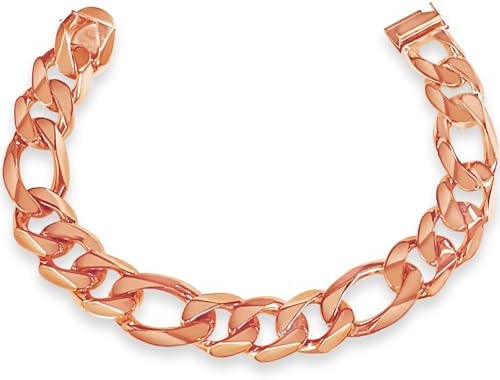

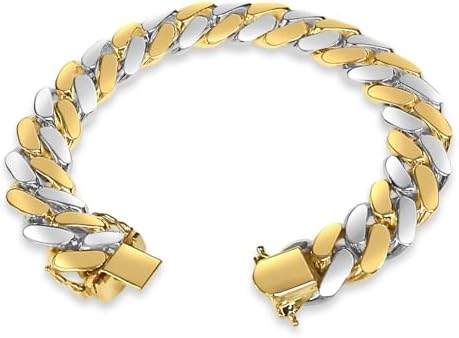
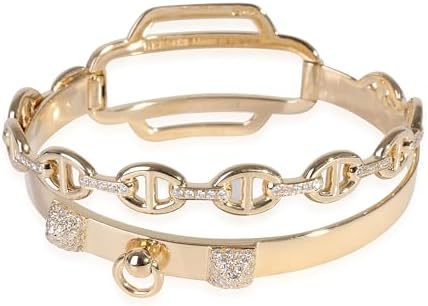
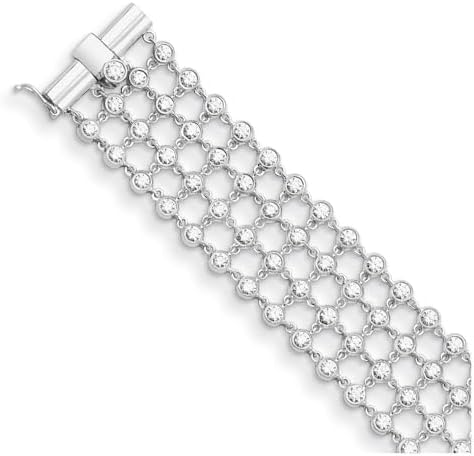
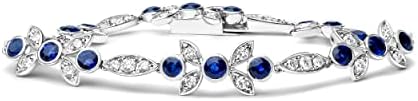

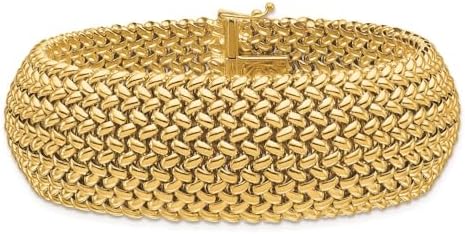
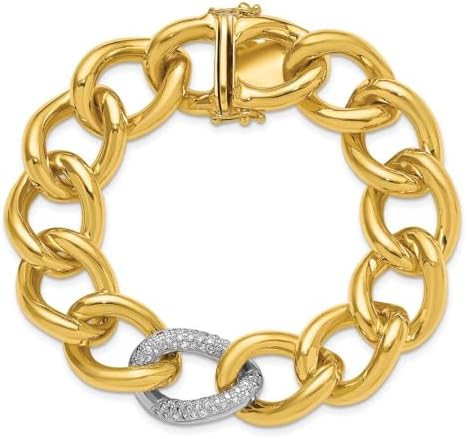

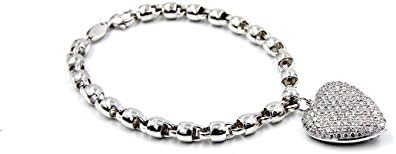
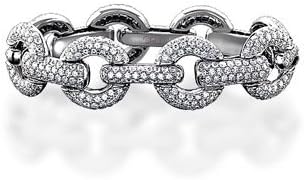


Frequently Asked Questions About Luxury Bracelets
What is a tennis bracelet, and what makes it different from other luxury bracelets?
A tennis bracelet is a flexible bracelet composed of a continuous line of closely matched diamonds, lab-grown diamonds, gemstones, or diamond alternatives. Unlike a rigid bangle, decorative cuff, or dangling charm bracelet, tennis bracelets use articulated links that allow the row of stones to bend naturally around the wrist.
The defining quality is visual continuity. A traditional diamond tennis bracelet does not rely on one large center stone. Instead, its effect comes from repetition: individually set diamonds create an uninterrupted ribbon of light. This balanced construction makes a tennis bracelet diamond design feel refined without becoming visually heavy.
Several characteristics distinguish high-quality tennis bracelets:
- Closely matched stones in size, cut, color, and clarity
- Smooth articulation between individual links
- A secure box clasp or concealed clasp
- One or more secondary safety mechanisms
- Even gemstone settings with no visibly crooked stones
- Sufficient flexibility to follow the wrist without twisting
- A properly finished underside that does not scratch the skin
A classic tennis bracelet may be made as a white gold, yellow gold tennis bracelet, rose gold tennis bracelet, platinum bracelet, sterling silver bracelet, or gold-plated fashion piece. The stones may be natural diamonds, lab-created diamonds, moissanite, cubic zirconia, sapphire, ruby, emerald, or crystal.
| Bracelet type | Defining construction | Primary visual effect | Typical purpose |
|---|---|---|---|
| Tennis bracelet | Continuous articulated row of stones | Symmetrical brilliance | Daily luxury, anniversaries and formal wear |
| Bangle | Rigid circular or oval form | Clean metal presence | Stacking and minimalist styling |
| Cuff bracelet | Open or hinged structured design | Bold architectural shape | Statement dressing |
| Charm bracelet | Chain carrying symbolic charms | Personal storytelling | Milestones and sentimental gifting |
| Cuban-link bracelet | Dense interlocking metal links | Weight and material authority | High-end gold styling |
| Cartier Love bracelet | Structured oval bangle with screw motifs | Recognizable heritage design | Iconic luxury and commitment symbolism |
Among all bracelets for women, the tennis bracelet is particularly versatile because it can move between professional clothing, bridal styling, eveningwear, and understated daily outfits. Its combination of sparkle, balance, and fluid movement explains why it remains one of the most recognizable forms of luxury jewelry.
Why is it called a tennis bracelet?
The question “why is it called a tennis bracelet?” is connected to professional tennis player Chris Evert. During a match at the 1978 U.S. Open, the diamond-line bracelet she was wearing reportedly came loose or broke, and play was paused while the bracelet was located.
Before this incident, the style was commonly described as a diamond-line bracelet or eternity-style bracelet. The widely reported match transformed its cultural identity. What had previously been viewed primarily as formal jewelry became associated with movement, athletic confidence, and active elegance.
This also answers related searches such as:
- Why do they call it a tennis bracelet?
- Why is a tennis bracelet called a tennis bracelet?
- Why are diamond-line bracelets associated with tennis?
- What did Chris Evert have to do with tennis bracelets?
The name did not arise because the bracelet was designed specifically for playing tennis. Rather, the sporting incident gave an existing diamond-bracelet style a memorable new name.
The story remains relevant because it highlights an essential feature of quality tennis bracelets: security. A valuable diamond tennis bracelet should not depend on appearance alone. The clasp, safety latch, link condition, and individual stone settings are crucial.
A secure tennis bracelet commonly includes:
| Security feature | Purpose |
|---|---|
| Box clasp | Locks the two ends into an integrated metal housing |
| Figure-eight latch | Provides secondary protection if the main clasp opens |
| Side safety lock | Reinforces the main closing mechanism |
| Safety chain | Prevents immediate loss after clasp failure |
| Tight articulation | Reduces abnormal pulling and stress on links |
The event helped transform the bracelet into a symbol of active sophistication. A modern diamond, gold, or lab grown diamond tennis bracelet can be worn with formal clothing, business tailoring, knitwear, or a luxury watch without appearing limited to ceremonial occasions.
How much is a tennis bracelet?
The answer to “how much is a tennis bracelet?” depends on the stones, total carat weight, metal, craftsmanship, brand, clasp construction, certification, and whether the diamonds are natural or laboratory-created.
An affordable fashion tennis bracelet made with cubic zirconia and plated metal may cost less than $100. A sterling silver or gold-vermeil piece may fall into the low hundreds. A lab diamond tennis bracelet set in solid gold may cost several thousand dollars, while a natural diamond tennis bracelet with high-quality stones can reach five figures or more.
General Tennis Bracelet Price Structure
| Tennis bracelet category | Typical material combination | General price positioning |
|---|---|---|
| Fashion tennis bracelet | Cubic zirconia with plated alloy | Entry-level |
| Premium fashion bracelet | Crystal, moissanite or CZ with sterling silver | Affordable to moderate |
| Lab-grown diamond bracelet | Lab diamonds with 10K, 14K or 18K gold | Moderate to luxury |
| Natural diamond bracelet | Natural diamonds with solid gold | Luxury |
| High-carat natural diamond bracelet | Larger certified diamonds with 18K gold or platinum | High luxury |
| Signed designer bracelet | Precious stones, luxury branding and provenance | Collector-level luxury |
The largest price drivers are:
- Total carat weight: A five-carat bracelet generally costs more than a one-carat bracelet of similar quality.
- Stone origin: A natural diamond tennis bracelet normally carries a higher initial price than a comparable lab-created diamond tennis bracelet.
- Diamond cut: Well-cut stones can look more brilliant than larger but poorly cut diamonds.
- Metal purity: An 18K gold bracelet contains more gold than a comparable 14K gold bracelet.
- Bracelet weight: A solid gold tennis bracelet normally costs more than a lightweight or hollow construction.
- Brand and provenance: Designer signatures and documented history may add substantial premiums.
- Clasp and setting quality: Secure engineering and precise stone matching increase production costs.
Relative Influence on Tennis Bracelet Price
Diamond or gemstone weight     ████████████████████  Very high
Stone origin and quality       ██████████████████    Very high
Precious-metal weight          ███████████████       High
Craftsmanship and setting      █████████████         High
Designer name and provenance   ████████████          Variable to high
Packaging alone                ██                    Low
A buyer should not judge value solely by total carat weight. A three-carat bracelet with bright, closely matched diamonds, fluid links, and a secure clasp may provide a more luxurious experience than a heavier bracelet with cloudy stones, uneven settings, or weak construction.
Is a lab-grown diamond tennis bracelet as good as a natural diamond tennis bracelet?
A lab grown diamond tennis bracelet can provide the same essential diamond appearance, hardness, brilliance, and chemical composition as a natural diamond tennis bracelet. The primary differences involve origin, rarity, pricing, traditional perception, and expected resale behavior.
A lab-grown diamond is not cubic zirconia or imitation glass. It is a diamond produced in a controlled technological environment rather than formed beneath the earth over geological time. The phrases lab created diamond tennis bracelet, lab diamond tennis bracelet, and lab-grown diamond bracelet generally describe the same product category.
For many buyers, a laboratory-created bracelet offers a significant visual advantage. Because lab-grown diamonds usually cost less at retail than natural diamonds with comparable specifications, the shopper may be able to choose:
- A greater total carat weight
- Larger individual diamonds
- Better color or clarity grades
- A heavier gold setting
- A wider bracelet design
- A platinum or 18K gold bracelet rather than a lighter metal option
| Factor | Lab-grown diamond tennis bracelet | Natural diamond tennis bracelet |
|---|---|---|
| Chemical identity | Diamond | Diamond |
| Optical brilliance | Depends primarily on cut | Depends primarily on cut |
| Geological rarity | No | Yes |
| Initial purchase price | Usually lower | Usually higher |
| Size available for budget | Often larger | Often smaller |
| Traditional heirloom perception | Developing | Established |
| Resale expectations | Generally more limited | Often stronger, but not guaranteed |
| Disclosure requirement | Must be clearly disclosed | Must be accurately represented |
A lab-created diamond tennis bracelet is especially suitable for someone prioritizing sparkle, size, design, and daily enjoyment. A natural diamond bracelet may be more compelling for a buyer who values geological rarity, conventional luxury provenance, and traditional collector recognition.
Neither option is automatically superior. The better choice depends on whether the buyer defines luxury through origin and rarity or through visual performance and purchasing efficiency.
For both types, request transparent disclosure of total carat weight, metal purity, approximate diamond grades, treatment information, warranty terms, and return policies.
How can you tell if a diamond tennis bracelet is real?
The question “how to tell if a diamond tennis bracelet is real” has two separate dimensions. First, the buyer must determine whether the stones are diamonds. Second, the buyer must determine whether the metal, carat weight, brand, and specifications match the seller’s claims.
Visual inspection alone is not conclusive. Moissanite, cubic zirconia, crystal, natural diamonds, and lab-grown diamonds can all appear bright under retail lighting. A basic handheld tester may also produce incomplete results, particularly when distinguishing natural diamonds from lab-created diamonds.
A more dependable authentication process includes the following checks.
Examine the Metal Hallmark
Look for marks such as:
- 10K or 417
- 14K or 585
- 18K or 750
- PT or 950 for platinum
- 925 for sterling silver
A hallmark supports identification but is not absolute proof, because markings can be copied or altered.
Inspect the Stone Settings
Real diamond tennis bracelets are generally constructed with precise prong, bezel, channel, or shared-prong settings. Visible glue, irregular spacing, rough prongs, or poorly aligned stones may suggest inexpensive fashion construction.
Compare the Stones
The diamonds should appear closely matched. A quality bracelet will normally avoid obvious variations in size, color, or brilliance unless the design intentionally uses graduated stones.
Test the Clasp and Articulation
A genuine luxury tennis bracelet should feel fluid, balanced, and secure. The clasp should close positively and ideally include secondary protection.
Request Professional Verification
A trained jeweler or independent gemologist can test the stones and metal. Advanced laboratory equipment is needed to reliably separate many lab-grown diamonds from natural diamonds.
| Authentication method | What it can indicate | Main limitation |
|---|---|---|
| Hallmark inspection | Claimed metal purity | Marks can be imitated |
| Magnification | Setting quality and stone condition | Does not prove origin |
| Thermal tester | May distinguish diamond from some simulants | Cannot always separate lab and natural diamonds |
| Electronic metal test | Approximate metal composition | Requires proper equipment |
| Gemological examination | Stone type and characteristics | Quality depends on examiner |
| Independent laboratory report | Detailed diamond identification | May not be practical for every small stone |
For an expensive natural or lab grown diamond tennis bracelet, the safest approach is to purchase from a reputable seller with clear disclosure, a return window, documented specifications, and independent authentication options.
How much is a 14K gold tennis bracelet worth?
The answer to “how much is a 14K gold tennis bracelet worth?” depends on whether the buyer is asking about raw gold value, private-sale value, insurance replacement value, or retail jewelry value.
A solid 14K gold tennis bracelet contains approximately 58.3% pure gold before accounting for diamonds, non-gold clasp components, solder, or other materials. Its theoretical gold content can be estimated through a basic calculation:
Bracelet weight × 0.583 × current pure-gold price per gram
For example, a 20-gram bracelet would theoretically contain approximately:
20 × 0.583 = 11.66 grams of pure gold equivalent
This does not mean the bracelet should sell for exactly that amount. The actual offer may be lower because refiners and dealers deduct testing, processing, operational costs, and profit margins. Conversely, the complete bracelet may be worth substantially more than melt value because of its diamonds, craftsmanship, condition, and brand.
| Type of value | What it considers |
|---|---|
| Melt value | Gold purity, recoverable gold weight and live metal price |
| Scrap offer | Melt value minus buyer or refiner deductions |
| Private-sale value | Design, condition, stones and market demand |
| Retail replacement value | Cost of replacing the complete bracelet at retail |
| Designer resale value | Brand, authenticity, documentation and collector demand |
The diamonds can represent a major part of the bracelet’s value, but their contribution depends on whether they are natural or lab-grown, their total carat weight, cut, color, clarity, condition, and documentation.
A 14K gold diamond tennis bracelet with well-matched natural diamonds may sell far above its raw gold value. A lab created diamond tennis bracelet may also have significant retail value, although its secondary-market pricing may behave differently.
To estimate a 14K gold bracelet accurately:
- Confirm whether it is solid, hollow, plated, or gold filled.
- Record the gram weight.
- Verify the 14K purity.
- Separate the approximate stone weight where possible.
- Identify whether the diamonds are natural or lab-grown.
- Examine the clasp, links, and settings.
- Compare recent sales of genuinely similar bracelets.
- Obtain a professional appraisal for a high-value item.
How much is an 18K gold bracelet worth?
The answer to “how much is 18K gold bracelet worth?” begins with purity. Solid 18K gold contains approximately 75% pure gold, making its intrinsic gold content higher than that of an equal-weight 14K bracelet.
The theoretical pure-gold content can be estimated as:
Total bracelet weight × 0.75
A 40-gram solid 18K gold bracelet would therefore contain approximately 30 grams of pure-gold equivalent before adjustments for stones, springs, solder, or internal clasp parts.
Illustrative Gold-Content Comparison
| Bracelet weight | Approximate pure gold in 14K | Approximate pure gold in 18K |
|---|---|---|
| 10 g | 5.83 g | 7.50 g |
| 20 g | 11.66 g | 15.00 g |
| 40 g | 23.32 g | 30.00 g |
| 75 g | 43.73 g | 56.25 g |
| 100 g | 58.30 g | 75.00 g |
To estimate theoretical metal value, multiply the pure-gold equivalent by the current pure-gold price per gram. The live market price should be checked on the day of valuation because gold prices change.
However, an 18K gold bracelet may be worth more than its metal content when it includes:
- Natural diamonds or rare gemstones
- Recognized designer provenance
- Handcrafted links
- Vintage or discontinued design
- Original documentation
- Strong condition
- Heavy solid construction
- A collectible maker’s signature
An 18K yellow gold Cartier Love bracelet, for example, is not valued merely as 18K gold. Its recognized design, brand authentication, condition, size, serial information, and included accessories can add substantial value over melt price.
Insurance appraisals and retail replacement values are also different from cash resale values. An appraisal may estimate what it would cost to replace the bracelet through a retail channel, while a dealer offer reflects what the buyer expects to resell it for after expenses.
What is the Cartier Love bracelet price for a pre-owned bracelet?
The Cartier Love bracelet price depends on metal, size, model, age, condition, authenticity, gemstone configuration, seller, and whether original accessories and service records are included.
The pre-owned Cartier Love bracelet referenced for this article is listed at approximately $8,000 on Amazon. Because marketplace prices and availability can change, the current product page should be checked before publishing or purchasing.
An 18K yellow gold Cartier Love bracelet may be priced differently from an 18K white gold or rose gold version. Diamond-set models may carry significantly higher prices than plain-metal bracelets.
| Value factor | Why it affects the pre-owned price |
|---|---|
| Authenticity | Genuine Cartier provenance is fundamental |
| Metal | Yellow, white and rose gold may have different market demand |
| Model and width | Classic, Small and diamond-set models differ |
| Size | Certain wrist sizes may be more commercially desirable |
| Condition | Deep scratches, dents or distorted screw details reduce appeal |
| Polishing history | Heavy polishing may soften edges and remove metal |
| Original packaging | Adds completeness but does not prove authenticity |
| Service papers | Support provenance and maintenance history |
| Seller reputation | Trusted authentication may justify a premium |
| Return policy | Reduces buyer risk |
Before buying a pre-owned Cartier Love bracelet, verify:
- Serial numbers and hallmarks
- Bracelet dimensions and weight
- Screw construction
- Metal purity
- Exact model and size
- Condition of the screw motifs
- Evidence of over-polishing
- Authentication policy
- Return and refund terms
- Included box, pouch, screwdriver, papers, or receipts
A low Cartier Love bracelet price can be attractive, but an unusually low price without credible authentication should be treated cautiously. Packaging can be replaced or counterfeited; the bracelet itself must be professionally examined.
What is the average bracelet size for a woman?
The question “what is the average bracelet size for a woman?” is often answered with a standard retail length of approximately 7 inches, but that should be treated as a starting point rather than a universal size.
Women’s wrist measurements vary considerably. Bracelet construction also changes the fit. A thick charm bracelet requires more room than a fine chain bracelet, while a rigid bangle must pass over the widest part of the hand.
A useful general sizing framework is:
| Wrist measurement | Suggested close fit | Suggested comfortable fit | Suggested loose fit |
|---|---|---|---|
| 5.5 inches | 5.75–6.0 in | 6.0–6.25 in | 6.5 in |
| 6.0 inches | 6.25 in | 6.5 in | 6.75–7.0 in |
| 6.5 inches | 6.75 in | 7.0 in | 7.25–7.5 in |
| 7.0 inches | 7.25 in | 7.5 in | 7.75–8.0 in |
| 7.5 inches | 7.75 in | 8.0 in | 8.25 in |
For a tennis bracelet, adding approximately 0.25 to 0.5 inches to the wrist measurement usually creates a comfortable fit. The bracelet should move slightly without sliding over the hand or rotating continuously.
For charm bracelets for women, additional room may be needed because charms occupy interior space. A fully loaded charm bracelet can fit more tightly than an empty bracelet of the same listed length.
To measure correctly:
- Wrap a flexible measuring tape around the wrist.
- Keep it close to the skin without compressing it.
- Record the wrist circumference.
- Add the allowance appropriate to the bracelet style.
- Consider whether the bracelet will be worn beside a watch.
- Check the seller’s sizing method before ordering.
The ideal bracelet for women is not necessarily the average size. It is the size that supports comfort, security, intended movement, and the structure of the specific design.
Which luxury bracelets are best for women?
The best luxury bracelets depend on lifestyle, aesthetic preferences, budget, and whether the buyer prioritizes sparkle, precious-metal content, symbolism, collectability, or everyday practicality.
A diamond tennis bracelet is one of the most versatile choices because it works with professional, formal, bridal, and everyday clothing. A solid gold bracelet for women provides tactile warmth and intrinsic precious-metal value. A Cartier Love bracelet offers recognizable design heritage. Charm bracelets allow personal storytelling, while high-end link bracelets communicate weight and craftsmanship.
Luxury Bracelet Selection Table
| Buyer priority | Recommended bracelet category |
|---|---|
| Maximum versatility | Diamond tennis bracelet |
| Larger diamond appearance for budget | Lab grown diamond tennis bracelet |
| Warm everyday luxury | 14K gold bracelet |
| Rich high-purity gold color | 18K gold bracelet |
| Romantic metal tone | Rose gold tennis bracelet |
| Heritage brand recognition | Cartier Love bracelet |
| Personal symbolism | Charm bracelets for women |
| Bold precious-metal presence | Cuban or curb-link bracelet |
| Affordable experimentation | Gold-plated, crystal or sterling silver bracelet |
| Heirloom ownership | Natural diamond, platinum or solid 18K gold bracelet |
For women who wear jewelry daily, a solid 14K gold design may offer a practical balance of precious-metal value and relative durability. An 18K gold bracelet offers greater gold purity and a richer yellow tone but may acquire surface marks more readily.
A gold diamond tennis bracelet combines warm metal with repeated diamond brilliance. A white gold version emphasizes the diamonds, while a rose gold tennis bracelet creates a softer and more romantic effect.
The best gold bracelets for women should be evaluated for more than appearance. Consider gram weight, solid or hollow construction, clasp quality, repairability, hallmarking, comfort, and compatibility with the wearer’s routine.
Ultimately, the strongest bracelet is the one that will actually be worn. Luxury becomes meaningful when material quality, personal identity, and daily life support one another.
Find Your Perfect Bracelet at Schopping
Whether you are drawn to the enduring sparkle of a diamond tennis bracelet, the warm radiance of a 14K gold bracelet, or the iconic heritage of a Cartier Love bracelet, the right piece should reflect more than a passing trend. It should complement your lifestyle, express your personal taste, and carry a meaning that feels distinctly your own.
Bracelets are among the most intimate forms of jewelry because they remain visible throughout the day. They move with your hands, become part of your daily rituals, and gradually collect memories of the places you visit and the milestones you celebrate.
At Schopping, you can explore everything from affordable bracelets for everyday styling to solid gold, diamond, and high-end designer bracelets intended for long-term ownership. Consider the materials, craftsmanship, fit, durability, and emotional significance of each design before making your choice.
A bracelet may celebrate a promotion, anniversary, relationship, personal transformation, or quiet act of self-reward. Whatever your reason for wearing it, the most meaningful bracelet is one that feels connected to your journey—not simply an accessory, but a marker of where you have been and who you are becoming.