
Amazon Affiliate Disclosure
Schopping may participate in affiliate programs, including the Amazon Services LLC Associates Program and other affiliate advertising programs. This means we may earn a commission when visitors click certain links and make qualifying purchases, at no extra cost to the buyer. Our content is designed to help readers understand digital assets, premium domains, authority websites, online business assets and digital real estate with practical, buyer-focused guidance.
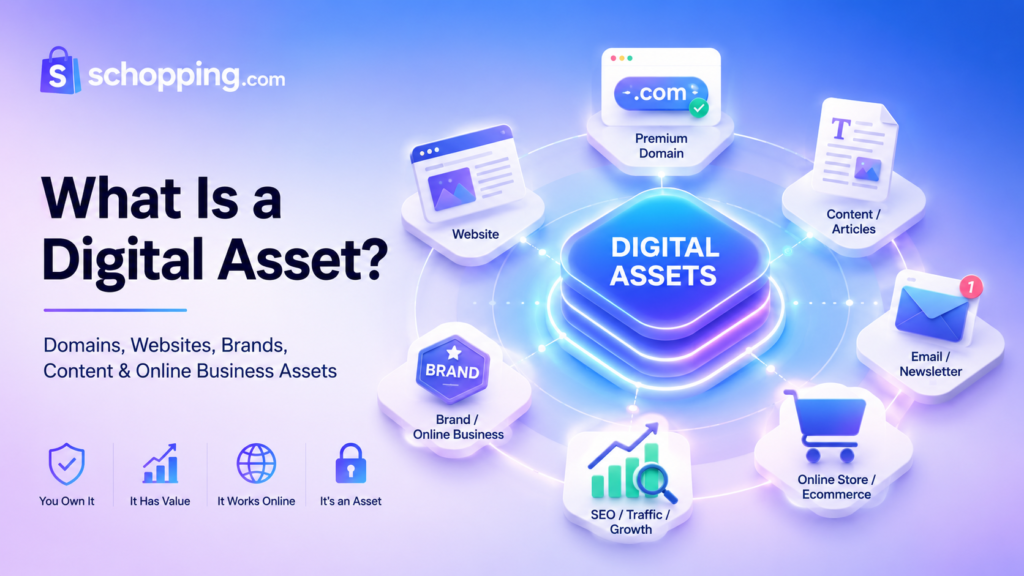
A digital asset is any online property, file, brand, platform, website, domain, content system or digital resource that can hold value, create leverage or support business activity. In simple terms, a digital asset is something you can own, control, build, monetize, transfer or use to grow online.
But the phrase “digital asset” is often misunderstood.
Some people think digital assets only mean cryptocurrency or NFTs. Others think of downloadable files, online courses, software accounts or social media pages. Those can be digital assets, but for Schopping’s Digital Assets ecosystem, the most important meaning is more practical:
A digital asset is a web-based property that can become a brand, traffic engine, revenue channel or acquisition opportunity.
That includes ultra premium domains, starter authority sites, authority websites, SEO domain names, brandable domain names, new websites, niche websites and pre-revenue online business assets.
A premium domain can become the front door of a business. An authority website can become a trusted niche destination. A content site can become an affiliate property. A digital brand can become a lead generation machine. Together, these assets form what many buyers call digital real estate.
Quick Picks: Find the Section You Need
| Visitor Question | Best Section |
|---|---|
| I want the simple definition | What Is a Digital Asset? |
| I want examples | Examples of Digital Assets |
| I want to understand domains | Are Domain Names Digital Assets? |
| I want to understand websites | Are Websites Digital Assets? |
| I want to buy assets | How to Buy Digital Assets |
| I want to compare assets and businesses | Digital Asset vs Online Business |
| I want valuation guidance | How Digital Assets Are Valued |
| I want costs | Digital Asset Costs |
| I want risks | Risks of Digital Assets |
| I want premium domains | Premium Domains as Digital Assets |
| I want authority websites | Authority Websites as Digital Assets |
What This Guide Is For
This guide is for readers who want to understand digital assets before buying, building or valuing them.
It is especially useful if you are:
- Buying a premium domain name
- Launching a new website
- Comparing digital assets vs online businesses
- Building an authority website
- Researching domain names for sale
- Trying to understand digital real estate
- Looking at SEO domain names
- Exploring brandable domain names
- Planning an affiliate website
- Evaluating a starter authority site
- Considering acquisition-ready authority brands
- Learning how online assets become valuable
If your main goal is to browse acquisition or purchase opportunities, start from premium domain names for sale or Authority Brands. If you want a specific overview, explore our atom premium domains guide.
Who Needs to Understand Digital Assets?
Digital assets are relevant to more people than most beginners expect. They are not only for domain investors, software founders, or online business buyers. Any person or company building a presence on the internet is already working with digital assets, even if they do not use that language yet.
A domain name, website, email list, content library, landing page, online store, social account, digital product, customer database, software tool, or niche authority brand can all become part of a larger digital asset strategy. The difference between casual ownership and serious ownership is intent. A beginner may register a domain and leave it unused. A strategic buyer asks how that domain can support branding, SEO, traffic, leads, revenue, resale value, or acquisition potential.
Understanding digital assets matters because online value often compounds quietly. A strong domain can make a new website easier to trust. A well-built content hub can keep attracting visitors months after publication. An email list can reduce dependence on social media platforms. A niche website can become a lead generation engine. A premium domain can become the foundation for an authority brand.
The people who understand this early usually build better online foundations.
Entrepreneurs
Entrepreneurs need to understand digital assets because most modern businesses begin with digital infrastructure before they become known brands. A business idea may start in a notebook, but it becomes visible through a domain name, website, landing page, email address, content strategy, product page, social profile, booking form, or online sales funnel.
A strong digital asset can reduce early-stage friction. Instead of struggling with a weak name, confusing website, or unclear positioning, an entrepreneur can begin with a better foundation.
For entrepreneurs, important digital assets include:
| Digital Asset | Why It Matters for Entrepreneurs |
|---|---|
| Premium domain name | Creates a stronger first impression and brand identity |
| Website | Gives the business a public home |
| Landing page | Tests demand before a full launch |
| Email list | Builds direct audience ownership |
| Content library | Educates users and supports SEO |
| Brand identity | Makes the business easier to remember |
| Digital product | Creates scalable revenue potential |
| Lead capture system | Turns visitors into prospects |
A founder launching a new website should not treat the domain as a small technical detail. The domain often becomes the name people remember, the email address customers see, the URL investors type, and the brand anchor used across search, social, advertising, and partnerships.
This is why premium domains and authority websites can be valuable to entrepreneurs. They shorten the distance between idea and market presence. A buyer who already owns a clean domain, polished homepage, clear niche structure, and first content map is not starting from zero.
Entrepreneurs should understand digital assets because every early decision compounds: the name, the website structure, the content direction, the trust signals, and the monetization path.
Affiliate Marketers
Affiliate marketers need to understand digital assets because their business model is built almost entirely on owned and semi-owned online properties. A successful affiliate operator does not simply publish product links. They build trust through search visibility, useful content, comparison pages, buying guides, reviews, topical authority, email capture, and conversion-focused website structure.
For affiliate marketers, digital assets are the machinery behind commission income.
A strong affiliate asset may include:
- A niche domain name
- A review website
- Product comparison pages
- Buying guides
- Informational articles
- Internal links
- Product tables
- Email opt-in pages
- SEO rankings
- Backlinks
- Affiliate relationships
- Content templates
- Tracking systems
The most valuable affiliate websites are not random collections of articles. They are structured digital assets. They understand search intent. They organize topics properly. They help readers compare products, avoid bad purchases, understand features, and choose the right option.
For example, an earbuds authority site could include content around best cheap earbuds, best earbuds under 100, active noise cancellation, gaming earbuds, workout earbuds, charging case problems, Bluetooth versions, and product comparisons. Each page becomes a small digital asset, but the full website becomes the larger authority asset.
Affiliate marketers should also understand risk. Rankings can change. Affiliate programs can reduce commissions. Products can go out of stock. Competitors can copy content angles. That is why serious affiliate operators build brands, not disposable websites.
The more an affiliate marketer understands digital assets, the better they can build a site that earns, survives, and potentially sells.
Ecommerce Founders
Ecommerce founders need digital assets because an online store is more than a product catalog. A serious ecommerce brand depends on domain quality, product pages, landing pages, email lists, customer data, brand identity, product photography, reviews, content, search visibility, and conversion systems.
A product may be physical, but the business value is often carried by digital assets.
For ecommerce founders, key digital assets include:
| Asset | Ecommerce Role |
|---|---|
| Domain name | Brand address and trust signal |
| Product pages | Conversion and sales engine |
| Category pages | SEO and shopping navigation |
| Email list | Repeat sales and retention |
| Customer database | Future marketing and segmentation |
| Product images | Visual trust and conversion |
| Reviews | Social proof |
| Blog content | Search traffic and product education |
| Checkout system | Revenue capture |
| Brand story | Differentiation and emotional connection |
A weak domain can make a store feel temporary. A strong domain can make the same store feel more legitimate. A thin product page can lose a buyer. A persuasive product page with clear images, benefits, FAQs, trust badges, and comparisons can increase conversions.
Ecommerce founders also need to understand digital asset ownership. Are product photos owned or supplier-provided? Is the customer list exportable? Are reviews portable? Is the brand name legally safe? Is the domain clean? Are product descriptions original? These questions matter because ecommerce value depends on more than sales.
A digital-first ecommerce brand becomes stronger when it builds assets that cannot be easily replaced: a recognizable name, loyal buyers, useful content, customer trust, email subscribers, and organic search visibility.
Agencies and Consultants
Agencies and consultants need to understand digital assets because service businesses depend heavily on credibility. A prospect may judge a consultant, SEO agency, design firm, legal consultant, healthcare consultant, marketing agency, or business advisor before speaking to them. The domain, website, case studies, lead forms, service pages, content, and email address all shape that first impression.
For agencies, a digital asset is not only something to sell. It is something that proves authority.
A service business may use digital assets to:
- Attract inbound leads
- Prove expertise
- Rank for service keywords
- Publish case studies
- Build trust with prospects
- Capture consultation requests
- Create lead magnets
- Support paid ads
- Build an email nurture sequence
- Develop a niche-specific acquisition channel
A consultant with a strong authority website can look more credible than one relying only on social profiles. An agency with a focused lead generation site can attract clients without constant outreach. A niche service domain can become a landing page network for a specific market.
For example, a healthcare marketing agency could own a senior-care lead generation site. A dental marketing company could own an oral care content asset. A product review agency could own a consumer tech comparison site. These assets can support both client acquisition and strategic positioning.
Agencies and consultants should understand digital assets because they can become proof of skill, lead sources, portfolio assets, and resale opportunities.
Investors
Investors need to understand digital assets because online property can hold value in different ways from traditional businesses. Some digital assets produce revenue. Others hold strategic value. Some are undeveloped but scarce. Others are small websites with traffic, content, rankings, leads, or email subscribers.
Digital asset investors may look at:
- Premium domains
- Brandable domain names
- SEO domains
- Authority websites
- Affiliate websites
- Ecommerce stores
- SaaS tools
- Newsletters
- Lead generation websites
- Content libraries
- Online communities
- Digital products
- Acquisition-ready authority brands
The challenge is that digital asset value is not always obvious. A domain with no revenue may still be valuable if it is short, brandable, and commercially relevant. A website with revenue may be risky if it depends on one ranking or one affiliate program. A newsletter with a smaller list may be valuable if the audience is highly engaged.
Investors should evaluate digital assets through several lenses:
| Investor Lens | What It Measures |
|---|---|
| Scarcity | Is the asset difficult to replace? |
| Demand | Is there a real buyer or user market? |
| Monetization | Can the asset generate income? |
| Transferability | Can ownership move cleanly? |
| Risk | Are there legal, SEO, technical, or platform issues? |
| Development upside | Can the asset become more valuable with work? |
| Liquidity | Could it be resold later? |
| Strategic fit | Would a specific buyer pay more for it? |
Digital assets can be attractive because they may have lower overhead than physical businesses and can scale globally. But they require careful due diligence. Investors who treat digital assets as random internet collectibles usually make poor decisions. Investors who treat them as business foundations make better ones.
Content Publishers
Content publishers need to understand digital assets because content itself can become a business asset when it is organized, useful, search-visible, and monetized. A single article may attract visitors. A structured content library can become a traffic engine. A publication with topical authority can become a brand.
Publishers use digital assets such as:
- Websites
- Articles
- Pillar pages
- Topic clusters
- Newsletters
- Search rankings
- Internal linking systems
- Editorial templates
- Product comparison pages
- Review databases
- Media libraries
- Email subscribers
- Audience data
A content publisher should not think only in terms of “posts.” A better way to think is in terms of content architecture. Each page should support a larger topical map. Each cluster should reinforce authority. Each internal link should guide readers and search engines. Each commercial page should connect useful information with buyer intent.
For example, a digital assets publication could have separate clusters on what is a digital asset, types of digital assets, how to buy digital assets, how to value digital assets, premium domain names, authority brands, starter websites, and digital assets vs online business. Each article becomes a node in a larger authority system.
Content publishers should understand digital assets because the website, content library, rankings, newsletter, audience, and monetization routes can become sellable value. A well-built publisher site is not just a collection of words. It is an owned media asset.
Strategic Buyers
Strategic buyers need to understand digital assets because companies often acquire online assets for reasons beyond immediate revenue. A business may buy a domain, website, newsletter, authority brand, or content hub to enter a niche faster, protect a brand, capture search demand, gain leads, expand into a vertical, or prevent competitors from owning valuable digital territory.
A strategic buyer may acquire a digital asset to:
- Enter a new market
- Strengthen brand authority
- Capture organic search traffic
- Build a lead generation channel
- Acquire a memorable domain
- Protect a brand name
- Expand content coverage
- Launch a new product line
- Support a white-label service
- Build a niche media property
- Add a future acquisition asset to the portfolio
Strategic buyers often value assets differently from casual buyers. A domain that looks moderately valuable to one person may be highly valuable to a company that can plug it into an existing business. A content website with modest traffic may become powerful when connected to an ecommerce product, service team, affiliate program, or sales funnel.
For example, a senior care company may see more value in a geriatric telemedicine domain than a general investor would. An oral care brand may see more value in a hydroxyapatite toothpaste authority site than a generic publisher would. A consumer audio company may see strategic value in an earbuds content property because it connects directly to product demand.
Strategic buyers should understand digital assets because acquisition can be faster than building. Instead of starting with a blank domain, they can buy a name, website, content structure, topical position, or traffic base that supports expansion.
Digital Asset Buyer Types Comparison
| Buyer Type | Main Goal | Best Digital Assets |
|---|---|---|
| Entrepreneurs | Launch faster and build brand credibility | Premium domains, websites, landing pages, authority brands |
| Affiliate marketers | Build traffic and commission income | Review sites, comparison pages, niche blogs, SEO domains |
| Ecommerce founders | Sell products and build customer trust | Domains, product pages, email lists, ecommerce stores |
| Agencies and consultants | Generate leads and prove expertise | Service websites, lead generation assets, authority sites |
| Investors | Hold, develop, monetize or resell online assets | Premium domains, authority websites, online business assets |
| Content publishers | Build search traffic and audience value | Content libraries, newsletters, topic clusters, media brands |
| Strategic buyers | Enter markets or acquire digital leverage | Authority brands, premium domains, niche websites, lead assets |
Why This Matters
Different buyers see different value in the same digital asset.
A premium domain may be a branding shortcut for an entrepreneur, a resale asset for an investor, a lead generation foundation for an agency, or a strategic acquisition for an established company. An authority website may be a content business for a publisher, an affiliate engine for a marketer, or a market-entry asset for a brand.
That is why understanding digital assets is not only about definitions. It is about recognizing what an asset can do for a specific buyer.
A digital asset becomes more valuable when the right owner can use it better than the previous owner.
What Is a Digital Asset?
A digital asset is an online or electronic property that has value because it can be owned, used, transferred, monetized, developed or protected.
In the Schopping context, a digital asset usually falls into one of these categories:
- A domain name
- A premium domain
- A website
- An authority website
- A starter authority site
- A digital brand
- A content library
- An affiliate site
- A lead generation site
- An ecommerce website
- A newsletter
- A digital product
- A software tool
- A marketplace
- A social media property
- An email list
- A database
- A monetized online business
The value may come from ownership, audience, traffic, brand identity, revenue, scarcity, search visibility, content depth, backlinks, technology, data or buyer demand.
A digital asset does not have to be profitable today to be valuable. Some assets are valuable because they are rare. Some are valuable because they are useful. Some are valuable because they are already producing revenue. The best digital assets usually combine more than one value source.
Simple Digital Asset Definition
A digital asset is something online that can create, store or transfer value.
That value may be:
- Brand value
- Search value
- Traffic value
- Revenue value
- Audience value
- Product value
- Data value
- Strategic value
- Resale value
A premium domain is a digital asset because it can become a valuable brand address.
An authority website is a digital asset because it can attract visitors, educate buyers, generate leads and earn revenue.
A newsletter is a digital asset because it gives the owner direct access to an audience.
A content library is a digital asset because it can rank, inform, convert and compound over time.
Why Digital Assets Matter
Digital assets matter because online business value is no longer limited to physical inventory, office space or traditional infrastructure.
A company may be valuable because it owns:
- A memorable domain
- A trusted website
- A ranking content hub
- A loyal email list
- A product comparison engine
- A niche affiliate property
- A lead generation funnel
- A digital brand in a profitable category
- A website with high-intent organic traffic
Digital assets create leverage.
A physical store can serve people in one location. A digital asset can reach visitors across search engines, email, social platforms, direct traffic and partnerships.
This is why many buyers compare digital assets to real estate. The comparison is not perfect, but it is useful. A domain can be like an address. A website can be like a building. Content can be like rooms. Traffic can be like footfall. Monetization can be like rent or sales. A strong brand can increase the value of the whole property.
Examples of Digital Assets
Digital assets can be grouped by function.
Identity Assets
These assets help people recognize and remember a business.
| Asset Type | Example |
|---|---|
| Domain name | example.com |
| Premium domain | A short, brandable, high-value domain |
| Brand name | A memorable commercial identity |
| Logo | Visual identity |
| Trademarkable brand concept | A distinct market identity |
| Social media handle | A username connected to brand presence |
Identity assets are often the first layer of digital real estate. Without a strong name, the rest of the business may feel weaker.
Website Assets
These assets help the business publish, educate, sell, rank or convert.
| Asset Type | Example |
|---|---|
| Homepage | Main brand entry point |
| Authority website | Niche content and commercial structure |
| Ecommerce store | Product sales website |
| Affiliate site | Product review and comparison website |
| Lead generation website | Captures inquiries for services |
| Blog | Editorial traffic asset |
| Landing page | Conversion-focused page |
| Directory | Organized listings or marketplace structure |
A website becomes stronger when it has useful content, clean structure, clear navigation, technical quality and a monetization path.
SEO Assets
These assets help a website become more discoverable.
| Asset Type | Example |
|---|---|
| Keyword-rich content | Pages targeting search intent |
| Topic clusters | Groups of related articles |
| Pillar pages | Main authority pages |
| Internal links | Connections between related content |
| Backlinks | External sites linking to the asset |
| SEO domain | A domain aligned with search intent |
| Search rankings | Visibility in search results |
SEO assets require time and quality. A domain alone does not guarantee ranking, but a clear domain, strong site structure and relevant content can support search visibility.
Audience Assets
These assets give the owner access to people.
| Asset Type | Example |
|---|---|
| Email list | Subscribers |
| Newsletter | Direct communication channel |
| Community | Group of engaged users |
| Social following | Platform-based audience |
| Customer list | Past or current buyers |
| App users | Active digital product audience |
Audience assets are valuable because they reduce dependence on rented traffic.
Revenue Assets
These assets generate or support income.
| Asset Type | Example |
|---|---|
| Affiliate website | Earns commissions |
| Ecommerce store | Sells products |
| Digital product | Course, template, guide or software |
| SaaS tool | Subscription software |
| Lead generation funnel | Captures paid leads |
| Membership site | Recurring access model |
| Display ad site | Earns from traffic |
Revenue assets usually require deeper due diligence because buyers need to verify earnings, expenses, traffic quality and operational requirements.
Are Domain Names Digital Assets?
Yes. A domain name is one of the most important digital assets because it controls the address of a website and often becomes the identity of the brand.
A domain name can be valuable when it is:
- Short
- Memorable
- Easy to spell
- Easy to say
- Brandable
- Commercially relevant
- Category-specific
- Search-aligned
- Attached to a trusted extension
- Useful to multiple possible buyers
A regular domain may be inexpensive to register. A premium domain can cost much more because it may carry scarcity, buyer demand, brand value and commercial relevance.
For buying intent, visit premium domain names for sale. For strategy, read how to choose a domain name and brandable domain names.
Premium Domains as Digital Assets
A premium domain is a digital asset with stronger-than-average naming value.
A premium domain may help a business:
- Look more trustworthy
- Be easier to remember
- Improve first impression
- Support direct traffic
- Strengthen email credibility
- Make advertising cleaner
- Become more attractive to buyers
- Create future resale potential
Premium domains are often compared to high-quality real estate because the best names are limited. There is only one exact domain in a specific extension.
A strong premium domain can become the foundation for:
- A startup
- An ecommerce store
- An authority website
- A lead generation site
- A content brand
- A marketplace
- A future acquisition asset
Domain industry reporting in 2026 continues to describe domains as strategic brand assets, while domain trend reports highlight the continuing importance of .com, the rise of specialized extensions and growing concern around brand protection in the domain space. (CSC)
Are Websites Digital Assets?
Yes. A website is a digital asset when it has value beyond the files used to create it.
A website may be valuable because it has:
- A good domain
- Useful content
- Search rankings
- Traffic
- Brand recognition
- Email subscribers
- Leads
- Revenue
- Backlinks
- Conversion systems
- Product pages
- Editorial authority
- Customer relationships
A simple brochure website may have limited asset value. A well-structured authority website can become much more valuable because it can attract traffic, build trust and generate revenue over time.
If you want a complete acquisition-oriented brand foundation, see Authority Brands. If you want an early-stage niche site foundation, see starter authority sites.
Authority Websites as Digital Assets
An authority website is a digital asset designed to become a trusted source inside a niche.
It usually includes:
- A clear topic
- A focused audience
- Pillar pages
- Supporting cluster articles
- Internal links
- Commercial pages
- Informational content
- Product comparisons
- Lead capture or monetization paths
- Strong brand positioning
Authority websites are different from random blogs. A blog may publish scattered posts. An authority website builds a structured library around a market.
For example:
- Hydropaste.com can become an oral care authority brand.
- TeleGeriatric.com can become a senior telemedicine authority brand.
- Geronutrition.com can become a senior nutrition authority brand.
- Earsbud.com can become an audio tech authority brand.
These types of brands can be developed into affiliate sites, lead generation platforms, ecommerce properties, educational hubs or acquisition-ready digital assets.
Digital Asset vs Online Business
A digital asset is not always a full online business.
This distinction matters.
A digital asset may be a premium domain, website foundation, content structure or brand. An online business usually has revenue, customers, operations, systems and ongoing activity.
Digital Asset vs Online Business
| Feature | Digital Asset | Online Business |
|---|---|---|
| Main value | Ownership, potential, brand, traffic or structure | Revenue, customers, systems and cash flow |
| Examples | Domain, website, authority brand, content library | Ecommerce store, SaaS, affiliate business, agency |
| Revenue required? | Not always | Usually yes |
| Operations required? | Low to moderate | Moderate to high |
| Buyer focus | Potential and development path | Performance and transferability |
| Valuation logic | Scarcity, usefulness, build cost, strategic value | Profit, traffic, growth, risk and operations |
| Best for | Builders, founders, SEO operators, investors | Operators and acquisition entrepreneurs |
For a dedicated comparison, read digital assets vs online business.
Digital Asset vs Physical Asset
Digital assets differ from physical assets in several important ways.
| Factor | Digital Asset | Physical Asset |
|---|---|---|
| Location | Online | Physical place |
| Transfer | Often fast, but requires secure process | Usually legal and logistical |
| Scaling | Can reach global users | Often location-bound |
| Maintenance | Technical, content, security, hosting | Repairs, storage, physical upkeep |
| Scarcity | Depends on name, audience, code, data or brand | Depends on supply and location |
| Monetization | Ads, leads, products, subscriptions, affiliate revenue | Rent, resale, services, physical sales |
| Risk | Platform changes, cyber risk, legal risk, SEO loss | Damage, theft, depreciation, local market risk |
Digital assets are powerful because they can scale quickly. They are risky because online conditions can change quickly too.
Benefits of Digital Assets
Digital assets are valuable because they give individuals, founders, publishers, ecommerce operators, investors, and companies a way to own and develop online value. A digital asset may begin as a domain name, website, content library, email list, online brand, software tool, authority site, or ecommerce property, but its real strength comes from what it can become over time.
Unlike a one-time advertisement or temporary campaign, a digital asset can keep working after the first investment is made. A premium domain can continue to represent a brand. A website can keep attracting visitors. A content page can keep ranking. An email list can keep generating repeat engagement. An authority brand can keep growing into new topics, products, partnerships, and revenue models.
The strongest digital assets do not depend on one single advantage. They combine ownership, scalability, distribution, monetization, strategic value, compounding growth, and transferability.
1. Ownership
Ownership is one of the most important benefits of digital assets. When you own a domain name, website, content library, brand identity, email list, digital product, or online business asset, you control something that can be developed, improved, protected, monetized, or sold.
This is different from renting attention.
A paid ad disappears when the budget stops. A social media post may fade after a few hours. A marketplace listing can be removed if the platform changes rules. But an owned digital asset can continue to exist and build value independently.
A premium domain gives the owner control over a digital address. A website gives the owner a central publishing and conversion platform. An email list gives the owner direct access to an audience. A content library gives the owner searchable knowledge assets that can support traffic, leads, and revenue.
Why Ownership Matters
| Owned Digital Asset | Why It Creates Control |
|---|---|
| Premium domain | Gives the business a permanent brand address |
| Website | Creates an owned platform for content, products, services, and lead capture |
| Email list | Gives direct audience access outside social platforms |
| Content library | Builds searchable authority over time |
| Digital product | Can be sold repeatedly without physical inventory |
| Authority brand | Combines name, niche, website, and monetization potential |
| Customer database | Supports retention, segmentation, and repeat sales |
Ownership does not mean there is no risk. Domains must be renewed. Websites need maintenance. Email lists require permission and trust. Content needs updates. But ownership gives the buyer a base of control that rented traffic cannot provide.
For example, a business that owns a strong premium domain and a useful authority website has a place to send visitors from search, ads, email, social media, podcasts, partnerships, and direct referrals. That website becomes the central asset. Everything else becomes a distribution channel.
This is why serious buyers treat digital assets as online property, not just marketing tools.
2. Scalability
Digital assets are scalable because they can serve more people without requiring the same increase in physical infrastructure. A website can be visited by ten people or ten thousand people. A digital product can be downloaded repeatedly. A content asset can rank for years. A newsletter can reach thousands of subscribers with one send. A software tool can serve users across different locations.
This scalability is one reason digital assets are often compared to digital real estate. A physical storefront is limited by location, opening hours, staff, and local foot traffic. A digital asset can reach people through search engines, direct visits, email, social media, paid ads, referrals, and partnerships.
Examples of Scalable Digital Assets
| Digital Asset | How It Scales |
|---|---|
| Authority website | More pages can attract more search traffic |
| Premium domain | Can support a larger brand as the business grows |
| Content article | Can keep bringing visitors after publication |
| Digital product | Can be sold repeatedly without manufacturing more units |
| Email newsletter | Can reach a growing audience at relatively low distribution cost |
| Affiliate website | Can earn from multiple product pages and buying guides |
| Lead generation website | Can capture inquiries from different regions or niches |
| Ecommerce store | Can add more products, categories, and customer segments |
Scalability does not mean automatic success. A website still needs good content, technical health, trust, user experience, and monetization. A digital product still needs demand. A domain still needs a business behind it. But once the foundation is strong, digital assets can expand more efficiently than many physical assets.
A single well-built content hub can grow into hundreds of pages. A domain can become a brand. A small email list can become a loyal audience. A starter authority site can become a full online business. That is the power of scalable online infrastructure.
3. Lower Distribution Friction
Digital assets reduce distribution friction because they can be promoted across many channels. A business does not need to rely on one physical location or one sales route. A digital asset can be discovered through search engines, email, social platforms, referral links, podcasts, YouTube, paid ads, affiliate partnerships, newsletters, online communities, and direct navigation.
A domain name can be mentioned in a podcast.
A website can rank in search results.
A landing page can convert paid traffic.
A guide can attract backlinks.
A newsletter can bring visitors back.
A social post can send traffic to an owned page.
A product comparison can generate affiliate clicks.
The lower the distribution friction, the easier it becomes to test, promote, and improve the asset.
Distribution Channels for Digital Assets
| Channel | How It Supports a Digital Asset |
|---|---|
| Organic search | Brings visitors through informational and commercial keywords |
| Brings repeat visitors without relying on algorithms | |
| Social media | Creates awareness and sends users to owned pages |
| Paid ads | Tests landing pages, offers, and buyer intent quickly |
| Podcasts | Builds brand recall and direct traffic |
| Video platforms | Educates users and supports product or service discovery |
| Partnerships | Creates referral traffic and business relationships |
| Direct navigation | Happens when users remember the domain or brand |
| Backlinks | Support authority, referral traffic, and SEO visibility |
This is especially important for premium domains and authority websites. A memorable premium domain is easier to promote across channels because people can remember it. A strong authority website gives every campaign a destination. Instead of sending users to disconnected pages or temporary offers, the business can build traffic toward an owned asset.
Lower distribution friction also makes experimentation easier. A buyer can test content angles, landing pages, affiliate offers, email sequences, lead magnets, product pages, and calls-to-action without rebuilding the entire business each time.
4. Monetization Flexibility
One of the strongest benefits of digital assets is monetization flexibility. A single website, domain, audience, or authority brand can support multiple revenue models depending on the niche, traffic, audience intent, and buyer strategy.
A content website can earn through affiliate links, display ads, sponsored content, lead generation, digital products, consulting, or ecommerce. A premium domain can become a brand, landing page, store, publication, marketplace, or resale asset. An email list can support product launches, sponsorships, affiliate offers, and recurring newsletters.
Digital assets are valuable because they are not always locked into one business model.
Monetization Options for Digital Assets
| Monetization Model | Best-Fit Digital Assets |
|---|---|
| Affiliate marketing | Review sites, comparison pages, product guides, authority websites |
| Lead generation | Service websites, healthcare sites, local niche assets, B2B pages |
| Display advertising | High-traffic informational sites and media brands |
| Ecommerce | Product-focused domains, niche stores, authority brands |
| Sponsored content | Niche publications and expert-led content sites |
| Digital products | Educational brands, templates, courses, tools, guides |
| Consulting | Expert websites, personal brands, professional authority sites |
| Newsletter sponsorship | Email audiences and niche media assets |
| Memberships | Communities, premium education, research hubs |
| Marketplace listings | Directories, comparison engines, niche platforms |
For example, an audio technology authority site could monetize through affiliate product reviews, display ads, earbuds deal pages, sponsored placements, and email alerts. A senior nutrition site could monetize through supplement affiliate content, digital meal plans, practitioner referrals, and newsletter sponsorships. A dental care site could support ecommerce, oral care product comparisons, sponsored content, and lead generation.
This flexibility matters because online revenue changes. Affiliate commissions may fall. Ad rates may fluctuate. Search traffic may shift. A digital asset with multiple monetization routes is less fragile than one dependent on a single income source.
A strong digital asset should not only answer “How does it make money today?” It should also answer “What other revenue paths could this asset support later?”
5. Strategic Value
Digital assets can hold strategic value beyond direct revenue. A company may acquire a domain, website, authority brand, newsletter, content library, or SEO asset because it helps the business move faster, enter a niche, protect a brand, capture search demand, or build a new vertical.
Strategic value is often different from current earnings. A digital asset may not produce much revenue today, but it may be valuable to the right buyer because it solves a positioning problem.
A company may acquire a digital asset to:
- Enter a new market faster
- Own a better domain name
- Protect a brand from competitors
- Capture search demand
- Build a lead generation channel
- Add authority in a profitable niche
- Launch a new product category
- Strengthen an existing website
- Redirect traffic to a main brand
- Acquire content and topical coverage
- Build a portfolio of niche properties
Strategic Value Examples
| Digital Asset | Strategic Use |
|---|---|
| Premium domain | Improves brand trust and direct recall |
| SEO domain | Supports search-focused expansion |
| Authority website | Gives the buyer a niche content foundation |
| Lead generation site | Captures service inquiries |
| Newsletter | Gives access to a focused audience |
| Content library | Expands topical coverage quickly |
| Ecommerce domain | Supports a product category launch |
| Brandable domain | Helps create a new company or product line |
Strategic buyers often value digital assets more than casual buyers because they can use the asset immediately. A senior care company may see strong value in a geriatric telemedicine brand. An oral care company may see value in a hydroxyapatite toothpaste content property. A consumer tech publisher may see value in an earbuds-focused website.
That is why digital asset value is partly about buyer fit. The same asset can be ordinary to one buyer and highly strategic to another.
6. Compounding Potential
Digital assets can compound when useful layers are added over time. This is one of their biggest long-term advantages.
A website starts with a domain. Then it adds content. Then internal links. Then search rankings. Then backlinks. Then email subscribers. Then brand searches. Then affiliate revenue, leads, products, or partnerships. Each layer can strengthen the next.
A single article may not change a business. But a hundred well-structured articles around one niche can create topical authority. A few visitors may not matter. But repeat visitors, email subscribers, and brand searches can become long-term audience value. One backlink may be small. But many relevant backlinks can strengthen the entire site.
How Digital Assets Compound
| Layer Added | How It Increases Value |
|---|---|
| Strong domain | Improves trust, recall, and brand identity |
| Useful content | Attracts visitors and answers search intent |
| Internal links | Connects pages and improves site structure |
| Backlinks | Builds authority and referral signals |
| Email subscribers | Creates repeat audience access |
| Brand searches | Shows growing recognition |
| Product pages | Adds commercial intent |
| Lead forms | Converts traffic into opportunities |
| Reviews and testimonials | Increases trust |
| Analytics data | Helps improve decisions |
Compounding is not automatic. It happens when the asset is maintained and expanded. Thin content, poor technical quality, weak trust signals, and inconsistent publishing can limit growth. But when a digital asset is developed properly, its value can grow beyond the original purchase or setup cost.
This is why authority websites are attractive. They are built to compound. A strong content architecture can keep expanding into new clusters, buyer questions, comparison pages, reviews, guides, tools, and monetization paths.
The best digital assets become stronger because yesterday’s work supports tomorrow’s growth.
7. Transferability
Transferability means a digital asset can be sold, acquired, migrated, or handed over to another owner. This is one reason domains, websites, newsletters, ecommerce stores, authority brands, and online business assets can become valuable.
A premium domain can be transferred to another registrar account.
A website can be migrated to new hosting.
A content library can be included in a sale.
An authority brand can be acquired by a strategic buyer.
An email list can be transferred if consent and legal requirements are handled properly.
A digital product can be sold with its files, sales pages, and customer systems.
Transferability turns a digital asset from a marketing expense into a potential resale asset.
Transferable Digital Asset Components
| Component | Transfer Consideration |
|---|---|
| Domain name | Registrar transfer or account push |
| Website | Files, database, CMS access, hosting migration |
| Content | Ownership rights and originality |
| Logo and brand files | Usage rights and design source files |
| Email list | Consent, privacy compliance, platform export |
| Analytics | Historical visibility and reporting access |
| Social accounts | Platform rules and account handover limits |
| Affiliate relationships | May not always transfer directly |
| Digital products | Files, sales pages, customer access systems |
| Software code | Licensing, dependencies, documentation |
Transferability matters to investors and founders because it creates optionality. The owner can develop the asset, hold it, merge it into another business, sell it later, or use it as part of a larger acquisition package.
However, transferability depends on clean ownership. A website with copied content, unclear image rights, non-transferable software licenses, or platform-dependent accounts may be harder to sell. A clean domain, original content, clear documentation, and organized asset files make transfer easier and increase buyer confidence.
The best digital assets are not only useful to the current owner. They are structured so a future buyer can understand, trust, and continue developing them.
Benefits of Digital Assets: Summary Chart
| Benefit | What It Means | Why It Matters |
|---|---|---|
| Ownership | Control over a domain, website, audience, content, or brand | Builds long-term online value instead of renting attention |
| Scalability | Can serve more users without physical expansion | Supports growth across traffic, content, products, and audiences |
| Lower distribution friction | Can be promoted across search, email, social, ads, and partnerships | Makes marketing more flexible and efficient |
| Monetization flexibility | Can support multiple revenue models | Reduces dependence on one income stream |
| Strategic value | Can help a buyer enter a niche or protect a market position | Makes assets useful beyond current revenue |
| Compounding potential | Content, traffic, links, subscribers, and trust can build over time | Turns ongoing work into accumulated value |
| Transferability | Can often be sold, migrated, or acquired | Creates resale potential and investor appeal |
Buyer Takeaway
Digital assets are valuable because they can become more than online objects. A domain can become a brand. A website can become a traffic engine. A content library can become a search asset. An email list can become an owned audience. An authority site can become a monetized niche property. A digital product can become a scalable revenue stream.
The real benefit is not only that digital assets exist online. It is that they can be owned, improved, distributed, monetized, compounded, and transferred.
That is what separates a serious digital asset from a temporary campaign or forgotten web page.
Trends and Latest Tech in Digital Assets
Digital assets are evolving because online discovery, domain strategy, AI search, ecommerce and creator-led businesses are changing quickly.
Trend 1: Domains Are Treated as Strategic Brand Assets
Recent domain industry coverage increasingly frames domains as strategic assets rather than simple web addresses. Reports on 2026 domain trends point to changing registration patterns, new extension adoption, brand protection concerns and growing interest in .ai names. (CSC)
Trend 2: .com Still Carries Mainstream Trust
Domain reporting continues to show .com as a dominant and highly recognized extension, while newer extensions such as .ai, .app, .shop and others are gaining relevance in specific sectors. (TechRadar)
Trend 3: AI and Search Systems Are Changing Discovery
Search engines and AI-driven discovery systems increasingly interpret intent, credibility and relevance across signals that include domains, site structure and content quality. A domain alone does not make a website rank, but naming clarity can support trust and interpretation in a crowded web environment. (EuroDNS)
Trend 4: Brand Protection Is More Important
Digital squatting, typo domains and lookalike domains have become serious brand-protection concerns. Recent reporting described rising domain impersonation risks and record levels of domain disputes, which makes domain ownership strategy more important for serious brands. (TechRadar)
Trend 5: Online Business Models Keep Expanding
Online business models such as ecommerce, digital education, subscriptions and service-based platforms continue to attract founders and investors because of scalable revenue potential. This supports demand for strong domains, authority websites and web-based business assets. (feinternational.com)
Upcoming Digital Asset Models
1. Premium Domain + Website Foundation
Instead of buying only a domain, buyers increasingly want the domain paired with a basic website foundation, homepage structure, niche direction and brand identity.
2. Authority Brand Assets
Authority brands combine a premium domain, focused niche, topical map, content strategy and monetization routes. See Authority Brands for acquisition-style examples.
3. SEO Domain + Content Map
SEO-focused buyers may seek domains that align with search demand and come with pillar pages, keyword clusters and internal linking plans.
4. Digital Product Brands
A domain and content site may become the foundation for templates, guides, tools, courses, memberships or paid downloads.
5. Lead Generation Assets
Service domains and niche websites can become lead capture engines for clinics, consultants, agencies, home services, legal services or financial providers.
6. Newsletter-Led Authority Brands
A website may support a newsletter, and the newsletter may become the core asset. This works especially well in niches where readers want ongoing recommendations or analysis.
7. Micro-Marketplaces
Some digital assets can become small marketplaces or directories for a specific niche, such as senior care providers, oral care products, earbuds deals or nutrition professionals.
How Digital Assets Make Money
Digital assets make money when they connect audience attention to a monetization model.
Common Monetization Routes
| Monetization Model | Best Asset Fit |
|---|---|
| Affiliate marketing | Review sites, comparison sites, authority websites |
| Display advertising | High-traffic content websites |
| Lead generation | Service niche websites |
| Ecommerce | Product-focused brands |
| Digital products | Educational brands and expert content |
| Sponsorships | Niche media brands |
| Subscriptions | Tools, memberships, newsletters |
| Consulting | Expert authority websites |
| Direct sales | Product or service websites |
| Licensing | Content, software, data or brand assets |
A digital asset becomes more valuable when monetization matches user intent.
For example, an earbuds website can monetize through product reviews and affiliate links. A senior telemedicine website may monetize through appointments, lead generation or provider partnerships. A senior nutrition website may monetize through supplements, meal planning tools or professional referrals.
For deeper business model planning, see niche website business models.
How Digital Assets Are Valued
Digital asset valuation depends on the asset type.
A domain is not valued the same way as a revenue-generating website. A newsletter is not valued the same way as a SaaS tool. A pre-revenue authority brand is not valued the same way as a mature ecommerce store.
Digital Asset Valuation Framework
| Valuation Factor | Why It Matters |
|---|---|
| Ownership clarity | Buyers need secure transfer and control |
| Domain quality | Strong names improve trust and recall |
| Niche demand | Valuable markets create buyer interest |
| Traffic | Visitors can support revenue |
| Revenue | Income helps justify price |
| Content quality | Useful content supports trust and rankings |
| SEO strength | Search visibility can compound value |
| Audience ownership | Email lists and communities reduce platform dependence |
| Monetization routes | More options can increase value |
| Legal risk | Trademark or compliance issues reduce value |
| Technical quality | Fast, secure, clean assets are easier to develop |
| Strategic fit | The right buyer may value the asset more highly |
Simple Valuation Logic
A practical digital asset value formula:
Digital Asset Value = Usefulness + Scarcity + Traffic Potential + Monetization Potential + Strategic Fit – Risk
For a deeper guide, visit how to value digital assets.
Digital Asset Costs
Digital asset costs vary widely. A basic domain may cost very little. A premium domain may cost much more. A revenue-generating website may cost based on profit, traffic quality and growth potential.
Cost Chart
| Digital Asset Type | Cost Logic | Buyer Should Watch |
|---|---|---|
| Regular domain | Registration and renewal | Weak name quality |
| Premium domain | Scarcity, brand value, buyer demand | Overpriced names |
| Brandable domain | Naming quality and future use | Confusing spelling |
| SEO domain | Search relevance and history | Spammy past use |
| Starter website | Build work and structure | Thin content |
| Authority website | Domain, content, SEO architecture | Monetization fit |
| Affiliate site | Traffic and commission potential | Revenue volatility |
| Ecommerce store | Revenue, supplier setup, brand value | Inventory and margin risk |
| Newsletter | Audience quality | Engagement depth |
| SaaS | Revenue and software quality | Churn and maintenance |
Hidden Costs
Buyers should also budget for:
- Hosting
- Domain renewals
- Website maintenance
- Content creation
- Design upgrades
- SEO tools
- Email software
- Analytics setup
- Legal review
- Security
- Conversion optimization
- Affiliate program applications
- Technical cleanup
- Paid promotion
A digital asset is not free after purchase. It needs development.
Risks of Digital Assets
Digital assets can become powerful online business foundations, but they are not risk-free. A premium domain, authority website, affiliate content property, ecommerce brand, email list, or SEO asset may look attractive at first glance, yet still carry hidden problems that affect future growth, resale value, traffic, revenue, or legal safety.
The biggest mistake buyers make is treating digital assets as “easy online property.” In reality, a digital asset behaves more like a living business foundation. It needs clean ownership, strong positioning, technical health, legal safety, market relevance, and a clear development plan. Without those layers, even a promising domain or website can become expensive to fix.
Before buying any digital asset, especially premium domains, authority websites, starter websites, SEO domain names, or online business assets, buyers should understand the major risks below.
Risk 1: Overpaying for Potential
Some digital assets are priced based on what they could become, not what they currently are. This is one of the most common traps in the digital asset market. A seller may describe a domain as “perfect for a million-dollar brand,” or a starter website as “ready to dominate search,” but those claims do not automatically create value.
Potential is useful, but it is not the same as proof.
A premium domain may have brand value, but if it has no clear buyer market, awkward spelling, weak extension, or limited commercial use, the price may be inflated. An authority website may have a good niche, but if it has thin content, no traffic, poor structure, or no monetization path, the buyer is paying for an idea rather than an asset.
To avoid overpaying, separate the asset into two parts:
| Asset Element | What It Means |
|---|---|
| Current value | What the asset already has today: domain quality, content, traffic, revenue, backlinks, audience, design, structure |
| Future potential | What the asset may become if the buyer invests time, money, content, SEO, products, or partnerships |
A buyer should pay more for current value and be more cautious with future potential. Future potential belongs partly to the buyer’s execution, not only to the seller’s asset.
A useful question is:
“If I did nothing with this asset for six months, what value would still remain?”
If the answer is “almost nothing,” the purchase price should reflect that.
Risk 2: Weak Ownership Rights
Ownership risk is serious because a digital asset is only valuable if the buyer can fully control it after purchase. A seller may list a domain, website, logo, content library, social account, email list, or software tool, but that does not always mean they own every part legally or can transfer it cleanly.
For example, a website may include stock images without proper licenses. A logo may have been created by a freelancer who never assigned rights. Articles may have been copied, rewritten from competitors, or generated under unclear ownership terms. A software tool may rely on third-party code that cannot be resold. A social media account may violate platform rules if transferred.
Before buying, confirm what is included:
| Asset Component | Ownership Question |
|---|---|
| Domain name | Is the seller the legal registrant, and can it be transferred? |
| Website content | Is the content original, licensed, and included in the sale? |
| Logo and brand assets | Does the seller own full usage and transfer rights? |
| Code and plugins | Are licenses transferable? |
| Email list | Was consent properly collected? |
| Social accounts | Are transfers allowed under platform rules? |
| Product images | Are they original, licensed, or supplier-approved? |
| Analytics data | Can the buyer access historical data? |
Weak ownership rights can turn a good-looking digital asset into a liability. A buyer should ask for written confirmation of included assets, transfer rights, and exclusions before completing a purchase.
Risk 3: Trademark Problems
A domain name can be available for purchase and still be legally dangerous. Trademark risk happens when a domain, brand name, logo, slogan, or website identity is too close to an existing business, product, service, or protected mark.
This is especially important with premium domains and brandable domain names. A name may look attractive because it resembles a known brand, but that similarity can create legal exposure. Buyers should be careful with misspellings, lookalike names, famous brand references, product names, industry terms attached to protected marks, or domains that imply affiliation with another company.
Trademark risk can lead to:
- Forced rebranding
- Domain disputes
- Legal notices
- Loss of the domain
- Wasted SEO and content investment
- Damaged trust
- Reduced resale value
A safe digital asset should have enough originality to stand on its own. The goal is not only to buy a domain that sounds good. The goal is to buy a name that can be used confidently.
For high-value digital asset purchases, especially in health, finance, software, ecommerce, and consumer products, buyers should consider professional trademark review before building heavily on the name.
Risk 4: Bad SEO History
SEO history can quietly affect the future of a domain or website. Some digital assets look clean today but have a questionable past. A domain may have previously hosted spam pages, adult content, gambling content, hacked pages, fake shops, doorway pages, private blog network links, or aggressive redirects.
This matters because search engines may have already formed signals around the domain. Even if the current owner removed the old content, bad history can make future SEO growth harder.
Common signs of bad SEO history include:
| Warning Sign | Why It Matters |
|---|---|
| Sudden topic changes | The domain may have been repurposed repeatedly |
| Irrelevant backlinks | Links from unrelated or low-quality sites can reduce trust |
| Spam anchor text | May suggest manipulative link building |
| Previous hacked content | Can damage reputation and indexing |
| Expired domain abuse | May indicate the domain was used only for SEO manipulation |
| Manual action history | Can severely restrict search performance |
| Deindexed pages | May suggest serious quality or spam issues |
This risk is especially important for buyers interested in SEO domain names, authority websites, affiliate sites, and content-based digital assets. A clean domain with less history can sometimes be safer than an older domain with suspicious signals.
A buyer should inspect domain history, backlink quality, previous snapshots, indexed pages, anchor text, and topical consistency before purchase.
Risk 5: Platform Dependence
Some digital assets are valuable only because a third-party platform allows them to exist. Social media accounts, marketplace stores, app store listings, YouTube channels, Amazon affiliate sites, advertising accounts, and platform-based audiences can all lose value if the platform changes rules.
Platform dependence is risky because the buyer does not fully control the environment.
A social media account can be restricted.
An ecommerce marketplace store can be suspended.
An affiliate program can lower commissions.
A search engine can change rankings.
An ad account can be disabled.
A payment processor can freeze activity.
A newsletter platform can change pricing or deliverability.
This does not mean platform-based assets are bad. It means buyers should understand the difference between owned assets and rented attention.
| Asset Type | Control Level |
|---|---|
| Premium domain | High control |
| Self-hosted website | High control |
| Email list with consent | Moderate to high control |
| Social media account | Lower control |
| Marketplace store | Lower control |
| Search rankings | Valuable but not fully controlled |
| Affiliate income | Dependent on partner terms |
The strongest digital asset strategy usually combines owned assets with platform distribution. A website and domain should be the foundation. Social, search, marketplaces, and affiliate programs should support the asset, not be the entire asset.
Risk 6: Revenue Instability
Revenue can make a digital asset look more valuable, but not all revenue is stable. Affiliate commissions, display ad rates, search traffic, product demand, sponsored content, and lead generation payouts can change quickly.
A website earning today may not earn the same amount six months from now.
Revenue instability can happen because of:
- Search ranking drops
- Affiliate commission cuts
- Product availability changes
- Seasonal demand
- Ad market fluctuations
- Program bans
- Competitor content
- Supplier issues
- Payment processor problems
- Changes in user behavior
For example, an affiliate website may depend on one product category or one affiliate program. If that program reduces commission rates, the website’s income can fall even if traffic remains stable. A lead generation site may depend on one buyer. If that buyer stops purchasing leads, the revenue disappears.
Before buying a revenue-generating digital asset, examine:
| Revenue Question | Why It Matters |
|---|---|
| Is revenue diversified? | Reduces dependence on one source |
| How long has revenue existed? | Shows whether earnings are stable or recent |
| Is traffic seasonal? | Prevents overpaying during a temporary peak |
| Are expenses included? | Revenue is not the same as profit |
| Are earnings verified? | Screenshots alone are not enough |
| Can the buyer maintain the model? | Some income requires active operation |
A digital asset with lower revenue but stronger stability may be safer than one with high short-term earnings and fragile traffic.
Risk 7: Technical Debt
A website may look polished on the surface while hiding technical problems underneath. Technical debt refers to old, messy, insecure, slow, or poorly built website infrastructure that makes future growth harder.
This is common with starter websites, authority websites, ecommerce sites, affiliate blogs, and custom-coded digital assets.
Technical debt may include:
- Slow page speed
- Poor mobile performance
- Broken internal links
- Bloated themes
- Too many plugins
- Outdated WordPress setup
- Security vulnerabilities
- Messy URL structure
- Duplicate content
- Poor schema setup
- Broken analytics
- No conversion tracking
- Weak hosting
- Unoptimized images
- Poor Core Web Vitals
- Bad redirect chains
Technical debt matters because it creates hidden cost. The buyer may think they are buying a finished digital asset, but after purchase they may need to rebuild the site, clean the code, improve hosting, redesign templates, fix indexing issues, or replace the entire content structure.
A simple rule:
If the website needs to be rebuilt before it can grow, the purchase price should not be based on the appearance of a finished asset.
For digital assets where SEO matters, technical health is not optional. It affects crawlability, rankings, user experience, conversion rate, and long-term maintainability.
Risk 8: Compliance Risk
Some niches carry higher compliance risk because the content affects health, finances, safety, legal decisions, medical choices, or vulnerable audiences. This is especially important for digital assets in healthcare, senior care, nutrition, supplements, finance, insurance, legal services, and medical technology.
A website in these categories must be careful with claims.
For example:
- A senior care website should avoid making unsupported medical promises.
- A nutrition website should avoid presenting supplement claims as guaranteed outcomes.
- A finance website should not imply guaranteed returns.
- A legal website should not make misleading service claims.
- A health affiliate website should separate education from medical advice.
Compliance risk can affect:
| Area | Possible Problem |
|---|---|
| Content claims | Unsupported promises or misleading language |
| Affiliate disclosures | Missing or unclear compensation notices |
| Privacy | Improper handling of user data |
| Medical topics | Advice presented without proper qualification |
| Financial topics | Risky claims or investment promises |
| Senior care | Vulnerable-user trust and accuracy concerns |
| Data collection | Forms collecting sensitive information without proper safeguards |
This does not mean high-trust niches should be avoided. In fact, they can be valuable because demand is strong and user intent is serious. But they require better editorial standards, disclaimers, expert review, privacy practices, and careful monetization.
For authority brands in health or senior care, compliance-aware content is part of the asset’s long-term value.
Risk 9: No Development Plan
The final risk is the most practical one: buying a digital asset without knowing what to do next.
Many buyers purchase domains, websites, or starter authority brands because the idea feels exciting. Then the asset sits untouched. No content is published. No monetization is added. No technical improvements are made. No email capture is installed. No traffic strategy is built.
An undeveloped digital asset can lose momentum quickly.
A buyer should know the first 90-day plan before purchase. That plan does not need to be complicated, but it should be specific.
Example 90-Day Development Plan
| Timeframe | Action |
|---|---|
| First 7 days | Complete transfer, hosting, email, analytics, backups, and security setup |
| First 30 days | Improve homepage, core pages, navigation, internal links, and technical foundation |
| First 60 days | Publish priority content, product pages, comparison pages, or lead capture pages |
| First 90 days | Add monetization, build email capture, start outreach, improve conversion paths, measure performance |
A digital asset should be bought with a use case in mind:
- Will it become an authority website?
- Will it support affiliate revenue?
- Will it become a lead generation site?
- Will it become an ecommerce brand?
- Will it protect an existing business?
- Will it be held as a premium domain?
- Will it be developed for resale?
- Will it become part of a larger digital asset portfolio?
Without a plan, even a strong asset becomes idle inventory.
Digital Asset Risk Checklist
Before buying a digital asset, review this checklist carefully.
| Risk Area | Buyer Question |
|---|---|
| Price | Am I paying for current value or imagined future potential? |
| Ownership | Can the seller legally transfer every included asset? |
| Trademark | Could this name conflict with an existing brand? |
| SEO history | Has the domain or website been used for spam or manipulation? |
| Platform dependence | Does the asset rely too heavily on one platform? |
| Revenue | Are traffic and income stable, verified, and diversified? |
| Technical health | Will I need to rebuild the site after purchase? |
| Compliance | Does the niche require legal, medical, financial, or privacy caution? |
| Development plan | Do I know what I will do in the first 90 days? |
How to Reduce Digital Asset Risk
A buyer cannot remove every risk from a digital asset purchase. Domains, websites, authority brands, content libraries, SEO assets, ecommerce stores, and online business foundations all carry some level of uncertainty. Search rankings can change. Affiliate programs can adjust commissions. Websites can need more technical work than expected. A niche that looks strong today may become more competitive tomorrow.
But smart buyers do not rely on luck.
They reduce risk before purchase by verifying ownership, studying the asset’s history, checking legal safety, separating real value from projected value, estimating future costs, matching the asset to their skills, and creating a practical first 90-day plan.
This framework is especially important when buying premium domains, authority websites, starter authority sites, SEO domain names, affiliate websites, or other digital assets that may become part of a larger online business strategy.
1. Verify Ownership
Before buying any digital asset, confirm that the seller actually owns what they are selling. This sounds obvious, but ownership in digital assets can be more complicated than ownership of physical products.
A domain name may be registered in one person’s account. Website content may have been written by freelancers. Images may come from stock libraries. Logos may have unclear licensing. Software code may include third-party components. Social media accounts may not be transferable under platform rules. An email list may contain subscribers who never gave proper consent.
A buyer should not assume that “included in the sale” means “legally transferable.”
What to Verify Before Purchase
| Asset Component | What to Check |
|---|---|
| Domain name | Seller controls the registrar account and can transfer the domain |
| Website files | Theme, templates, media files and site database are included |
| Written content | Articles, product descriptions and landing pages are original or properly licensed |
| Logo and brand assets | Full usage rights and transfer rights are included |
| Images and graphics | Stock licenses, custom graphics or usage permissions are clear |
| Code and plugins | Licenses are valid and transferable where required |
| Email list | Subscribers were collected with proper consent |
| Analytics accounts | Historical data can be shared or transferred |
| Social accounts | Platform rules allow ownership change or handover |
| Product data | Product feeds, supplier details or databases are included if promised |
For premium domains, ownership verification is usually simpler: confirm the registrar, WHOIS status where possible, domain lock status, expiration date, and transfer process.
For authority websites or online business assets, ownership verification is deeper because the buyer may be acquiring multiple layers: domain, website, content, design, email, accounts, analytics, brand files, and monetization relationships.
A strong acquisition should leave no confusion about what the buyer owns after payment.
2. Inspect the Asset History
A digital asset has a past, and that past can affect its future. This is especially true for domain names, SEO domains, authority websites, affiliate sites, content websites, and expired domains.
A domain may look clean now, but it may have previously hosted spam, hacked content, adult content, gambling pages, low-quality affiliate pages, fake ecommerce listings, or irrelevant redirects. A website may show traffic today, but that traffic may come from one temporary ranking, one viral page, one paid campaign, or one unstable referral source.
Before buying, inspect the asset’s history like a buyer inspecting a building before purchase.
What to Review
| History Check | Why It Matters |
|---|---|
| Domain history | Shows what the domain was previously used for |
| Website snapshots | Reveals old content, design, niche changes and possible misuse |
| Backlink profile | Identifies quality links, spam links, irrelevant links or toxic patterns |
| Indexed pages | Shows what search engines currently associate with the site |
| Traffic patterns | Helps detect sudden drops, spikes, seasonality or unstable growth |
| Past content themes | Reveals whether the domain has stayed topically consistent |
| Redirect history | Shows whether the domain was used for SEO manipulation |
| Anchor text | Helps detect spammy link-building or unnatural optimization |
| Ranking history | Shows whether traffic is growing, declining or unstable |
A domain that has always been related to oral care, senior health, audio tech, ecommerce, or a clean business niche is usually easier to trust than a domain that has jumped across unrelated topics.
For SEO-focused digital assets, history matters because search engines build signals over time. A bad history does not always make an asset unusable, but it can increase risk and reduce valuation.
A buyer should ask:
“Is this asset starting with clean momentum, or am I buying hidden baggage?”
3. Check Legal Safety
Legal risk can destroy the value of a digital asset even when the name, website, or business model looks attractive. The most common legal issue is trademark conflict, but compliance, licensing, privacy, and misleading claims can also create problems.
A premium domain may be short and memorable, but if it resembles an existing brand too closely, it can become dangerous. A health website may attract traffic, but if it makes unsupported medical claims, it may create compliance problems. An ecommerce site may use product images or brand names incorrectly. A finance-related website may use language that sounds like guaranteed returns. A senior care site may collect sensitive information without adequate privacy practices.
Legal safety is not only about avoiding lawsuits. It is about protecting the long-term usability of the asset.
Legal Areas to Review
| Risk Area | What to Watch For |
|---|---|
| Trademark conflict | Names too close to existing brands, products or services |
| Copyright issues | Copied articles, images, graphics, videos or product descriptions |
| Brand impersonation | Domains that imply affiliation with another company |
| Restricted terms | Regulated wording in health, finance, legal or medical niches |
| Affiliate disclosure | Missing disclosure where monetized links are used |
| Privacy compliance | Forms, email capture and user data handling |
| Medical claims | Unsupported treatment, cure or diagnosis language |
| Financial claims | Guaranteed income, investment return or risk-free promises |
| Product claims | Exaggerated benefits or misleading comparison language |
For Schopping-style digital assets, this is especially important in niches such as TeleGeriatric.com, Geronutrition.com, and Hydropaste.com, because senior care, nutrition, supplements, dental wellness, and healthcare-related content require careful editorial language.
A buyer does not need to be afraid of high-trust niches. These niches can be valuable. But the buyer must develop them responsibly.
4. Separate Potential From Proof
One of the biggest risks in digital asset buying is paying for a dream instead of paying for an asset.
A seller may say:
“This domain could become a major brand.”
“This authority website could rank for thousands of keywords.”
“This niche could generate affiliate revenue.”
“This starter site could become a full online business.”
Those statements may be true, but they are not proof.
Potential is what might happen after the buyer invests more work. Proof is what already exists.
Potential vs Proof
| Potential | Proof |
|---|---|
| “This domain could become a brand” | The domain is short, clean, memorable and commercially relevant |
| “This website could rank” | It already has indexed pages, rankings, topical structure or quality content |
| “This niche could make money” | There are clear products, services, lead buyers or affiliate programs |
| “This site could get traffic” | There is keyword demand and a realistic content path |
| “This asset could be resold” | Similar assets have buyer demand and the name has broad usefulness |
A buyer should pay carefully for potential because potential depends on execution. If the buyer has the skill, budget and strategy to unlock that potential, the asset may be worth acquiring. If not, potential becomes a story rather than value.
Practical Buyer Question
Before paying a premium price, ask:
“What value exists today, before I add my own work?”
If the asset only becomes valuable after the buyer writes all the content, rebuilds the website, fixes the branding, adds monetization, and creates traffic, then the purchase price should be lower.
A serious digital asset should have at least one strong current value layer:
- Premium domain quality
- Clean niche positioning
- Existing content
- Existing traffic
- Existing revenue
- Strong backlink profile
- Good brand identity
- Useful website structure
- Clear monetization path
- Strategic fit for a buyer
The stronger the proof, the easier it is to justify the price.
5. Estimate Post-Purchase Costs
Many buyers focus only on the purchase price. That is a mistake.
The real cost of a digital asset includes the money required to make it useful after acquisition. A low-priced asset may become expensive if it needs technical cleanup, new content, legal review, design work, SEO restructuring, hosting upgrades, security fixes, analytics setup, and monetization development.
A higher-priced digital asset may actually be more efficient if it saves months of work and has a better foundation.
Common Post-Purchase Costs
| Cost Area | Why It Matters |
|---|---|
| Hosting | Website speed, reliability and security depend on good infrastructure |
| Domain renewal | Premium extensions or multiple domains may have higher renewal costs |
| Content creation | Authority websites need ongoing content expansion |
| SEO tools | Keyword research, backlink checks and tracking may require paid tools |
| Technical cleanup | Slow themes, broken links, redirects and indexing issues need fixing |
| Design improvements | Trust and conversion often depend on visual quality |
| Security setup | Backups, malware protection and updates reduce operational risk |
| Analytics setup | Buyers need tracking to measure growth and performance |
| Legal review | Important for trademarks, privacy, health, finance and affiliate disclosures |
| Monetization setup | Affiliate accounts, lead forms, ads, ecommerce or email funnels may need work |
| Email software | Newsletters and lead capture require tools and management |
| Conversion optimization | Traffic is less valuable if visitors do not take action |
Example
A starter authority site may cost less upfront than a developed website, but the buyer may still need to invest in:
- 30–50 new articles
- better homepage copy
- internal linking
- schema
- speed improvements
- email capture
- affiliate program setup
- comparison tables
- product review templates
- link acquisition
- trust pages
That does not mean the purchase is bad. It means the buyer should understand the full development budget.
A smart buyer calculates:
Total Asset Cost = Purchase Price + Setup Cost + Cleanup Cost + Growth Cost
That number is more useful than purchase price alone.
6. Match the Asset to Your Skill Set
A digital asset should fit the buyer’s ability, budget and operating style. Many bad acquisitions happen because the buyer purchases an asset that requires skills they do not have.
A beginner may buy an aged SEO domain without knowing how to inspect backlinks. A content operator may buy an ecommerce store without understanding suppliers and margins. A domain investor may buy a health authority website without understanding compliance. A founder may buy a premium domain but have no plan to build the website.
The asset may be good, but not good for that buyer.
Match Asset Type to Buyer Skill
| Asset Type | Best Buyer Skill Set |
|---|---|
| Premium domain | Branding, business planning, negotiation, website development |
| Brandable domain | Naming strategy, startup positioning, long-term brand building |
| SEO domain | Backlink analysis, search strategy, content planning |
| Starter authority site | Content publishing, SEO, internal linking, monetization |
| Affiliate website | Product research, review content, conversion optimization |
| Lead generation site | Local SEO, paid ads, forms, partnerships, sales follow-up |
| Ecommerce site | Product sourcing, inventory, margins, fulfillment, customer support |
| Health website | Editorial quality, compliance, expert review, trust-building |
| SaaS tool | Software development, maintenance, support, churn management |
| Newsletter | Audience building, email copywriting, sponsorship sales |
The right digital asset should feel challenging but manageable. If it requires a completely unfamiliar operating model, the buyer should either avoid it, partner with someone experienced, or lower the acquisition budget to account for the learning curve.
A useful question:
“Do I know how this asset will become more valuable under my ownership?”
If the answer is unclear, the asset may not fit the buyer yet.
7. Build a First 90-Day Roadmap
A digital asset loses energy when it sits untouched. The first 90 days after purchase are important because they turn ownership into momentum.
A buyer should never acquire a premium domain, authority website, starter site, SEO asset, or online brand without knowing what happens next. The plan does not need to be overly complicated, but it should be specific enough to prevent stagnation.
Why the First 90 Days Matter
The first 90 days help the buyer:
- Secure the asset properly
- Fix technical problems
- Improve trust signals
- Publish or update important pages
- Build internal linking
- Set up analytics
- Start monetization
- Create a content roadmap
- Validate the niche
- Build early traffic or lead flow
Without a roadmap, the asset becomes idle inventory. Idle digital assets can lose opportunity, search freshness, buyer interest, and strategic value.
First 90-Day Roadmap for a Digital Asset
| Timeframe | Priority | Actions |
|---|---|---|
| Days 1–7 | Secure and stabilize | Transfer domain, update registrar details, set up hosting, configure DNS, install SSL, create backups, secure admin access |
| Days 8–15 | Audit and diagnose | Review site speed, content quality, indexing, backlinks, analytics, broken links, plugin health and legal pages |
| Days 16–30 | Fix the foundation | Improve homepage, navigation, trust pages, internal links, technical SEO, mobile usability and tracking |
| Days 31–60 | Build growth assets | Publish priority articles, product pages, comparison pages, lead forms, email capture and monetization elements |
| Days 61–90 | Expand and measure | Track rankings, traffic, leads, clicks, conversions, affiliate performance and content gaps |
Example for a Premium Domain
If the buyer acquires a premium domain, the first 90-day plan may include:
- connect domain to hosting
- create brand email
- design simple homepage
- publish about/contact/legal pages
- create a landing page
- develop brand positioning
- plan website architecture
- launch first content or service pages
Example for an Authority Website
If the buyer acquires an authority website, the plan may include:
- review existing content
- improve internal linking
- update outdated pages
- add comparison tables
- create affiliate disclosures
- improve page speed
- build content clusters
- add email capture
- apply to affiliate programs
- track keyword movement
Example for a Lead Generation Asset
If the buyer acquires a lead generation digital asset, the plan may include:
- create conversion-focused landing pages
- add inquiry forms
- set up call tracking
- build service pages
- improve local or niche SEO
- create buyer-intent content
- connect with lead buyers or service partners
- test paid traffic
The faster the asset becomes useful, the lower the risk of stagnation.
Digital Asset Risk-Reduction Framework
| Step | Goal | Buyer Question |
|---|---|---|
| Verify ownership | Confirm legal control | Will I fully own what I am buying? |
| Inspect history | Find hidden baggage | Has this asset been used safely and consistently? |
| Check legal safety | Avoid disputes and compliance problems | Can I build on this asset without obvious legal risk? |
| Separate potential from proof | Avoid overpaying | What value exists today? |
| Estimate costs | Understand true budget | What will I need to spend after purchase? |
| Match skill set | Avoid operational mismatch | Am I the right buyer for this asset? |
| Build 90-day roadmap | Create momentum | What happens immediately after acquisition? |
Buyer Takeaway
Reducing digital asset risk is not about being negative. It is about buying with discipline.
A good digital asset can give a buyer a strong advantage: a better domain, stronger brand, useful website foundation, search potential, content structure, monetization path, or acquisition-ready niche position. But that advantage only matters when the buyer understands what is real, what is assumed, what needs work, and what must happen next.
The safest digital asset purchase is not always the cheapest one. It is the one where ownership is clear, the history is clean, the legal risk is manageable, the current value is visible, the development costs are realistic, the asset fits the buyer’s skill set, and the first 90 days are already mapped before payment.
How to Buy Digital Assets
Buying digital assets requires more than finding an attractive domain, website, or online brand and agreeing on a price. A digital asset may look simple from the outside, but behind the name or website there can be ownership rights, SEO history, content quality, revenue assumptions, legal risk, technical issues, and post-purchase development costs.
The best buyers treat digital asset acquisition like a disciplined business decision. They do not buy only because a name sounds good, a website looks polished, or a seller claims the asset has “huge potential.” They verify what is included, study the market, check the asset’s past, understand what work is still needed, and create a plan for what happens after transfer.
This process applies whether you are buying a premium domain, authority website, starter authority site, SEO domain name, affiliate website, ecommerce store, newsletter, software tool, or broader online business asset.
Step 1: Identify the Asset Type
The first step is to understand exactly what kind of digital asset you are buying. Different assets carry different risks, valuation methods, transfer requirements, and growth paths.
A premium domain is not the same as an authority website.
An authority website is not the same as a revenue-generating online business.
An email list is not the same as a social media account.
A software tool is not the same as a content library.
Before comparing prices, define the asset type clearly.
Common Digital Asset Types
| Digital Asset Type | What You Are Buying | Main Buyer Focus |
|---|---|---|
| Premium domain | A valuable domain name | Brandability, scarcity, extension, buyer fit |
| SEO domain | A domain with search relevance or history | Topic relevance, backlinks, past use |
| Brandable domain | A name that can become a brand | Memorability, originality, future flexibility |
| Starter website | A basic website foundation | Structure, design, launch readiness |
| Authority website | A niche-focused content asset | Topical depth, SEO structure, monetization |
| Content library | Articles, guides, media, or educational material | Originality, usefulness, search potential |
| Affiliate website | A site earning or built for commissions | Product intent, traffic, conversion potential |
| Ecommerce store | A product-selling website | Inventory, margins, suppliers, operations |
| Newsletter | Email audience and publishing system | Subscriber quality, engagement, consent |
| Software tool | Code, app, SaaS, plugin, or calculator | Technical quality, users, maintenance |
| Social media account | Platform-based audience | Engagement, platform rules, transfer risk |
| Authority brand | Domain + niche positioning + website direction | Brand strength, market fit, growth potential |
This step prevents confusion later. A seller may call something an “online business,” but if it has no revenue, no customers, and no operations, it may actually be a digital asset or pre-revenue website foundation. That difference affects price.
A useful question is:
“Am I buying an asset, a website, a brand foundation, or a real operating business?”
That one question can prevent overpaying.
Step 2: Define Your Goal
After identifying the asset type, define why you want it. A digital asset should be purchased for a specific business reason.
Do not buy a domain, website, or online brand only because it sounds interesting. Buy it because it fits a clear goal.
You may be buying for:
- Branding
- SEO growth
- Organic traffic
- Lead generation
- Affiliate revenue
- Ecommerce
- Digital products
- Authority building
- Portfolio investment
- Strategic acquisition
- Resale
- Brand protection
- Market entry
Match Goal to Asset Type
| Buyer Goal | Best-Fit Digital Asset |
|---|---|
| Build a memorable brand | Premium domain or brandable domain |
| Launch a niche content site | Starter authority site or authority website |
| Grow search traffic | SEO domain, topical website, content library |
| Generate service leads | Lead generation website or niche service domain |
| Earn affiliate revenue | Review site, comparison site, authority website |
| Sell products | Ecommerce store or product-focused domain |
| Build a senior care, health, or wellness brand | Authority brand with clear niche trust |
| Enter a market faster | Acquisition-ready authority brand |
| Hold for future resale | Premium domain or strong digital brand |
| Build a portfolio | Multiple related domains or niche websites |
A buyer who wants SEO traffic should not judge the asset only by name quality. They should examine search demand, backlinks, content architecture, and ranking potential.
A buyer who wants brand identity should not obsess only over current traffic. A clean, memorable premium domain may be valuable even before development.
A buyer who wants revenue should verify income, expenses, traffic sources, conversion rates, and operational workload.
The clearer the goal, the easier it becomes to judge whether the asset is worth buying.
Step 3: Check Ownership
Ownership is the foundation of the transaction. If the seller cannot legally transfer what is being sold, the asset is not clean.
For a domain-only purchase, ownership may be relatively simple: confirm that the seller controls the domain at the registrar and can transfer it. For a website, authority brand, ecommerce store, or software tool, ownership may include many layers.
The buyer should confirm the seller can transfer:
- Domain name
- Website files
- Database
- Written content
- Images and graphics
- Logo and brand assets
- Theme or design files
- Custom code
- Plugin licenses where transferable
- Product descriptions
- Email list, if included
- Analytics access
- Social accounts, if included
- Affiliate accounts, if transferable
- Supplier or partner information, if part of the sale
Ownership Verification Checklist
| Asset Element | Buyer Question |
|---|---|
| Domain | Is the seller the registrant or authorized owner? |
| Content | Is the content original and transferable? |
| Logo | Are full rights included? |
| Images | Are licenses valid for resale or transfer? |
| Code | Is it custom, licensed, or dependent on third-party tools? |
| Plugins | Are paid licenses transferable? |
| Email list | Was consent properly collected? |
| Social accounts | Can these accounts legally change hands? |
| Analytics | Can historical data be shared or transferred? |
| Revenue accounts | Are affiliate, ad, or payment accounts included or excluded? |
Ownership should be documented clearly. A simple asset agreement or written sale confirmation should list what is included and what is not included.
This matters because buyers often assume they are purchasing “the whole brand,” only to discover later that the logo, content, email list, social profiles, or monetization accounts were not part of the deal.
Step 4: Review History
Every digital asset has a history. That history can strengthen or weaken the asset.
For domains and websites, history is especially important because previous use may affect brand trust, SEO performance, search indexing, backlink quality, and future development.
A premium domain with a clean history can be a strong foundation. A domain with spam history can create problems. A website with stable traffic may be valuable. A website with artificial traffic spikes may be risky.
What to Review Before Buying
| History Area | Why It Matters |
|---|---|
| Previous website snapshots | Shows past content, niche changes, spam, or misuse |
| Backlink profile | Reveals link quality, toxic links, and topical relevance |
| Indexed pages | Shows what search engines currently associate with the site |
| Traffic history | Helps identify growth, decline, seasonality, or sudden drops |
| Ranking history | Shows whether search visibility is stable |
| Revenue history | Helps separate real income from temporary earnings |
| Past ownership changes | Frequent changes may indicate flipping or instability |
| Topic consistency | Stable topical history can support authority |
| Redirect history | Excessive redirects may indicate SEO manipulation |
| Reputation signals | Reviews, mentions, complaints, or brand issues may exist |
A website may show impressive traffic, but the buyer should ask where that traffic comes from. Is it organic search? Direct traffic? Referral spam? Paid campaigns? Social spikes? One ranking page? One seasonal keyword?
A domain may have backlinks, but backlinks are not automatically good. Links from relevant, reputable websites are helpful. Links from spam networks, unrelated foreign sites, hacked pages, or irrelevant directories can increase risk.
A buyer should ask:
“Does this asset have clean momentum, or will I spend months repairing its past?”
Step 5: Study the Market
A digital asset is only useful if it connects to real demand. A beautiful domain in a weak market may not become a valuable business. A polished website in a niche with no buyer intent may struggle to monetize. A content library with no commercial path may attract readers but produce little revenue.
Before buying, study the market behind the asset.
Look for:
- Search demand
- Buyer intent
- Product availability
- Affiliate programs
- Lead buyers
- Service demand
- Competition level
- Content gaps
- Audience urgency
- Revenue models
- Long-term niche durability
Market Evaluation Table
| Market Signal | Strong Sign | Weak Sign |
|---|---|---|
| Search demand | People actively search the topic | Few searches or unclear intent |
| Commercial intent | Users compare, buy, book, or request quotes | Users only browse casually |
| Product ecosystem | Many products or services exist | Few monetizable offers |
| Affiliate potential | Programs and commissions are available | No clear affiliate route |
| Lead generation | Businesses pay for inquiries | No obvious lead buyers |
| Content depth | Many subtopics can be built | Topic is too narrow |
| Audience pain point | Problem is urgent or recurring | Interest is shallow |
| Competition | Strong competitors prove demand | No competitors may mean no market |
| Differentiation | Buyer can create a unique angle | Market is overcrowded without advantage |
For example, a domain about senior telemedicine has potential because the market includes healthcare services, caregiver concerns, remote care, chronic disease management, and appointment intent. A domain about earbuds has commercial potential because users compare products, prices, features, and deals. A dental care domain may support oral health education, product reviews, ecommerce, and affiliate content.
Market demand is what turns a digital asset from “nice name” into “business foundation.”
Step 6: Estimate Development Cost
The purchase price is not the full cost. After buying a digital asset, the buyer may still need to invest in content, technical work, design, SEO, monetization, compliance, branding, and maintenance.
A cheap asset can become expensive if it needs everything rebuilt. A more expensive asset can be reasonable if it saves months of setup and gives the buyer a stronger foundation.
Common Development Costs After Buying
| Cost Area | Examples |
|---|---|
| Technical setup | Hosting, SSL, DNS, backups, security |
| Website cleanup | Speed, mobile design, broken links, redirects |
| Content expansion | Articles, guides, product pages, reviews |
| SEO work | Keyword mapping, internal links, schema, indexing |
| Design improvements | Homepage, branding, UX, conversion sections |
| Legal pages | Privacy policy, terms, disclaimers, affiliate disclosures |
| Monetization setup | Affiliate links, lead forms, ads, ecommerce checkout |
| Analytics | Tracking, conversion goals, search console, reporting |
| Email capture | Newsletter tools, lead magnets, signup forms |
| Compliance review | Health, finance, legal, privacy, senior care claims |
| Branding | Logo, colors, templates, style guide |
| Outreach | Backlinks, partnerships, PR, guest placements |
True Cost Formula
A useful formula is:
True Cost = Purchase Price + Cleanup Cost + Development Cost + Growth Cost
This gives a more realistic picture than price alone.
For example, a starter authority site may be affordable, but if the buyer needs 100 articles, a redesign, speed optimization, affiliate setup, and legal review, the true cost may be much higher.
A premium domain may cost more upfront, but if it saves months of naming work and becomes the foundation of a serious brand, the cost may be justified.
The buyer should estimate not only what the asset costs today, but what it will take to make the asset useful.
Step 7: Use Secure Transfer
Digital asset transfer should be handled carefully. The higher the value, the more important secure transfer becomes.
For small domain purchases, a trusted domain marketplace or registrar transfer may be enough. For higher-value domains, websites, authority brands, ecommerce stores, or online businesses, buyers should consider escrow or structured marketplace processes.
Secure Transfer Priorities
| Transfer Area | What to Confirm |
|---|---|
| Payment safety | Use secure marketplace, escrow, or protected payment method |
| Domain transfer | Confirm registrar, auth code, domain lock, and transfer timeline |
| Website migration | Confirm files, database, hosting access, and backups |
| Account handover | Change passwords, recovery emails, and two-factor authentication |
| Content files | Download and verify all included content and media |
| Analytics access | Transfer or share historical data where possible |
| Brand files | Receive logos, design files, fonts where licensed, and style assets |
| Monetization assets | Clarify what accounts are transferable and what must be recreated |
| Documentation | Keep written record of included assets and transfer steps |
A secure transfer prevents disputes and reduces the chance of losing access after payment.
For domains, the buyer should ensure the domain is unlocked, the authorization code is provided when needed, the registrant email is accessible, and the domain is pushed or transferred correctly.
For websites, the buyer should confirm the site works after migration, all pages load correctly, forms function, analytics is installed, and admin access is secure.
After transfer, the buyer should immediately update:
- Registrar password
- Hosting password
- CMS admin password
- Recovery email
- Two-factor authentication
- DNS access
- Database access
- Email accounts
- Payment integrations
- API keys where applicable
Security should happen immediately after acquisition, not later.
Step 8: Plan the First 90 Days
A digital asset should not sit idle after purchase. The first 90 days are where the buyer turns ownership into momentum.
Before buying, create a basic post-acquisition plan. This plan does not need to be perfect, but it should identify the first actions that will make the asset more useful, more secure, more visible, and more monetizable.
First 90-Day Plan
First 90-Day Roadmap
Use this interactive roadmap after buying a digital asset, premium domain, authority website, starter site or online business asset. Click each stage to see the priority actions that move the asset from ownership to momentum.
Secure and Stabilize
The first week is about control. Secure the asset, protect access, confirm technical ownership and make sure nothing breaks during the handover.
- Complete domain, website or account transfer.
- Update passwords, recovery emails and two-factor authentication.
- Set up backups and confirm admin access.
- Verify DNS, hosting, SSL and core website access.
- Secure registrar, CMS, analytics and email accounts.
What to Do After Buying a Premium Domain
If you buy a premium domain, your first 90 days may include:
- Set up domain security
- Create branded email
- Build a landing page
- Define brand positioning
- Create homepage copy
- Set up social profiles
- Plan website architecture
- Publish first core pages
- Connect analytics
- Build lead capture
What to Do After Buying an Authority Website
If you buy an authority website, your first 90 days may include:
- Audit existing content
- Refresh outdated pages
- Improve internal linking
- Add comparison tables
- Strengthen trust pages
- Add affiliate disclosures
- Improve speed
- Build new clusters
- Add email capture
- Apply monetization
What to Do After Buying a Lead Generation Asset
If you buy a lead generation digital asset, your first 90 days may include:
- Add inquiry forms
- Create service landing pages
- Set up call tracking
- Improve local or niche SEO
- Build buyer-intent content
- Add testimonials if available
- Create partner outreach
- Test paid traffic
- Track conversion rate
The goal is to make the asset active quickly. The longer a digital asset sits unused, the more likely the buyer loses focus, search momentum, and development discipline.
Digital Asset Buying Framework
| Step | Main Question | Buyer Outcome |
|---|---|---|
| Identify asset type | What exactly am I buying? | Clear category and valuation method |
| Define goal | Why do I want this asset? | Better buyer fit |
| Check ownership | Can everything be transferred legally? | Cleaner acquisition |
| Review history | Does the asset have hidden baggage? | Lower SEO and reputation risk |
| Study market | Is there real demand? | Stronger monetization logic |
| Estimate development cost | What will it cost after purchase? | Realistic budget |
| Use secure transfer | How do I protect payment and ownership? | Safer transaction |
| Plan first 90 days | What happens after acquisition? | Faster momentum |
Buyer Takeaway
Buying digital assets is not about collecting online properties. It is about acquiring something that can become useful under the right ownership.
A premium domain can become a stronger brand.
An authority website can become a search and content engine.
A starter site can become an online business foundation.
An ecommerce asset can become a revenue channel.
A content library can become a traffic asset.
A newsletter can become an owned audience.
But the buyer must know what they are buying, why they are buying it, what risks come with it, what work remains, and how the asset will be developed after purchase.
The safest digital asset purchase is the one where the buyer can clearly answer:
What is included?
Why does it matter?
Is ownership clean?
Is the market real?
What will it cost to grow?
How will I use it in the first 90 days?
For a deeper dedicated buying framework, continue to how to buy digital assets.
Digital Asset Buyer Checklist
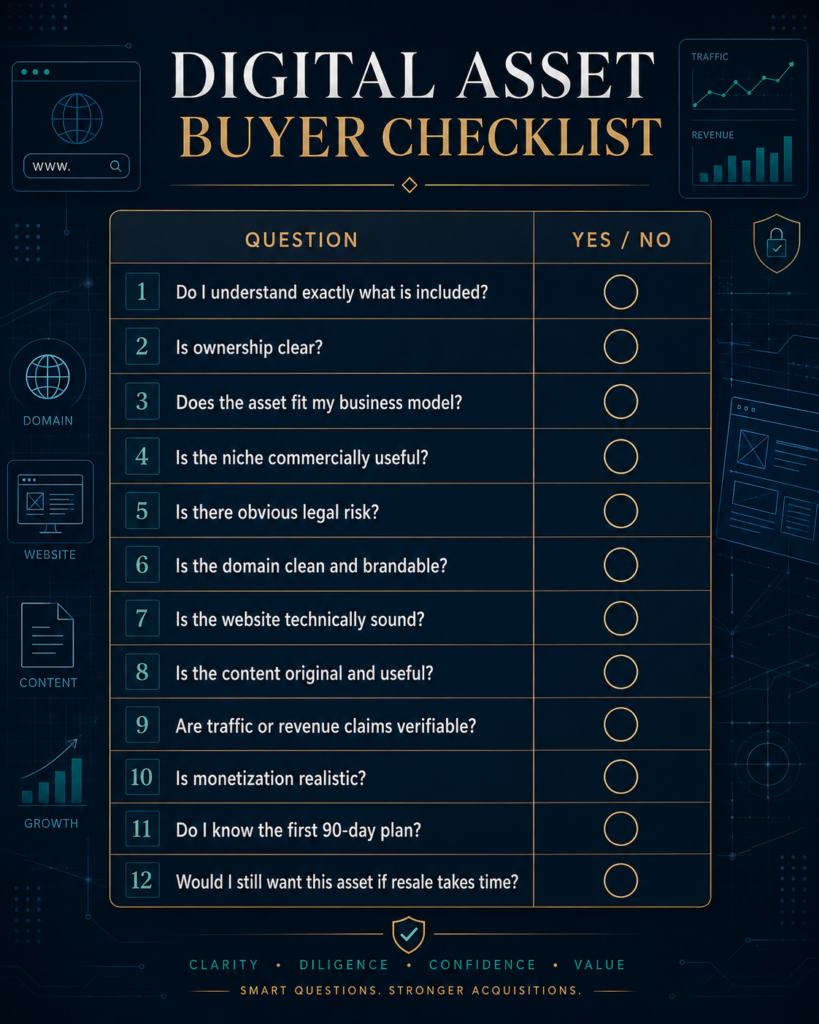
Digital Real Estate: Why the Phrase Matters
Digital real estate is a popular phrase because it helps people understand online ownership.
A domain can be like land.
A website can be like a building.
Content can be like rooms.
Traffic can be like footfall.
Revenue can be like rent or sales.
Brand trust can be like location reputation.
But digital real estate also behaves differently from physical real estate.
It can scale faster, but it can lose visibility faster. It can reach global users, but it may depend on search engines, platforms, security and technical quality. It can produce high margins, but it can also be copied, disrupted or neglected.
The best buyers treat digital real estate seriously. They do not buy random names and hope. They buy assets with purpose, structure and a development plan.
Best Digital Assets for Beginners
Beginners should avoid complex assets they do not know how to operate.
Good Beginner-Friendly Digital Assets
| Asset | Why It Can Work |
|---|---|
| Brandable domain | Simple ownership, future flexibility |
| Premium domain | Strong foundation if budget allows |
| Starter authority site | Easier than building from zero |
| Niche content site | Clear development path |
| Newsletter domain + landing page | Simple audience-building model |
| Lead generation micro-site | Focused business use case |
Assets Beginners Should Approach Carefully
| Asset | Why It Requires Caution |
|---|---|
| Aged domains | SEO history can be risky |
| Revenue websites | Claims need verification |
| Ecommerce stores | Operations, suppliers and margins matter |
| SaaS tools | Technical maintenance can be heavy |
| Social media accounts | Platform dependence is high |
| Regulated health/finance sites | Compliance and trust are critical |
Return to the Schopping homepage to explore digital assets, authority brands and premium domain opportunities.
FAQs
What is a digital asset in simple terms?
A digital asset is something online that can hold value, create value or be transferred to another owner. It may be a domain name, website, online brand, content library, email list, digital product, software tool, affiliate site, ecommerce store or authority website.
In business terms, a digital asset is useful because it can support traffic, trust, revenue, audience growth, branding or acquisition value. A premium domain can help a new website look more credible. An authority website can attract visitors and monetize through affiliate links, leads, ads or products.
Is a domain name a digital asset?
Yes, a domain name is a digital asset because it is owned, controlled and transferable. It can also hold brand value, search relevance, scarcity value and resale potential.
A premium domain name is often more valuable than a regular domain because it may be shorter, cleaner, more memorable, more brandable or more commercially relevant. For a business, the domain is often the first digital asset because it becomes the address and identity of the website.
Is a website a digital asset?
Yes, a website is a digital asset when it has value through content, traffic, rankings, branding, revenue, leads, customers or strategic use. A simple website may have limited value, but a well-developed authority website can become a serious online business asset.
A website becomes more valuable when it has original content, clean structure, search visibility, monetization routes, strong user experience and a clear niche.
What are examples of digital assets for online businesses?
Examples of digital assets for online businesses include premium domains, authority websites, ecommerce stores, affiliate sites, landing pages, email lists, newsletters, digital products, software tools, online courses, content libraries, SEO rankings, backlinks, lead generation funnels and customer databases.
For Schopping, the most important examples are premium domain names, ready-to-launch authority brands, starter authority sites and SEO-focused website assets.
Why are digital assets valuable?
Digital assets are valuable because they can help a business attract attention, build trust, generate traffic, produce revenue or become easier to sell later. A strong domain can improve first impression. A content site can attract visitors from search. An email list can reach people directly. A website can convert visitors into leads or customers.
The value depends on usefulness, ownership, quality, market demand, monetization potential and risk.
People Also Ask
What is the difference between a digital asset and digital real estate?
A digital asset is any online property or resource that can hold value. Digital real estate is a common way to describe web-based assets such as domains, websites, authority sites, ecommerce stores and online brands.
All digital real estate is a type of digital asset, but not every digital asset is digital real estate. For example, a downloadable PDF or software license may be a digital asset, but a premium domain and authority website are closer to digital real estate because they function like owned online property.
Can digital assets generate passive income?
Digital assets can generate semi-passive or recurring income, but they usually require work first. A website may earn through affiliate links, ads, digital products, subscriptions or lead generation. A newsletter may earn through sponsorships. A domain may be resold, leased or developed.
The phrase “passive income” can be misleading. Most valuable digital assets require setup, maintenance, updates, traffic growth and optimization before they produce reliable income.
What digital assets should a beginner buy first?
A beginner should start with a digital asset that is easy to understand and develop. A strong domain name, starter authority site or focused niche website is usually easier than buying a complex ecommerce business, SaaS product or revenue site with many moving parts.
The best beginner asset should have a clear niche, low legal risk, simple ownership, realistic monetization and a development plan. Beginners should avoid buying assets only because they sound trendy.
How do you know if a digital asset is worth buying?
A digital asset is worth buying when it fits your goal, has clear ownership, serves a real market, has low legal risk, offers realistic monetization and saves meaningful time compared with building from scratch.
For domains, evaluate name quality, extension, brandability and buyer demand. For websites, evaluate content quality, traffic, rankings, technical condition and monetization potential. For online businesses, verify revenue, costs, operations and customer data.
Are digital assets the same as online businesses?
No. A digital asset may be part of an online business, but it is not always a full business. A premium domain, content site or authority brand may have value even without revenue. An online business usually includes customers, revenue, systems, operations and ongoing activity.
This distinction matters because buyers should not pay online-business prices for assets that only have potential. A digital asset can become an online business, but it requires execution.
A Digital Asset Is Valuable When It Can Be Used
A digital asset is not valuable simply because it exists online. It becomes valuable when it can be used.
A premium domain can be used to launch a better brand.
An authority website can be used to build trust and traffic.
A content library can be used to educate and convert visitors.
An email list can be used to reach an audience directly.
A digital product can be used to sell knowledge or utility repeatedly.
The strongest digital assets combine ownership, usefulness, market demand and development potential.
That is why Schopping treats digital assets as serious online business foundations, not random internet collectibles. Whether you are buying a premium domain, evaluating an authority brand, building a starter site or comparing online business models, the goal is the same: own something digital that can grow in strategic value.
To continue, explore Digital Assets, browse Premium Domain Names for Sale, or review acquisition-ready Authority Brands.