
How to Buy Digital Assets: A Smart Buyer’s Guide to Domains, Websites and Online Properties
Amazon Affiliate Disclosure
Schopping may participate in affiliate programs, including the Amazon Services LLC Associates Program and other partner programs. This means we may earn a commission when readers click qualifying links or make purchases through certain recommendations. Our editorial guidance remains independent, and affiliate relationships do not determine which digital assets, tools, marketplaces or buying methods we discuss.
Buying Digital Assets Is Not Like Buying a Product
Learning how to buy digital assets is one of the most important skills for modern founders, investors, creators and acquisition-minded businesses. A digital asset can be a premium domain name, a starter authority website, an online business, a content property, a newsletter, a software product, a social media brand, a digital product catalog or a monetized web property. Some are simple brand foundations. Others are revenue-generating machines with traffic, customers, operating history and risk.
At Schopping, the digital economy is treated as a serious acquisition category, not a trend. A strong digital asset can shorten your path to market, improve brand authority, reduce customer acquisition friction and create long-term strategic leverage. But the wrong asset can bring hidden liabilities, inflated traffic claims, weak monetization, trademark conflicts, SEO problems or transfer complications.
This guide is built for buyers who want to move carefully, negotiate intelligently and understand what they are actually acquiring before money changes hands.
Quick Picks: Jump to the Section You Need
Use these navigation links to move directly to the part of the guide that fits your buying stage.
| Buyer Need | Jump Link |
|---|---|
| Understand the purpose of this guide | What This Guide Is For |
| Know who should use it | Who Needs This Guide |
| Understand digital asset types | Types of Digital Assets |
| Compare domains, websites and online businesses | Domain Names vs Websites |
| Learn the buying framework | Digital Asset Buying Framework |
| Review due diligence steps | Digital Asset Due Diligence |
| Understand valuation | How to Value Digital Assets |
| Step-by-Step Method | How to buy digital assets |
| Learn the best way to negotiate | Smart Buyer Negotiation Strategy |
| Learn safe payment methods | How to Buy Digital Assets Safely |
| Review escrow options | Escrow and Transfer Protection |
| Avoid buyer mistakes | Common Buying Mistakes |
| Read FAQs | FAQs |
| Read People Also Ask | People Also Ask |
What This Guide Is For
This guide is for buyers who want to understand how to buy digital assets with discipline. It explains what to inspect, how to compare opportunities, when to use escrow, how to review seller claims and how to avoid paying a premium for assets that only look valuable from the outside.
A digital asset purchase usually has three layers:
| Layer | What You Are Buying | What You Must Verify |
|---|---|---|
| Surface Asset | Name, website, brand, content, account or property | Ownership, transferability, trademarks, access |
| Performance Asset | Traffic, revenue, rankings, subscribers or users | Analytics, earnings proof, retention, source quality |
| Strategic Asset | Brand authority, niche position, future growth potential | Market fit, defensibility, expansion value |
A smart buyer does not only ask, “Is this asset available?” A smart buyer asks, “What exactly creates the value, and can that value survive after the transfer?”
Who Needs This Guide
This guide is useful for:
Founders Buying a Brand Foundation
A founder may buy a premium domain name before launching a company, product or media brand. The right domain can make the business easier to remember, easier to trust and easier to market.
Investors Looking for Digital Assets for Sale
Investors may buy content websites, domain portfolios, affiliate sites, newsletters, niche media properties or starter authority websites with the goal of growing traffic, improving monetization or reselling later.
Agencies and Consultants Building Client Assets
Agencies often need strong names, web properties or aged digital foundations for clients. Buying the right asset can save months of branding, SEO and positioning work.
Existing Businesses Expanding Into New Categories
A company may acquire a domain, content site or small online property to enter a niche faster. This is common when the target asset already has audience relevance, topical authority or search visibility.
SEO Operators and Content Publishers
Publishers often look for starter authority websites, aged domains or niche digital assets that already have a topical direction. For buyers exploring Schopping’s digital property ecosystem, the main Digital Assets center explains how domains, starter websites and online brands fit together.
Types of Digital Assets
Digital assets vary widely. Some are brand-only assets. Some are operating businesses. Some are early-stage foundations with room for growth.
To understand deeper and explore all types of digital assets, check out dedicated guide on Types of Digital Assets.
1. Premium Domain Names
A premium domain name is a high-quality web address with branding, memorability, commercial relevance or exact-match keyword value. Premium domains are often short, clear, category-relevant or strong enough to become a standalone brand.
Examples of premium domain value drivers include:
| Value Driver | Why It Matters |
|---|---|
| Short length | Easier to remember, type and promote |
| Strong extension | .com usually carries the strongest commercial perception |
| Clear meaning | Reduces explanation burden |
| Category relevance | Helps buyers understand the business instantly |
| Brandability | Makes the name easier to build into a company |
| Search intent | Some names naturally match what customers search for |
Buyers exploring brand-first opportunities can review premium domain names for sale to understand how strong digital naming assets are positioned.
2. Starter Authority Websites
A starter authority website is an early-stage web property built around a defined niche, editorial structure and brand direction. It may not yet be a large revenue asset, but it can give the buyer a cleaner starting point than building everything from zero.
A starter authority website may include:
| Component | Buyer Value |
|---|---|
| Domain and branding | Faster launch foundation |
| Content architecture | Clear topical structure |
| Initial pages | Faster indexing and user experience |
| Monetization direction | Affiliate, lead generation, ads, products or services |
| Brand positioning | Easier expansion into a niche |
For buyers who want more than a domain but less than a mature business acquisition, Schopping’s starter authority websites page is the natural next step.
3. Content Websites
Content websites usually earn through affiliate links, display ads, sponsorships, lead generation, digital products or newsletters. When buying one, the buyer must inspect traffic stability, content quality, backlink risk, revenue sources and update requirements.
4. Online Businesses
An online business may include a website, customer list, supplier relationships, software, revenue history, brand assets, operational processes and sometimes employees or contractors. These are more complex than domains or starter websites because the buyer is acquiring an operating system, not just a digital property.
5. Newsletters and Audience Assets
Newsletters, communities and social accounts can be powerful, but they require careful review. Audience size alone is not enough. Engagement, list quality, deliverability, platform risk and monetization history matter more than vanity numbers.
6. Software, Apps and Digital Products
Software assets require technical due diligence. Buyers must examine code ownership, dependencies, hosting, security, user churn, recurring revenue, support workload and whether the product can be maintained after transfer.
Domain Names vs Websites: What Are You Really Buying?
The comparison between domain names vs websites is one of the most important decisions for digital asset buyers.
| Asset Type | Best For | Main Advantage | Main Risk |
|---|---|---|---|
| Premium Domain Name | Brand launch, naming, authority positioning | Clean ownership and flexible use | Value depends on buyer’s ability to build |
| Starter Website | Faster niche entry | Existing structure and early content base | Needs continued development |
| Content Website | Traffic and monetization | Can generate revenue sooner | SEO, content and traffic quality risk |
| Online Business | Cash flow and operations | Existing customer or revenue system | Complex transfer and operational risk |
| Newsletter or Community | Audience acquisition | Direct relationship with users | Engagement may decline after ownership change |
A domain is like owning a premium address on a major commercial street. A website is like owning the building, layout and early foot traffic. An online business is the full shop with inventory, staff, systems and customers. Each can be valuable, but they require different levels of inspection.
Digital Asset Buying Framework
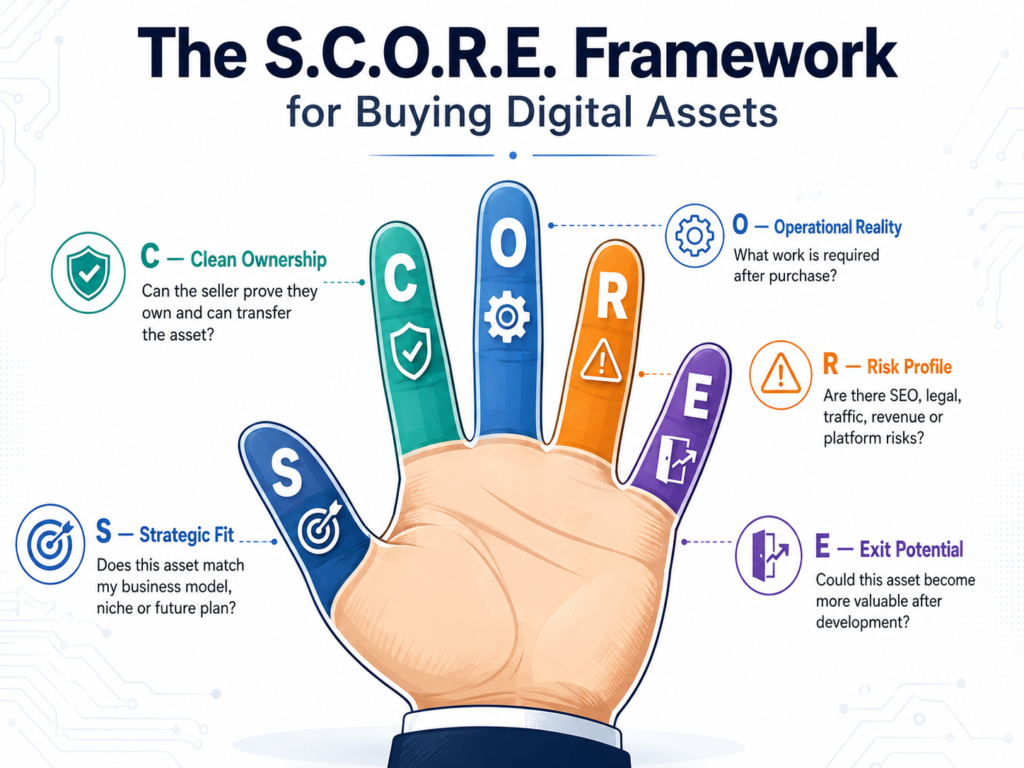
Use this framework before evaluating any asset. It keeps the buying decision grounded in strategy rather than excitement.
The S.C.O.R.E. Framework for Buying Digital Assets
| Step | Meaning | Buyer Question |
|---|---|---|
| S | Strategic Fit | Does this asset match my business model, niche or future plan? |
| C | Clean Ownership | Can the seller prove they own and can transfer the asset? |
| O | Operational Reality | What work is required after purchase? |
| R | Risk Profile | Are there SEO, legal, traffic, revenue or platform risks? |
| E | Exit Potential | Could this asset become more valuable after development? |
Strategic Fit
A digital asset should serve a clear purpose. Do not buy a domain only because it sounds attractive. Do not buy a website only because it has traffic. The asset should fit your market, audience, offer, monetization model and growth plan.
Ask:
- Will this asset reduce my launch time?
- Does it improve trust?
- Does it match a commercial niche?
- Can I build products, services or content around it?
- Would another buyer understand its value later?
Clean Ownership
Ownership is non-negotiable. Before buying digital assets online, confirm that the seller controls the domain registrar account, website files, hosting, analytics access, content rights, brand assets and any connected accounts.
Operational Reality
Some digital assets look passive from the outside but require regular updates, technical maintenance, content refreshes, customer service, security work or compliance review. The purchase price is only one cost. The operating burden is the second price.
Risk Profile
Every digital asset has risk. The goal is not to find an asset with zero risk. The goal is to know what risks you are accepting and whether the price reflects them.
Exit Potential
Even if you plan to build long-term, think like a future buyer. Assets with clean naming, strong documentation, diversified traffic and clear revenue logic are usually easier to resell than messy assets with unclear ownership or unstable performance.
How to Buy Digital Assets Step by Step
1. Define the Asset Category Before You Search
Before searching for digital assets for sale, decide what you actually need.
| Goal | Best Asset Type |
|---|---|
| Launch a brand | Premium domain |
| Build a content site | Starter authority website |
| Acquire traffic | Existing content website |
| Buy revenue | Online business |
| Reach an audience | Newsletter or community |
| Build software revenue | SaaS, app or digital product |
A buyer who wants a clean brand foundation should not evaluate assets the same way as a buyer looking for monthly profit. Different goals need different diligence.
2. Set a Realistic Budget Range
Digital assets are priced based on perceived future value, not only current performance. A premium domain may have no revenue but high strategic value. A website may have revenue but limited growth potential. A starter website may be priced around structure, niche potential and brand readiness.
Your budget should include:
| Cost Area | Why It Matters |
|---|---|
| Purchase price | Asset acquisition cost |
| Escrow or transaction fees | Safer payment handling |
| Transfer and setup | Registrar, hosting, migration, DNS, email |
| Content or technical upgrades | Post-purchase improvement |
| Legal review | Trademark, contract and ownership checks |
| Growth investment | SEO, design, content, product development or ads |
A common buyer mistake is spending the full budget on the asset and leaving nothing for improvement. The best digital acquisition is often the one you can afford to develop after purchase.
3. Build a Buyer Checklist
Before contacting a seller, create a checklist based on the asset type.
For Premium Domains
Check:
- Registrar ownership
- Expiration date
- Transfer eligibility
- Trademark conflicts
- Spelling clarity
- Extension quality
- Brand fit
- Comparable names
- Renewal cost
- Past usage history
For Websites
Check:
- Analytics access
- Traffic sources
- Revenue proof
- Content originality
- Backlink profile
- Search visibility
- Hosting setup
- CMS access
- Plugin or theme licensing
- Content update needs
For Online Businesses
Check:
- Profit and loss history
- Customer acquisition sources
- Supplier or partner agreements
- Refund rate
- Customer support workload
- Software dependencies
- Contractor relationships
- Legal obligations
- Platform accounts
- Owner involvement
4. Review Seller Claims Carefully
A seller may emphasize the best parts of the asset. Your job is to inspect what is missing.
If a listing says “high traffic,” ask where the traffic comes from. If it says “passive income,” ask what maintenance is required. If it says “brandable,” test whether the name is easy to spell, pronounce and remember. If it says “SEO-ready,” inspect whether the content structure actually supports topical growth.
5. Negotiate Based on Verified Value
Do not negotiate only by asking for a lower price. Negotiate based on verified strengths and documented risks.
Examples:
| Finding | Negotiation Angle |
|---|---|
| Strong domain, no revenue | Price based on brand value, not income |
| Good traffic, weak monetization | Value may rise if monetized better |
| Revenue depends on one affiliate program | Higher risk should affect price |
| Content needs updates | Deduct post-purchase editorial cost |
| Strong niche, weak design | Growth upside may justify purchase |
| Unverified earnings | Treat revenue claims cautiously |
Digital Asset Due Diligence
Due diligence is the part of the buying process where excitement must slow down. The more valuable the asset, the more formal the review should be.
Ownership Due Diligence
Confirm that the seller can transfer what they are selling.
| Asset | Proof to Request |
|---|---|
| Domain | Registrar screenshot, WHOIS consistency, transfer readiness |
| Website | CMS admin access, hosting access, files and database control |
| Revenue | Screenshots, statements, affiliate dashboards or platform reports |
| Content | Confirmation of original content ownership |
| Brand Assets | Logos, design files, trademarks if applicable |
| Email List | Platform access, consent status, engagement metrics |
| Social Accounts | Platform transfer rules and login control |
SEO Due Diligence
For websites, SEO due diligence is critical. Traffic alone is not enough.
Review:
- Organic traffic trend
- Top-ranking pages
- Keyword concentration
- Backlink quality
- Traffic source diversity
- Content freshness
- Manual penalty risk
- Sudden traffic drops
- AI-spam or thin content patterns
- Over-reliance on one page
A website with 80% of traffic coming from one article is riskier than a website with traffic spread across many strong pages.
Revenue Due Diligence
Revenue should be reviewed with context.
Ask:
- Is revenue recurring or one-time?
- How many sources produce income?
- Are earnings seasonal?
- Are expenses included?
- Are refunds deducted?
- Does the seller’s personal brand drive sales?
- Would revenue continue after transfer?
A website earning $1,000 per month from diversified sources may be stronger than a website earning $2,000 per month from one fragile partnership.
Legal and Brand Due Diligence
Digital assets can carry legal risk. Before purchase, review:
- Trademark conflicts
- Copyright ownership
- Content licensing
- Image rights
- Affiliate disclosure requirements
- Privacy policy obligations
- Terms of service
- Data handling
- Email subscriber consent
- Platform transfer restrictions
For larger purchases, legal review is not optional. It is part of the acquisition cost.
How to Value Digital Assets
Valuation depends on asset type. A premium domain is valued differently from a monetized website.
Premium Domain Valuation
Premium domain value may come from:
| Factor | Impact |
|---|---|
| Extension | .com generally carries stronger buyer confidence |
| Length | Shorter names are often easier to brand |
| Clarity | Clear names reduce marketing friction |
| Commercial category | Finance, health, tech, luxury and commerce names may command stronger interest |
| Brandability | A name that sounds like a real company can carry strategic value |
| Exact-match relevance | Some names capture direct search intent |
| Scarcity | Unique names are not easily replaced |
A strong domain is not only a web address. It is a brand shortcut.
Website Valuation
Website valuation often considers:
| Factor | Why It Matters |
|---|---|
| Monthly profit | Indicates earning power |
| Traffic quality | Determines monetization potential |
| Content depth | Supports future growth |
| Backlink profile | Affects SEO strength |
| Revenue diversity | Reduces dependency risk |
| Niche strength | Impacts advertiser and buyer demand |
| Operational workload | Affects true profitability |
| Growth runway | Determines upside |
A lower-revenue website in a premium niche may be more attractive than a higher-revenue website in a declining or low-value niche.
Starter Website Valuation
Starter websites are not valued like mature businesses. Their value often comes from:
- Naming
- Structure
- Niche selection
- Early content foundation
- Brand positioning
- Development readiness
- Monetization potential
A starter authority website should be judged by its ability to reduce launch friction and create a credible foundation.
How to Buy Digital Assets Safely
The safest buying process is structured, documented and staged.
Safe Buying Process
| Step | Action |
|---|---|
| 1 | Identify asset type and buying goal |
| 2 | Request seller documentation |
| 3 | Perform ownership and performance due diligence |
| 4 | Agree on price and transfer terms |
| 5 | Use a trusted escrow/payment process |
| 6 | Transfer domain, files, accounts and assets |
| 7 | Confirm full control before release of funds |
| 8 | Change passwords, DNS, hosting and admin access |
| 9 | Document the completed acquisition |
Never send full payment directly to an unknown seller without protection. Digital transfers can be difficult to reverse once completed.
Escrow and Transfer Protection
Escrow is one of the most important tools when learning where to buy digital assets safely. It helps reduce risk by holding funds until the agreed transfer conditions are completed.
Using Escrow.com
Escrow.com is commonly used for domain names, websites and online asset transactions. A typical escrow process includes buyer and seller agreement, buyer payment into escrow, seller delivery or transfer, buyer inspection and fund release.
Escrow.com is useful when:
- Buying a domain from a private seller
- Buying a website from an independent owner
- Handling a higher-value transaction
- Working with an international seller
- Requiring a neutral payment process
Using Atom.com for Domain Transactions
Atom.com is primarily relevant for premium domain names. Buyers searching for brandable domain names can use Atom’s marketplace experience, domain listing environment and domain-focused transaction support. For domain-only purchases, Atom.com and AtomPay-style domain transaction handling can be useful because the process is designed specifically around domain transfers.
Use Atom-style domain escrow or transaction support when:
- The asset is a domain name only
- You are buying through the Atom marketplace
- You want domain-specific transfer assistance
- You prefer a managed purchase path rather than direct negotiation
Escrow.com vs Atom.com for Domain Buyers
| Option | Best For | Buyer Advantage |
|---|---|---|
| Escrow.com | Domains, websites and broader digital asset transactions | Neutral escrow flow for many asset types |
| Atom.com / AtomPay | Premium domain name purchases | Domain-focused marketplace and transfer support |
| Direct Payment | Low-value or trusted relationship transactions only | Faster, but riskier |
For serious purchases, escrow is not a sign of distrust. It is a professional transaction standard.
How to Inspect a Premium Domain Before Buying
A premium domain can look simple, but the evaluation requires discipline.
Domain Buyer Checklist
| Check | Why It Matters |
|---|---|
| Extension quality | Affects trust and resale value |
| Spelling | Confusing spelling weakens brand recall |
| Pronunciation | Hard-to-say names are harder to promote |
| Trademark risk | Can create legal problems |
| Past use | Previous spam use can damage reputation |
| Transfer status | Domain may be locked or recently registered |
| Renewal cost | Some extensions carry high renewal fees |
| Comparable sales | Helps estimate fair pricing |
| Brand flexibility | Strong names can support multiple business models |
A domain should pass the “radio test”: if someone hears it once, can they spell it correctly without explanation?
How to Inspect a Starter Authority Website Before Buying
Starter authority websites are attractive because they reduce the blank-page problem. But the buyer still needs to evaluate whether the structure is meaningful.
Starter Website Buyer Checklist
| Area | What to Review |
|---|---|
| Niche | Is the topic commercially useful? |
| Content map | Are the main categories organized logically? |
| Existing pages | Are they useful, original and expandable? |
| Monetization | Is there a clear path to affiliate, lead generation, products or services? |
| Brand | Does the name fit the audience? |
| Design | Is it professional enough to build trust? |
| Technical setup | Is the CMS, hosting and ownership transferable? |
| Growth plan | Can the site become a real authority property? |
A starter site is not valuable because it exists. It is valuable when it gives the buyer a smarter starting position.
How to Inspect an Existing Website or Online Business
Buying an existing website or online business requires deeper analysis.
Website Acquisition Review
| Area | Questions to Ask |
|---|---|
| Traffic | Is traffic stable, diversified and real? |
| Revenue | Is income verified and repeatable? |
| Content | Is content original, useful and updateable? |
| Backlinks | Are links natural or risky? |
| Expenses | Are all costs disclosed? |
| Operations | How many hours per week are required? |
| Transfer | What accounts, files and systems are included? |
| Growth | What realistic improvements can the buyer make? |
The most dangerous listings are the ones that show revenue without explaining workload.
Red Flags When Buying Digital Assets
Watch for These Warning Signs
| Red Flag | Why It Is Dangerous |
|---|---|
| Seller refuses escrow | Higher payment risk |
| No analytics access | Traffic claims may be unreliable |
| Revenue screenshots only | Earnings may be incomplete or manipulated |
| Recent traffic spike | Could be temporary or artificial |
| Trademark-heavy domain | Legal risk |
| Thin content site | Weak long-term SEO value |
| One-page traffic dependency | High ranking-loss risk |
| Unclear ownership | Transfer problems |
| Seller rushes the deal | Pressure often hides risk |
| No written agreement | Disputes become harder to resolve |
A good seller should be able to answer reasonable questions without becoming defensive.
Smart Buyer Negotiation Strategy
Negotiation should be calm, evidence-based and respectful.
How to Negotiate Digital Asset Purchases
| Buyer Finding | Negotiation Response |
|---|---|
| Strong asset, clean documentation | Pay fairly to secure it |
| Good brand, weak development | Offer based on future work required |
| Traffic exists but monetization is poor | Value upside, but price current reality |
| Revenue is unverified | Do not price it as proven income |
| Transfer is complex | Add escrow conditions |
| Legal uncertainty exists | Pause or request documentation |
The best negotiation is not about “winning” the lowest price. It is about paying a rational price for a verified opportunity.
Post-Purchase Checklist
After buying a digital asset, move quickly to secure control.
Immediate Steps After Purchase
| Step | Action |
|---|---|
| Domain control | Transfer to your registrar or account |
| Passwords | Change all admin, hosting, email and CMS passwords |
| DNS | Confirm DNS records and nameservers |
| Hosting | Back up files and database |
| Analytics | Add your own analytics and search tools |
| Security | Update plugins, themes, software and users |
| Legal pages | Review privacy, terms, disclosures and disclaimers |
| Monetization | Replace affiliate IDs, ad codes and payment settings |
| Documentation | Store transaction records, agreements and access notes |
The first week after acquisition should be about control, security and continuity. Growth comes after stability.
Buyer Decision Matrix
Use this table to decide which type of digital asset fits your current situation.
| Buyer Profile | Best Asset Type | Why |
|---|---|---|
| New founder | Premium domain | Strong brand foundation |
| Content publisher | Starter authority website | Faster niche development |
| SEO investor | Existing content website | Traffic and monetization potential |
| E-commerce operator | Brand domain or online store | Commercial use case |
| Agency | Domains and starter sites | Client-ready foundations |
| Private investor | Revenue-generating website | Cash flow and resale potential |
| Creator | Newsletter, brand site or content asset | Audience ownership |
Practical Buying Scenarios
Scenario 1: You Want to Launch a Premium Brand
Buy a premium domain first. Prioritize clarity, .com strength, memorability and commercial fit. A clean domain gives the brand a more serious foundation before design, content and advertising begin.
Scenario 2: You Want to Build an Authority Website
A starter authority website may be the better choice. You get a name, structure and early editorial direction without paying for mature revenue.
Scenario 3: You Want Immediate Revenue
Look for an existing website or online business with verified earnings. Expect deeper due diligence, higher risk and more operational responsibility.
Scenario 4: You Want a Long-Term Digital Portfolio
Consider a mix of premium domains, starter sites and selective operating assets. Domains give optionality. Starter websites give development paths. Revenue assets give cash flow, but require management.
Editorial Insights: The Future of Buying Digital Assets
The digital asset market is becoming more mature. Buyers are no longer only looking for catchy domains or small websites with traffic. They are looking for strategic entry points: names that can become brands, websites that can become media properties, and online assets that can reduce the time required to build authority.
The smartest buyers will not chase every listing. They will develop a clear acquisition thesis. They will know which markets they understand, which asset types fit their skill set and which risks they are willing to accept. A digital asset is not valuable because it is online. It is valuable when it gives the buyer leverage that would be expensive, slow or difficult to build from nothing.
For buyers ready to explore brand foundations, web properties and digital growth opportunities, Schopping provides a broader gateway into digital assets, online brands and acquisition-ready opportunities.
FAQs
What is the best way to buy digital assets online safely?
The best way to buy digital assets online safely is to start with due diligence, verify ownership, review performance claims and use a trusted escrow process before releasing payment. For domain names, confirm registrar control, transfer eligibility, trademark safety and past usage. For websites, review analytics, revenue proof, content ownership, backlinks, hosting access and technical dependencies. A safe purchase is not only about paying through a secure platform; it is about knowing what is included, what can be transferred and what risks remain after the transaction.
How do I know if digital assets for sale are worth buying?
A digital asset is worth buying when it has strategic fit, clean ownership, realistic pricing and a clear path to future value. A premium domain may be worth buying if it improves brand trust, memorability or category authority. A website may be worth buying if its traffic, content and revenue are verified. A starter authority website may be worth buying if it reduces launch time and gives the buyer a strong niche foundation. The key is to separate visible appeal from durable value.
Should I buy a premium domain name or a starter website first?
Buy a premium domain name first if your main goal is branding, naming control or long-term company positioning. Buy a starter website first if you want a structured foundation with content direction and a clearer path toward search visibility. The better choice depends on whether your biggest problem is brand identity or execution speed. Many serious buyers eventually use both: a strong domain for trust and a structured website for growth.
Where can I buy digital assets safely with escrow?
Digital assets can be bought safely through marketplaces, private transactions and brokered deals when escrow or managed payment protection is used. Escrow.com is often used for domain and website transactions, while Atom.com is especially relevant for premium domain purchases and domain-focused transaction support. Buyers should avoid direct full payment to unknown sellers unless the deal is low-value or the relationship is already trusted.
What should I check before buying an online business?
Before buying an online business, check revenue proof, expenses, traffic sources, customer acquisition, refund rate, supplier relationships, software dependencies, platform access, legal obligations and owner workload. You should also inspect whether the business depends heavily on the seller’s personal reputation. A business that looks profitable on paper may be less attractive if it requires constant owner involvement or depends on fragile traffic sources.
People Also Ask
How do beginners start buying digital assets?
Beginners should start with simpler assets such as premium domains or starter websites rather than complex online businesses. These assets are easier to understand, easier to transfer and less operationally demanding. A beginner should first learn how domains work, how ownership is transferred, how escrow protects transactions and how to inspect basic website quality. Starting small builds buyer judgment without exposing the buyer to unnecessary operational risk.
Are domain names better investments than websites?
Domain names and websites serve different investment purposes. Domain names can be cleaner, lower-maintenance assets with strong brand or resale potential, but they usually do not produce income unless developed or sold. Websites can produce revenue and traffic, but they require more due diligence and ongoing maintenance. A domain is often better for buyers who want brand leverage and optionality. A website is better for buyers who want operating potential and are prepared to manage it.
What makes a digital asset valuable?
A digital asset becomes valuable when it combines scarcity, utility, trust and growth potential. For a domain, value may come from name quality, extension, category relevance and brandability. For a website, value may come from traffic, revenue, content depth, audience trust and monetization options. For an online business, value may come from recurring income, systems, customers and operational stability. The strongest assets are not just attractive; they are useful in a commercial strategy.
Can I buy digital assets without technical experience?
Yes, but the type of asset matters. A buyer without technical experience may be better suited to premium domains or professionally structured starter websites. Buying an existing website, software product or online business requires more technical review. If the asset includes hosting, code, databases, plugins, email systems or analytics, the buyer should involve a technical reviewer before purchase. Lack of technical experience is manageable, but skipping technical due diligence is dangerous.
Why should digital asset buyers use escrow?
Digital asset buyers should use escrow because many digital transfers happen between parties who do not know each other personally. Escrow helps protect the buyer by holding funds until the seller completes the agreed transfer. It also protects the seller by confirming that the buyer has funded the transaction. For higher-value domain names, websites and online businesses, escrow creates a structured process that reduces confusion, fraud risk and payment disputes.